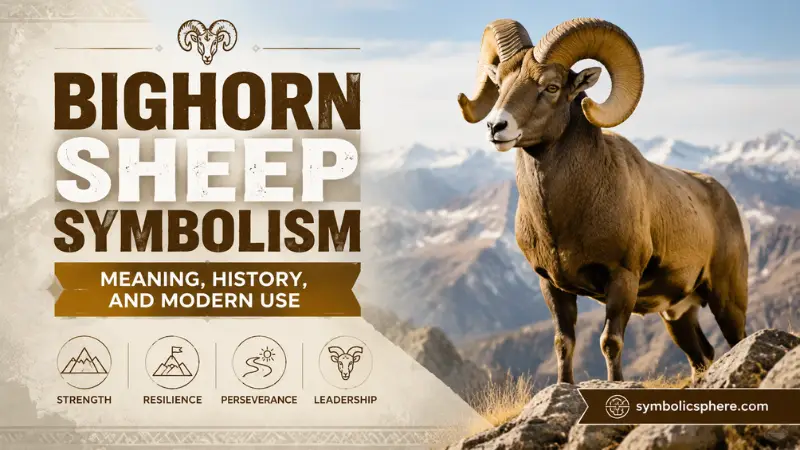
Anyone who has watched a bighorn ram stand motionless on a cliff edge, or seen two rams crack horns in a mountain pass, understands why this animal carries so much meaning. Bighorn sheep symbolism has grown out of centuries of close contact between people and these animals across the mountains and deserts of western North America. The sheep’s ability to move confidently along terrain that would kill most other large mammals has made it a natural stand-in for balance, endurance, and quiet strength.
For a lot of Americans, the bighorn isn’t an abstract icon. It’s a real animal seen on a hiking trail in Colorado, printed on a state quarter, or mounted as a trophy in a family cabin. That mix of the practical and the symbolic is part of what makes the topic interesting: the meaning didn’t come from myth alone, it came from watching the animal actually survive.
This article covers where bighorn sheep symbolism originated, how it developed across different cultures, and what the image communicates in American life today — from tattoos to team logos to state seals.
What Does a Bighorn Sheep Symbolize? (Quick Answer)
A bighorn sheep symbolizes resilience, sure-footed confidence, and mastery of difficult terrain — the reason it appears so often in tattoos, outdoor brand logos, and western state emblems. Historically, Indigenous peoples of the Southwest and Great Basin regarded the bighorn as a spiritual figure tied to mountain power and hunting success, while older Old World traditions linked wild sheep more broadly to fertility and authority.
Key Takeaways
- Represents balance and confidence on unstable or risky ground
- Rooted in Indigenous rock art and ceremonial traditions of the Southwest
- Serves as the official state animal of Colorado and Nevada
- Common in tattoos symbolizing recovery from hardship
- Used by outdoor and mountain-focused brands to signal ruggedness
- Distinct from generalized “ram” symbolism tied to mythology or the zodiac
What Does a Bighorn Sheep Look Like?
Before getting into meaning, it helps to picture the animal clearly. A mature bighorn ram carries a pair of thick, curling horns that can weigh more than the rest of its skeleton combined. Ewes have smaller, only slightly curved horns. Coats range from grayish brown to dark brown, with a distinctive white patch across the rump. People most often encounter bighorn sheep in the Rocky Mountains, the deserts of Nevada and Arizona, and protected parks such as Rocky Mountain National Park, where the animals are known for standing on narrow rock ledges that look nearly vertical from below.
The Core Meaning Behind the Symbol
The central meaning attached to the bighorn sheep is stability under pressure. The animal’s defining skill isn’t speed or size — it’s the ability to plant its hooves on a narrow rock shelf and stay calm while everything below is a steep drop. That physical trait translates easily into a human idea: staying grounded and clear-headed in situations that would unsettle most people.
A second layer of meaning comes from the ram’s horns, which grow throughout its life and often show visible scars from head-to-head combat during mating season. Because of this, the bighorn is often read as a symbol of experience made visible — proof that hard seasons leave a mark rather than wearing an animal down.
Where the Symbolism Began: Historical Origins
Long before European settlers arrived, bighorn sheep were already woven into the symbolic life of Indigenous peoples across the Great Basin, the Colorado Plateau, and parts of the Mojave and Sonoran Deserts. Petroglyphs and pictographs depicting bighorn sheep are among the most common images found at rock art sites throughout this region, appearing far more often than most other animals. Archaeologists have connected many of these carvings to hunting rituals, seasonal ceremonies, and requests for rain, since the sheep’s movement through the mountains was closely tied to water sources.
Ceremonial masks and headdresses incorporating bighorn horns or imagery have also been documented among peoples of the desert Southwest, where the animal held a status closer to a spiritual mediator between the human world and the mountains than a simple food source.
How Americans Interpret Bighorn Sheep Symbolism Today
In the U.S., bighorn sheep symbolism is closely tied to the identity of the American West. The animal represents the same rugged, self-reliant spirit associated with mountain ranges, open frontier land, and the idea of surviving on one’s own terms. That’s part of why Colorado made the Rocky Mountain bighorn sheep its official state animal, and why Nevada designated the desert bighorn sheep for the same role — both states use the animal to represent a landscape-based identity rather than a purely decorative mascot.
Beyond official symbols, the bighorn appears in the logos of outdoor gear companies, hunting and conservation organizations, and sports teams looking to signal toughness tied to a specific place rather than aggression alone. Unlike a symbol such as the eagle, which carries broad national meaning, the bighorn’s symbolism stays regional — it speaks specifically to mountain states and Southwest desert identity.
What Does the Bighorn Sheep Mean in Other Cultures?
Wild sheep and rams carry symbolic weight well beyond North America, though the species and context differ. In ancient Mesopotamian and Egyptian traditions, ram imagery was linked to fertility, virility, and divine kingship, most famously through the ram-headed god Khnum. In Chinese and other East Asian traditions, the sheep or goat (the two are often blended in translation) is associated with gentleness, harmony, and the zodiac. These older ram traditions aren’t about the bighorn specifically, since the species is unique to North America, but they show how widely sheep symbolism recurs across unrelated cultures — usually circling back to strength, fertility, or steadiness.
The Emotional and Psychological Pull of the Symbol
People are drawn to the bighorn because it models composure without avoiding risk. The animal doesn’t retreat from steep or exposed terrain — it simply moves through it with total confidence. Psychologically, this resonates with anyone navigating a period defined by instability, whether that’s a health struggle, a career shift, or grief. The bighorn doesn’t represent the absence of danger; it represents functioning well within it.
The horns add another layer here. Because they grow larger and more scarred with age, the bighorn is sometimes used to frame lived experience as an asset rather than a liability — which is part of why people who feel they’ve “earned” their strength through hardship gravitate toward the image.
Why Bighorn Sheep Tattoos Are Growing in Popularity
Bighorn sheep tattoos have become increasingly common, especially in the western and mountain states, and they tend to fall into a few recognizable styles. Realistic black-and-grey portraits emphasize the animal’s weathered look, often focusing on the horns and a steady, direct gaze. Geometric or line-art versions appeal to people who want a cleaner, more modern take on mountain identity. The personal meaning cited most often behind these tattoos is having come through a difficult period — illness, addiction recovery, a major loss — and wanting a permanent reminder of staying balanced when the ground felt unstable.
Bighorn Sheep in Jewelry, Home Decor, and Fashion
In home decor, bighorn sheep motifs appear often in mountain-lodge and western-ranch interiors, typically alongside elk, bear, and pine imagery as part of a broader “wilderness lodge” aesthetic. In jewelry, the animal shows up less frequently than wolves or bears but appears in western-inspired pieces, belt buckles, and cufflinks marketed to hunters and outdoorspeople. In fashion, the bighorn is more common as a printed or embroidered logo — on flannel shirts, outdoor gear, and regional apparel brands — than as a standalone fashion symbol.
Bighorn Sheep in Sports Branding and Pop Culture
Several minor-league sports teams and outdoor brands use the bighorn specifically because it signals a mountain-region identity that a generic ram or goat logo doesn’t capture. National park gift shops, wildlife documentaries, and conservation nonprofits also lean on bighorn imagery, often silhouetting a ram against a ridgeline as shorthand for “protected wilderness.” This differs from how a wolf or bear is typically used, since the bighorn rarely signals danger or predation — it signals endurance and terrain mastery instead.
Controversies and Misunderstandings
The main tension around bighorn sheep symbolism isn’t cultural appropriation in the way that’s often discussed with feathers or totem imagery — it’s a conservation-based controversy. Bighorn populations across the West declined sharply through the 20th century due to disease transmitted from domestic livestock, habitat loss, and unregulated hunting. Some conservationists have criticized the gap between how heavily the animal is used as a symbol of wild, untouched nature and how fragile actual wild populations remain, arguing the image is sometimes used commercially without matching support for habitat protection.
A smaller, more historical controversy involves trophy hunting. Bighorn rams with especially large horns have long been prized hunting trophies, which has occasionally put the symbolic meaning of “earned strength” in tension with concerns about population management and ethical hunting, particularly for endangered subspecies like the Sierra Nevada bighorn.
How the Meaning Has Changed Over Time
The meaning of the bighorn sheep has shifted from a primarily spiritual and subsistence-based symbol among Indigenous peoples, to a frontier-era hunting trophy during westward expansion, to today’s more conservation-minded symbol of resilience and wilderness identity. Through much of the 1900s, the bighorn was tied mostly to hunting prowess and rugged masculinity. As populations declined and recovery programs succeeded in reintroducing sheep to parts of their former range, the animal increasingly came to represent successful conservation and careful stewardship of western landscapes, alongside its older association with toughness.
Bighorn Sheep Symbolism at a Glance
| Context | U.S. Meaning | Common Associations | Notes |
|---|---|---|---|
| State symbolism | Regional identity, toughness | Colorado, Nevada state animal | Chosen for landscape connection |
| Tattoos | Overcoming hardship | Recovery, resilience, mountains | Popular in realistic and line-art styles |
| Indigenous rock art | Spiritual power, hunting success | Rain, mountains, ceremony | Common across Great Basin, Southwest petroglyphs |
| Outdoor brands/logos | Ruggedness tied to place | Hiking, hunting, conservation | Signals terrain mastery, not aggression |
| Conservation messaging | Fragile wilderness, recovery success | Habitat protection, reintroduction | Contrasts with heavy commercial imagery use |
FAQs
What does a bighorn sheep tattoo mean?
A bighorn sheep tattoo represents resilience and staying steady through a difficult period, often chosen after someone has been through a major life challenge. The horns, which grow more prominent and scarred with age, are frequently read as a mark of hard-won experience rather than just decoration.
Is the bighorn sheep a religious symbol?
It isn’t tied to a major world religion, but it held ceremonial and spiritual significance for Indigenous peoples of the Great Basin and Southwest, appearing in rock art connected to hunting rituals and rain-related ceremonies. It’s better understood as a regional spiritual symbol than a religious one in the organized sense.
Why is the bighorn sheep a state animal?
Colorado and Nevada chose the bighorn sheep because it represents the mountain and desert terrain that defines those states, not because of a generalized strength symbol. The choice reflects regional pride in a native species closely tied to the landscape.
Does the bighorn sheep symbolize anything negative?
The symbolism is almost entirely positive, though it intersects with real controversy around trophy hunting and habitat loss. Some conservationists point out a gap between the animal’s popularity as a symbol of wild nature and the ongoing fragility of actual wild populations.
How is bighorn sheep symbolism different from general ram symbolism?
General ram symbolism, found in ancient Mediterranean and Middle Eastern traditions, tends to focus on fertility, virility, and divine authority. Bighorn sheep symbolism, being specific to North America, is grounded instead in terrain, endurance, and regional American identity.
What is the significance of bighorn sheep horns specifically?
The horns grow continuously and often show visible breaks and wear from combat during mating season, which is why they’re treated as a visual record of a ram’s age and experience. This is part of why the horns, more than the animal’s body, carry most of the symbolic weight in tattoos and artwork.
Do different bighorn sheep species carry different meanings?
Not really — Rocky Mountain and desert bighorn subspecies carry essentially the same symbolic associations. The main difference is regional identity: Rocky Mountain bighorns are linked to Colorado and the mountain states, while desert bighorns are linked to Nevada and the Southwest.
Conclusion
Bighorn sheep symbolism holds up because it’s built on something observable rather than invented. The animal really does stay composed on terrain that would panic most creatures, and its horns really do carry visible evidence of the fights it has survived. That’s a rare case where symbolic meaning and biological reality line up almost perfectly.
For Americans, especially in the mountain and desert West, the bighorn has become shorthand for a specific kind of toughness — not aggressive or showy, but steady and earned. Whether it appears on a state seal, a hiking trail sign, or someone’s forearm, the image keeps pointing back to the same idea: real strength looks like staying balanced when the ground gets difficult.


