
The number 4 symbolism is closely connected with stability, order, reliability, and the practical foundations of life. From the four corners of a room to the four seasons of the year, this number appears in familiar patterns that help people understand their surroundings. Its straightforward shape and recurring presence in nature have made it an enduring symbol of structure and completeness. Across different cultures, the number four also carries deeper meanings related to the natural world, as explored in this overview of four symbolism from the Natural History Museum of Utah.
In the United States, four often suggests dependability, organization, and a well-established foundation. People encounter it in architecture, calendars, religious imagery, education, and everyday expressions. In spiritual and numerological settings, it may also represent discipline, patience, and the steady effort required to achieve long-term goals.
Yet the number does not carry one universal meaning. Some traditions associate it with harmony and the natural world, while others regard it with caution or connect it to specific religious teachings. Understanding these differences reveals why an ordinary numeral can communicate such different ideas across cultures.
Quick Answer
Number 4 symbolism commonly represents stability, order, security, and dependable foundations in modern American culture. Its historical associations include the four cardinal directions, four seasons, and four-part systems in religion and philosophy, while modern numerology often interprets it as a sign of discipline, practical effort, and steady progress.
TL;DR
- Four commonly symbolizes stability, structure, and reliability.
- Its natural associations include four seasons and four cardinal directions.
- Ancient Greek philosophy connected four with elements and moral order.
- Some Native American traditions give four important ceremonial and cosmological meanings.
- Modern numerology associates four with discipline, patience, and practical achievement.
- In Chinese-speaking cultures, four can carry negative associations because of its pronunciation.
What Does the Number 4 Represent?
The number four frequently represents the idea that something has a dependable structure. A table stands on four legs, a square has four sides, and a building often relies on a framework that distributes weight across multiple supports. These everyday examples make stability an intuitive association.
Four also suggests organization. People divide the year into four seasons, identify four primary compass directions, and use groups of four to make information easier to understand. These patterns turn the number into a convenient symbol of an ordered world.
Its common symbolic meanings include:
- Stability: A secure foundation that can support future growth.
- Order: A system in which different parts have defined relationships.
- Practicality: Attention to tangible needs and achievable results.
- Completeness: A whole organized through four distinct parts.
- Reliability: Consistency, responsibility, and follow-through.
These associations are interpretations rather than universal rules. Four can mean something different when it appears in a religious ceremony, a mathematical problem, a personal tattoo, or a cultural superstition.
The Historical Origins of Four’s Symbolism
The symbolic importance of four developed through several traditions rather than one identifiable starting point. Ancient societies used numbers to count objects, organize calendars, classify the natural world, and express ideas about the universe. Repeated patterns involving four gradually acquired significance beyond their numerical function.
In ancient Greek thought, the four classical elements—earth, water, air, and fire—provided one way to explain the composition and behavior of the natural world. The philosopher Empedocles is associated with an influential formulation of this system in the fifth century BCE. Although modern science does not accept these elements as a physical explanation of matter, the framework influenced Western philosophy and later symbolic traditions.
Four also became associated with moral order. Plato discussed four cardinal virtues: wisdom, courage, moderation, and justice. These virtues subsequently became important in classical and Christian ethical traditions.
Geometry contributed another layer of meaning. A square, with its four sides and right angles, offers a visible image of balance and regularity. Four-sided shapes became useful in architecture and design because they could create clear boundaries and practical structures.
There was no single historical moment when four acquired all these meanings. Rather, its symbolism grew through the intersection of observation, philosophy, religion, and everyday experience.
Why Four Is Associated With Stability and Security
The connection between four and stability is especially easy to understand through physical objects. Four legs can support a table, four walls can enclose a room, and four corners define the basic shape of a rectangle. These familiar structures give the number a concrete association with support and protection.
The square is particularly important here. Unlike a circle, which has no corners, a square visibly establishes boundaries. Its straight sides and right angles suggest regularity, making it a common visual shorthand for order and solidity.
This association appears in interior design, architecture, product branding, and graphic design. A square logo may communicate dependability or straightforward service, although the intended impression depends on the rest of the design.
In personal symbolism, the same idea can become more emotional. Someone who chooses four as a meaningful number might associate it with a secure home, a dependable family, or the routines that help life feel manageable.
Stability does not necessarily mean refusing change. A strong foundation can make change easier to navigate. That distinction helps explain why four can represent both security and the patient work required to build something new.
Four in Nature: Seasons, Directions, and the Physical World
Nature provides some of the most recognizable associations with four. The number organizes familiar cycles and spatial relationships, giving people a practical way to describe their place in the world.

The four seasons
Spring, summer, autumn, and winter represent recurring cycles of growth, abundance, decline, and renewal. Symbolically, they can suggest the acceptance of change within a larger, recognizable pattern.
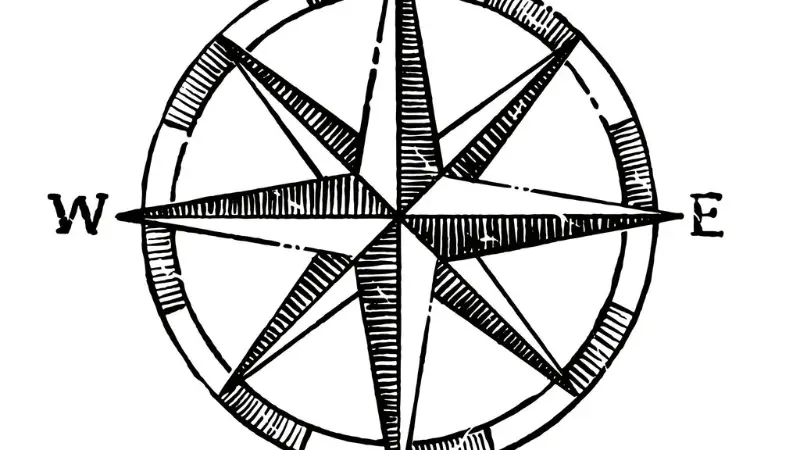
The four cardinal directions
North, south, east, and west provide a framework for navigation. Their symbolic associations often involve orientation, balance, and finding one’s place, although particular meanings vary by tradition.

The four-sided square
A square creates a defined space with four sides and four corners. It often communicates order, boundaries, and a sense of physical groundedness in buildings, artwork, and decorative patterns.
The four classical elements—earth, air, fire, and water—provide another historical example. Ancient Greek philosophy used these elements to explain aspects of the physical world. Their symbolic meanings continue to appear in literature, astrology, art, and contemporary spiritual practices, even though the ancient model is not modern chemistry.
Together, these patterns help explain why four is frequently associated with an ordered and comprehensible world. Its significance often comes from the structures people can observe rather than from any proven supernatural property.
Number 4 Symbolism in American Culture
In the United States, four is generally an ordinary, practical number rather than a universally recognized spiritual sign. Its symbolic associations emerge through familiar objects, traditions, and expressions.
The four seasons influence American calendars, school schedules, gardening, travel, and seasonal celebrations. Four directions are fundamental to maps and navigation. Four-sided rooms, windows, tables, and buildings connect the number with domestic life and shelter.
One especially familiar American association is the four-leaf clover. It is widely regarded as a good-luck symbol, partly because four-leaf specimens are uncommon compared with the familiar three-leaf form. The association belongs to broader Irish and Irish American folklore and has become popular in St. Patrick’s Day decorations, greeting cards, jewelry, and gifts.
Four also appears in public geography. The Four Corners region is where Arizona, Colorado, New Mexico, and Utah meet. The name turns a geographical arrangement into a memorable cultural reference, illustrating how four can organize identity and place.
In everyday American life, the number can also suggest dependability without any mystical meaning. A four-legged table or a four-wheel vehicle may evoke support, balance, and practical function. These are associations created by experience, not evidence that the numeral itself causes stability or success.
Spiritual and Religious Meanings of Four
Religious traditions have used four to organize teachings, describe the world, and structure ceremonies. The meanings differ, so it is important not to treat every tradition as if it shares one interpretation.
In Christianity, four is associated with the four canonical Gospels: Matthew, Mark, Luke, and John. These accounts present the life and teachings of Jesus through distinct but related narratives. Christian art and interpretation have also connected four with the cross and the spread of the Gospel throughout the world.
In some Hindu traditions, groups of four appear in religious philosophy and cosmology. Examples include the four Vedas, foundational bodies of sacred knowledge, and the four traditional stages of life described in certain Hindu frameworks. These examples reflect particular theological and historical systems rather than a single meaning shared by every Hindu community.
Islamic traditions also include significant groupings of four in specific legal, theological, and cultural contexts. However, four is not universally regarded as the central sacred number of Islam, and its importance depends on the subject being discussed.
The broader lesson is that numbers can help religions arrange complex ideas into memorable patterns. Four may express order, completeness, or a set of essential categories, but its interpretation depends on the text, practice, and community involved.
Four in Indigenous North American Traditions
The number four holds important ceremonial and cosmological meanings in some Indigenous North American traditions. These meanings deserve particular care because Native American peoples are culturally diverse, with distinct languages, histories, spiritual practices, and teachings.
In Diné (Navajo) tradition, four is connected with the cardinal directions, sacred mountains, seasons, colors, stages of life, and other relationships that help organize the world. These associations are part of a broader worldview involving place, community, balance, and ceremonial practice.
Some Lakota and other Indigenous traditions also give four important roles in their understandings of directions, seasons, virtues, and ceremonial life. The specific meanings attached to directions and colors can differ among nations and communities.
For these traditions, four should not be reduced to a decorative symbol of good luck or a generic sign of spiritual energy. Its significance can be rooted in living systems of knowledge, community responsibilities, sacred geography, and practices passed between generations.
Non-Indigenous Americans may encounter four-direction imagery in artwork, jewelry, public education, or cultural events. Appreciating such imagery means learning its specific context and respecting the people to whom its teachings belong rather than assuming that every design carries the same message.
What Four Means in Numerology
In modern Western numerology, four is commonly interpreted as the number of the builder: practical, disciplined, organized, and focused on creating lasting results.
Numerology assigns symbolic or spiritual interpretations to numbers, often using birth dates or numerical patterns associated with names. These interpretations vary between systems, and they should be understood as belief-based frameworks rather than scientifically established personality assessments.
Within this framework, four is often associated with:
- Discipline: Following a plan even when progress is slow.
- Responsibility: Taking care of commitments and obligations.
- Persistence: Continuing through setbacks rather than abandoning a goal.
- Organization: Creating routines and systems that make work manageable.
- Long-term achievement: Building results through repeated effort.
A person who identifies with four might use it as a reminder to budget carefully, establish a regular routine, complete a project, or make gradual progress toward a larger ambition.
Numerology also recognizes potential challenges. The same emphasis on rules and predictability can be interpreted as rigidity, excessive caution, or reluctance to experiment. In this reading, four invites a balance between reliable structure and openness to new possibilities.
There is no scientific evidence that being born on the fourth day of a month or repeatedly encountering the number determines someone’s character or future. Its value for an individual lies in the meaning they choose to assign to it.
Number 4 in Chinese Culture: Why It Can Be Unlucky
The number four has a notably different association in many Chinese-speaking communities. In Mandarin, the word for four, sì, sounds similar to sǐ, the word for death. This resemblance has contributed to an association between four and misfortune.
The belief can influence practical choices. Some people prefer to avoid apartment numbers, telephone numbers, or vehicle registration numbers containing four. In certain buildings and hotels, a fourth floor or room numbers containing four may be omitted or labeled differently, although practices vary considerably by location, business, and individual preference.
This cultural association is sometimes described using the term tetraphobia, meaning fear or avoidance of the number four. The term describes a cultural or psychological response; it does not mean that every Chinese person avoids the number.
Nor does four have exclusively negative associations in Chinese culture. It appears in traditional classifications, philosophical ideas, and familiar expressions. Its meaning depends on language, context, and the particular tradition being considered.
For Americans, this is a useful reminder that a number considered neutral or fortunate in one setting may carry an entirely different association elsewhere. Cultural sensitivity matters when selecting apartment numbers, planning international events, designing products, or choosing gifts for people from different backgrounds.
The Emotional and Psychological Meaning of Four
Four can feel reassuring because people repeatedly encounter it in structures that make daily life predictable. A calendar divides time into recognizable seasons, a room establishes a defined space, and a routine can break a complicated task into manageable steps.
These associations help explain why four is often linked with emotional security. A person may connect it with the stability of a childhood home, the reliability of a family routine, or the sense of accomplishment that comes from completing a carefully planned project.
In personal reflection, four can also stand for boundaries. Boundaries establish what belongs within a space, what responsibilities need attention, and where one commitment ends and another begins. In that sense, the number can represent a desire for greater control over a busy or uncertain life.
However, the emotional meaning is not always positive. A strong preference for order can become uncomfortable when circumstances change unexpectedly. Four’s association with structure can therefore suggest both the comfort of consistency and the need to avoid becoming overly attached to fixed plans.
Psychologically, there is no universal emotional response to the numeral. People interpret numbers through memories, cultural learning, personal beliefs, and the situations in which they encounter them. Its meaning is often more revealing of the person’s associations than of any inherent property of the number itself.
How Number 4 Is Used in Tattoos, Jewelry, and Personal Style
Four appears in personal design because it is visually simple and can carry several different meanings without requiring an elaborate image. A small numeral can be discreet, recognizable, and easy to combine with other symbols.
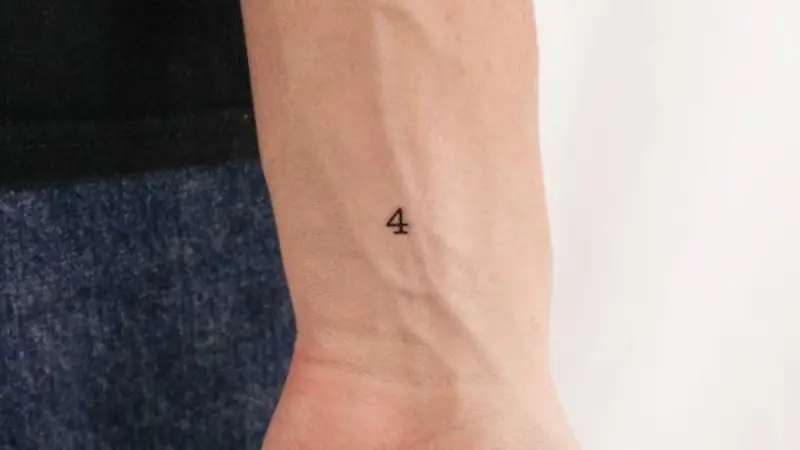
Tattoos
A number four tattoo might commemorate a birthday, a family member, a sports jersey, or a meaningful date. Someone drawn to numerology may instead use it as a personal reminder of discipline, responsibility, and perseverance.

Jewelry and keepsakes
A pendant, ring, or engraved object can turn four into a private symbol of family, a milestone, or an important personal commitment. Its meaning often comes from the story behind the item.

Decor and graphic design
Four-sided shapes, balanced layouts, and repeated geometric patterns can communicate order and simplicity. Designers may use these forms to make a space feel organized without explicitly invoking numerology.
Before choosing four for a tattoo or gift, it helps to identify the intended message. A family reference, a numerological interpretation, and an Indigenous ceremonial design have different contexts and should not be treated as interchangeable.
Number 4 in Dreams, Repeating Numbers, and Spiritual Reflection
Some people interpret seeing four repeatedly as a reminder to slow down, organize their priorities, or pay attention to the foundations of their lives. In numerology-inspired spiritual practices, the number may be connected with practical progress, patience, and the need to turn intentions into action.
For example, someone who repeatedly notices the time 4:44 might use the experience as a prompt to consider whether their daily routines support their goals. Another person might associate the same pattern with a loved one, a memorable event, or a personal milestone.
Dream interpretations work similarly. A house with four rooms, four doors, or four prominent objects might remind a dreamer of family, structure, or a situation requiring organization. But there is no reliable universal dictionary that establishes what a number in a dream must mean.
Ordinary explanations should also remain in view. Once a number becomes important to someone, they may notice it more often because their attention is tuned to it. This is sometimes described as selective attention, and it can help explain why a previously unremarkable number suddenly seems to appear everywhere.
Repeated appearances can still provide a useful opportunity for reflection. The distinction is that a person can choose to make an experience meaningful without assuming it predicts an event or delivers an objectively verified supernatural message.
Is Number 4 a Positive or Negative Symbol?
In many American contexts, four is a positive or neutral symbol. It can represent stability, practical achievement, organization, and the comfort of a reliable foundation. In numerology, these associations often make it a favorable number for people who value persistence and careful planning.
Its meaning changes across cultures and circumstances, however. In some Chinese-speaking settings, pronunciation gives four an association with death and bad luck. In other contexts, the number simply identifies a quantity, position, date, or category without any additional symbolism.
The following table compares common interpretations.
| Context | Common association | What it may communicate |
|---|---|---|
| Everyday American life | Stability and order | Reliability and a secure foundation |
| Western numerology | Discipline and persistence | Practical effort toward lasting goals |
| Christianity | Four canonical Gospels | Accounts of Jesus’ life and teachings |
| Some Indigenous traditions | Directions and ceremonial order | Culturally specific relationships and responsibilities |
| Some Chinese-speaking communities | Misfortune or death | A pronunciation-based cultural taboo |
No interpretation should automatically override the others. A number’s meaning depends on the person using it, the community interpreting it, and the circumstances in which it appears.
Common Misunderstandings About Number 4 Symbolism
Several misconceptions can make the symbolism of four seem more universal or mysterious than it really is.
Four always means stability. Stability is a common association, especially in Western numerology and geometric symbolism, but it is not the only interpretation. Cultural traditions may connect the number with entirely different ideas.
Seeing four repeatedly predicts the future. Some spiritual practices interpret recurring numbers as signs or reminders. There is no reliable scientific evidence that repeated sightings of four predict specific future events.
All Native American traditions interpret four the same way. Indigenous nations have distinct cultural and spiritual traditions. Similar numerical patterns do not mean that every community assigns identical meanings to them.
Four is unlucky everywhere in East Asia. The association with death is particularly well known in Chinese-speaking communities, but attitudes differ by region, language, individual, and circumstance.
Numerology determines personality. Numerology offers a symbolic framework for reflection, not a scientifically validated method of determining someone’s character, destiny, or future.
The most accurate approach is to separate documented cultural practices from personal beliefs and modern interpretations. This preserves the usefulness of symbolism without turning an interpretation into a universal fact.
How the Meaning of Four Has Evolved
Four’s symbolism has developed through practical observation, philosophical systems, religious traditions, and contemporary personal expression.
In early systems of classification, four helped people organize the world into recognizable groups. Directions made navigation easier, seasons helped structure the year, and philosophical models used four elements to explain nature. Religious and ethical traditions later incorporated other groups of four into their teachings.
In modern America, these older associations coexist with more personal uses. A person might choose four as a reminder to establish healthy routines, while a designer uses a square to create visual balance. Someone else may attach significance to the number because it appears in a family date or a cherished memory.
Digital culture has added another layer. Repeating-number content and numerology-inspired posts circulate through social media, encouraging people to interpret ordinary numbers as prompts for reflection. These interpretations can be meaningful to individuals, but their popularity does not establish a shared historical origin or supernatural explanation.
The number’s evolution shows how symbolism works: a familiar form acquires meaning through repeated use, cultural transmission, and individual experience. Its interpretation changes as people apply it to new situations.
FAQs
1. What does the number 4 mean spiritually?
In many modern spiritual and numerological interpretations, four represents grounding, stability, discipline, and the work needed to build a secure life. Other religious and cultural traditions give it different meanings, so its spiritual significance depends on the framework being used.
2. Is number 4 a lucky number in America?
Four is generally considered neutral or positive in mainstream American culture, particularly when associated with stability and dependable structures. The four-leaf clover is a familiar good-luck symbol, although its meaning comes from folklore rather than a universal belief that four guarantees good fortune.
3. What does a number 4 tattoo symbolize?
A number four tattoo can represent family, a meaningful date, personal discipline, or a connection to numerology. Its precise meaning usually depends on the wearer’s experience and any accompanying imagery.
4. What does the number 4 mean in the Bible?
Four appears in Christian traditions through the four canonical Gospels: Matthew, Mark, Luke, and John. It is also associated in some Christian interpretations with the four directions and the spread of the Gospel, though these associations are interpretive rather than a single universal biblical definition.
5. Why is the number 4 unlucky in Chinese culture?
In Mandarin, the word for four sounds similar to the word for death. This resemblance has led some people and businesses in Chinese-speaking communities to avoid four in addresses, room numbers, and other settings, although individual attitudes vary.
6. What does seeing 444 mean?
In modern numerology, 444 is often interpreted as a reminder of stability, persistence, and practical progress. There is no scientifically established universal meaning for the sequence, but someone may use it as a personal prompt to reflect on their goals and responsibilities.
7. Does the number 4 have a negative meaning?
It can. Some Chinese-speaking communities associate it with misfortune because of its pronunciation, while certain numerological interpretations emphasize rigidity or excessive attachment to rules. In many other settings, it remains neutral or symbolizes dependable structure.
Conclusion
Number 4 symbolism most commonly centers on stability, order, reliability, and the foundations that support everyday life. Its associations with seasons, directions, geometry, philosophy, and religious traditions explain why it appears so often in systems people use to understand the world.
In modern American culture, four can represent a dependable home, disciplined effort, personal milestones, or a simple preference for balanced design. Other cultures may interpret it differently, reminding us that numbers acquire meaning through language, history, and shared beliefs rather than through arithmetic alone. For example, the National Park Service’s resource on the number four explores its cultural significance in Indigenous traditions.
Ultimately, four offers a practical symbol of how lasting things are built: one solid foundation, one thoughtful decision, and one consistent effort at a time.


