Witch symbolism carries an unusual mix of fear, independence, magic, persecution, rebellion, and personal power. In the United States, the familiar witch might show up as a Halloween character in a pointed hat, a villain in a fairy tale, a practitioner of modern witchcraft, or a deliberately reclaimed image of female autonomy — and it rarely means the same thing twice.
Those meanings developed at different times, for different reasons. European fears about harmful magic, Christian ideas about the Devil, early-modern witch trials, colonial American accusations, folklore, children’s stories, theater, film, and Halloween marketing all added their own layer to the symbol.
That history matters because “witch” can describe a fictional character, an accusation once used against real people, a modern spiritual identity, or simply an aesthetic. Treating those four as interchangeable misses most of what the symbol actually communicates.
Quick Answer: What Does Witch Symbolism Represent?
Witch symbolism most commonly represents magic, independence, rebellion, and unconventional power in modern American culture — especially in Halloween imagery, tattoos, fashion, and entertainment. Historically, the same figure was tied to feared supernatural harm, religious transgression, and the persecution of people accused of witchcraft, a meaning that still shapes how the symbol is read today.
TL;DR
- Witches can symbolize magic, rebellion, danger, independence, or transformation.
- Early witch imagery grew from real fears of harmful supernatural practices.
- Salem made the witch a lasting symbol of false accusation and injustice.
- Halloween turned frightening witch imagery into seasonal popular culture.
- Modern witches often represent autonomy, spirituality, or outsider identity.
- Wicca, witchcraft, folklore, and Satanism are not interchangeable terms.
What Does a Witch Symbol Look Like?
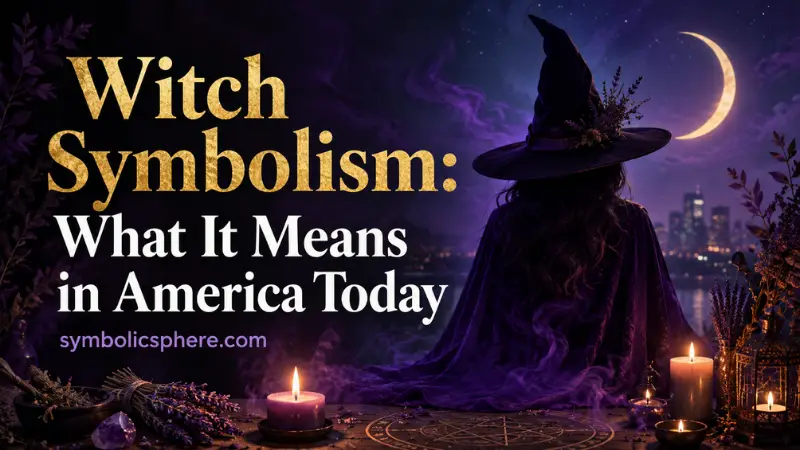
American audiences generally recognize the fictional witch through a set of visual cues: a tall pointed hat, dark clothing, a broomstick, a bubbling cauldron, spell books, black cats, candles, moons, herbs, and sometimes an exaggerated face.
That combination isn’t a historically accurate uniform worn by people accused of witchcraft — it developed gradually through European folklore, prints, literature, stage design, commercial Halloween art, and later film and television.
The broom has especially old visual ties to witches. One of the earliest surviving European images showing witches riding broom-like objects dates to the fifteenth century. By the early seventeenth century, engravings were already pairing witches with brooms, cauldrons, magic books, demons, and preparations for supernatural flight.
Today, these objects work as visual shorthand. You don’t need to believe in magic to read a broom-and-pointed-hat silhouette as “witchy.”
What the Witch Commonly Means in the United States
No single meaning dominates every context. The modern American witch usually falls somewhere between five broad ideas: magic, threat, outsider status, independence, and self-directed power.
A children’s Halloween decoration communicates nothing more serious than playful spookiness. A horror-movie witch signals corruption or supernatural danger. A tattoo might represent independence. Someone who identifies as a witch may be describing a spiritual practice rather than borrowing fictional imagery at all.
Context changes the message every time:
| Context | Common U.S. Meaning | Typical Associations | Tone |
|---|---|---|---|
| Halloween | Spooky fun | Hats, brooms, cats, cauldrons | Playful |
| Horror | Supernatural threat | Curses, darkness, possession | Negative |
| Tattoos | Independence or transformation | Moon, herbs, tarot, broom | Personal |
| Feminist imagery | Defiance and autonomy | Rebellion, outsider identity | Empowering |
| Modern spiritual practice | Ritual or personal spirituality | Nature, divination, seasonal practice | Spiritual |
| Fairy tales | Danger or temptation | Spells, forests, transformation | Cautionary |
The same figure can be frightening in one setting and empowering in the next — the symbol itself doesn’t change; the frame around it does.
How the Witch Became a Symbol of Feared Magic
Long before the modern Halloween witch existed, societies already had concepts of people believed capable of causing harm through supernatural means. European understandings eventually merged older ideas about harmful magic with Christian concerns about heresy, demonic influence, and pacts with the Devil.
During the early-modern period, witch accusations intensified across parts of Europe. Trials varied considerably by place and century, and both women and men were accused — though many regions disproportionately targeted women, which helped cement the later cultural link between witchcraft and threatening female power.
The historical witch wasn’t a fantasy magician. In many communities, accusing someone of witchcraft meant claiming that an actual neighbor had caused illness, crop failure, death, or spiritual danger. The colorful fictional witch familiar today grew partly out of beliefs that once produced real prosecutions.
Salem and the Weight of American Witch Symbolism
The Salem witch trials of 1692–1693 gave the witch an especially important place in American cultural memory. More than 200 people were accused during the crisis, and 20 were executed — an episode shaped by religious belief, community conflict, fear, political instability, and accusations that authorities increasingly accepted as evidence.
Because of Salem, the American witch can symbolize something well beyond magic: false accusation, collective fear, scapegoating, and failures of justice.
That meaning later expanded into metaphor. The phrase “witch hunt” now describes any aggressive campaign against a suspected enemy. Arthur Miller’s The Crucible turned the Salem trials into a way of examining political persecution in twentieth-century America — proof of how far the symbol had traveled from its literal origin.
Salem imagery, in other words, can carry a far darker charge than Halloween merchandise ever suggests.
Why Witches Became Halloween Symbols
By the twentieth century, the witch was firmly established as one of America’s standard Halloween characters, alongside ghosts, black cats, skeletons, and jack-o’-lanterns.
Halloween softened the witch’s older, frightening associations. Commercial illustration could still portray her as ugly and threatening, but just as easily humorous, glamorous, or mischievous. Archived American Halloween imagery consistently pairs witches with black cats and other familiar seasonal motifs, reinforcing witches as entertainment rather than accusation.
A witch decoration on a suburban porch isn’t accusing anyone of supernatural wrongdoing. It signals October, costumes, imaginative fear, and childhood play — which is exactly why Americans can treat the witch as both a reminder of historical persecution and a lighthearted holiday icon at the same time.
What the Pointed Hat, Broom, and Cauldron Symbolize
Individual objects around the witch have acquired meanings of their own.
The broomstick represents movement between ordinary domestic life and the supernatural. Because sweeping was historically household work associated with women, the broom also draws a visual line between everyday labor and imagined magical escape.
The cauldron symbolizes transformation. Ordinary ingredients go in, something changed comes out — a natural storytelling device for potions, hidden knowledge, and experimentation.
The pointed hat is now the fastest way to identify a witch, though its origin isn’t settled by one proven historical story. What’s certain is that popular illustration, costume culture, and film eventually standardized the tall black hat as part of the American witch archetype.
Together, these objects form a symbolic vocabulary — not a historical costume.
Black Cats, Moons, Herbs, and Other Witch Imagery
A witch is frequently surrounded by supporting symbols that extend her meaning.
- Black cats contribute ideas of nighttime, secrecy, and companionship; in fiction, the animal often becomes a familiar or magical assistant.
- The moon, especially crescent or full, suggests night, cycles, intuition, and activity outside normal daytime society.
- Herbs and plants represent knowledge of nature, healing traditions, or practical craft, depending on the setting.
- Candles often signal ritual, focus, or spiritual intention.
- Spell books symbolize specialized or forbidden knowledge.
These objects have separate histories and shouldn’t automatically be read as evidence of one religious tradition — modern witch imagery is highly composite, drawing from folklore, entertainment, and personal style all at once.
The Witch as a Symbol of the Outsider
One of the witch’s most durable meanings is social exclusion. Folklore repeatedly places witches at boundaries — the edge of a village, inside a forest, outside respectable society. Historically, accusations often fell on people already caught in local conflicts or seen as socially difficult or unconventional.
That gives the witch a double identity. From the community’s perspective, she represents danger because she refuses accepted rules. From the outsider’s perspective, that same refusal represents independence.
Modern storytellers exploit this reversal constantly: the supposedly frightening witch becomes sympathetic, while the society condemning her becomes the real source of cruelty. That inversion is central to how the figure gets used in contemporary film and fiction.
Female Power, Rebellion, and Feminist Reclamation
Although historical witch accusations weren’t limited entirely to women, Western popular culture eventually made the witch overwhelmingly female. That gendering turned the symbol into a way of exploring cultural anxieties about women who hold knowledge, anger, sexuality, economic independence, or authority.
Older stories often code those traits as dangerous. Contemporary use flips the script: a woman wearing witch imagery today might be signaling independence rather than supernatural belief, using the witch as an archetype for someone who sets her own boundaries and stays comfortable outside conventional approval.
Modern feminist interpretations build directly on this by reclaiming the witch as a symbol of women who were punished, feared, or marginalized. That idea needs some care — historical witch trials were complex, not every prosecution reduces to misogyny, and men were accused too. But gender clearly mattered in many persecutions, and today’s activists have used the memory of witch trials to talk about women’s vulnerability to institutional violence and social suspicion. The reclaimed witch, as a result, represents resistance: a once-condemned identity turned into an emblem of agency.
Witchcraft, Wicca, and Paganism Are Not the Same Thing
Modern use gets confusing fast when distinct terms get collapsed together.
Witchcraft can refer broadly to magical practices, folk traditions, occult practices, or a self-described personal craft — its meaning shifts between communities. Wicca is a specific modern Pagan religious tradition, in which nature, seasonal cycles, ritual practice, and concepts of divine femininity and masculinity may play important roles, depending on the branch.
Some Wiccans practice forms of witchcraft, but the terms aren’t interchangeable, and neither should be equated with Satanism or Devil worship. Plenty of people who enjoy witch fashion, movies, tarot imagery, crystals, or Halloween costumes have no religious identification attached to any of it. The symbol has to be read according to the person and context using it — not assumed.
Why the Witch Symbolizes Knowledge and Transformation
Modern positive interpretations frequently connect witches with hidden or specialized knowledge, and the symbolism makes narrative sense: fictional witches study plants, spells, stars, and forces invisible to ordinary characters. Their knowledge lets them heal, curse, protect, or transform one thing into another.
Transformation is especially important here. Witch stories repeatedly involve changing appearances, crossing boundaries, or reversing fortune. In personal symbolism, that can translate into reinvention, learning, recovery from an old identity, or deliberately changing course in life — the witch doesn’t need to represent literal magic to function as a symbol of change.
Emotional and Psychological Meaning
Psychologically, witch imagery often expresses a relationship with control. A frightening witch can embody fear of forces that can’t be understood or managed. A heroic or self-chosen witch identity expresses the opposite — a desire to set boundaries, trust one’s own judgment, and develop skills other people don’t share.
The symbol also communicates comfort with ambiguity. Witches sit between categories — ordinary and supernatural, healer and threat, insider and outsider — which is likely why the image appeals to people who identify with complexity over a simple idea of good or evil.
Witch Tattoo Meaning, Jewelry, and Personal Style
In tattoo culture, witch imagery is highly customizable, and the details change the meaning:
- A witch flying on a broom often represents freedom, escape, or refusal to be controlled.
- A witch hat alone can signal identification with alternative culture, or just affection for Halloween.
- A cauldron suggests change and creation.
- A witch paired with lunar imagery commonly leans toward intuition, cycles, or personal spirituality.
Some designs deliberately echo vintage Halloween illustrations, emphasizing nostalgia over religious meaning. Others combine witches with herbs, tarot cards, crystals, mushrooms, ravens, or celestial imagery, where the overall composition matters more than any single object. Before assuming someone’s tattoo signals a spiritual identity, it’s safer to treat the meaning as a possibility, not a confirmation.
Witches in Film, Television, and Pop Culture
American entertainment has rewritten the witch again and again. Older fairy-tale and horror traditions often present her as an ugly, dangerous woman who threatens children or disrupts moral order — the green-skinned Wicked Witch of the West in The Wizard of Oz (1939) became especially influential in shaping that frightening screen archetype.
Later stories broadened the role dramatically: witches as teenagers, mothers, romantic leads, superheroes, or protagonists learning to control inherited abilities. That variety changed the symbol itself. The modern witch can still represent evil, but audiences no longer expect it automatically — depending on the story, magic might stand for adolescence, difference, responsibility, temptation, or personal freedom.
Cross-Cultural Meanings Require Caution
Ideas translated into English as “witch” exist across many societies, but they shouldn’t be treated as regional versions of one universal Western character. Different cultures have their own concepts of sorcery, spirit work, healing, divination, and accusations of occult harm, and their social and religious meanings can differ sharply from European or American witch traditions.
Even gender varies. Western popular imagery strongly favors the female witch, but historical and cross-cultural accusations have also involved men — nineteenth-century Chiloé, Chile, for example, documented cases involving men accused of belonging to a secret magical society. Using the English word “witch” for all of this can hide real differences, so when a specific cultural tradition is being discussed, its own terminology and history should take priority over Halloween imagery.
Common Misunderstandings About the Witch
The biggest misunderstanding is assuming every use of the symbol means evil magic. A second is imagining that people executed in historical witch trials were simply members of a recognizable modern witch religion — most were accused by others, and the accusation itself can’t be treated as evidence that the accused practiced anything resembling what modern Americans call witchcraft.
A third mistake is treating every pointed hat, pentacle, black cat, tarot card, or moon symbol as interchangeable; each has a different history. And finally, Halloween witches shouldn’t be confused with modern religious practitioners — seasonal entertainment, historical accusation, modern Pagan religion, occult practice, and fictional magic overlap culturally, but they are not the same thing.
How the Meaning of the Witch Has Changed Over Time
The witch’s development is best understood as a long shift from accusation to archetype. In early-modern communities, the label represented a feared real-world threat. In colonial America, Salem attached it permanently to memories of accusation and judicial failure. Folklore, illustration, literature, and entertainment then turned the witch into a recognizable fictional character, and Halloween made that character playful and commercial.
More recently, people have reclaimed the witch as a symbol of independence, feminism, spiritual exploration, or outsider identity, while others still encounter it primarily through horror and fantasy. Neither reading has replaced the other — they now exist side by side, which is why the same witch can look sinister on a horror poster, cheerful on a Halloween decoration, spiritual on a pendant, and defiant on a protest sign, all in the same year.
FAQs
Is a witch a positive or negative symbol?
It depends entirely on context. Traditional European and colonial American imagery often treated witches as dangerous, while modern culture also uses the witch to symbolize independence, transformation, and resistance to social expectations.
What does a witch tattoo symbolize?
A witch tattoo can represent freedom, personal power, transformation, alternative identity, spiritual practice, or simply love of Halloween and fantasy. Details like moons, brooms, cauldrons, or black cats shift the intended meaning.
Does witch imagery always represent Wicca?
No. Wicca is a specific modern Pagan religious tradition, while witch imagery shows up throughout folklore, entertainment, fashion, Halloween, occult practice, and personal art — someone can use witch imagery without being Wiccan at all.
What does a witch symbolize in Halloween culture specifically?
At Halloween, witches usually represent playful supernatural fear, magic, and traditional spooky entertainment. Commercial Halloween culture has made the witch far less threatening than the figure associated with historical witchcraft accusations.
Why are witches so often shown as women?
Women made up a large share of those accused during many European witch persecutions, though men were targeted too. Centuries of folklore, art, and entertainment later reinforced the idea of the witch as primarily female.
What does a witch flying on a broom symbolize?
A flying witch typically symbolizes supernatural movement, freedom, and crossing normal boundaries. The broom’s older association with household labor adds a contrast between ordinary domestic life and imagined magical freedom.
Is the witch connected to Satanism?
Not automatically. Some historical Christian ideas linked witches to the Devil, but modern witchcraft and Wicca cover a range of beliefs and practices that shouldn’t be casually labeled Satanic.
Conclusion
The witch has traveled an unusually long symbolic path. Once associated primarily with feared supernatural harm and accusations that could destroy real lives, the figure later became a fairy-tale villain, Halloween staple, horror character, fantasy hero, spiritual identity, and emblem of unconventional independence — and the meaning of the witch has evolved to carry all of those associations at once, depending entirely on who’s using it and where.
Its lasting cultural pull comes from that tension: the witch can represent what society fears, what it excludes, or what an individual chooses to reclaim..