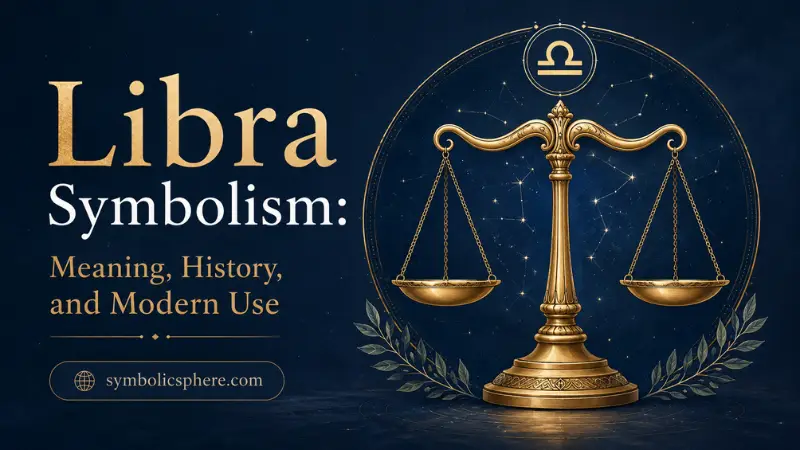
Libra symbolism centers on balance, fairness, partnership, diplomacy, and the careful weighing of choices. Represented by a pair of scales, Libra stands apart from most zodiac signs because its central image is an object rather than an animal or human figure. That image gives Libra an immediate visual connection to equality, judgment, and the search for a reasonable middle ground.
In the United States, Libra is most familiar as an astrological identity — encountered on horoscope pages, jewelry, tattoos, birthday gifts, social media bios, and zodiac artwork. The meanings people attach to it today blend ancient celestial traditions with modern ideas about relationships, personal style, fairness, and social harmony.
Those meanings didn’t emerge all at once. The stars now called the Libra constellation have been interpreted differently across Mesopotamian, Greek, Roman, medieval, and later astrological traditions. Understanding that history explains how one simple image — the scales — came to suggest everything from justice to indecision.
What Does Libra Symbolize? (Quick Answer)
Libra symbolizes balance, fairness, harmony, diplomacy, and partnership in modern Western culture. Its scales trace back to ancient zodiac traditions and later became closely tied to equality, seasonal balance, judgment, and the weighing of competing sides.
In short:
- Libra’s scales represent balance, fairness, and measured decision-making.
- Ancient cultures interpreted Libra’s stars in several different ways before the scales became fixed.
- Roman tradition strengthened the association between Libra and balanced scales.
- Modern culture links Libra with diplomacy, relationships, and personal identity.
- Astrological personality traits are cultural beliefs, not scientifically established facts — a distinction worth keeping in mind throughout.
What the Libra Symbol Looks Like
Libra is represented by a balance scale and by the zodiac glyph ♎, typically drawn as a curved line rising above a horizontal base (artistic versions vary).
Libra is also the official name of a constellation — the International Astronomical Union lists it as “the Scales,” preserving the traditional image in modern astronomical naming.
It’s worth noting that astronomy and astrology use the name differently. In astronomy, Libra identifies a defined region of the sky. In Western astrology, it identifies one of twelve zodiac signs, conventionally associated with people born from late September through late October. The two systems overlap historically but aren’t interchangeable — more on that below.
What Libra Commonly Represents Today
The clearest way to understand Libra is through the image of a scale: a mechanism that compares two sides and responds whenever one outweighs the other. That physical action became a lasting metaphor for social and emotional life.
| Context | Common Meaning | Typical Association | Possible Tension |
|---|---|---|---|
| Balance | Moderation and stability | Keeping competing needs in proportion | Difficulty choosing |
| Justice | Fairness and equality | Hearing both sides | Excessive neutrality |
| Relationships | Partnership and cooperation | Compromise and mutual respect | People-pleasing |
| Communication | Diplomacy and tact | Reducing conflict | Avoiding confrontation |
| Personal style | Grace and refinement | Beauty and social ease | Concern with appearances |
These associations belong largely to modern Western astrological culture rather than astronomy. As symbolic character themes, they describe someone who weighs alternatives, seeks fairness, values cooperation, and dislikes unnecessary imbalance.
Why the Scales Define Libra
A scale turns an abstract idea into something visible. Fairness can’t literally be held in the hand, but two balanced pans can show equality at a glance — which is why scales appear well beyond astrology, as familiar symbols of legal judgment, impartiality, measurement, and trade.
The Latin name Libra itself refers to a balance or weighing scale. NASA materials on the astronomical term libration note the same Latin root — a balance scale moving from side to side — underscoring how deeply the weighing metaphor runs through the word’s history.
Symbolically, Libra isn’t about achieving perfect equilibrium so much as the process of adjusting, comparing, and correcting imbalance.
Ancient Roots of the Scales
Libra’s history is more layered than the idea that one civilization invented the sign exactly as it appears today.
Ancient Mesopotamian traditions associated this region of the zodiac with a balance or scales. In Greek star lore, however, the same stars were often treated as the claws of neighboring Scorpius — a reading that survives in traditional star names referencing “northern” and “southern” claws.
That shifting identity matters: symbols frequently develop as cultures inherit earlier astronomical systems and reinterpret what they see. Libra carries two layers of celestial history as a result — one centered on weighing and balance, another in which its stars belonged visually to a larger scorpion figure.
How Greek and Roman Traditions Shaped Libra
Greek influence was central to Western zodiac traditions generally, but the scales became especially prominent under Roman interpretation. Roman-era writers connected Libra with balanced conditions and gave the scales more independence as a zodiac figure, rather than treating the stars merely as Scorpio’s claws. Classical references also tied the sign to the seasonal period when daylight and darkness were thought to approach equality.
Later Western imagery sometimes linked Libra’s scales with personifications of justice, reinforcing an enduring symbolic overlap between Libra, judgment, fairness, and law. That said, Libra’s present meaning draws from several overlapping traditions rather than one universally accepted myth.
The Equinox and the Idea of Balance
Libra’s symbolism was reinforced by its traditional placement near the September equinox, one of two points in the year associated with the changing balance between daylight and darkness.
In the tropical zodiac used by most Western astrology, Libra begins at 180 degrees of zodiacal longitude, opposite the starting point of Aries. The tropical zodiac organizes around seasonal reference points — equinoxes and solstices — rather than the modern boundaries of astronomical constellations, which helped make “balance” feel especially fitting for this sign: equal scales visually echoed the concept of day and night reaching a seasonal turning point.
The actual length of day and night is more complex than the simple phrase “equal day and night,” and Earth’s slow axial precession has shifted the relationship between astrological signs and background constellations over centuries. Even so, the seasonal metaphor proved culturally durable.
Justice, Fairness, and Diplomacy
Justice is one of Libra’s strongest secondary meanings, since scales already serve as a widespread image of impartial judgment. In Libra imagery, though, fairness usually reads more broadly than courtroom justice — giving different people a chance to speak, seeking compromise, or trying to understand opposing positions.
This is also why modern astrology often describes the Libra archetype as diplomatic: it doesn’t rush to one side of the scale, but evaluates what each side carries. Balance, in this sense, isn’t passivity — a balanced judgment can still produce a firm decision once competing arguments have been weighed.
Venus, Air, and Relationship Symbolism
Within Western astrological tradition, Libra is classified as a cardinal air sign and traditionally associated with Venus, adding themes beyond the scales alone. The air association contributes ideas of communication, thought, and social exchange; Venus contributes conventional associations with attraction, beauty, affection, and aesthetic taste.
Combined with the scales, these produce Libra’s familiar modern image as relationship-oriented — someone balancing attraction and equality, or closeness without losing mutual respect. As with the traits above, these are part of astrology’s interpretive system rather than scientifically demonstrated effects.
Libra in American Culture
Astrology has held a visible place in American popular culture for well over a century. Historical U.S. newspapers helped spread interest in zodiac signs and personal horoscopes, with a notable “zodiac craze” emerging in the early twentieth century.
Today, Libra often functions less as a formal spiritual symbol and more as personal identity shorthand — a ♎ in a bio, a Libra necklace, a zodiac-themed birthday card, or a joke about being unable to choose between two restaurants. That flexibility is part of why the sign has stayed culturally relevant: people don’t need to treat astrology as literal fate to use zodiac language socially.
Emotional and Psychological Meaning
As a psychological metaphor, the scales describe the effort to keep different parts of life in proportion. Someone may identify with Libra imagery because they value peace between friends, dislike unfairness, or often act as a mediator — expressing an aspiration toward emotional equilibrium even when daily life feels far from balanced.
That points to a useful distinction between identity and aspiration: wearing a Libra symbol doesn’t necessarily mean someone believes they already embody perfect harmony. It may represent the balance they’re working toward — self-awareness, reflection, and sensitivity to competing needs, without requiring literal belief that zodiac signs determine personality.
Love, Friendship, and Partnership
Libra’s relationship symbolism comes largely from the idea of two sides working together rather than one side dominating. In romantic contexts, the scales can represent reciprocity — giving and receiving affection, sharing responsibility, maintaining equality between partners. In friendship, Libra imagery suggests listening, social tact, and ease moving between different personalities.
The less flattering read: constant concern with harmony can make direct disagreement uncomfortable. Partnership requires adjustment, but healthy balance doesn’t mean surrendering personal boundaries just to keep someone else satisfied.
Libra Tattoos, Jewelry, and Personal Style
Libra adapts easily into personal design because the symbol works at several levels. A tattoo might use the ♎ glyph as a simple birth-sign marker, or incorporate literal scales, stars, flowers, the Sun, Moon, Venus imagery, or a birthdate. Scales can also express values independent of horoscope belief — fairness, recovery of emotional balance, equal partnership, or weighing reason against emotion.
Libra jewelry usually serves a lighter identity function: necklaces, rings, bracelets, and birth-themed gifts using either the glyph or miniature scales to signal zodiac affiliation. Because the symbol is simple and symmetrical, it also suits minimalist design particularly well.
[Internal link opportunity: link to a related “zodiac tattoo ideas” or “birthstone and zodiac jewelry guide” post here.]
Libra in Fashion, Decor, and Digital Culture
Zodiac imagery has moved easily into modern lifestyle design, appearing on wall art, candles, phone cases, clothing, stationery, and personalized birthday products. Online, the sign often becomes shorthand for quick self-description — the ♎ glyph identifying someone’s sun sign without a full statement, while memes exaggerate familiar stereotypes like indecision, flirting, or conflict avoidance.
Those jokes are a good example of symbolic evolution: ancient balance imagery converted into everyday personality humor, where “the person standing between two choices” becomes “the Libra who can’t decide.” The joke lands because it still depends on the ancient visual logic of weighing two sides.
Libra Across Medieval and Islamic Art
The zodiac didn’t stay confined to Greek and Roman culture. Astronomical and astrological material circulated across the Mediterranean, Middle East, Europe, and Islamic world, where zodiac figures appeared in manuscripts, scientific instruments, architectural decoration, and luxury arts.
In Islamic astrological imagery, Libra could appear as al-Mīzān, the Balance — preserving the recognizable scales while artists adapted the surrounding visual language to their own traditions. Medieval European manuscripts likewise transmitted zodiac imagery through calendars, Books of Hours, and astronomical illustrations. This wider history shows Libra doesn’t belong exclusively to today’s newspaper or app-based astrology.
[Internal link opportunity: link to a broader “history of the zodiac” or “zodiac symbols across cultures” post here.]
Positive and Difficult Sides of the Symbol
Libra’s positive meanings generally grow from balance used constructively: fairness without rigidity, compromise without submission, sociability without manipulation, and careful thought without endless hesitation.
The same traits can turn less flattering when pushed too far — a person who considers every side may read as indecisive; someone committed to harmony may avoid necessary conflict; concern with social approval may tip into people-pleasing. This isn’t a claim that everyone born under Libra behaves this way — it’s that the scales offer a clear metaphor for a common human tension: when does careful consideration become avoidance of decision?
Libra Symbolism vs. Astronomical Fact
It’s worth being direct about where symbolism ends and astronomy begins, since the two are often conflated.
The Libra constellation and the Libra zodiac sign are related historically but operate in different systems. Astronomical constellations occupy defined, unequal regions of the sky, while the tropical zodiac divides the ecliptic into twelve equal 30-degree signs anchored to seasonal points. Because Earth’s axis slowly precesses, zodiac constellations no longer align neatly with the traditional tropical signs.
It’s also worth noting that common Libra personality descriptions are cultural and symbolic, not scientifically verified. Astrology carries real cultural influence, but no scientific testing has established zodiac signs as reliable predictors of personality or life events. That doesn’t erase Libra’s symbolic value — symbols can shape art, identity, storytelling, fashion, and self-reflection without functioning as scientific law.
Why Libra’s Meaning Has Changed Over Time
Libra shows how symbols accumulate meaning rather than simply replace it. An ancient cluster of stars was interpreted as a balance, absorbed into the claws of a scorpion, restored as independent scales, linked to seasonal equality, folded into astrological character theory, and eventually printed on a T-shirt or used as a social media emoji.
American horoscope culture added another layer, turning zodiac signs into accessible personality categories through newspaper columns that brought astrology from specialized practice into everyday popular reading. Modern Libra carries several histories at once: celestial observation, ancient astrology, classical imagery, justice symbolism, relationship metaphors, and contemporary identity culture.
FAQs About Libra Symbolism
What is the main symbol of Libra? Libra’s main symbol is a balance scale, shown either literally or as the glyph ♎. It represents weighing alternatives, which is why the sign is associated with fairness, equality, moderation, and judgment.
Is Libra a symbol of justice? Yes, in a general sense — scales have long represented impartial weighing and fair judgment. However, Libra and the legal “scales of justice” are related symbolic traditions rather than exactly the same historical symbol.
What does a Libra tattoo usually mean? A Libra tattoo often marks the wearer’s zodiac sign or birth period. Depending on the design, it can also represent balance, equality, partnership, fairness, or a desire to make more thoughtful decisions.
Does Libra symbolize love? Libra can symbolize love mainly through its astrological association with Venus and partnership. Unlike symbols focused purely on romance, Libra tends to emphasize mutuality, cooperation, and balance within relationships.
Why is Libra represented by an object instead of an animal? Libra is represented by scales rather than a creature or human figure, making it unusual among zodiac signs. This reflects ancient interpretations of the region of sky it occupies, which became increasingly fixed under classical tradition.
Does the Libra constellation match Libra horoscope dates? Not exactly. Tropical astrology uses equal, fixed-length zodiac signs tied to seasonal points, while the astronomical constellation occupies a differently sized region of sky that has shifted relative to those points due to precession.
Is Libra symbolism positive or negative? It can be either, depending on context. Balance can suggest fairness, diplomacy, and thoughtful judgment — but an exaggerated concern with balance can also signal hesitation or difficulty committing to a decision.
Conclusion
Libra symbolism is grounded in one remarkably adaptable image: the scales. From ancient celestial traditions to Roman ideas of balance and modern American zodiac culture, the scales have come to represent fairness, partnership, diplomacy, judgment, and the effort to keep competing needs in proportion.
Its meaning endures partly because balance is never a finished condition — like a physical scale, relationships, decisions, and personal priorities constantly require adjustment. Libra’s most lasting message isn’t that life should stay perfectly even, but that fairness often begins by noticing what has become unequal.