A maple leaf can mean several different things depending on where you see it. On a porch in October, it usually just means fall has arrived. On a red-and-white flag, it means Canada. On a tattoo, it might mean something the wearer alone fully understands.
That range is the whole story of maple leaf symbolism: the same shape carries different weight depending on its color, setting, and cultural context. In the United States, most people connect the leaf with autumn weather, New England scenery, and maple syrup long before they think of it as a national symbol. But because Canada put a red maple leaf on its flag in 1965, the image also carries an unmistakable national meaning that can override every other interpretation the moment it appears in that stylized red form.
This guide separates those meanings out, so you can tell what a given maple leaf is actually saying.
Quick Answer
In modern American use, maple leaf symbolism usually points to autumn, change, and connection to place, especially in the Northeast and upper Midwest. A stylized red leaf shifts that meaning toward Canadian identity. Indigenous and Japanese traditions add further layers tied to specific cultural practices rather than one universal meaning.
TL;DR
- Maple leaves typically symbolize autumn, change, and maturity.
- Americans often link them to New England and northern landscapes.
- A red, symmetrical leaf usually signals Canada, not nature.
- Maple sugaring has deep roots among specific Indigenous nations.
- Japanese maple imagery centers on seasonal beauty, not Canada.
- Meaning shifts more with color and design than with species.
What Makes a Maple Leaf Look Like a Maple Leaf
Maple leaves are known for their pointed, spreading lobes, but the exact shape varies a lot between species. Sugar maple leaves, the most familiar in the eastern United States, typically have five broad lobes and turn from green to yellow, orange, or red as the growing season ends.
That color shift is what gives the leaf its symbolic weight. A leaf that visibly changes and eventually falls is an easy stand-in for transition — it marks an ending you can watch happen, without necessarily implying anything is destroyed. The tree keeps standing after its leaves drop, which is part of why the image works for ideas like change, continuity, and starting over.
Core Themes in Maple Leaf Symbolism
A few meanings show up again and again in American art, home decor, and tattoos.
Change and transition are the most common. Leaves turn color right as summer ends, so the image naturally lines up with moving from one stage of life to the next.
Maturity follows a similar logic. Red and gold coloring appears near the end of a leaf’s life cycle, which can suggest experience or a later stage of development rather than a beginning.
Endurance comes from the tree, not the leaf. Maples lose their foliage every year and grow it back, so the plant itself — rather than any single leaf — represents surviving hard seasons.
Connection to place matters just as much. For someone who grew up around maples, the leaf can feel less like an abstract symbol and more like a specific memory of home.
Why the Maple Leaf Represents Canada
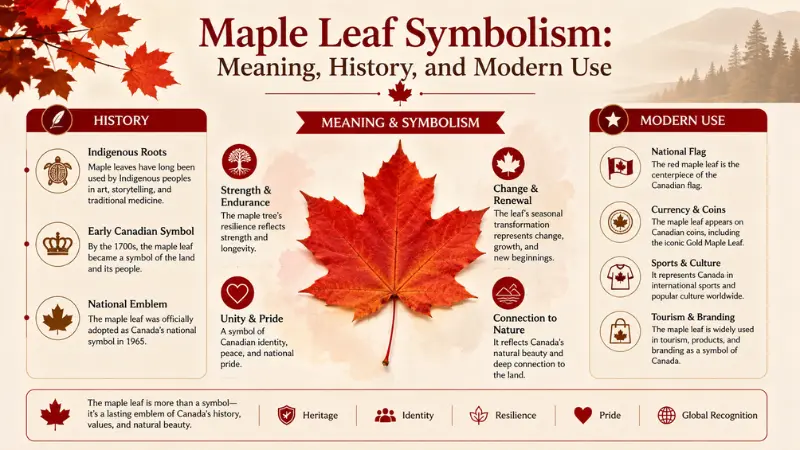
Maple trees were already common across eastern Canada, and their sap had long been used by Indigenous communities in the region. Starting in the 19th century, the leaf itself began showing up more often as a distinct marker of Canadian identity — on military badges, coins, and public decorations.
That symbolism became official when Canada adopted a new national flag on February 15, 1965, centered on a single stylized red maple leaf. The design was chosen partly because its simplified shape stayed clear and recognizable even at a distance or in motion. The eleven points on that leaf are a design choice, not a reference to provinces or founding regions, despite a common assumption otherwise.
Because of the flag, a red, symmetrical maple leaf reads as Canadian almost automatically for most viewers — often faster than it reads as a tree at all. Context here does most of the work: an orange leaf on a sidewalk means autumn, while the same leaf rendered in red on a white background usually means Canada.
What the Maple Leaf Means in the United States
Americans don’t generally treat the maple leaf as a national symbol. Its meaning comes more from landscape, food, and season.
The sugar maple is the official state tree of New York, Vermont, West Virginia, and Wisconsin, and it’s a defining part of fall in the Northeast and upper Midwest. That regional presence gives the leaf associations with wooded roads, small towns, cooler weather, and the start of the school year.
Maple syrup adds another layer specific to the U.S. context. Production remains concentrated in northern states, with Vermont especially well known for it, which reinforces the leaf’s ties to that part of the country.
| Leaf Type | Common U.S. Meaning | Typical Associations |
|---|---|---|
| Stylized red leaf | Canada | National identity, travel, hockey |
| Orange or gold leaf | Autumn | Fall weather, harvest, foliage |
| Green leaf | Growth | Living trees, spring, nature |
| Sugar maple leaf | Regional heritage | Vermont, syrup, New England forests |
| Falling leaf | Transition | Change, letting go, moving on |
| Japanese maple | Seasonal beauty | Gardens, autumn viewing, Japan |
Indigenous Maple Traditions
Maple sugaring has long been practiced by specific Indigenous nations in the Great Lakes and northeastern regions, including Anishinaabe, Menominee, and Seneca communities, each with its own customs and history. At Grand Portage, for instance, the seasonal sugarbush has served as a gathering place where sugaring knowledge passes between generations. European settlers in the region later learned maple sugar and syrup techniques from Native peoples, not the other way around.
There is no single, shared “Native American meaning” of the maple leaf. Where maple traditions are discussed, they’re best tied to a specific nation and practice — seasonal gathering, food, and continuity of knowledge — rather than treated as one symbol shared across all Indigenous cultures.
Maple Leaves in Japanese Culture
Japan has its own long-running relationship with autumn leaves, separate from anything Canadian or American. Momijigari, or autumn leaf viewing, developed among aristocrats and later became a widely shared seasonal tradition centered on visiting places to see maples and other trees change color.
Maple leaves also appear throughout Japanese painting, textiles, and seasonal design, usually tied to a specific moment in the year rather than a fixed symbolic meaning. In this context, the leaf points to attentiveness to the season and appreciation of a fleeting sight — not a general idea of spiritual transformation, which is a modern reading rather than a traditional one.
Autumn, Change, and What the Leaf Represents Emotionally
Because leaf color change happens gradually and predictably, the maple leaf works well as a personal symbol for transitions people can see coming — graduations, moves, career changes, or simply getting older. The shift from green to red mirrors a familiar arc: something reaches a peak, changes shape, and moves on.
Unlike more abrupt symbols of endings, the maple leaf tends to read as gentler, since the cycle is expected and repeats every year. That’s part of why it shows up often in art and writing about aging, memory, or leaving a chapter of life behind without treating the change as a loss.
Resilience and Renewal
A leaf lasts one season; a mature maple tree can live for well over a century. That gap between the two is where ideas of resilience come from; losing one phase — a job, a relationship, a home — doesn’t necessarily mean losing everything built around it.
Spring reinforces this reading more than any other detail. After winter dormancy, maples grow new leaves each year, which makes renewal a more accurate interpretation than permanence. For someone looking for a symbol of getting through hard periods without pretending nothing changed, that yearly return is the more honest version of the idea.
Home, Memory, and Regional Identity
For people from maple-growing regions, the leaf can function less as a symbol and more as a direct memory — a specific yard, a school campus, a drive through the mountains in October. Smell and taste often reinforce that connection: maple syrup, wood smoke, and cool air tend to arrive together in memory.
That’s part of why maple-leaf jewelry or tattoos are sometimes chosen as a way of marking where someone is from, rather than as a comment on nature at all. For Canadians living elsewhere, the same design often works as an even more direct marker of national origin.
Maple Leaf Colors and What They Signal
Color changes the message more than almost anything else about the design.
A green leaf leans toward growth and the living tree rather than autumn. Yellow or gold suggests early fall, harvest, and warmth. Orange is the most classic autumn color, tied to outdoor life and seasonal nostalgia. A naturalistic red leaf can suggest late-season intensity or dramatic change, while a stylized, symmetrical red leaf shifts the reading toward Canada, especially paired with white. A brown, fallen leaf tends to carry quieter meanings — completion, aging, or simply returning to the ground.
None of this is a fixed code. Surrounding design and context still matter more than color alone.
Maple Leaf Tattoos
Tattoo meaning depends heavily on style and placement. A bold red leaf is often chosen for Canadian heritage. A realistic orange or brown leaf more often marks a personal transition. A Japanese maple design usually points to travel, gardens, or an interest in Japanese aesthetics rather than anything Canadian or American.
Additional elements shift the meaning further. Roots or a trunk added to the design tend to bring in ideas of family and stability. Multiple leaves scattered together often emphasize the passage of time. Dates or initials worked into the design can turn it into a memorial piece. Because the image already carries strong associations, it’s worth being clear about which reading you actually want — a plain red silhouette will likely be read as Canadian even if that’s not the intent.
Decor, Jewelry, and Everyday Use
In American home decor, maple leaves are almost always a fall signal — on wreaths, table settings, candles, and seasonal packaging, generally without any national meaning attached. Jewelry leaves more room for personal interpretation, since a small pendant can point to nature, home, or heritage depending on color and finish. Online, leaf emojis and illustrations typically serve as quick shorthand for fall foliage, hiking season, or maple-product content, with the specific meaning usually clear from the surrounding post.
Religious and Spiritual Interpretations
The maple leaf doesn’t have an established meaning in any major religious tradition, and it isn’t accurate to describe it as having a fixed biblical, Christian, or Buddhist symbolism. Personal or modern spiritual readings — using the leaf’s yearly cycle as a reminder of impermanence or renewal — are legitimate as individual interpretations, but they come from observing the tree’s natural pattern rather than from any established doctrine.
Common Misconceptions
Not every maple leaf refers to Canada — a realistic autumn leaf usually just means fall, while the stylized red version is the one with a strong national reading. The eleven points on Canada’s flag leaf are a graphic design choice, not a symbol of provinces or founding regions. And maple traditions among Indigenous peoples shouldn’t be flattened into one shared symbolic system; each nation’s practices and history are distinct. In heavily stylized art, maple leaves are also sometimes confused with cannabis leaves, even though the two plants have very different leaf structures.
Frequently Asked Questions
Does a maple leaf always mean Canada? No. A stylized red leaf strongly suggests Canada, but a realistic orange, yellow, or brown leaf usually just represents autumn or nature in the U.S.
What does a maple leaf tattoo usually mean? It can represent Canadian heritage, personal change, home, or a specific memory. Color, leaf style, and any added elements determine which meaning is most likely.
Is the maple leaf a Native American symbol? Maple sugaring is culturally significant to several Indigenous nations, including Anishinaabe, Menominee, and Seneca communities, but there’s no single meaning shared across all of them.
What does a Japanese maple leaf represent? In Japanese tradition, maple leaves are tied to momijigari, the practice of viewing autumn foliage, and to broader seasonal art and appreciation — not to Canadian symbolism.
Does the maple leaf have a biblical or religious meaning? No major religion assigns it a fixed symbolic meaning. Spiritual interpretations of the leaf are personal and modern rather than traditional.
Why does the Canadian flag leaf have eleven points? The count was chosen for visual clarity at a distance, not to represent provinces, territories, or any political division.
Is maple leaf symbolism generally positive? Mostly. It’s usually tied to autumn beauty, home, and resilience, though a falling leaf can also represent aging or the end of a life stage.
Conclusion
Maple leaf symbolism doesn’t have one fixed meaning — it shifts with color, shape, and setting. In the U.S., the leaf mostly points to autumn and a sense of place, especially in maple-growing regions of the Northeast and upper Midwest. A stylized red version points somewhere else entirely: straight to Canadian national identity.
Layered underneath both are older, more specific traditions — Indigenous maple sugaring practices tied to particular nations, and Japanese customs built around viewing autumn foliage. None of these should be collapsed into one universal idea.
What decides the meaning, in the end, is context. The same shape can stand for a country, a season, a homeland, or a personal turning point, depending on how and where it’s shown.