Few names in Western culture carry as much instant emotional weight as Judas. Say it in almost any setting — a workplace dispute, a family argument, a movie script — and people immediately understand you’re talking about betrayal. Judas symbolism draws on one of the most famous stories in the Christian New Testament, but its reach goes far beyond religious life. Few names in Western culture carry as much instant emotional weight as Judas. Say it in almost any setting — a workplace dispute, a family argument, a movie script — and people immediately understand you’re talking about betrayal. It shows up in political commentary, sports rivalries, song lyrics, and everyday arguments about loyalty.
People care about this symbolism because betrayal is a universal fear. Almost everyone has been let down by someone they trusted, and almost everyone has worried, at some point, about being the one who lets someone else down. Judas gives that fear a name and a face.
In American culture specifically, the symbol has taken on a life somewhat separate from its biblical roots. It gets used casually, sometimes harshly, and occasionally with more nuance than the original story allows. Understanding where the symbolism comes from helps explain why the name still lands with so much force today.
Quick Answer: What Does Judas Symbolize?
Judas symbolizes betrayal — specifically, betrayal by a trusted insider for personal gain. The name comes from Judas Iscariot, the apostle who identified Jesus to Roman-era authorities in exchange for silver coins, which is why “Judas” is still used as shorthand for someone who sells out a friend, ally, or cause. In modern American usage, it applies most often to politics, sports, and personal relationships, while its historical meaning also touches on themes of greed, guilt, and weak faith.
Key Takeaways
- Judas symbolizes betrayal, specifically betrayal for personal or financial gain
- The symbolism originates with Judas Iscariot in the New Testament Gospels
- “Thirty pieces of silver” signals betrayal bought cheaply
- The “Judas kiss” means betrayal disguised as affection or loyalty
- Americans use “Judas” as an insult in politics, sports, and pop culture
- Modern film and literature portray Judas with more moral complexity than earlier tradition did
What the Symbol Looks Like
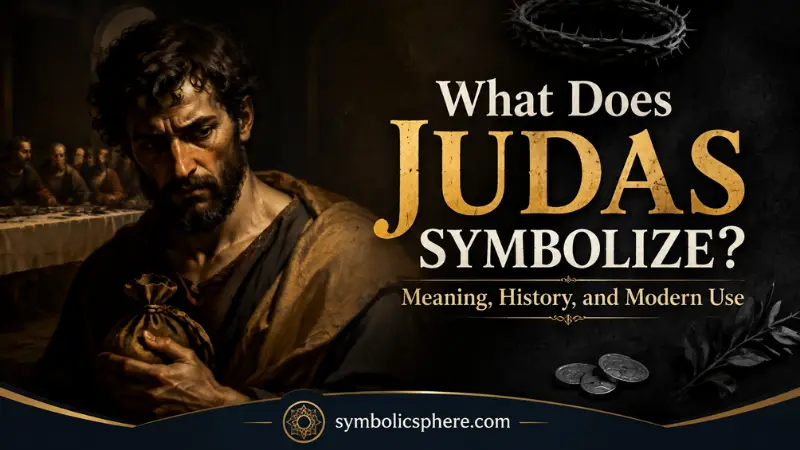
Judas symbolism isn’t tied to a single image the way a dove or a skull is. Instead, it’s carried through a cluster of recognizable motifs: a kiss on the cheek, a small bag or handful of coins, a rope referencing his reported death by hanging, and — in older paintings — a red-haired, red-cloaked figure, since red signaled treachery to medieval audiences.
In religious art, Judas is frequently shown apart from the other apostles at the Last Supper: turned away, cast in shadow, or clutching a money bag. Painters used this visual shorthand for centuries so viewers could identify him at a glance. Today, these motifs appear most often in religious paintings, stained glass, Easter-season sermons, and film retellings of the Passion story. Outside religious spaces, people invoke the symbolism verbally, through phrases like “a Judas kiss” or “thirty pieces of silver,” without needing to explain the reference.
Core Meaning
At its center, Judas symbolism means betrayal by someone close to you — not a stranger or an outright enemy, but a trusted insider. That distinction matters. The pain the story communicates isn’t just about being harmed; it’s about being harmed by someone who already had access to your trust.
Motive is the second layer. In the biblical account, Judas doesn’t betray Jesus over an ideological disagreement — he does it for payment. That’s why calling someone “a Judas” today usually implies the betrayal was self-serving rather than principled: they sold out a relationship or a cause for money, status, or personal advantage.
Historical Origins
The Biblical Account
The story comes from the four Gospels of the New Testament. Judas Iscariot, one of Jesus’s twelve apostles, arranges to hand Jesus over to religious authorities in Jerusalem in exchange for silver coins. He identifies Jesus to the arresting soldiers with a kiss — a gesture normally reserved for greeting or respect, which is part of why the story has remained so unsettling. According to Britannica, Judas later regretted the act, returned the money, and, per the Gospel of Matthew, hanged himself; the Book of Acts gives a different account of his death.
Early Christian communities used the story to teach lessons about greed, weak faith, and the danger of choosing material gain over loyalty. Over the following centuries, Judas became a stock figure in Christian art and literature — almost always the clearest example of a traitor in Western religious storytelling.
The Thirty Pieces of Silver
The specific payment Judas received became its own standalone symbol. “Thirty pieces of silver” is now used in English to describe any low, shameful price for betraying someone or something important. Its power comes from implying that the betrayal wasn’t just wrong — it was cheap, sold for an almost insultingly small amount.
The Kiss of Judas
The “Judas kiss” has become a phrase in its own right: an act of betrayal disguised as a show of warmth or loyalty. It’s used in political commentary when an ally publicly turns against a colleague, in personal relationships when trust is broken by someone close, and in business when a partner acts against someone’s interests while appearing supportive. [Internal link opportunity: a glossary entry on “the symbolism of a kiss” or “gestures of loyalty and betrayal.”]
Judas Symbolism in the United States
In American culture, Judas symbolism functions mainly as rhetorical shorthand rather than a religious reference point. Politicians accuse rivals within their own party of being “a Judas” when they break ranks. Sports commentators use it when a star player leaves for a rival team, especially if money was clearly the deciding factor. Talk radio and cable news reach for “thirty pieces of silver” as a quick way to suggest someone abandoned their principles for a payoff.
Because the U.S. has a large Christian population alongside a highly secular public discourse, the symbol gets used broadly, regardless of the speaker’s own faith. It has entered general cultural vocabulary the way “good Samaritan” or “doubting Thomas” has: biblical in origin, but used without religious framing.
The name is also almost never given to American children, unlike most biblical names. That avoidance itself is telling — it shows how thoroughly “Judas” has been absorbed into the symbolism of betrayal rather than treated as a neutral historical name.
Judas Symbolism at a Glance
| Context | Meaning in the U.S. | Common Associations | Notes |
|---|---|---|---|
| Politics | Betraying one’s party or ally | “Thirty pieces of silver,” defection | Used across the political spectrum |
| Sports | Leaving a team for money or a rival | Booing, jersey burning, “sellout” | Common with high-profile player transfers |
| Music and film | A character who turns on an ally | Kiss, coins, a shadowed figure | Increasingly reworked with more sympathy |
| Everyday speech | A friend or partner who betrays trust | “Don’t be a Judas” | Casual, sometimes half-joking |
| Religious settings | The apostle who betrayed Jesus | Easter sermons, Passion plays | The most literal and traditional use |
Cross-Cultural and Religious Meaning
Within Christianity, interpretations of Judas vary. Mainstream traditions treat him as a cautionary figure whose greed and weak faith led to tragedy. Some early Christian groups, however, read the story differently. A non-canonical text known as the Gospel of Judas — a Coptic manuscript radiocarbon-dated to roughly A.D. 220–340 and unveiled by the National Geographic Society in 2006 — portrays Judas as acting on Jesus’s own request rather than out of pure betrayal. Mainstream churches reject this account, but it has influenced later scholarly and creative reinterpretations of the character.
Outside Christianity, the specific figure of Judas isn’t a shared symbol, though the broader archetype of “the trusted insider who betrays” appears across cultures under different names. What makes Judas distinct is how vivid and specific the details are — an exact number of coins, an exact gesture — which is part of why the story has stayed more memorable than more generic betrayal myths.
Emotional and Psychological Meaning
Judas symbolism taps into a specific kind of pain: betrayal by proximity. Research on trust in relationships consistently finds that betrayal by someone close causes deeper, longer-lasting harm than betrayal by a stranger, partly because it damages a person’s ability to trust future relationships. The Judas story compresses that dynamic into a single dramatic act, which helps explain why it resonates even with people unfamiliar with its religious context.
Calling someone “a Judas” also does rhetorical work for the accuser: it frames them as the wronged, loyal party and casts the other person as morally compromised. That’s part of why the term surfaces so often in public disputes where each side is competing for sympathy.
Modern Usage
Tattoos and Personal Style
Judas imagery in tattoos is far less common than symbols like crosses, doves, or rosaries. When it does appear, it usually carries one of two meanings. Some people use motifs like coins, a rope, or a kiss as a personal marker of a betrayal they survived — commemorating the experience rather than glorifying it. Others use the imagery more provocatively, referencing guilt, moral complexity, or a rejection of simple “good versus evil” narratives, often influenced by more sympathetic modern portrayals of the character.
Pop Culture and Media
Judas has become a recurring reference point well beyond religious media. Stage and film productions like Jesus Christ Superstar reimagine him as a conflicted figure wrestling with faith and political pressure, rather than a simple villain. Musicians have used “Judas” as a song title or lyrical device to explore self-betrayal or toxic relationships, applying the symbolism to personal struggles rather than literal treachery.
On social media, “Judas” and “thirty pieces of silver” get used quickly in comment sections to call out perceived betrayals in celebrity feuds, corporate decisions, or public disputes — usually stripped of any religious framing.
Common Misunderstandings
One common misunderstanding is treating Judas as a symbol of evil in the abstract, when the original story is specifically about betrayal for material gain by someone in a position of trust — not villainy in general. Another is assuming all Christian traditions agree on how to judge him; theologians have long debated questions of free will, fate, and forgiveness in relation to his actions.
The phrase “Judas goat” is sometimes misunderstood too. It refers to a trained goat used to lead other animals to slaughter while it is spared — a term borrowed directly from betrayal symbolism, used today mostly to describe someone manipulated into acting against their own group without realizing it.
Controversies and Misuse
Historically, Judas symbolism has been misused in troubling ways — most notably as part of antisemitic rhetoric that generalized the betrayal of one individual into prejudice against Jewish people as a whole. Responsible discussion of Judas symbolism draws a clear line between the biblical narrative and this historical misuse, which many Christian denominations have explicitly rejected in recent decades.
In casual modern use, the term can also be applied too loosely — to disagreements that aren’t really betrayals at all, like someone simply changing jobs, teams, or opinions. That looser use stretches the symbolism thin and can unfairly frame ordinary decisions as moral failures.
How the Meaning Has Evolved
Early Christian tradition treated Judas almost entirely as a cautionary villain — a warning against greed and weak faith. Medieval and Renaissance art reinforced this with visual cues marking him as untrustworthy at a glance. Over the last century, portrayals have grown more psychologically complex, exploring his possible motivations, doubts, and even the theological question of whether his betrayal was a necessary part of a larger plan.
That shift mirrors a broader cultural trend toward viewing morally complicated figures with more nuance, even while the everyday use of “Judas” as an insult has stayed largely unchanged.
FAQs
What does Judas symbolize?
Judas symbolizes betrayal by a trusted insider, usually for personal or financial gain. The symbolism comes from Judas Iscariot’s role in identifying Jesus to authorities for payment in the New Testament.
What does Judas symbolize in a tattoo?
In tattoos, Judas imagery usually represents personal experience with betrayal, moral complexity, or an acknowledgment of guilt rather than straightforward villainy. It’s a less common choice than most biblical symbols, often selected for its emotional specificity.
Is Judas always viewed negatively in Christianity?
Most mainstream Christian traditions view Judas negatively because of his betrayal of Jesus, though theologians have long debated his motives, free will, and whether forgiveness applies. Some non-canonical texts, rejected by mainstream churches, portray him more sympathetically.
Why do people say “thirty pieces of silver”?
The phrase refers to the payment Judas reportedly received for betraying Jesus. It’s used today to describe any betrayal committed for a small or shameful price, emphasizing that the act wasn’t just wrong, but cheaply bought.
What is a “Judas kiss”?
A Judas kiss describes betrayal disguised as a friendly or affectionate gesture, referencing how Judas identified Jesus to authorities with a kiss. It’s commonly invoked when someone is betrayed by an unexpected show of warmth.
Is calling someone “a Judas” a serious insult?
Yes. It implies deliberate, self-serving betrayal of someone who trusted the person, so it’s typically used in moments of real anger or public criticism rather than lightly.
Does Judas symbolism appear outside Christian contexts?
Yes. Phrases like “Judas,” “Judas goat,” and “thirty pieces of silver” are used widely in American politics, sports, and entertainment regardless of the speaker’s religious background, functioning as general cultural shorthand for betrayal.
Conclusion
Judas symbolism endures because it captures something people continue to fear and recognize in their own lives: being betrayed not by an outsider, but by someone who was supposed to be on their side. From its origins in the New Testament to its casual use in modern politics and pop culture, the core meaning has stayed remarkably consistent, even as interpretations of the man himself have grown more complicated.
In the United States, this symbolism shows up anywhere loyalty is broken publicly and painfully, largely detached from strict religious observance. Whether used in a sermon, a sports headline, or an argument between friends, Judas remains one of the most immediately understood shorthands for betrayal in the English language.
Understanding where that shorthand comes from doesn’t diminish its power — if anything, it explains why a single name can still carry so much weight, centuries after the story that created it.