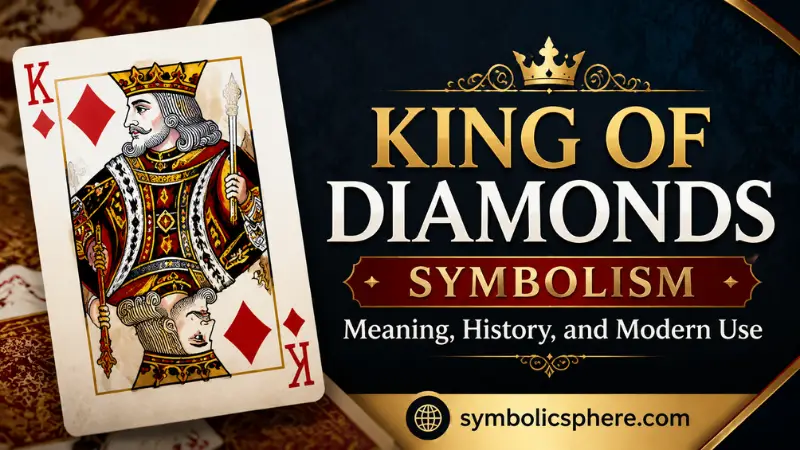
Most people have handled a king of diamonds card hundreds of times without ever looking closely at him. He’s the only face card holding an axe instead of a sword, and the only one drawn in profile instead of staring straight out at the player. That small design quirk is the door into a much bigger story about money, ambition, and how a 500-year-old piece of European card art still shapes the way Americans talk about power today.
People go looking for the meaning behind this card for very different reasons. Some are choosing a tattoo and want to know what they’re actually putting on their skin. Others pulled the card in a cartomancy or tarot-adjacent reading and want context before taking it seriously. Poker players, collectors, and anyone who’s simply curious after staring at a deck a little too long all end up asking the same basic question: why does this particular king look and feel so different from the other three?
That question matters beyond trivia. Playing cards are one of the few pieces of everyday design that have stayed almost completely unchanged for centuries, which means the symbolism attached to them has had unusual staying power. Understanding where the king of diamonds symbolism actually comes from — and where it doesn’t — helps separate genuine cultural history from the kind of vague, repeated-until-it-sounds-true folklore that circulates widely online.
This guide draws that line clearly. It separates what’s actually documented about the card’s history from the folklore that gets repeated so often it starts to sound like fact, and it lays out how the card’s meaning shows up differently across poker culture, tattoo art, fortune-telling, and even prison subcultures, where the same four suits can mean very different things.
What Does the King of Diamonds Symbolize?
The king of diamonds symbolizes wealth, ambition, and authority earned through results rather than inherited status. In U.S. card and tattoo culture, he’s read as the “self-made” figure — the leader, provider, or builder archetype. Historically, French card makers linked the figure to Julius Caesar, tying him to conquest and material power long before he became a shorthand for financial success in modern games and design.
In short:
- Represents authority built on wealth and practical results, not birthright
- Traced to a French card-naming tradition that linked him to Julius Caesar
- The only king shown in profile, holding an axe instead of a sword
- Read in the U.S. mainly through poker culture, tattoos, and personal symbolism
- Carries a very different, harsher meaning in some Russian prison tattoo traditions
- In cartomancy, read as a determined, sometimes ruthless businessman figure
What the Card Actually Looks Like
The king of diamonds is easy to spot once you know the details. He’s drawn in side profile, showing only one eye, and holds an axe raised near his shoulder rather than the sword carried by the kings of spades, hearts, and clubs. His crown, robe, and beard follow the same general court-card style as the rest of the deck, but the axe and turned head set him apart.
That exact image appears on nearly every mass-produced deck sold in the U.S., since American card makers adopted the standard French-style court designs that English printers popularized in the 1800s — which is why the king of diamonds looks almost identical whether you buy a deck at a gas station or a specialty card shop.
The Meaning Behind the Card: Authority Built on Wealth
Strip away the folklore, and the card’s meaning is fairly consistent across sources: he represents power that comes from controlling resources, not from bloodline, romance, or intellect alone. If the king of spades is read as a figure of judgment and the king of hearts as one of emotion, the king of diamonds is read as the figure who leads through money, negotiation, and tangible outcomes.
That’s why card readers often call him the “provider” or “builder” type. He isn’t framed as a warrior conquering territory for glory — he’s framed as someone who accumulates and manages resources well enough that people follow him for what he can deliver. The diamond suit itself carries this same association: it’s tied historically to the merchant and wealthy classes, in contrast to hearts (clergy), spades (nobility and military), and clubs (peasants and laborers). That class-based suit system is one of the clearest, most historically grounded explanations for why diamonds became linked to money from the very start.
Where the Suit System Came From
Playing cards trace back to games that spread from Asia into the Islamic world and then into Europe by the late 1300s. European card makers adapted these foreign suit systems into local symbols, and by the late 15th century, French card makers had settled on the four suits still used today: hearts, diamonds, clubs, and spades. The Metropolitan Museum of Art’s overview of early European playing cards is a good primer on just how unstandardized card design was before the French system took over as the dominant format across the English-speaking world.
(Internal link opportunity: if your site has a general “history of playing card suits” piece, link it here.)
Was the King of Diamonds Really Based on Julius Caesar?
French card makers in the 1500s began assigning historical and legendary names to court cards as a kind of decorative, semi-educational flourish. In that tradition, the king of diamonds is most commonly tied to Julius Caesar — the Roman general whose ambition reshaped an empire.
It’s worth being precise here: this naming convention wasn’t applied uniformly across every regional deck, and record-keeping from that era is incomplete. So the Caesar connection is best treated as a well-established piece of card-making tradition rather than a single confirmed historical fact. It remains, by far, the most frequently cited explanation for why the card carries connotations of ambition turned into lasting power rather than power that was simply inherited.
Why Does He Hold an Axe Instead of a Sword?
The axe is often treated as deeply symbolic, but the more grounded explanation is practical. Early English and French engravers copied earlier woodblock designs by hand, generation after generation, and small details — weapons, head position, posture — drifted or were simplified in that process. Over time, the king of diamonds ended up as the one court card holding an axe, and the design stuck once printing became standardized. Specialist archives like The World of Playing Cards document these small regional variations across historical French and English decks in detail.
That doesn’t mean the axe carries zero symbolic weight today. Modern card readers and tattoo artists often interpret it as a sign of decisive, sometimes blunt action — reinforcing the idea of a leader who gets things done rather than one who negotiates carefully.
How Americans Read the King of Diamonds Today
In the United States, the card shows up most often in three contexts: casual card games, poker culture, and personal symbolism like tattoos or jewelry. Outside dedicated tarot and cartomancy circles, most Americans don’t assign it deep meaning during an ordinary game night. It becomes symbolically loaded mainly when someone chooses it deliberately — a poker player treating it as a personal lucky card, or someone getting it tattooed to represent ambition or a specific birthday.
American casino and poker branding has reinforced the wealth association simply through repeated exposure. The image shows up on slot machine graphics, casino signage, and poker merchandise, keeping the “money and success” reading in front of a far wider audience than tarot or fortune-telling ever would.
In actual gameplay, the card carries no special mechanical power in poker, blackjack, or rummy — its value is identical to any other king. Its reputation as a strong or lucky card comes entirely from cultural association, not from any rule advantage, though some players do treat it as a personal talisman at the table.
Cross-Cultural Meaning Beyond the Standard Deck
Not every culture that uses playing cards assigns diamonds the same meaning. In German-suited decks, the equivalent suit is often bells rather than diamonds, tied more to status and festivity than to money specifically. In tarot’s Minor Arcana, the closest equivalent is the King of Pentacles — a card almost universally read as material mastery, financial stability, and grounded, practical decision-making, which lines up closely with the standard playing-card interpretation.
Some Eastern European and Russian card traditions diverge sharply from this Western, wealth-focused reading, assigning diamonds a very different social meaning within specific subcultures — covered separately below, since it has little to do with the card’s mainstream American symbolism.
What Feelings or Traits Does the Card Signal?
When people choose the king of diamonds to represent themselves or someone else, they’re usually signaling a specific personality type: practical, ambitious, and motivated by security rather than recognition. Card readers frequently describe this figure as someone who leads with strategy over sentiment — which can read as admirably grounded or emotionally guarded, depending on context.
That dual reading matters. The same traits that make him a symbol of stability and provision can also read as coldness, or a willingness to prioritize results over relationships — which is why several fortune-telling traditions describe him as capable but not always warm.
Tattoos, Jewelry, and Personal Style
As a tattoo, the king of diamonds is usually chosen to represent ambition, financial independence, or identification with the self-made archetype rather than inherited advantage. Because the imagery is already detailed and iconic, it translates well into both bold-line traditional tattoo styles and more realistic illustrative work.
In jewelry and fashion, the diamond suit symbol alone is more common than the full court card image — a minimalist nod to the same wealth and confidence associations, without the added weight of a specific face card’s backstory.
What Does He Mean in Fortune-Telling and Cartomancy?
In cartomancy, the king of diamonds is traditionally read as a fair-haired, forceful man, often associated with a demanding or even hazardous occupation. Older cartomancy texts describe him less flatteringly than modern readers typically do — sometimes casting him as headstrong, self-important, or difficult to work with, particularly when surrounding cards in a reading suggest tension.
Modern practitioners tend to soften this into a more balanced read: someone competent and driven who may need to watch a tendency toward stubbornness or prioritizing results over people’s feelings. The consistent throughline across nearly every cartomancy tradition, old or new, is that this card points to a man whose identity is closely tied to money, work, and control.
Misunderstandings and Subcultural Meanings
The most important thing to know about the king of diamonds is that its meaning isn’t universal. In some regional prison tattoo traditions, particularly within parts of Russian criminal culture, the diamond suit has historically carried a very different and much harsher meaning — associated with informants rather than wealth or leadership. That meaning developed within a specific, closed social system and has no real connection to how the card is understood in American card games, tattoo culture, or fortune-telling.
Confusing these two traditions is a common mistake for people researching the card online, since search results often blend general playing-card symbolism with niche subcultural tattoo meanings without clearly separating them. When Americans reference a king of diamonds tattoo or the card generally, they’re almost always drawing on the wealth-and-ambition tradition — not the unrelated prison-specific one.
How the Meaning Has Changed Over Time
The king of diamonds started as one piece of a class-based suit system, picked up a specific historical identity during the French naming tradition, then drifted into fortune-telling as European cartomancy grew popular in the 1700s and 1800s. As card games and casino culture spread through the U.S. in the 20th century, the card’s meaning simplified again — shedding much of its cartomancy backstory in favor of a more generic association with money, poker, and success.
What’s stayed consistent through every stage is the underlying theme of earned rather than inherited power. Whether he’s called Caesar, read in a cartomancy deck, or tattooed on someone’s forearm, the throughline never really changes.
The King of Diamonds in Pop Culture
The card shows up regularly in poker-themed branding, casino signage, and card-game iconography across American media, usually as visual shorthand for stakes, money, or a high-value hand. It’s less common as a standalone pop culture reference than a card like the ace of spades, but it appears consistently in any visual built around gambling, wealth, or high-stakes decision-making.
(Internal link opportunity: if your site covers other face cards — e.g., “ace of spades symbolism” or “king of hearts symbolism” — link them here for topical relevance.)
King of Diamonds Symbolism at a Glance
| Context | Meaning in the USA | Common Associations | Notes |
|---|---|---|---|
| Poker and card games | Strong, high-value card | Money, confidence, stakes | No special rule power; symbolism is cultural, not mechanical |
| Tattoo art | Ambition and self-made success | Wealth, independence, leadership | Popular in both bold-line and realistic styles |
| Cartomancy and fortune-telling | A determined, businesslike man | Strategy, risk, occupational danger | Older texts read him more harshly than modern practitioners do |
| Tarot (King of Pentacles equivalent) | Material mastery and stability | Practical wisdom, groundedness | Closest tarot parallel to the playing-card meaning |
| Regional prison tattoo tradition | Informant status (historical, Russian context) | Betrayal, downcast status | Unrelated to mainstream American card symbolism |
FAQs
What does the king of diamonds mean in tattoos?
In American tattoo culture, it typically represents ambition, financial independence, and a self-made approach to success. It’s a popular choice for anyone wanting a card-themed tattoo built around personal drive rather than luck or fate.
Is the king of diamonds considered a lucky card?
It has no special advantage in actual card games, but players often treat it as a personal lucky symbol because of its long-standing wealth and success associations. That reputation comes from cultural symbolism, not gameplay rules.
Why does the king of diamonds hold an axe instead of a sword?
The most widely accepted explanation is that early European card engravers copied and gradually altered earlier woodblock designs over generations, and the axe became a fixed feature once printing standardized the image. Modern interpreters often read added meaning into it, framing it as a symbol of decisive action.
What does the king of diamonds mean in tarot?
There’s no identical card in tarot’s Major or Minor Arcana, but the closest equivalent is the King of Pentacles, representing material success, financial stability, and practical, grounded leadership. The two cards share a nearly identical core meaning across their respective systems.
Is the Julius Caesar connection confirmed history?
It comes from an old French card-naming tradition rather than a single documented historical record, so it’s best treated as well-established card-making folklore rather than settled fact. It remains the most commonly repeated explanation for the card’s identity.
Does the king of diamonds mean something different in other cultures?
Yes. Some regional traditions, including certain prison tattoo subcultures, assign the diamond suit a meaning tied to informants rather than wealth — unrelated to how the card is used in mainstream American games or tattoo art. Always consider the specific tradition before applying one culture’s meaning to another.
What personality does the king of diamonds represent in cartomancy?
Traditionally, a fair-haired, ambitious man in a demanding or risky occupation, described in older texts as headstrong and occasionally difficult. Modern readings soften this into someone competent and driven who leads with strategy rather than emotion.
Conclusion
The king of diamonds symbolism that’s lasted across five centuries comes down to one consistent idea: power that’s built rather than inherited. From a French printer’s decision to name a court card after Julius Caesar to a modern tattoo chosen to represent financial independence, the throughline never really changes.
What makes the card genuinely interesting isn’t the axe or the profile pose — both largely accidents of printing history. It’s how consistently people across very different eras and contexts have reached for the same figure to represent ambition that pays off in something real. That’s rare staying power for a piece of paper most people shuffle without a second thought.thing real. That’s rare staying power for a piece of paper most people shuffle without a second thought.


