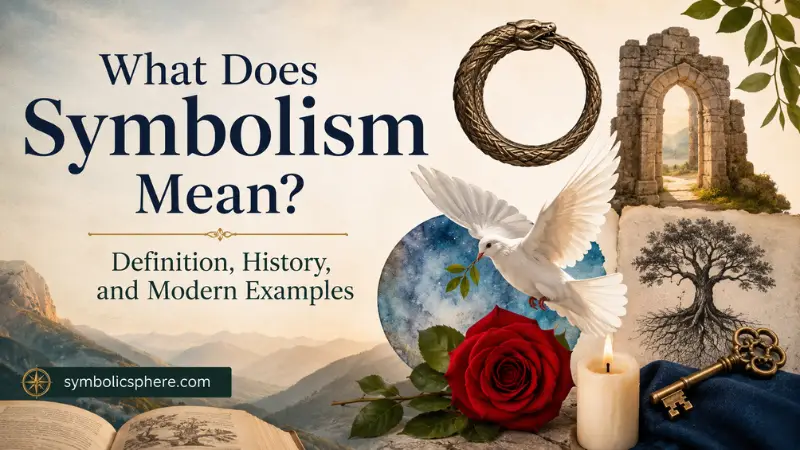
What does symbolism mean? Symbols surround us every day, often without us noticing. A wedding ring, a national flag, a tattoo, a company logo, a color chosen for a warning sign — each one carries meaning that goes far beyond its physical form. This is the essence of symbolism: using something visible and concrete to represent something abstract, whether that’s love, freedom, danger, or belonging.
Understanding symbolism isn’t just useful for reading a poem in an English class. It shapes how people express identity, practice religion, build brands, and connect with one another across cultures and generations. This article breaks down what symbolism actually means, where it came from, and how it shows up in modern American life — from art and religion to tattoos and social media.
Symbolism matters because humans often communicate through shared meaning rather than words alone. Across cultures and generations, symbols have helped people express emotions, beliefs, memories, and social connections in ways language sometimes can’t capture as quickly or as powerfully.
Quick Answer
Symbolism is the use of an object, image, color, action, or person to represent an idea, emotion, or belief beyond its literal meaning. A rose can represent love, a dove can represent peace, and a flag can represent national identity. Symbolism appears throughout art, religion, design, fashion, and personal expression, and its meanings shift across cultures and time periods.
At a Glance
- Symbolism uses tangible things to represent abstract ideas
- Meanings shift across cultures, communities, and generations
- Common categories include religious, national, color, and animal symbolism
- Art, literature, and branding all rely on symbolic communication
- Context determines how a symbol should be interpreted
What Symbolism Means and How It Works
Symbolism is the practice of using a person, object, image, color, place, or action to represent something beyond its literal form. The symbol itself is visible and concrete, but its meaning comes from shared cultural understanding, personal experience, and collective association.
A heart shape isn’t a human heart, yet most people instantly recognize it as a symbol of love. A national flag is just fabric and color, yet it can carry an entire history — belonging, sacrifice, identity, pride.
This is what separates a symbol from a simple sign. A stop sign gives one direct instruction. A sunset in a painting might suggest an ending, a sense of peace, or quiet reflection, depending on the story around it. Signs inform; symbols invite interpretation.
According to Merriam-Webster, symbolism is formally defined as “the art or practice of using symbols especially by investing things with a symbolic meaning or by expressing the invisible or intangible by means of visible or sensuous representations.”
Symbol vs. Symbolism: What’s the Difference?
A symbol is the actual object or image used to represent something. Symbolism is the meaning or system of meaning behind it.
An owl, for instance, is a symbol. The idea that an owl represents wisdom is the symbolism attached to it — the physical image and its associated meaning working together.
| Symbol | Common Meaning in the U.S. | Associated Ideas | Notes |
|---|---|---|---|
| American flag | National identity | Freedom, pride, history | Meaning can vary by personal or political viewpoint |
| White dove | Peace | Hope, reconciliation | Common in religious and memorial settings |
| Wedding ring | Commitment | Love, partnership | Tied to marriage traditions |
| Oak tree | Strength | Stability, endurance | Frequently used in heritage and nature themes |
Why Humans Use Symbols to Communicate
Symbols let people express complex ideas quickly. A single image can carry emotion, memory, or belief in a way that would otherwise take paragraphs to explain.
This is especially powerful within communities that share common experiences. A candle at a memorial service represents remembrance and respect without a word being spoken. A graduation cap represents years of effort and achievement. These associations form because people repeatedly connect the same object with the same experience, until the connection becomes automatic.
Symbols also carry tradition forward. Families and cultures pass meaning down through ceremonies, clothing, architecture, and storytelling — often long after the original context has faded from memory.
The History of Symbolism
Symbolic communication is almost as old as human communication itself. Ancient societies used drawings, patterns, and objects to represent spiritual beliefs, social roles, and natural forces long before written language existed.
Cave paintings, ceremonial objects, and early markings show that humans have used images to communicate ideas — not just practical information — for tens of thousands of years. Civilizations including ancient Egypt, Greece, Rome, and many Indigenous cultures developed rich symbolic systems tied to religion, leadership, and daily life. Britannica’s overview of symbols and symbolism traces how these systems evolved across different societies.
Animals were especially common symbols in ancient traditions. Lions frequently represented strength and authority, while snakes carried different meanings depending on the culture — renewal, danger, or transformation.
Symbolism in American Culture
Symbolism shows up across nearly every layer of American public and personal life, from national identity to personal storytelling.
The American flag is one of the most recognizable examples. For many, it represents patriotism, independence, and shared history — though it can also carry different meanings for different groups, which is itself a good example of how symbols aren’t fixed.
Holidays are built on symbolism, too. The turkey is tied to Thanksgiving, pumpkins signal Halloween, and fireworks represent celebration on the Fourth of July.
Religious and Spiritual Symbolism
Religion relies heavily on symbols to express beliefs and values that are difficult to put into words. A cross is central to Christianity, representing faith, sacrifice, and salvation. The Star of David is closely tied to Jewish identity and tradition. The crescent and star are commonly associated with Islamic cultures, though interpretations vary across communities and regions.
These symbols often hold deeply personal meaning for individuals while simultaneously representing a much larger shared tradition — shaped by history, teaching, and community practice.
Symbolism in Art, Literature, and Storytelling
Writers and artists use symbolism to add depth without stating the meaning outright. Rather than explaining an idea directly, they let an image or setting do the work.
In literature, a storm might represent inner conflict. A journey might represent personal growth. A broken object might suggest loss.
Visual artists lean on the same principle through color and composition — a dark, muted palette can create sadness or mystery, while bright colors suggest energy or hope.
Color Symbolism
Colors carry symbolic weight because people associate them with nature, experience, and cultural tradition.
In American culture, red is often linked to energy, love, danger, or urgency. Blue tends to suggest trust and calm. Green is closely tied to nature, growth, and environmental awareness.
These associations aren’t universal, though. A color tied to celebration in one culture might represent mourning in another — which is why context always matters more than the color itself.
Animal Symbolism in Modern Life
Animals remain some of the most widely used symbols in American culture, showing up in logos, tattoos, sports teams, and personal artwork.
A wolf often represents independence or loyalty. A butterfly frequently symbolizes transformation. An eagle is closely associated with freedom, strength, and national pride in the U.S. Movies, books, and brands lean on these same associations to communicate personality or theme without spelling it out.
Symbolism in Tattoos, Fashion, and Personal Identity
Modern personal expression is one of the clearest places symbolism shows up today. Tattoos are a prime example — someone might choose a flower to honor a loved one, a mountain to represent adventure, or a specific date to preserve a memory. The same image can mean something completely different from one person to the next, depending on their story.
Fashion works the same way. Clothing, jewelry, and accessories can quietly communicate interests, cultural ties, or personal values.
Symbolism in Branding and Digital Culture
Companies build entire identities around symbolism. A logo, color palette, or shape can communicate reliability, creativity, or luxury before a customer reads a single word of copy.
Digital culture has only accelerated this. Emojis, profile pictures, and memes function as modern symbols — a heart emoji expresses affection, and certain icons now represent entire communities or movements.
Common Misunderstandings About Symbolism
Not every symbol has one fixed meaning. A snake might represent danger in one context and healing or renewal in another. A skull might represent death — or, in a different design context, rebellion or remembrance.
Not every symbol hides a secret message, either. Most symbols simply communicate familiar, widely understood ideas rather than encoding something concealed.
How Symbol Meanings Change Over Time
Symbol meanings aren’t fixed in stone — they shift as societies change and new generations reinterpret older images. Social movements, entertainment, and global communication all influence how a symbol is understood, which is why the same image can mean something different to a grandparent than it does to their grandchild.
The Positive — and Negative — Use of Symbols
Symbols can unite people, preserve tradition, and express hope, love, or courage. But they can also be misused: some images have been co-opted by extremist groups in ways that distort their original meaning entirely. Understanding a symbol’s full historical context helps separate its broader cultural history from later misuse, rather than judging it on appearance alone.
Why Symbolism Still Matters
People continue to communicate through shared images and objects because symbols do something words alone often can’t — they compress emotion, memory, and identity into something instantly recognizable. Technology hasn’t diminished that; it’s accelerated it. A single image posted online can now carry meaning across the world in seconds.
FAQs
What is the simple meaning of symbolism?
Symbolism is the use of a visible object, image, or color to represent a larger idea or feeling — a way of communicating meaning beyond the literal thing itself.
Why is symbolism important in everyday life?
It helps people express emotion, belief, memory, and identity across communication, design, celebration, religion, and personal choices like tattoos or fashion.
What are common examples of symbolism?
Hearts represent love, doves represent peace, rings represent commitment, and flags represent national identity — though meaning always depends on cultural and personal context.
Does symbolism mean the same thing in every culture?
No. The same symbol can carry different — sometimes opposite — meanings depending on the culture and time period.
Why do people choose symbolic tattoos?
Symbolic tattoos often represent memories, beliefs, relationships, or personal milestones. The meaning is usually rooted in the individual’s own story rather than a universal definition.
Can a symbol have a negative meaning?
Yes. Depending on context and history, a symbol can represent conflict, fear, or loss just as easily as it can represent something positive.
Conclusion
Symbolism is the practice of using images, objects, colors, and actions to represent ideas beyond their literal form — a way of communicating identity, emotion, and belief that goes back to the earliest human societies. Understanding what symbolism means requires looking past what something appears to be and asking why people connected that particular meaning to it in the first place. From national traditions to a single tattoo, symbols remain one of the most enduring ways people make sense of — and express — the world around them.


