
Poetry often says more than the words on the page. One of the most effective ways poets achieve this is through symbolism in poetry, using people, objects, colors, animals, or natural elements to represent larger ideas and emotions. A single image can suggest love, loss, freedom, hope, memory, or identity without stating those ideas directly.
Readers continue to value symbolism because it invites interpretation rather than delivering a single fixed message. In the United States, symbolism remains central to literature classrooms, contemporary poetry, spoken-word performances, and even popular song lyrics.
Understanding symbolism helps readers appreciate not only what a poem says but also how it creates emotional meaning. Whether the symbol is a rose, a raven, a road, or a river, its significance depends on cultural traditions, historical context, and the poet’s own creative choices.
Quick Answer
Symbolism in poetry commonly represents abstract ideas, emotions, or experiences through concrete images, objects, people, or events. In modern American literature, it is widely used to express themes such as identity, love, freedom, grief, and hope, while historically it developed from religious, mythological, and literary traditions that encouraged layered meaning.
TL;DR
- Symbols represent ideas beyond literal meaning.
- Meanings depend on cultural and literary context.
- American poetry often explores identity and freedom.
- Symbols evolve as society changes.
- Readers interpret symbols through shared experiences.
- Strong symbolism invites multiple thoughtful readings.
What Symbolism in Poetry Means
Symbolism is the literary practice of allowing one thing to stand for something more than itself. Unlike a simple description, a symbol carries additional meaning that readers gradually discover through the poem’s language and context.
For example, rain may literally describe weather while also suggesting renewal, sadness, cleansing, or emotional release. A journey can describe physical travel while symbolizing personal growth or life’s progression.
Importantly, symbols rarely have only one correct interpretation. Instead, poets balance shared cultural meanings with their own artistic intentions, allowing readers to find different but reasonable insights.
Rather than replacing the literal meaning, symbolism adds another layer to it.
How Symbols Work Inside a Poem
A successful symbol grows naturally from the poem rather than feeling artificially inserted.
Poets establish symbols by:
- Repeating important images
- Placing objects at emotional turning points
- Connecting descriptions to recurring themes
- Using contrast and metaphor
- Drawing from familiar cultural associations
For instance, a candle appearing throughout a poem may begin as an ordinary object but gradually come to represent hope, memory, or resilience as the poem unfolds.
Readers recognize symbolism through patterns instead of isolated words.
The Historical Origins of Symbolism in Poetry
Symbolic language existed long before written literature. Ancient myths, sacred texts, oral storytelling traditions, and early epics frequently used animals, celestial bodies, plants, and natural landscapes to communicate moral lessons and spiritual beliefs.
Greek mythology assigned symbolic meaning to olive branches, owls, and laurel wreaths. Biblical poetry associated light with divine guidance and water with purification or renewal. Medieval poets continued this tradition by giving flowers, birds, and precious stones moral and religious significance.
During the nineteenth century, symbolism also became associated with a literary movement that emphasized suggestion over direct explanation. Although modern poetry has evolved considerably, many contemporary poets still rely on this principle of indirect meaning.
Why Symbolism Matters in American Poetry
American poetry often uses symbolism to explore individual identity, democracy, race, migration, belonging, and personal freedom.
Rather than relying solely on traditional religious imagery, many American poets transformed everyday objects into meaningful symbols. Roads, fences, cities, rivers, trains, and front porches became ways to discuss opportunity, separation, memory, and community.
Nature also occupies a distinctive place in American symbolism. Forests, mountains, deserts, and oceans frequently represent both physical landscapes and emotional experiences tied to independence or self-discovery.
Because the United States includes many cultural traditions, American symbolism continues to blend Indigenous perspectives, African American literary traditions, immigrant experiences, and European influences.
Common Symbols Found in Poetry
Certain images appear repeatedly because readers already associate them with familiar ideas. Their exact meaning still depends on context, but they often carry recognizable symbolic associations.
| Symbol | Common Meaning in the USA | Common Associations | Notes |
|---|---|---|---|
| Rose | Love, beauty | Romance, affection | Can also symbolize loss when fading |
| River | Change, life’s journey | Movement, renewal | Direction matters within the poem |
| Bird | Freedom, aspiration | Hope, escape | Species often changes interpretation |
| Tree | Growth, family | Stability, memory | Seasonal changes add meaning |
| Fire | Passion, destruction | Transformation | Can symbolize both creation and loss |
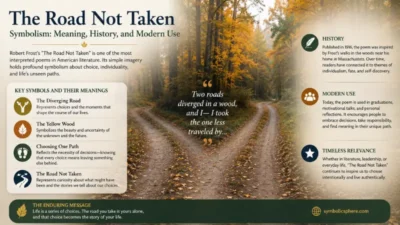
| Road | Life choices | Opportunity, uncertainty | Frequently appears in American literature |
These familiar symbols help readers connect with poems while leaving room for individual interpretation.
Nature as a Source of Symbolism
Nature remains one of poetry’s richest symbolic languages.
The changing seasons often reflect stages of life. Spring commonly suggests beginnings, summer vitality, autumn maturity, and winter endings or reflection. Mountains may symbolize challenges or permanence, while oceans represent uncertainty, possibility, or emotional depth.
Animals also communicate recognizable ideas. Eagles frequently represent freedom in the United States, while butterflies often symbolize transformation. Wolves, foxes, deer, and ravens may carry different meanings depending on folklore, regional traditions, and the poem itself.
Because natural imagery is widely understood, poets can express complex emotions without lengthy explanations.
Color Symbolism in Poetry
Colors influence readers long before they consciously analyze a poem.
White often suggests innocence, peace, simplicity, or remembrance. Black may represent mourning, mystery, authority, or uncertainty. Red frequently conveys love, sacrifice, danger, or courage, while blue may evoke calmness, distance, melancholy, or reflection.
Modern poets sometimes deliberately reverse these expectations. A white landscape can become frightening rather than peaceful, while darkness may symbolize comfort instead of fear.
Context always determines whether traditional meanings remain intact or are intentionally challenged.
Religious and Mythological Influences
Many poetic symbols draw upon religious stories and mythology because these traditions are familiar across generations.
Light commonly symbolizes wisdom, guidance, or spiritual understanding. Gardens may suggest innocence or renewal. Floods often represent judgment or transformation. Phoenixes symbolize rebirth, while labyrinths suggest difficult journeys toward knowledge.
Contemporary American poets may borrow these images without making explicitly religious statements. Instead, they use familiar cultural references to enrich emotional meaning.
Readers do not need to share the same beliefs to appreciate how these symbols function within a poem.
Emotional and Psychological Symbolism
Symbols often express feelings that are difficult to describe directly.
A locked door may symbolize emotional isolation. An empty chair can represent grief or absence. Broken glass may suggest fractured relationships, while bridges often symbolize reconciliation or transition.
Psychologically, symbolic images allow readers to connect personal experiences with universal emotions. Two people may interpret the same symbol somewhat differently while still understanding the poem’s broader emotional direction.
This flexibility is one reason symbolism remains such an effective literary technique.
Symbolism and Personal Identity
Modern poetry increasingly uses symbols to explore identity rather than universal moral lessons alone.
Family heirlooms, hometown streets, languages, hairstyles, clothing, and cultural foods often become symbols of belonging or heritage.
American poets frequently transform ordinary experiences into symbols of immigration, resilience, gender, race, community, or personal memory. A suitcase might represent both travel and generational sacrifice. A family recipe could symbolize continuity despite changing circumstances.
These symbols gain meaning through lived experience rather than fixed tradition.
Symbolism in Contemporary Culture
Although symbolism is closely associated with poetry, it extends into everyday American culture.
People encounter symbolic imagery in:
- Song lyrics
- Film
- Television
- Public memorials
- Fashion
- Tattoos
- Social media
- Graphic design
- Advertising
A butterfly tattoo may express personal transformation. A semicolon tattoo often represents perseverance after mental health struggles. Rainbow imagery can symbolize diversity and inclusion. A phoenix appears in both literature and popular culture as a sign of recovery after hardship.
Modern readers therefore approach poetry with symbolic knowledge shaped by many forms of media.
How Symbolic Meanings Change Over Time
Symbols rarely remain completely fixed.
The dove has long represented peace, but modern writers may also use it ironically to question conflict or political ideals. Roses once appeared mainly in romantic poetry but now may symbolize memory, environmental concerns, or changing relationships.
Similarly, technological symbols have entered contemporary poetry. Screens, notifications, passwords, and digital profiles increasingly symbolize connection, loneliness, identity, or surveillance.
As society evolves, poets adapt familiar symbols and create entirely new ones.
Common Misunderstandings About Symbolism
One of the biggest misconceptions is that every object in a poem must symbolize something.
Many poetic details simply create atmosphere, realism, or rhythm. Searching for hidden meaning in every word can distract readers from the poem’s overall message.
Another misunderstanding is that symbols always have universal meanings. Cultural background, historical period, and the poet’s intentions all influence interpretation.
Strong literary analysis balances shared symbolic traditions with careful attention to context.
When Symbolism Becomes Controversial
Symbols sometimes change meaning because of political events, historical conflicts, or social movements.
Images that once held primarily religious, cultural, or artistic significance may later become associated with extremist groups or controversial ideologies. In these cases, modern readers often interpret the symbol differently than earlier audiences.
Poets sometimes reclaim older symbols by restoring their historical context, while others intentionally challenge modern assumptions. Understanding when a meaning originated helps distinguish historical symbolism from later reinterpretations.
This evolving relationship between symbol and society demonstrates that symbolism is shaped by culture rather than remaining permanently fixed.
Why Readers Continue to Value Symbolism
Symbolism encourages readers to participate in creating meaning instead of simply receiving information.
A poem becomes memorable because readers continue thinking about its images after finishing the final line. Symbols invite reflection, discussion, and personal connection without requiring identical interpretations from every reader.
This openness explains why poems written decades—or even centuries—ago can still feel relevant. While individual symbols may evolve, the human desire to communicate complex emotions through meaningful images remains constant.
FAQs
What is the difference between symbolism and metaphor in poetry?
A metaphor directly compares one thing with another, while symbolism gives an object, image, or event a broader meaning throughout a poem. A symbol often develops gradually and may support multiple themes rather than making one direct comparison.
Is symbolism in poetry always intentional?
Not always. Many poets consciously build symbols into their work, but readers may also recognize meaningful patterns the poet did not deliberately plan. Literary interpretation usually considers both authorial context and the text itself.
Why do American schools emphasize symbolism in poetry?
Studying symbolism helps students move beyond literal reading and understand how language communicates ideas indirectly. It also encourages critical thinking by showing how historical, cultural, and personal contexts influence interpretation.
Can one symbol have different meanings in different poems?
Yes. A raven might symbolize death in one poem, wisdom in another, and resilience in a third. The surrounding language, tone, and theme determine how readers should interpret it.
Does symbolism have religious meaning?
Sometimes. Many poetic symbols originated in religious traditions, mythology, or sacred literature, but modern poets often use the same images in secular ways. The meaning depends on the poem rather than the symbol alone.
Why are natural objects used so often as symbols?
Nature provides familiar experiences that readers can easily recognize. Trees, rivers, birds, flowers, and changing seasons offer visible examples of growth, change, loss, and renewal, making them effective symbolic tools.
Can modern technology become a poetic symbol?
Absolutely. Contemporary poets increasingly use smartphones, digital messages, algorithms, and online identities to symbolize communication, isolation, memory, privacy, or the complexity of modern life.
Conclusion
Poetry becomes more meaningful when readers recognize that ordinary images often carry extraordinary ideas. Symbols in poetry allow poets to express emotions, beliefs, and experiences with subtlety, inviting readers to discover significance rather than simply receiving it.
Today, symbolism in poetry remains one of literature’s most enduring techniques because it adapts to changing cultures while preserving the ability to communicate across generations. Whether rooted in ancient mythology, American history, personal memory, or contemporary life, symbols continue to help poetry express what plain language alone often cannot.

[…] wood symbolizes strength and courage above all else. That meaning isn’t abstract poetry — it comes directly from the Hawaiian word “koa,” which translates to […]