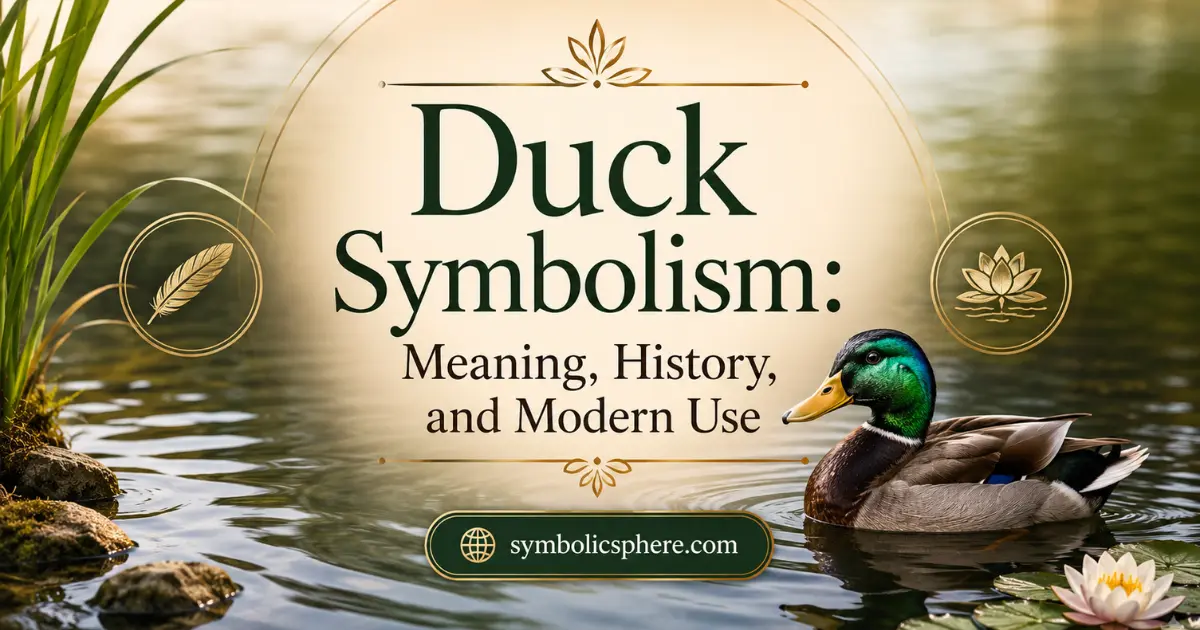
Ducks are among the most familiar birds in North America, appearing in parks, wetlands, farms, children’s stories, and wildlife habitats across the United States. Because they live comfortably on land, water, and in the air, people have long attached symbolic meaning to their adaptable way of life. Duck symbolism continues to appear in art, literature, home décor, fashion, tattoos, and personal reflection.
Unlike birds that symbolize only one idea, ducks carry several meanings depending on the setting. They can represent family, flexibility, emotional balance, resourcefulness, good fortune, and seasonal change. Their symbolism developed gradually through observation of their behavior rather than through a single religious tradition or myth.
Today, Americans often see ducks as friendly, resilient animals that remind people to adapt to changing circumstances while remaining connected to family and community.
Quick Answer
Duck symbolism most commonly represents adaptability, emotional balance, family, and resilience in modern American culture. Historically, ducks have also symbolized prosperity, seasonal renewal, safe travel across water, and the ability to move comfortably between different worlds.
TL;DR
- Ducks symbolize adaptability and resilience.
- They often represent family and loyalty.
- Water links ducks with emotional balance.
- Many cultures connect ducks with prosperity.
- Americans associate ducks with nature and seasonal renewal.
- Modern tattoos often reflect flexibility and personal growth.
What a Duck Represents at First Glance
A duck is a medium-sized waterfowl recognized by its broad bill, webbed feet, waterproof feathers, and ability to swim, fly, and walk with ease. Wild ducks live throughout North America, while domesticated ducks have accompanied human communities for thousands of years.
People encounter ducks in city parks, lakes, marshes, wildlife refuges, farms, and migration routes. Their calm appearance on the water, paired with energetic movement beneath the surface, has inspired symbolic interpretations about maintaining composure while working through life’s challenges.
Their annual migrations have also made ducks natural symbols of changing seasons and life’s ongoing cycles.
The Core Meanings of Duck Symbolism
Although interpretations vary, several meanings appear consistently across cultures and in contemporary American life.
Adaptability
Perhaps the strongest symbolic meaning of a duck is adaptability. Ducks transition effortlessly between water, land, and sky. This versatility suggests adjusting to changing circumstances without losing one’s direction.
Emotional Balance
Because ducks spend much of their lives on water, they are commonly connected with emotions. Water has long represented feelings, intuition, and the unconscious mind. A duck moving smoothly across the surface symbolizes emotional stability even during uncertain times.
Family and Care
Many people recognize ducks as attentive parents. Ducklings closely follow their mother soon after hatching, making ducks enduring symbols of guidance, protection, and family bonds.
Resourcefulness
Ducks survive in varied environments, from frozen lakes to urban ponds. Their ability to find food and shelter under changing conditions reinforces their symbolic connection to resilience and practical problem-solving.
Ancient Roots and Early Symbolism
Long before ducks became familiar park birds, ancient civilizations observed their seasonal migrations and remarkable ability to navigate wetlands.
In ancient Egypt, waterfowl were associated with fertility and the annual renewal brought by the Nile’s flooding. Ducks and similar birds appeared in artwork celebrating abundance and life.
In parts of ancient Europe, migratory birds signaled the arrival of changing seasons. Communities dependent on agriculture naturally associated ducks with the rhythms of nature, harvest cycles, and survival.
Because ducks travel long distances and return each year, they gradually became symbols of continuity and dependable renewal rather than permanence.
Duck Symbolism in Native American Traditions
There is no single Native American interpretation of ducks because hundreds of Indigenous nations maintain distinct beliefs and traditions.
Among some communities, ducks are respected as intelligent water birds that understand both aquatic and terrestrial environments. Their movement between different habitats sometimes symbolizes adaptability and cooperation with nature.
Stories involving ducks often emphasize:
- Community living
- Respect for natural balance
- Seasonal migration
- Survival through cooperation
- Awareness of changing environments
Rather than representing luck alone, ducks frequently illustrate practical wisdom gained by observing the natural world.
Ducks in European and Asian Traditions
Across Europe, ducks often appeared in folklore connected with rivers, marshes, and rural life. Because they nested near water sources essential to farming communities, they could symbolize household prosperity and dependable resources.
East Asian symbolism gives ducks additional meanings, especially certain species.
Mandarin ducks became enduring symbols of:
- Lasting marriage
- Romantic loyalty
- Partnership
- Domestic harmony
Their reputation comes from observing paired birds that appear closely bonded. As a result, decorative duck imagery remains common in wedding gifts and household art in parts of East Asia.
These interpretations differ somewhat from American symbolism, where adaptability and family tend to receive greater emphasis.
What Duck Symbolism Means in the United States
Modern American interpretations are shaped more by everyday experience than by mythology.
People commonly associate ducks with:
- Peaceful neighborhood ponds
- National wildlife refuges
- Hunting traditions
- Wetland conservation
- Childhood memories
- Family outings
- Nature photography
Because ducks appear in familiar public spaces, they often represent a healthy relationship with nature rather than distant mystery.
Their annual migration also reminds many Americans that change is natural and recurring. Seeing ducks return each year can symbolize hope, consistency, and life’s ongoing renewal.
Emotional and Psychological Meaning
From a psychological perspective, ducks illustrate the ability to remain composed during external challenges.
The familiar image of a duck gliding smoothly while paddling vigorously beneath the surface has become a popular metaphor for emotional resilience.
This symbolism encourages qualities such as:
- Staying calm under pressure
- Managing emotions constructively
- Adjusting without panic
- Remaining grounded during transitions
- Protecting loved ones
Many people also see ducks as reminders that outward confidence often depends on unseen effort and persistence.
Duck Symbolism in Religion and Spiritual Thought
Unlike doves, ravens, or eagles, ducks rarely occupy central roles in major world religions.
However, spiritual interpretations often arise from their natural behavior.
Some people associate ducks with:
- Trusting life’s changing currents
- Maintaining balance between action and reflection
- Moving gracefully through emotional experiences
- Living in harmony with nature
These interpretations are generally symbolic rather than based on formal religious doctrine.
Duck Symbolism in Art, Literature, and Popular Culture
Artists frequently use ducks to communicate warmth, familiarity, and everyday life.
Children’s literature often portrays ducks as:
- Curious
- Friendly
- Protective
- Independent
- Adventurous
American audiences have also embraced ducks through animation, comics, and family entertainment, reinforcing their image as approachable rather than intimidating animals.
In visual art, ducks commonly appear in paintings celebrating wetlands, rural landscapes, and seasonal migration.
Their ordinary presence allows them to symbolize simple joys and appreciation for nature.
Why Ducks Appear in Tattoos and Personal Style
Duck tattoos are less common than eagles or owls but hold personal meaning for many individuals.
Common tattoo interpretations include:
- Adaptability after major life changes
- Strong family connections
- Love of nature
- Emotional resilience
- Hunting heritage
- Personal independence
Minimalist duck outlines often emphasize peaceful living, while flying ducks may represent freedom or life’s changing direction.
Duck-inspired jewelry, clothing, and home décor likewise appeal to people who value outdoor lifestyles, wetlands, or meaningful wildlife imagery.
How Duck Symbolism Has Changed Over Time
The symbolic meaning of ducks has evolved alongside society.
| Historical Period | Meaning in the USA | Common Associations | Notes |
|---|---|---|---|
| Ancient civilizations | Fertility and renewal | Water, harvest | Linked to seasonal cycles |
| Medieval Europe | Household prosperity | Rivers, farming | Practical rural symbolism |
| Early America | Wildlife and survival | Hunting, wetlands | Connected to frontier life |
| 20th century | Family and nature | Parks, conservation | More accessible symbolism |
| Today | Adaptability and emotional balance | Tattoos, décor, personal growth | Strong everyday cultural meaning |
Modern symbolism places greater emphasis on personal resilience than earlier agricultural interpretations.
Common Misunderstandings About Duck Symbolism
One misconception is that ducks symbolize only luck.
While some traditions connect ducks with prosperity, this is not their universal meaning. Adaptability and family are much more consistently recognized across cultures.
Another misunderstanding is that all duck symbolism comes from one ancient tradition.
In reality, similar meanings developed independently because people observed comparable behaviors in ducks wherever they lived.
It is also inaccurate to assume every duck species carries identical symbolism. For example, mandarin ducks have unique associations with marriage that do not automatically apply to mallards or other North American species.
Where Duck Symbolism Appears Today
Duck symbolism continues to evolve in modern life.
People encounter symbolic duck imagery in:
- Wildlife conservation campaigns
- Nature-inspired home décor
- Outdoor recreation brands
- Children’s books
- Greeting cards
- Seasonal decorations
- Environmental education
- Social media photography
- Personal tattoos
- Garden ornaments
Many Americans appreciate ducks not because they are rare but because they represent everyday connections with local nature.
Positive and Negative Symbolic Interpretations
Like many symbols, ducks can represent both strengths and cautions depending on context.
| Context | Meaning in the USA | Common Associations | Notes |
|---|---|---|---|
| Calm duck on water | Emotional balance | Peace, patience | Most common interpretation |
| Mother with ducklings | Family devotion | Guidance, care | Widely recognized |
| Flying ducks | Transition | Freedom, migration | Positive life changes |
| Lone duck | Independence | Self-reliance | Sometimes solitude |
| Disturbed wetland | Environmental concern | Habitat loss | Modern conservation message |
Most modern interpretations remain positive because ducks are viewed as adaptable, social, and familiar wildlife.
FAQs
What does a duck symbolize spiritually?
Many spiritual interpretations associate ducks with emotional balance, adaptability, and trusting life’s natural changes. These meanings generally come from observing the bird’s behavior rather than from formal religious teachings.
Is seeing a duck considered good luck?
Some cultures connect ducks with prosperity or fortunate opportunities, particularly when they appear near water or in pairs. In the United States, people are more likely to interpret a duck as a reminder of resilience, family, or seasonal renewal than as a direct sign of luck.
What does a duck tattoo usually mean?
Duck tattoos often represent flexibility, family loyalty, emotional strength, or a love of nature. For some people, they also reflect hunting traditions or meaningful memories connected to wetlands and wildlife.
Why are ducks associated with family?
Ducklings closely follow their mother from an early age, creating one of nature’s most recognizable examples of parental care. This behavior has made ducks enduring symbols of guidance, protection, and close family relationships.
Are ducks symbols of love?
Certain species, especially mandarin ducks, symbolize faithful partnerships and lasting marriage in several Asian traditions. In American culture, ducks are more commonly associated with family life than with romantic love alone.
Do ducks have negative symbolic meanings?
Negative interpretations are relatively uncommon. In some contexts, ducks may symbolize distraction, vulnerability, or avoiding problems, but these meanings are much less widespread than their associations with adaptability and resilience.
Conclusion
Duck symbolism has grown from careful observation of an everyday bird that thrives on land, in water, and in the air. Across centuries and cultures, ducks have come to represent adaptability, family, emotional balance, practical wisdom, and seasonal renewal. While different traditions emphasize different qualities, these themes remain remarkably consistent.
Today, duck symbolism continues to resonate in American culture because it reflects experiences that many people recognize in their own lives: adjusting to change, caring for loved ones, staying steady during challenges, and maintaining a meaningful connection with the natural world. Rather than pointing to a single fixed meaning, the duck reminds us that resilience often comes from learning to move confidently through changing environments while remaining true to what matters most.