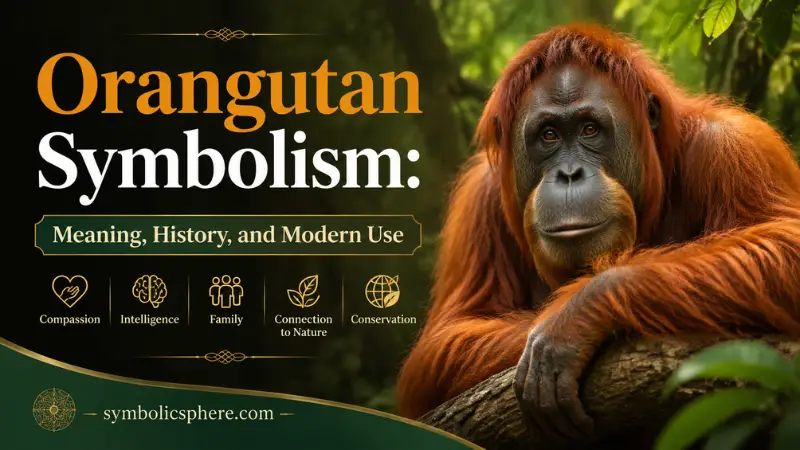
The orangutan is one of the few animals whose name literally describes what it is. In Malay, the word translates to “person of the forest,” and that phrase alone tells you most of what people have felt about this animal for centuries: something close to human, but wiser, quieter, and more solitary. Orangutan symbolism draws on exactly that tension — a creature that mirrors us in its expressions and intelligence, yet lives at a slower, more deliberate pace than we do.
People search for meaning in orangutans for a few different reasons. Some encounter the animal at a zoo and are struck by how personal its gaze feels. Others come across it through wildlife documentaries about deforestation in Borneo and Sumatra, where the orangutan has become a visual shorthand for everything being lost. Still others want to know what the animal represents before getting a tattoo, choosing a nursery theme, or picking a symbol tied to independence and self-reliance.
In American culture specifically, the orangutan rarely shows up in old folklore or religious tradition the way a wolf or an eagle does. Instead, its symbolism is newer and more environmental — shaped by nature media, conservation campaigns, and a growing cultural awareness of endangered species. That makes orangutan symbolism a useful case study in how meaning can form recently, in real time, rather than being inherited from centuries of myth.
Quick Answer
Orangutan symbolism in modern American culture centers on patience, quiet intelligence, independence, and environmental urgency, especially in conservation messaging and wildlife-inspired art. In Southeast Asia, where the species actually lives, it has long been regarded as a forest elder or near-human presence rather than a typical wild animal.
TL;DR
- Name means “forest person” in Malay, not a Western invention
- Represents patience, solitude, and deliberate intelligence
- Central figure in modern endangered-species and rainforest conservation messaging
- Native Southeast Asian view treats it as near-human, not just an animal
- Popular in tattoos and nursery decor for gentleness and individuality
- Increasingly tied to climate anxiety and habitat-loss awareness online
What Orangutans Actually Look Like and Where People Encounter Them
Orangutans are large, reddish-orange apes with long arms built for moving through rainforest canopy rather than walking on the ground. Adult males often develop wide cheek pads called flanges and a pouch under the chin used for long calls that travel through dense forest. Their faces are notably expressive, with deep-set eyes that many observers describe as unusually direct or thoughtful.
Because wild orangutans live only in the rainforests of Borneo and Sumatra, most Americans meet them secondhand: through zoo exhibits, nature documentaries, conservation nonprofits, or images shared on social media after a rescue or a habitat-loss story goes viral. That secondhand exposure matters. Unlike animals Americans encounter directly, orangutan symbolism has been shaped almost entirely by curated storytelling rather than firsthand folklore.
The Core Meaning: Patience, Intelligence, and Deliberate Living
Strip away the conservation messaging and the modern meaning of the orangutan comes down to a handful of consistent traits. Orangutans move slowly and deliberately through the canopy, planning each hand-hold before committing to it. Field researchers have long noted their careful, almost calculated approach to navigating the forest, which has fed into a symbolic association with patience and unhurried decision-making.
They are also among the most solitary of the great apes, especially adult males, which has made the orangutan a recognizable symbol of independence and self-sufficiency rather than group loyalty. Combined with well-documented problem-solving ability — including tool use in the wild — the animal reads symbolically as a figure of quiet, self-contained intelligence rather than dramatic power or aggression.
Ancient Roots: How the Name and the Image Form
The word “orangutan” comes from Malay, combining “orang” (person) and “hutan” (forest). While some earlier scholarship claimed the term was a European misunderstanding from the seventeenth century, more recent historical-linguistic research on Old Javanese texts suggests the “forest person” concept for this animal has circulated in the region for far longer than that, reaching back at least a millennium.
That naming choice reflects how the species was regarded locally long before it became a global conservation symbol: not simply as wildlife, but as a forest-dwelling being with a person-like presence. This near-human framing is the seed from which most later orangutan symbolism grows, whether in folklore, science, or modern branding.
Symbolism in the United States
Orangutan symbolism in the U.S. did not develop through inherited myth the way symbols like the owl or the deer did. Instead, it developed largely through twentieth- and twenty-first-century nature media, primatology research (including well-known studies on great ape cognition), and conservation campaigns highlighting palm oil-driven deforestation.
As a result, the American reading of the orangutan tends to blend two things at once: personal traits like patience, gentleness, and quiet intelligence, and a broader symbolic role as an ambassador for endangered rainforest ecosystems. It is common to see the orangutan used in American classrooms, children’s books, and zoo education programs specifically because its expressive face and human-like behavior make ecological loss feel emotionally immediate rather than abstract.
In design and identity contexts, Americans tend to reach for the orangutan when they want to signal individuality without aggression — a “gentle strength” that differs from more dominant animal symbols like the lion or the bear.
Cross-Cultural and Regional Meaning
In Indonesia and Malaysia, where orangutans actually live, the animal has historically been treated with a degree of respect bordering on kinship, tied to its human-like face and behavior and to local beliefs about forest spirits and ancestral connection to the land. Some indigenous Bornean communities, including various Dayak groups, hold broader animist traditions in which forest animals carry spiritual significance as part of a living, ancestor-connected landscape, though the hornbill — not the orangutan — is typically the most prominent sacred animal in Dayak visual tradition.
Outside Southeast Asia, the orangutan has no deep traditional symbolism in Western, East Asian, or Middle Eastern folklore, simply because the species was unknown there until relatively recent contact. This makes it somewhat unusual among widely recognized animal symbols: its meaning is geographically rooted rather than globally ancient.
Emotional and Psychological Signals
Psychologically, people tend to project a specific emotional register onto orangutans: calm rather than excitable, contemplative rather than reactive, and independent rather than pack-oriented. The animal’s slow movement and steady gaze read as thoughtfulness rather than passivity.
For individuals who identify with the symbol personally, it often signals a preference for solitude over crowds, patience over impulsiveness, and a quiet form of resilience — the ability to keep going steadily rather than dramatically. This is part of why the orangutan resonates with people who don’t see themselves reflected in louder, more aggressive animal symbols.
Orangutans in Tattoos and Personal Style
In tattoo culture, orangutan designs are chosen far less often than symbols like wolves or tigers, which makes them a deliberate, individual choice rather than a trend-driven one. Common reasons people cite include a personal connection to patience or introversion, a love of primates or wildlife conservation, or a tribute to time spent in Southeast Asia.
Stylistically, orangutan tattoos range from realistic portrait work focused on the face and eyes, to more graphic silhouette designs paired with jungle foliage. Because the animal’s expression carries so much of its symbolic weight, most tattoo artists recommend prioritizing facial detail over full-body composition.
Orangutans in Decor, Jewelry, and Everyday Design
In home decor, orangutan imagery tends to appear in nursery and children’s room themes, where its gentle, human-like features read as warm rather than wild. Botanical or rainforest-themed decor lines frequently include the orangutan alongside toucans and tropical foliage, using it as a softer counterpart to more intense jungle animals like big cats.
In jewelry and fashion, orangutan motifs are less common than in decor, appearing mostly in conservation-branded merchandise or nature-inspired collections rather than mainstream costume jewelry.
Orangutans in Modern Pop Culture and Digital Spaces
Popular media has reinforced a specific version of orangutan symbolism: wise, a little mischievous, and emotionally intelligent. Fictional orangutan characters in animated films are frequently written as sage-like guides or comic-relief elders rather than villains or predators, reflecting the broader cultural instinct to cast the species as thoughtful rather than threatening.
On social media, orangutans circulate heavily in two very different contexts: heartwarming clips highlighting problem-solving or apparent affection toward caretakers, and somber conservation content documenting habitat destruction. Both reinforce the same underlying symbolism — a creature whose intelligence and expressiveness make its situation feel personal to viewers.
Controversies and Misuse of the Symbol
The most persistent issue with orangutan symbolism isn’t malicious misuse so much as oversimplification. Because the species is critically endangered, some conservation messaging leans on exaggerated claims of near-human emotion or intelligence, which can blur the line between genuine primatology and sentimentalized marketing. Scientists studying great apes have cautioned against over-anthropomorphizing behavior in ways that misrepresent the animal’s actual cognition and needs.
There is also a tension in how the “gentle forest sage” image sits alongside the harder reality of habitat loss driven by palm oil agriculture and logging. Some critics argue that softened, plush-toy versions of the orangutan used in branding can inadvertently reduce urgency around the conservation crisis rather than support it.
Historically, in some colonial-era Western writing, the species was described in dehumanizing or crude terms that reflected outdated and racially charged assumptions about primates and humanity. Modern usage has moved firmly away from that framing, but it is a documented part of how the animal was once discussed in Western scientific literature.
How the Meaning Has Evolved Over Tim
The trajectory of orangutan symbolism moves in a fairly clear arc: from a locally understood “forest person” in Southeast Asian tradition, to a scientific curiosity in early Western natural history, to a globally recognized conservation icon in the twenty-first century. Each stage added a layer rather than replacing the last — the human-like framing from centuries ago is still present in how the animal is discussed today, just now filtered through environmental urgency rather than folklore.
What’s notable is how recent the dominant modern meaning actually is. Much of what Americans associate with the orangutan today — patience, endangered-species advocacy, gentle wisdom — solidified mainly over the last fifty years, alongside major primatology research and the rise of global conservation media
Orangutan Symbolism at a Glance
| Context | Meaning in the USA | Common Associations | Notes |
|---|---|---|---|
| Conservation media | Urgency, environmental loss | Deforestation, palm oil, endangered species | Most dominant modern American association |
| Tattoos | Patience, individuality | Facial portraits, jungle foliage | Less common than other animal tattoos, chosen deliberately |
| Children’s decor | Gentleness, warmth | Nursery themes, rainforest motifs | Softer alternative to big cats or predators |
| Pop culture | Wisdom, mild mischief | Sage-like or guide characters | Rarely portrayed as villainous |
| Southeast Asian tradition | Near-human forest presence | Ancestral land connection, animist belief | Regional meaning predates Western conservation framing |
FAQs
What does an orangutan symbolize spiritually?
In its native Southeast Asian context, the orangutan is often understood as a near-human presence tied to the forest itself rather than a distinct spiritual figure. In broader modern spiritual or personal-meaning contexts, it’s more commonly associated with patience, solitude, and deliberate living.
What does an orangutan tattoo mean?
Most people choose orangutan tattoos to represent patience, independence, or a personal connection to wildlife conservation. Because the design is uncommon compared to other animal tattoos, it also tends to signal individuality.
Is the orangutan a symbol of wisdom?
Yes, though the wisdom associated with orangutans is quieter and more observational than the commanding wisdom linked to animals like owls. It comes largely from their slow, deliberate movement and documented problem-solving intelligence.
Why is the orangutan associated with conservation so strongly?
Because the species is critically endangered due to rainforest habitat loss, largely from palm oil agriculture and logging, it has become one of the most recognizable faces of the broader conservation movement. Its expressive, human-like features make habitat destruction feel emotionally immediate to audiences.
Does the orangutan have religious symbolism?
The orangutan does not hold a defined role in major world religions. Its closest ties to spiritual meaning come from regional animist traditions in Borneo and Sumatra, where forest animals more broadly are woven into ancestral and land-based belief systems.
Is orangutan symbolism the same across Borneo and Sumatra?
The general “forest person” concept and human-like regard for the species is broadly shared, but specific cultural practices and beliefs vary by ethnic group and island rather than forming one single unified tradition.
What’s the difference between historical and modern orangutan symbolism?
Historically, the meaning centered on the animal’s human-like presence within the forest itself, rooted in regional language and belief. Modern symbolism, especially in the U.S., has shifted toward conservation urgency and personal traits like patience and quiet intelligence.
Conclusion
Orangutan symbolism works because it never asks you to imagine something mythical — it points directly at a real animal whose face and movements already feel personal. That’s the throughline connecting its centuries-old Malay name to its current role as a conservation icon: a consistent sense that this is a forest-dwelling being closer to us than most wildlife, deserving of patience rather than fear.
For American audiences in particular, the meaning has formed recently and visibly, shaped by documentaries, classrooms, and habitat-loss stories rather than inherited myth. That doesn’t make it any less real as a symbol — if anything, it makes orangutan symbolism a rare case of shared meaning still actively taking shape.
What stays constant, across every version of the story, is the sense of a quiet intelligence watching back.


