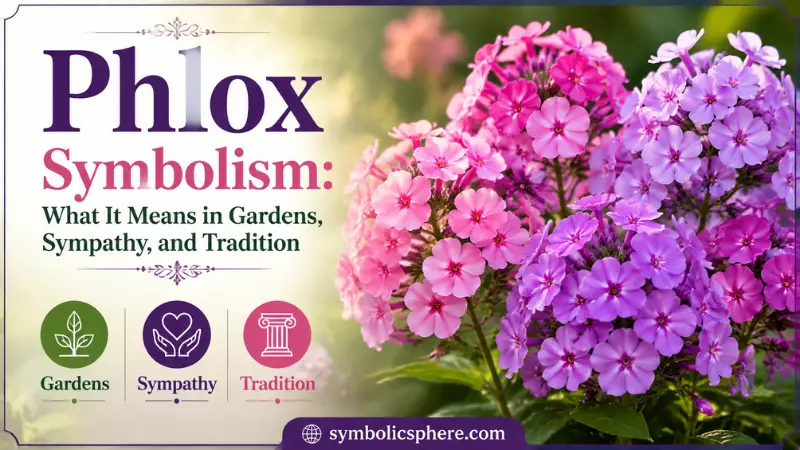
Walk through almost any American cottage garden in midsummer and you’ll likely catch the sweet, clove-like scent of phlox before you spot the flower itself. Its clustered blooms — pink, purple, white, deep red — rise in dense heads above narrow leaves, drawing bees, butterflies, and the occasional hummingbird moth. Phlox symbolism runs deeper than curb appeal, though. For generations, this North American native has carried meanings tied to togetherness, agreement, and quiet affection — ideas rooted in how the plant was actually grown and shared among neighbors, not in myth or scripture.
People look up flower meanings for practical reasons: choosing what to plant on a grave, deciding what belongs in a wedding bouquet, or wondering why a grandmother always kept a patch of phlox by the porch steps. Phlox doesn’t have the dramatic backstory of a rose or a lily, and that’s part of its appeal — its symbolism grew out of everyday life rather than legend.
This guide covers where phlox’s meaning comes from, how Americans understand it today, and where you’re likely to encounter it — from perennial borders to sympathy arrangements to tattoo studios.
Quick Answer: What Does Phlox Symbolize?
Phlox symbolizes harmony, unity, and warm affection in modern American culture, especially in sympathy arrangements, garden design, and gifts between family or close friends. The meaning traces back to Victorian-era flower language, where phlox represented agreement and togetherness — fitting, since its Greek name literally means “flame.”
TL;DR
- Phlox’s name comes from the Greek word for “flame.”
- Victorian flower language linked phlox to unity and agreement.
- Most species are native to North America, especially the U.S.
- American gardeners associate it with tradition, memory, and community.
- It appears often in sympathy flowers and cottage-garden design.
- Its meaning stays gentle and domestic rather than dramatic.
What Phlox Looks Like and Where You’ll Find It
Phlox is a genus of more than 60 species in the family Polemoniaceae, the overwhelming majority native to North America, with habitats ranging from alpine slopes to open woodland and prairie (Wikipedia). The flowers are small and tubular, typically opening into five petals arranged in tight, rounded clusters, often with a contrasting “eye” of color at the center that guides pollinators toward the nectar. Garden phlox grows upright and bushy, blooming in tall clusters from midsummer into early fall, while creeping or moss phlox hugs the ground and carpets slopes with color in early spring.
Americans encounter phlox most often in perennial borders, along fence lines, in rock gardens, and increasingly in native-plant landscaping meant to support pollinators — a trend well documented by university extension programs like Cornell’s Fruition blog. It’s a fixture of grandmother gardens and roadside plantings throughout the eastern and central United States, which is part of why its symbolism feels tied to home and continuity rather than exotic romance.
The Most Common Meanings Today
In contemporary American usage, phlox is associated above all with harmony and togetherness — the sense of people being of one mind or one heart. It’s also read as a symbol of warmth, hospitality, and steady affection, the kind that shows up in long friendships and family bonds rather than sudden passion. Because it spreads and multiplies readily once established, it’s sometimes tied to abundance and generosity too — a plant that keeps giving back to the gardener who plants it.
Unlike flowers loaded with contradictory meanings, phlox has stayed fairly consistent. It rarely appears as a symbol of loss, jealousy, or warning, which makes it a comfortable, low-risk choice for gift-giving and garden design alike.
Ancient Roots and Early Symbolism
Phlox’s name comes directly from the Ancient Greek word for “flame,” a reference to the vivid, glowing color of some varieties rather than any specific myth or deity. This matters because, unlike many classical flower symbols, phlox has no origin story rooted in Greek or Roman mythology — its early symbolism is descriptive, born from what the flower looked like rather than a legend attached to it.
Because most phlox species are native to North America, the plant simply wasn’t part of the older European symbolic traditions that shaped meanings for flowers like roses, lilies, or violets. Its symbolic life really begins later, once it was cultivated, named, and folded into the flower-language traditions of the 18th and 19th centuries.
How Victorian Flower Language Shaped Its Meaning
Phlox’s best-known symbolic meaning — unity, agreement, “our souls are united” — comes from the Victorian practice of floriography, in which specific flowers were assigned sentiments so they could be exchanged as coded messages. Guidebooks compiling these meanings were common household items in the 1800s, sitting alongside the family Bible in many homes, though the exact meaning attached to any flower could shift depending on which guide you consulted.
Phlox’s association with togetherness likely grew from a mix of visual and practical cues: it grows in dense, unified clusters rather than solitary blooms, and it was frequently divided and swapped between neighbors, making it a literal symbol of community ties. A gift of phlox wasn’t showy, but it suggested lasting closeness rather than fleeting attraction.
Phlox Symbolism in the United States
In American culture, phlox carries a distinctly domestic, community-oriented symbolism rather than a formal or ceremonial one. It’s the flower of a shared garden path more often than a florist’s showcase bouquet, and that context shapes how people read it.
In gardens and neighborhoods: Because phlox spreads easily and is often passed along as divided plants or cuttings, it has long served as a literal token of neighborliness — a start from one garden taking root in another. Many gardeners can point to a phlox patch that came from a parent’s or grandparent’s yard, reinforcing its ties to continuity and family memory.
In sympathy and memorial arrangements: Phlox appears often in memorial gardens and sympathy flowers — not because it symbolizes grief itself, but because its meanings of unity and enduring connection translate naturally into remembrance: the idea that a bond continues even after loss.
In regional identity: Certain native species, such as wild blue phlox carpeting eastern woodlands each spring, have become minor emblems of regional natural heritage, showing up in native-plant advocacy and state wildflower programs.
In public and civic life: Phlox rarely carries political or civic symbolism the way flags or eagles do. Its public presence is aesthetic and ecological — valued in pollinator gardens and public landscaping, which has given it a secondary, modern association with environmental stewardship.
Cross-Cultural Meaning
Because phlox is a North American plant, it doesn’t carry the layered symbolism found in cultures where a flower has grown for millennia. In parts of Europe, where garden phlox became popular after being imported in the 18th and 19th centuries, it absorbed general “cottage garden” associations with rural simplicity and old-fashioned charm rather than any singular cultural or religious meaning. It plays no significant role in East Asian, South Asian, or Middle Eastern flower traditions, largely because the plant wasn’t present there before modern horticultural trade. Its meaning, in other words, is a relatively recent, largely Western invention rather than an ancient cross-cultural one.
What Phlox Communicates Emotionally
Psychologically, phlox reads as a symbol of steadiness rather than intensity. Its colors — soft pinks, cool purples, clean whites — lean calming rather than dramatic, and its habit of blooming in dense, unified clusters visually suggests togetherness rather than individual standout beauty. People drawn to phlox in a garden or a gift often describe it as comforting and familiar, evoking childhood gardens or older relatives, which ties into its broader association with memory and rootedness.
Scent plays a role too. Many varieties carry a warm, clove-like fragrance that lingers in the evening air, and for many Americans that particular smell is tied directly to a specific home, porch, or relative — reinforcing the flower’s emotional link to belonging rather than romance or ambition.
Why Phlox Appears in Tattoos and Personal Style
Phlox tattoos are less common than rose or peony designs, but they do appear — usually chosen by people with a personal or family connection to the flower rather than a generic love of florals. Common motivations include commemorating a grandparent’s garden, marking a hometown or region where wild phlox grows, or representing a close friendship or family bond, echoing the flower’s core meaning of unity. Because the blooms cluster tightly, phlox also lends itself to designs meant to represent a group of people, such as siblings or a close friend circle, with each small bloom standing in for one member of the group.
Modern Everyday Uses
Beyond gardens, phlox shows up in a handful of recognizable modern contexts:
- Jewelry and home décor: Small-scale phlox motifs appear in botanical jewelry and décor aimed at a “cottagecore” or heirloom-garden aesthetic, trading on the flower’s old-fashioned, homey associations.
- Weddings: Phlox is an occasional but meaningful choice in wedding florals, particularly for couples wanting a symbol of unity that isn’t a rose, or for incorporating a family garden flower into the ceremony.
- Gardening culture and social media: Among home gardeners, phlox is frequently shared as a “pass-along plant,” and posts about it often explicitly reference the tradition of dividing and gifting it — the symbolism reinforcing itself through practice.
- Seasonal and regional markers: Wild blue phlox blooming on forest floors each spring has become a minor seasonal marker in parts of the eastern U.S., mentioned in local nature writing and wildflower walks as a sign that spring has fully arrived.
Common Misunderstandings About Phlox Symbolism
The most frequent confusion isn’t about phlox’s meaning so much as its identity — several unrelated plants share common names that sound similar or get mixed up with phlox at garden centers, which occasionally muddies the symbolism people attach to it. There’s also a persistent but overstated idea online that phlox has one fixed, singular Victorian meaning; in reality, 19th-century flower dictionaries didn’t always agree with each other, and phlox’s meaning varied somewhat by source, generally clustering around unity and agreement without ever being perfectly standardized.
Phlox hasn’t been meaningfully co-opted into hate symbolism, political movements, or commercial mythologizing the way some flowers have. Its “controversies,” such as they are, tend to be horticultural rather than symbolic — older garden varieties, for instance, are notorious for reverting to an unwanted magenta color over generations, a frustration well documented in gardening literature but unrelated to the flower’s symbolic meaning.
How Phlox’s Meaning Has Changed Over Time
Phlox’s symbolism has moved from a fairly narrow, coded Victorian sentiment toward a broader, softer set of associations. In the 1800s, giving phlox carried a fairly specific message about unity or agreement, understood within a shared system of floral code. As that formal language faded through the 20th century, phlox’s meaning loosened into something more general: togetherness, home, continuity, and quiet affection, shaped less by guidebooks and more by lived gardening tradition passed between generations.
More recently, its meaning has picked up an ecological dimension, as native phlox species have become valued specifically for supporting pollinators. This hasn’t replaced the older associations so much as layered a modern, environmentally conscious meaning on top of a long-standing domestic one.
Phlox Symbolism at a Glance
| Context | Meaning in the USA | Common Associations | Notes |
|---|---|---|---|
| Garden and neighborhood sharing | Unity, community | Pass-along plants, family gardens | Reinforced by how easily it’s divided and shared |
| Sympathy and memorial use | Enduring connection | Remembrance, continuity | Not a grief symbol itself, but suits memorial themes |
| Weddings | Togetherness | Partnership, family bonds | Less traditional than roses, chosen intentionally |
| Native and wild phlox | Seasonal renewal | Spring, regional identity | Especially wild blue phlox in eastern woodlands |
| Tattoos and personal symbols | Close bonds | Family, friendship groups | Often chosen for personal rather than generic meaning |
| Pollinator gardens | Environmental care | Sustainability, biodiversity | A newer, modern layer of meaning |
FAQs
What does phlox symbolize in general?
Phlox symbolizes unity, harmony, and lasting affection. This comes from its Victorian-era flower-language associations and its real-world habit of being shared and divided between gardeners as a token of friendship.
What does a phlox tattoo mean?
A phlox tattoo usually represents a close personal bond, such as family or friendship, often chosen by someone with a specific memory tied to the flower. Because phlox blooms in clusters, some people use it to represent a specific group of loved ones.
Does phlox have religious symbolism?
Phlox doesn’t hold a significant place in major religious traditions, largely because it’s a North American plant that wasn’t part of the older symbolic systems built around biblical or classical flowers. Any spiritual meaning attached to it today tends to be personal rather than doctrinal.
Is phlox a positive or negative symbol?
Phlox is almost always read positively, centered on togetherness, warmth, and continuity rather than warning or sorrow. It’s one of the more consistently gentle flowers in American symbolic tradition, without the mixed meanings some flowers carry.
Why is phlox associated with unity specifically?
The association likely comes from both its Victorian flower-language classification and its physical growth habit, since its blooms form dense, unified clusters rather than standing alone. Its long history as a pass-along plant between neighbors reinforced that meaning over time.
Is phlox’s meaning the same today as it was historically?
Not exactly — the specific coded Victorian meaning has faded, replaced by a broader, more informal sense of home, family, and togetherness. A newer layer tied to pollinator support and native-plant gardening has also been added in recent decades.
What’s the difference between wild and garden phlox symbolism?
Wild phlox species, like wild blue phlox blooming on forest floors, lean toward symbolizing spring, renewal, and regional natural heritage. Cultivated garden phlox carries more of the domestic, unity-focused meaning tied to shared gardens and family tradition.
Conclusion
Phlox’s symbolism doesn’t come from ancient myth or religious doctrine — it comes from something quieter: a flower named for its flame-like color, adopted into Victorian flower language as a sign of unity, and kept alive through generations of American gardeners literally dividing and sharing it with the people around them. That history is exactly why phlox symbolism feels less about grand passion and more about steady, lasting connection.
Today, whether it’s blooming wild on a forest floor in spring or filling a backyard border in July, phlox still carries that same throughline of togetherness — reinforced now by its role in supporting pollinators and native landscapes. It’s a modest flower with a modest message, and that consistency is exactly what has kept its meaning intact for so long.


[…] a symbol of loyal love that survives hardship, commonly used in tattoos, weddings, and gifts. Its meaning also draws on older European traditions, where roses more generally represented fleeting beauty and the passage of […]