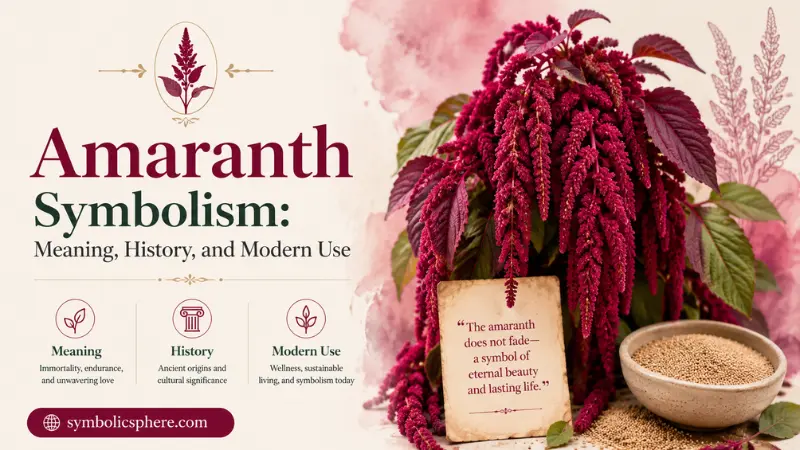
Amaranth symbolism centers on endurance, immortality, remembrance, and life that continues despite hardship. These associations come from the plant’s long-lasting flowers, ancient cultivation, ceremonial importance, and ability to remain visually striking after being cut and dried.
Amaranth is unusual because it is not simply an ornamental flower. Depending on the species, people grow it for grain, edible leaves, garden color, cut flowers, or cascading floral arrangements. Its many roles have produced several layers of meaning rather than one fixed interpretation.
In the United States today, amaranth may appear in wedding bouquets, memorial arrangements, sustainable gardens, tattoos, food products, and artwork. The message changes with the context: a burgundy tassel in a memorial piece can suggest remembrance, while a grain amaranth plant in a community garden may represent nourishment, cultural continuity, and self-reliance.
Quick Answer
Amaranth symbolism most commonly represents immortality, endurance, lasting love, and remembrance in modern American culture. Historically, its meaning also developed through the Greek idea of an “unfading” flower and the sacred agricultural and ceremonial importance of amaranth in pre-Hispanic Mesoamerica.
TL;DR
- Amaranth commonly represents endurance, immortality, and lasting remembrance.
- Its name comes from a Greek word meaning “unfading.”
- Mesoamerican communities valued amaranth as food, tribute, and sacred material.
- Red varieties can express devotion, grief, sacrifice, or emotional intensity.
- Modern Americans use it in weddings, tattoos, decor, and sustainable gardens.
- Not every amaranth species carries the same cultural association.
What the Amaranth Plant Looks Like
Amaranth belongs to a large group of plants with noticeably different forms. Some species grow upright, with dense flower heads resembling plumes, flames, or clustered grain. Others produce long strands that hang from the plant like ropes or velvet tassels.
The best-known ornamental form in American gardens is often Amaranthus caudatus, commonly called love-lies-bleeding. It produces narrow, drooping clusters made from many tiny, petal-free flowers. These tassels are usually red or burgundy, although green and golden varieties also exist.
The plant’s shape contributes directly to its symbolic interpretation. Upright varieties suggest confidence, vitality, and upward growth. Cascading varieties appear softer and more dramatic, sometimes resembling flowing hair, tears, vines, or drops of blood.
Amaranth flowers can also retain much of their shape and color when dried. This physical durability explains why the plant became associated with permanence and why it remains popular in dried bouquets, wreaths, and preserved floral displays.
Core Meanings in Modern American Culture
Although interpretation depends on color and setting, several meanings appear repeatedly in American floral design, personal art, and cultural writing.
| Context | Meaning in the USA | Common Associations | Important Note |
|---|---|---|---|
| Fresh red amaranth | Passion and vitality | Love, courage, emotional intensity | Red can also suggest blood or sacrifice |
| Dried amaranth | Endurance and remembrance | Memory, legacy, lasting bonds | Its form survives after cutting |
| Grain amaranth | Nourishment and resilience | Food security, survival, abundance | Meaning comes from practical use |
| Love-lies-bleeding | Love mixed with sorrow | Heartbreak, devotion, grief | The dramatic name shapes interpretation |
| Green amaranth | Renewal and continuity | Growth, fertility, balance | Often used in modern floral installations |
| Upright flower heads | Strength and confidence | Achievement, dignity, persistence | Visually different from hanging varieties |
The central thread is continuation. Amaranth does not generally symbolize a brief moment of beauty. It represents something that persists: affection after separation, identity after hardship, memory after death, or nourishment through difficult conditions.
That continuation does not always feel joyful. The same plant can communicate triumphant survival or unresolved grief. Its emotional tone depends on whether the arrangement emphasizes vivid growth, dried preservation, dark red color, or the mournful appearance of hanging tassels.
Why “Unfading” Became the Central Symbol
The word amaranth is connected to the ancient Greek amarantos, meaning unfading or unwilting. The name refers to the lasting character associated with the flower rather than a promise that a living bloom literally remains unchanged forever.
From that linguistic root came the ideas of immortality, incorruptibility, and enduring fame. Poets later used amaranth as an imagined heavenly flower that did not decay. In English literary tradition, John Milton described immortal amaranth near the fountain of life in Paradise Lost, strengthening its association with paradise and eternal existence.
Nineteenth-century flower-language books continued this interpretation. They commonly assigned amaranth the meaning of immortality and connected it with honor, lasting beauty, and memory beyond death.
This history requires one important distinction. The Greek name and poetic flower should not automatically be treated as a precise botanical reference to every modern species in the genus Amaranthus. The symbol developed through language, literature, and the visible durability of certain flowers. It was not a single, universally defined religious emblem.
In modern use, “immortality” is usually metaphorical. An amaranth tattoo does not necessarily express a belief in physical eternal life. It may represent a reputation that survives, love that remains meaningful, art that outlives its creator, or family memory carried into another generation.
Sacred Food and Ritual in Pre-Hispanic Mesoamerica
Amaranth has a separate and equally important history in the Americas. It was cultivated in Mexico thousands of years ago for both its seeds and edible leaves. Among the Aztecs and neighboring communities, it became a major crop, a tribute item, and an ingredient in ceremonial foods.
The Aztecs called it huauhtli. Popped seeds were combined with agave syrup to create a dough known as tzoalli. This material could be shaped into sacred figures, honored during ceremonies, divided, and eaten. Amaranth leaves also appeared in meals associated with offerings to the dead.
In this setting, amaranth represented more than immortality in the later European flower-language sense. It connected agriculture with communal obligation, divine relationships, seasonal ceremonies, political tribute, and physical survival.
Food and sacred practice were not separate categories. A crop could nourish the body, support the state, mark the calendar, and participate in religious life. The plant’s symbolism therefore included reciprocity: people cultivated the crop, offered it, shared it, and depended on it.
Modern discussions sometimes reduce this history to sensational claims about sacrifice. That approach distorts the plant’s place in daily life. Ritual use matters, but amaranth was also a practical food cultivated by families and communities. Its meaning cannot be understood only through descriptions of dramatic ceremonies.
Colonial Suppression and the Meaning of Survival
After the Spanish conquest of the Aztec Empire, colonial authorities attempted to suppress amaranth cultivation and its ceremonial uses. The crop’s connection to Indigenous religion made it a target during campaigns to replace local practices with Christianity and European agricultural systems.
Amaranth did not disappear. Wild populations survived, and people continued growing it in more remote areas. It remained part of Mexican and Central American food traditions, including alegría, a confection commonly made from popped amaranth and sweet syrup. In the Andes, related traditions continued around kiwicha, the Quechua name used for cultivated amaranth.
This history gives the plant a modern association with cultural survival. For some people, growing or eating amaranth can represent continuity after colonization, the preservation of ancestral knowledge, and the recovery of foods pushed aside by imposed systems.
That meaning is especially relevant in the United States among Indigenous, Mexican American, Central American, and food-sovereignty communities. However, it should not be assigned automatically to every use of the flower. A decorative arrangement may simply have been chosen for its texture, while a heritage seed project may carry deliberate historical significance.
The most respectful interpretation comes from context. Who selected the plant? How is it being used? Is its cultural history acknowledged, or has it been turned into an unsupported mystical claim?
Love, Loss, and the Name Love-Lies-Bleeding
The common name love-lies-bleeding has strongly influenced American perceptions of red, cascading amaranth. Its drooping tassels resemble streams, wounds, or dark red tears, making the plant a natural image for love accompanied by pain.
In flower-language traditions, ordinary amaranth was associated with immortality, while love-lies-bleeding could carry more sorrowful meanings, including hopeless love, abandonment, or affection that continues without fulfillment. Flower dictionaries never formed one perfectly standardized code, so exact definitions varied between books.
Today, the plant can symbolize:
- Love that survives a separation
- Grief after losing a partner
- Devotion that was not returned
- Emotional honesty after heartbreak
- The permanent effect of an important relationship
It does not have to represent romantic tragedy. Some people interpret the hanging flowers as the release of stored emotion rather than endless suffering. In that reading, the plant acknowledges pain while allowing it to become visible, named, and integrated into a person’s life.
This makes amaranth suitable for memorial artwork and remembrance pieces. It can honor love without pretending that loss is easy or that grief follows a simple path.
Amaranth Symbolism in the United States
Most Americans do not encounter amaranth as a formal national or religious symbol. They discover it through gardens, natural-food stores, floral design, weddings, social media, literature, or family food traditions.
As a result, its American meaning is flexible. A gardener may see it as a dependable annual that thrives in summer heat. A floral designer may value its dramatic movement. A tattoo wearer may connect it with survival. A cook may associate its seeds with nutritious grain and ancestral agriculture.
Amaranth also fits several contemporary American values:
Resilience: The plant tolerates heat and can grow under demanding conditions, supporting its use as an image of adaptability.
Sustainability: Grain and vegetable varieties attract interest among people exploring diverse crops, drought-conscious gardening, and alternatives to conventional grains.
Individuality: Its unusual tassels and intense colors appeal to people who prefer unconventional flowers over familiar roses or lilies.
Cultural recovery: Heritage cultivation can help communities maintain or restore relationships with traditional foods.
Hanging amaranth has also become increasingly visible in contemporary U.S. wedding design. Its cascading form adds movement to bouquets, suspended installations, arches, centerpieces, and table arrangements. Current designers use burgundy, bronze, green, coral, and dyed neutral versions in styles ranging from romantic to minimalist.
Color Symbolism: Red, Burgundy, Green, and Gold
Amaranth’s color changes the emotional message even when the plant remains the same.
Red Amaranth
Red is the most intense version. It can symbolize passion, courage, sacrifice, blood, desire, or a bond that remains emotionally active. In memorial arrangements, it may represent life remembered vividly rather than quietly.
Because of the name love-lies-bleeding, red hanging amaranth often carries a stronger association with heartbreak than upright red varieties.
Burgundy and Purple Amaranth
Dark burgundy communicates maturity, dignity, memory, and restrained emotion. It works well in autumn arrangements, formal events, and decor intended to feel reflective rather than cheerful.
Purple tones can also suggest distinction, creativity, or spiritual reflection. These are modern color associations, not proof of an ancient universal code.
Green Amaranth
Green hanging amaranth usually feels less tragic. It suggests fertility, renewal, continuity, and natural abundance. In wedding arrangements, it can represent a relationship expected to keep developing rather than a love preserved unchanged.
Its trailing form still creates softness and movement, but the green color shifts the mood toward growth.
Gold and Bronze Amaranth
Gold and bronze varieties suggest harvest, achievement, warmth, and mature abundance. They are particularly suited to late-summer and fall arrangements.
Gold can also connect immortality with honor. Instead of focusing on death, it emphasizes a life, relationship, or accomplishment considered worthy of lasting recognition.
Weddings, Memorials, and Personal Milestones
At weddings, amaranth usually represents lasting commitment, abundance, and a relationship strong enough to continue through change. Its cascading form makes it especially effective in bouquets that are meant to feel organic, dramatic, or overflowing.
Green amaranth suits themes of growth and partnership. Burgundy can communicate mature devotion, while red creates a more passionate effect. Because love-lies-bleeding also has associations with heartbreak, couples who care about traditional flower meanings may prefer to explain their intended interpretation.
In memorials, dried or dark-colored amaranth can represent memory that remains present. Its preserved form is particularly appropriate for keepsake wreaths, shadow boxes, grave arrangements, or anniversary-of-loss displays.
The flower can also mark nonromantic milestones:
- Recovery after a difficult period
- Completion of a long personal project
- Immigration and the preservation of family identity
- A career or artistic legacy
- Rebuilding life after major change
- Commitment to sustainable or ancestral food practices
Amaranth works best when its meaning matches a real story. Its symbolism becomes less convincing when it is added to an event only because it has been described online as a general “spiritual flower.”
Tattoos, Jewelry, Fashion, and Digital Art
An amaranth tattoo commonly communicates endurance, remembrance, unconventional beauty, or devotion that has survived hardship. The chosen form matters as much as the species.
An upright plume can resemble a flame and suggest ambition or renewed strength. Hanging tassels create a more emotional composition, particularly when drawn in red. Seed heads may represent abundance, future generations, or the idea that survival produces new life.
Amaranth can be combined with names, dates, birds, hands, grain, or family objects to make the meaning more specific. A dried-flower design may honor someone who died, while new leaves emerging from the stem can signal continuation after loss.
In jewelry and fashion, amaranth-inspired forms create movement and texture. Long earrings may imitate the plant’s hanging tassels, while burgundy fabrics use the color name to convey warmth, intensity, and autumnal richness.
Digital artists also use amaranth in fantasy settings because the flower already carries literary associations with immortality. In those works, it may represent an undying kingdom, forbidden love, magical restoration, or a character whose influence continues after death.
These modern uses are interpretive rather than fixed. The wearer or artist determines the final message.
Cross-Cultural Meanings Without Oversimplification
Amaranth does not have one universal meaning shared by every society that grows or eats it.
The immortality association developed largely from Greek language, later European literature, and flower-language traditions. Mesoamerican meaning grew from cultivation, tribute, food, ceremonial exchange, and relationships with sacred beings. Andean traditions emphasize kiwicha as an enduring food crop with both historical and contemporary importance.
In other regions, people may know amaranth primarily as a leafy vegetable, grain, ornamental plant, or common field species. Its symbolism may center on nourishment and abundance, or it may carry no established ceremonial meaning at all.
Combining these traditions into a single claim such as “all ancient cultures believed amaranth granted immortality” is inaccurate. Similar themes can arise independently, but shared vocabulary does not prove shared theology.
A culturally responsible interpretation keeps the traditions distinct:
- Greek-derived symbolism explains the unfading flower.
- European literature expanded immortality and remembrance.
- Mesoamerican history explains sacred food and cultural continuity.
- Contemporary American use combines these ideas with personal expression.
The plant becomes more meaningful when its different histories are acknowledged rather than blended into a fictional universal legend.
Common Misunderstandings and Modern Misuse
One common mistake is assuming that every reference to amaranth means the same plant. The name may refer to ornamental flowers, edible grain species, leafy vegetables, weeds, a red-purple color, or even an unrelated synthetic dye historically called amaranth.
Another misunderstanding is treating love-lies-bleeding as the only kind of amaranth. It is one recognizable ornamental species, but the genus includes many forms with different appearances and uses.
Americans may also encounter Palmer amaranth as a serious agricultural weed. It can spread rapidly, compete with crops, and develop resistance to herbicides. This agricultural association belongs to a particular species and should not be transferred automatically to cultivated grain or ornamental amaranths.
Historical misuse often involves sensationalizing Aztec ceremonies while ignoring amaranth’s importance as food. Describing the plant only through blood, sacrifice, or conquest turns a complex agricultural tradition into spectacle.
Modern spiritual content can create another distortion by assigning unsupported promises to the flower. Amaranth does not scientifically guarantee protection, eternal love, fertility, healing, or communication with the dead. People may use it in personal rituals, but those practices should be described as individual or modern interpretations.
Finally, symbolic meanings are not rules. Giving someone amaranth does not automatically predict heartbreak, and placing it in a wedding bouquet does not carry a negative message unless the people involved understand it that way.
FAQs
Is amaranth a positive or negative symbol?
Amaranth is usually positive because it represents endurance, remembrance, continuity, and lasting affection. Red love-lies-bleeding can have a sadder tone, especially when used to express heartbreak, sacrifice, or grief.
What does an amaranth tattoo mean?
An amaranth tattoo often symbolizes survival, an enduring bond, personal legacy, or remembrance after loss. Hanging red tassels may emphasize emotional pain, while seed heads and new leaves can represent abundance and future generations.
Does amaranth have a biblical meaning?
Amaranth is not a major named symbol in the Bible. Its association with paradise and eternal life comes mainly from later Christian-influenced literature, particularly poetic portrayals of an unfading heavenly flower, rather than a specific biblical teaching.
What does amaranth mean in love?
In a romantic context, amaranth can represent love that does not fade with time or separation. Love-lies-bleeding may add the idea of unreturned love, heartbreak, or devotion that remains after a relationship has ended.
Is amaranth appropriate for a wedding?
Yes. Green, bronze, burgundy, and red amaranth are used in bouquets, arches, centerpieces, and hanging installations to express abundance, continuity, and lasting commitment. Couples concerned about the name love-lies-bleeding can define the flower through their own ceremony or floral notes.
Why is amaranth associated with immortality?
The association comes from the Greek-derived meaning “unfading,” the ability of certain flowers to retain their appearance when dried, and later poetic and floral traditions. Immortality usually means lasting memory, reputation, or affection rather than literal physical life without end.
Conclusion
Amaranth symbolism brings together several ideas that should remain connected but distinct. Its durable flowers support meanings of immortality and remembrance, its seeds represent nourishment and abundance, and its survival through colonial suppression adds associations with cultural continuity and recovery.
In modern American life, amaranth can honor a lasting relationship, commemorate someone who has died, celebrate resilience, or acknowledge the value of ancestral food traditions. Its meaning becomes clearest when the plant’s color, form, history, and setting are considered together.
Amaranth does not promise that life will remain unchanged. It represents what can continue, feed others, or remain worthy of remembrance after change has already occurred.