If you’ve ever caught the scent of osmanthus before you spotted the flower itself, you already understand its symbolism. Osmanthus is an evergreen shrub or small tree better known for its fragrance than its flowers. Its tiny white, cream, yellow, or orange blossoms can perfume an entire garden — which is exactly why osmanthus symbolism centers on quiet beauty, remembrance, autumn, achievement, and affection.
For American readers, the flower carries two layers of meaning. It’s grown as the fragrant tea olive or sweet olive, especially in milder climates, while its deeper symbolic roots come from East Asian culture. In China, osmanthus became tied to the moon, Mid-Autumn traditions, family reunion, scholarly achievement, social distinction, and folklore.
That history matters because many flower guides flatten osmanthus into a generic symbol of love or happiness. Its real cultural story is more specific — and more interesting.
Quick Answer
Osmanthus symbolizes quiet beauty, affection, cherished memories, and autumn in modern American use — especially in gardens, fragrance, gifts, and Asian-inspired design. In Chinese tradition, it’s also linked to the moon, family reunion, scholarly success, prestige, and perseverance. These meanings are learned and context-dependent rather than fixed or universal, so the setting a flower appears in — a garden, a painting, a tattoo — shapes which interpretation applies.
At a glance:
- Tiny flowers, outsized fragrance → symbol of understated influence
- Blooms in autumn → tied to the Mid-Autumn Festival and lunar imagery
- Historically marked exam success in imperial China
- The Wu Gang legend adds a note of perseverance — or futility, depending on the telling
- In the U.S., meaning is usually personal, botanical, or borrowed from Chinese tradition
What Osmanthus Looks Like — And Why It Matters to the Symbolism
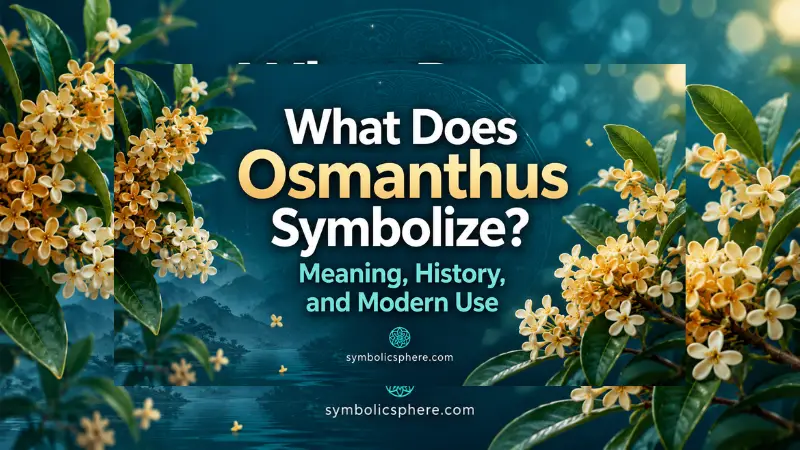
The species most associated with the plant’s cultural meaning is Osmanthus fragrans, commonly called fragrant tea olive, sweet osmanthus, tea olive, or sweet olive. It belongs to the olive family (Oleaceae) and is native to parts of East and Southeast Asia.
The plant has glossy evergreen leaves and small flowers tucked close to the stems. Depending on the variety, blooms range from white and cream to golden yellow or orange. The flowers themselves are modest, but the scent is striking — often compared to apricot or ripe peach.
That contrast between plain appearance and powerful fragrance is central to the flower’s symbolic appeal. Osmanthus can represent a person whose value is noticed through presence rather than display — influence that doesn’t depend on size, status, or visual extravagance. In that sense, it works well as a symbol of understatement and the idea that small things leave lasting impressions.
Osmanthus Meanings by Context
Osmanthus doesn’t have one universal definition. Its meaning shifts depending on whether it appears in Chinese art, an American garden, a tattoo, a perfume, or a seasonal celebration.
| Context | Common Meaning | Association | Note |
|---|---|---|---|
| Modern U.S. use | Quiet beauty, memory, affection | Fragrance and small flowers | Meaning is often personal |
| Chinese tradition | Autumn and reunion | Mid-Autumn season | Strongly tied to lunar imagery |
| Scholarly imagery | Achievement and advancement | Imperial examinations | Osmanthus branches signaled success |
| Court and decorative art | Prestige and prosperity | Wordplay and elite status | Meaning depended on context |
| Folklore | Perseverance or endless labor | Wu Gang and the moon tree | Both positive and cautionary readings exist |
| Gardens and fragrance | Comfort and remembrance | Distinctive scent | Often interpreted through sensory experience |
The most well-documented meanings come from Chinese cultural tradition rather than a universal Western “language of flowers.”
Why Fragrance Became Central to Its Meaning
Osmanthus offers an unusual symbolic contrast: the flowers are easy to overlook, but the scent is impossible to ignore. NC State Extension describes Osmanthus fragrans as having small, intensely fragrant flowers — and the botanical name itself reflects that: osme relates to smell, anthos to flower.
That physical trait supports a few modern interpretations:
- Hidden ability. Something visually modest turns out to be far more noticeable than expected.
- Memory. Fragrance is closely tied to memory in everyday life — a familiar scent can make a place, season, or person feel present again. For anyone who grew up around blooming tea olives, catching that scent years later can become a personal symbol of home, childhood, or family gardens.
- Reach beyond presence. Because the scent travels well beyond the flower itself, it can symbolize reputation, influence, or kindness that extends past someone’s immediate presence.
Ancient Chinese Roots and Autumn Associations
Osmanthus built much of its cultural identity in China, where its bloom time lines up closely with the traditional autumn season. Sweet osmanthus typically flowers from late summer into fall — timing that helped connect it to Mid-Autumn observances, when the full moon, seasonal foods, and family gathering take center stage.
Chinese paintings often use a blooming osmanthus branch as a seasonal marker, signaling autumn even when the season isn’t stated outright. That role explains why osmanthus can symbolize more than just “fall” — it can suggest maturity, harvest, homecoming, and appreciating what has ripened with time.
For Americans used to maple leaves or pumpkins as autumn markers, osmanthus can serve a similar function — though its cultural background is distinctly East Asian.
The Moon, Mid-Autumn Festival, and Family Reunion
One of the flower’s most important associations is with the moon. Osmanthus blooms around the Mid-Autumn period, and Chinese art repeatedly pairs the plant with lunar imagery — museum pieces show it alongside the moon goddess Chang’e and the lunar rabbit in seasonal scenes.
Because the Mid-Autumn Festival centers on family gathering and the full moon, osmanthus picks up related ideas of reunion, homecoming, togetherness, and longing for absent relatives — especially resonant when loved ones are separated by distance. That doesn’t mean the flower alone universally means “family”; the connection comes from its place within this larger seasonal tradition.
For Asian American families celebrating Mid-Autumn in the U.S., osmanthus-flavored tea, pastries, or fragrance can function as reminders of heritage as much as family connection.
Why Osmanthus Became a Symbol of Academic Success
An osmanthus branch once carried a meaning modern flower guides often miss: scholarly achievement. Under imperial China’s examination system, passing competitive civil-service exams could lead to official employment and major social advancement. Popular imagery described that achievement through the idea of plucking a branch from the osmanthus tree said to grow on the moon.
The association became recognizable enough to appear in decorative art — a nineteenth-century embroidered mirror case preserved by The Metropolitan Museum of Art depicts Chang’e offering an osmanthus branch to a successful scholar.
That makes the flower a fitting symbol for graduation, exam success, intellectual discipline, scholarships, and professional advancement. In an American context, using osmanthus in a graduation gift or academic tattoo can reasonably draw on this older association — provided the Chinese origin is acknowledged rather than presented as generic Western symbolism.
Prestige, Wealth, and Social Advancement
Osmanthus also appears in Chinese visual culture as a symbol of rank and inherited dignity, partly through wordplay: the Chinese name gui (used for osmanthus) sounds like terms tied to high status or preciousness. An Asian Art Museum painting uses an osmanthus branch in a scene about noble succession, and the museum notes this linguistic link between the flower and aristocratic standing.
This overlaps with the academic association, since passing exams could transform a person’s social position — so osmanthus could imply recognition earned through ability, not just inherited money. Modern readers should treat this as a historically specific Chinese association, not proof that every osmanthus image signals wealth.
Wu Gang, the Moon Tree, and Endless Effort
Chinese folklore adds a more complicated layer to the symbolism. In the story of Wu Gang, a man is condemned to cut down an osmanthus tree growing on the moon — but every time he chops it, the tree heals itself, trapping him in a task that can never be finished.
The legend supports two very different readings:
- Positive: the self-restoring tree suggests resilience, regeneration, and recovery after damage.
- Cautionary: focusing on Wu Gang himself, the story represents futile labor, repetition, or effort without progress.
That split matters — calling osmanthus simply “a symbol of perseverance” leaves out the warning built into the legend. In Wu Gang–inspired tattoos or art, the intended meaning often depends on whether the wearer identifies with the indestructible tree or the endlessly toiling man.
Love, Affection, and Relationships
Today, osmanthus is often linked to love, tenderness, loyalty, and affection, though these meanings are less historically established than its moon and scholarly associations. The connection makes intuitive sense: the fragrance is sweet without being visually dramatic, so modern interpretation tends to frame osmanthus as gentle or enduring affection rather than passionate romance.
It fits relationships where the intended message is closer to “I value the quiet ways you remain part of my life” — a contrast to the red rose’s far more standardized romantic meaning in American culture. For weddings, anniversaries, or relationship tattoos, osmanthus lands best when the recipient already has some connection to the flower, East Asian culture, autumn, or its fragrance.
What Osmanthus Commonly Means in the United States
In the U.S., osmanthus has no single standardized symbolic meaning the way the red rose, white lily, or poppy do. Americans more often encounter Osmanthus fragrans under horticultural names like tea olive, grown as an evergreen hedge or fragrant planting near patios and entrances in milder climates.
Because of that setting, American interpretations tend to develop from personal experience:
- A tea olive by a childhood porch might symbolize home
- A branch in a graduation arrangement might reference achievement
- An osmanthus perfume could represent nostalgia or intimacy
- A Mid-Autumn illustration may deliberately preserve Chinese lunar and reunion symbolism
The most accurate U.S. interpretation depends heavily on context — the flower’s historical meanings are available to Americans, but they’re usually learned or intentionally adopted rather than universally recognized.
Osmanthus in Asian American Cultural Contexts
Not every U.S. use of osmanthus is detached from Asian tradition. Chinese American and other East Asian communities encounter it through food, tea, family traditions, Mid-Autumn celebrations, and products whose imagery references the moon and autumn. Osmanthus flowers are used to fragrance teas and appear in various sweets, wines, and jams across Chinese culinary tradition.
In these settings, the flower can communicate several ideas at once — season, heritage, reunion, sensory memory, and cultural continuity. An American-born person may associate its scent with grandparents or family celebrations even without knowing the older scholarly symbolism. That’s how symbolic meaning evolves: an inherited cultural image attaches to new places and personal memories without losing its earlier history.
What Different Osmanthus Colors Can Suggest
Color shifts the mood of an osmanthus design, though there’s no fixed historical code assigning one meaning per variety.
- White or cream — simplicity, refinement, sincerity, quiet affection; emphasizes the contrast between modest looks and strong fragrance
- Golden yellow — autumn, warmth, achievement, good fortune; in Chinese art, gold blossoms often reinforce auspicious or elevated themes
- Orange — warmer and more energetic; can suggest enthusiasm, seasonal abundance, or comforting nostalgia
Treat these as color-informed modern readings rather than rigid rules — surrounding imagery matters more than color alone.
Tattoos, Jewelry, and Personal Symbolism
Osmanthus is far less common in mainstream American tattoo culture than roses, lotus flowers, cherry blossoms, or chrysanthemums — which can make it appealing to someone who wants a floral image with a more specific story.
An osmanthus tattoo might represent:
- Quiet strength, since tiny flowers create an outsized effect
- Academic achievement, through the exam-success association
- Family or reunion, through Mid-Autumn imagery
- Resilience, through the self-healing lunar tree
- Memory, especially when the wearer connects the scent to a person or place
Design choices shift the meaning: pairing osmanthus with a full moon points toward Chinese lunar folklore; adding books, a diploma, or calligraphy emphasizes scholarship; combining it with initials or a meaningful date makes it personal.
Osmanthus in Gardens, Perfume, Tea, and Home Decor
Many Americans encounter osmanthus without realizing it carries centuries of symbolism. In landscaping, fragrant tea olive is planted near walkways, patios, and entrances where its perfume can be appreciated. In perfumery, it’s valued for a distinctive fruity-floral character often compared to apricot and peach, sometimes with leathery undertones — the flowers are also used to fragrance tea.
These uses reinforce modern associations with comfort, elegance, memory, and understated luxury. In home decor, an osmanthus motif suits autumn displays or East Asian–inspired interiors — though paired with rabbits, a round moon, Chang’e, or lanterns, it should be read as culturally specific rather than purely decorative.
Common Misunderstandings About Osmanthus Meaning
“Osmanthus always means X.” It doesn’t have one universal spiritual definition. Claims that it “always means eternal love” or “universally represents enlightenment” oversimplify traditions that shifted by place, period, and artistic context.
Detaching the flower from its Chinese origins. Academic success, lunar associations, and the Wu Gang story aren’t generic botanical symbolism — they come from identifiable Chinese cultural traditions and are worth crediting as such.
Assuming every tea olive hedge carries ancient symbolism. Many gardeners simply plant it because it’s evergreen and fragrant, with no symbolic intent at all.
Context is the best guide: the same flower can be culturally loaded in one setting and purely ornamental in another.
How the Meaning Has Evolved
Osmanthus began as a real seasonal plant whose bloom time, fragrance, and autumn timing became woven into Chinese cultural life. Over centuries of literature, folklore, festival custom, and visual art, it picked up associations with the moon, exam success, prestige, family gathering, and legendary perseverance — documented in surviving textiles and paintings, not just modern invention.
As the plant spread through international horticulture, perfumery, and design, its symbolic range widened. Today, someone in the U.S. might use osmanthus to express nostalgia, subtle confidence, affection, cultural heritage, or academic accomplishment. These newer meanings don’t replace the older ones — they show how symbols keep evolving as plants move between languages, communities, and generations.
FAQs
What does an osmanthus flower symbolize?
Osmanthus symbolizes quiet beauty, affection, autumn, memory, and achievement. Chinese tradition adds strong associations with the moon, Mid-Autumn celebrations, scholarly success, and social advancement.
Is osmanthus a symbol of love?
It can represent gentle affection, loyalty, or lasting attachment in modern floral interpretation. Unlike the red rose in American culture, though, it has no single universally recognized romantic meaning.
What does an osmanthus tattoo mean?
It can represent understated strength, memory, academic achievement, family connection, or autumn. Adding a moon points more specifically toward Chinese lunar folklore and Mid-Autumn tradition.
Why is osmanthus associated with the moon?
Chinese folklore places an osmanthus tree on the moon, including the Wu Gang legend of a man endlessly cutting a self-healing tree. The plant’s Mid-Autumn bloom time reinforces the lunar connection.
Why does osmanthus symbolize academic achievement?
In imperial China, passing civil-service examinations became associated with “plucking an osmanthus branch from the moon.” Historical artworks depict the flower being presented to successful scholars.
Does osmanthus have a spiritual meaning?
It can carry spiritual or philosophical weight through lunar legends, seasonal ritual, or personal practice, but there’s no single religious doctrine assigning it one universal spiritual meaning.
Is osmanthus symbolism positive or negative?
Mostly positive — tied to achievement, reunion, affection, and resilience. The Wu Gang legend adds a cautionary note, since his endless struggle against a self-healing tree can represent futile or repetitive labor.
Conclusion
The most useful way to understand osmanthus symbolism is to start with the plant itself: tiny blossoms, a fragrance that reaches far beyond them, and a strong tie to autumn. Those qualities support modern ideas of quiet influence, memory, and understated beauty.
Its deeper history adds the rest — Chinese tradition links osmanthus to the moon, Mid-Autumn reunion, scholarly success, prestige, and the endlessly renewing tree of the Wu Gang legend. In the U.S., those inherited meanings now sit alongside newer ones built through gardens, perfume, food, tattoos, and personal memory — which is what makes osmanthus especially suited to expressing something meaningful without needing to be visually loud.