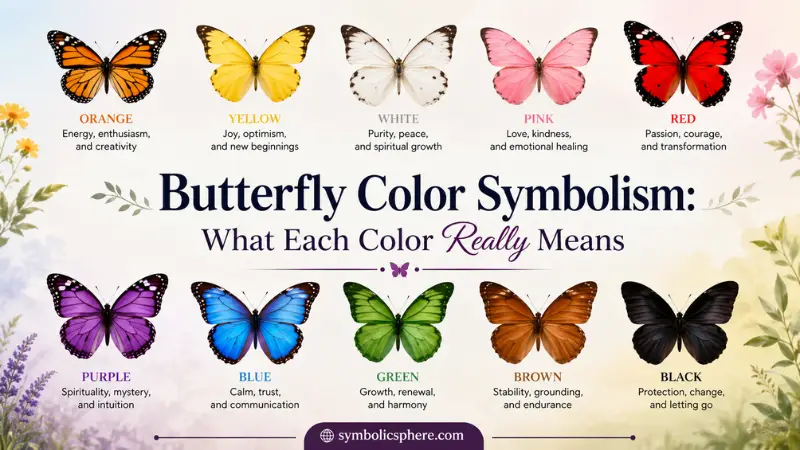
Butterflies are one of the most recognizable symbols of transformation, but their meaning shifts noticeably once color enters the picture. A white butterfly can suggest peace or remembrance, a blue one can evoke hope or freedom, and a black butterfly tends to feel more solemn — often tied to mystery, mourning, or change.
That’s because butterfly color symbolism isn’t one fixed meaning applied to every wing color. Butterflies themselves have long been associated with transformation and the soul, while individual colors draw on broader traditions of color psychology, religion, folklore, and everyday American culture. For anyone choosing a butterfly tattoo, memorial image, piece of jewelry, or garden decoration, color can shift the emotional message — usually through some combination of the butterfly itself and the cultural associations attached to its color.
Quick Answer
Butterfly color symbolism assigns different emotional meanings to different wing colors in modern American culture: blue suggests hope and freedom, white suggests peace or remembrance, yellow suggests joy, and black suggests mystery or mourning. Historically, butterflies themselves — regardless of color — have been linked to the soul, transformation, rebirth, and the passage between life and death across several cultures.
At a glance:
| Color | Common Meaning | Emotional Tone | Typical Use |
|---|---|---|---|
| Blue | Freedom, hope, calm | Peaceful, optimistic | Tattoos, art, jewelry |
| White | Peace, innocence, remembrance | Gentle, reflective | Memorials, weddings, decor |
| Yellow | Joy, optimism, friendship | Cheerful, energetic | Gifts, artwork, gardens |
| Orange | Creativity, vitality, confidence | Warm, energetic | Fashion, tattoos, nature art |
| Red | Passion, courage, intensity | Bold, emotional | Tattoos, romantic art |
| Purple | Individuality, spirituality, imagination | Reflective, expressive | Jewelry, tattoos, decor |
| Green | Growth, nature, healing | Calm, grounded | Garden art, wellness imagery |
| Black | Mystery, mourning, resilience | Serious, dramatic | Tattoos, memorial art |
These are cultural associations, not fixed rules — the surrounding imagery and the person’s own story usually matter more than any color chart.
Why Color Changes What a Butterfly Symbolizes
A butterfly already carries strong symbolism on its own, thanks to metamorphosis: it begins as a caterpillar, forms a chrysalis, and emerges in an entirely different form. That physical transformation naturally lends itself to ideas about growth, reinvention, and leaving an old stage of life behind.
Color adds a second layer on top of that. Human cultures have built associations around colors for thousands of years, and those associations shift depending on time and place — red can mean love in one setting and danger in another; white can mean purity in one tradition and mourning in another.
Butterflies work the same way. Blue doesn’t have some objectively “correct” meaning of hope — rather, blue already carries associations with calm, sky, water, and stability in much of American visual culture, and those associations combine with the butterfly’s existing symbolism of change and freedom. The result is a layered symbol, not a fixed dictionary entry.
Blue Butterfly Meaning: Hope, Freedom, and Renewal
Blue is one of the most popular colors for symbolic butterflies because it pairs the insect’s association with transformation with blue’s familiar cultural meaning: calm, trust, and openness.
In the U.S., a blue butterfly often represents moving toward a more peaceful stage of life after a difficult period, and it’s frequently used in art and tattoos tied to recovery, independence, or a fresh start. Shade matters too — pale blue tends to read as gentle and peaceful, while deep blue can feel more serious or confident. Neither has an “official” meaning; the surrounding design and the wearer’s story shape the interpretation.
White Butterfly Meaning: Peace, Innocence, and Remembrance
White butterflies are usually associated with peace, purity, and spiritual transition, drawing on white’s existing ties to weddings, new beginnings, and cleanliness in American culture. That makes white a natural choice for symbols of starting over.
White butterflies also show up often in memorial contexts. Because butterflies have long been connected to the soul in older traditions, a white butterfly can serve as a gentle image of remembrance after a loss — though this is a matter of personal or spiritual belief, not an established fact. Someone can find a butterfly sighting comforting after a death without treating it as literal proof of contact from the deceased.
Yellow Butterfly Meaning: Joy, Optimism, and New Beginnings
Yellow produces one of the more straightforward associations: sunlight, warmth, happiness, and energy. Paired with a butterfly, it typically reads as joy after change.
A yellow butterfly commonly represents:
- Happiness after a difficult period
- Optimism about the future
- Youthful energy or friendship
- A positive transition or renewed enthusiasm
Where a black or white butterfly might emphasize what’s been lost, yellow tends to emphasize what’s become possible — making it well suited to uplifting rather than solemn designs.
Orange Butterfly Meaning: Creativity, Energy, and Confidence
Orange sits between red’s intensity and yellow’s optimism, and often symbolizes enthusiasm, creativity, and confidence — someone becoming more expressive or comfortable in their own identity.
Orange is also the color of the monarch butterfly, one of the most recognizable species in North America. Monarchs’ multigenerational migration has made their orange-and-black wings a symbol of endurance, seasonal change, and conservation specifically — separate from what orange means as a standalone color. That’s a useful distinction: sometimes butterfly symbolism comes from the color, and sometimes it comes from the species itself.
Red Butterfly Meaning: Passion, Love, and Vitality
Red is one of the most attention-grabbing colors, typically tied to passion, romance, courage, and desire — so a red butterfly tends to represent intense transformation rather than quiet renewal. In tattoo culture, it’s often used to mark surviving an emotionally intense period or embracing individuality.
Context shifts the tone considerably. A red butterfly surrounded by roses reads as romantic; the same butterfly paired with darker imagery can instead suggest struggle, anger, or hard-won survival, since red also carries associations with danger and warning.
Purple Butterfly Meaning: Spirituality, Imagination, and Individuality
Purple has long been linked to prestige, creativity, and spirituality — a connection that traces back to how rare and expensive purple dyes once were. Combined with a butterfly, it tends to produce a more introspective symbol: individuality, imagination, or personal transformation.
Purple butterflies are especially common in decorative art because the color creates a sense of fantasy without requiring any religious framing. Someone may simply choose it for how it looks — symbolism doesn’t have to be intentional to exist, but personal intention usually matters more than a generic color chart.
Green Butterfly Meaning: Growth, Nature, and Healing
Green connects a butterfly to plants, gardens, and the living world, so green butterflies are typically read as symbols of growth, balance, and healing. In modern American culture, green can also signal environmental awareness — particularly when a butterfly is shown alongside native plants or wildflowers.
That’s not purely decorative: butterfly gardens are a genuine expression of interest in pollinators and biodiversity. Green also fits the idea of gradual change — unlike a dramatic color like red, it suggests transformation that happens steadily, over time.
Black Butterfly Meaning: Mystery, Mourning, and Change
Black butterflies tend to get more dramatic interpretations than brighter colors. Black is widely associated with mystery, elegance, grief, and seriousness, and combined with a butterfly it can symbolize profound personal change — some read it as mourning or remembrance, others as resilience or independence through hardship.
It’s worth resisting the assumption that a black butterfly automatically means death. While butterflies have been connected to death and the soul in several historical traditions, modern use is far more varied — a black butterfly tattoo may just as easily reflect aesthetic preference or a difficult chapter someone has moved past.
Where This Symbolism Comes From
The link between butterflies and the soul predates modern color symbolism by thousands of years. In ancient Greek, the word psyche referred to both the soul and a butterfly — a connection that shaped classical art and the myth of Cupid and Psyche, in which Psyche is often depicted with butterfly wings.
Mesoamerican cultures developed a separate tradition: evidence from Mexica art connects butterflies to the soul, fire, regeneration, and reincarnation, with some imagery appearing in funerary contexts. In Japan, butterflies have long been tied to femininity, transformation, and elegance, and other Asian traditions link them to love, longevity, or spiritual transformation depending on the culture. In Mexico, butterfly symbolism is closely tied to the seasonal arrival of monarchs, particularly around Día de los Muertos, where their migration has fed interpretations of returning souls.
These traditions developed independently and shouldn’t be flattened into one universal “ancient meaning” — but together, they show how consistently people across unrelated cultures reached for the butterfly’s transformation as a way to think about life, death, and change.
American butterfly symbolism draws on several of these threads at once: European classical imagery, Victorian decorative art, Indigenous relationships with nature, and modern conservation movements have all shaped how butterflies are used today — most notably as a symbol of personal reinvention, which is now common in tattoos, jewelry, and memorial art.
Butterflies in Everyday American Life
Butterflies aren’t tied to one major U.S. holiday the way pumpkins belong to Halloween — their symbolism is more flexible, showing up in spring and summer decor as a natural fit for seasonal renewal, and beside a name or photo as a way to express remembrance without explicit religious imagery.
The monarch carries an extra layer of meaning in American public life because its migration connects communities across the whole continent, and its dependence on milkweed has made it a recognizable figure in conservation education. That gives butterfly imagery two roles at once: an emotional symbol of personal change, and a real-world reminder of ecological responsibility.
Choosing a Butterfly Color for What You Want to Say
Start with the feeling you’re going for rather than a rigid chart:
- Blue — calm, freedom, hopeful change
- White — peace, remembrance, a gentle new beginning
- Yellow — happiness, friendship, celebration
- Orange — energy, creativity, confidence
- Red — passion, courage, intense transformation
- Purple — individuality, imagination, spiritual reflection
- Green — growth, balance, renewal
- Black — solemnity, mystery, resilience through hardship
Colors can also be combined — a blue-and-purple butterfly, for instance, can read as calm and individual without belonging to any established tradition. In butterfly tattoo design, placement matters as much as color: a wrist butterfly tends to feel delicate and intimate, while a large back piece reads as bold reinvention.
The strongest symbolism usually comes from the story behind the design, not the color alone.
Common Misconceptions
The biggest misconception is that every butterfly color has one fixed, universally recognized meaning. It doesn’t. Online color charts often blend modern aesthetic conventions, folklore, color psychology, and historical tradition into a single “always means this” claim — but as the sections above show, several of these meanings come from different, unrelated traditions.
A second misconception is that a butterfly sighting predicts an event. Black butterflies, for example, are sometimes described in folklore as omens of death — that’s a cultural belief, not a scientific claim. Someone may personally find a butterfly meaningful after losing someone, and that experience is real and valid, but it’s worth keeping personal meaning separate from any claim of an objectively verified message.
FAQs
What does a blue butterfly symbolize?
Freedom, hope, calm, and personal renewal — combining the butterfly’s link to transformation with blue’s cultural association with stability and openness.
What does a white butterfly mean after someone dies?
It’s often used as a symbol of remembrance or spiritual transition. Whether it represents an actual message from someone who died is a matter of personal or religious belief, not something that can be verified.
What does a black butterfly symbolize?
Mourning, mystery, resilience, or major personal change. Some folklore treats it as an omen of death, but that’s a cultural belief rather than a universal or scientific one.
What does a yellow butterfly symbolize?
Happiness, optimism, warmth, and friendship — one of the more consistently cheerful colors in American butterfly symbolism.
What does a butterfly tattoo symbolize in general?
Transformation, independence, and personal growth — the color, surrounding imagery, and the wearer’s own experience narrow down the specific meaning.
Are butterfly color meanings the same across cultures?
No. Meanings vary by culture, era, and individual — a meaning common in American design may have little connection to how the same color is understood elsewhere.
Is butterfly symbolism religious?
Butterflies have been linked to the soul, resurrection, and spiritual transition in various religious and cultural traditions, but there’s no single interpretation that applies universally.
Conclusion
Butterflies symbolize transformation because their life cycle gives us an unusually clear picture of change. Color adds the emotional detail on top: blue for hope, white for peace, yellow for joy, black for mourning or resilience, and so on. Butterfly color symbolism works best as a starting point — a blend of real cultural history and whatever meaning you personally bring to it — rather than a rule to follow exactly.
That flexibility is exactly why butterfly imagery has stayed so useful in American life. The same pair of wings can mark a new beginning, honor someone who’s gone, express individuality, or simply reflect an appreciation for the natural world — the color just sets the tone for which of those stories it’s telling.


[…] Meaning that shifts heavily with color and scale […]