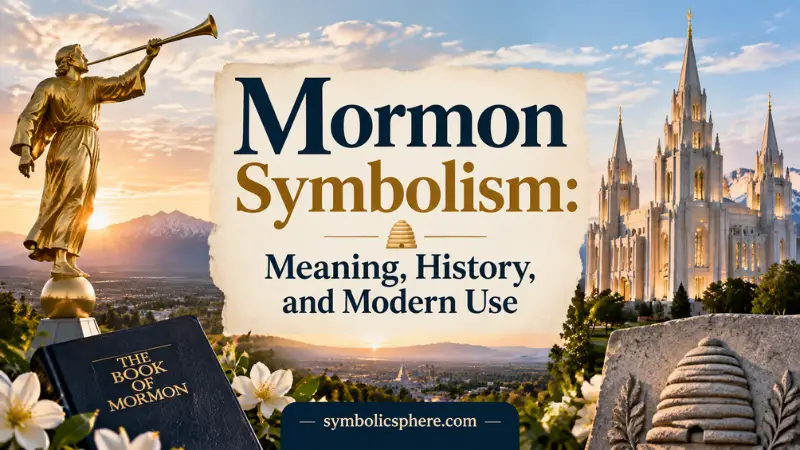
Mormon symbolism shows up everywhere in Latter-day Saint life: a beehive carved into stonework, a golden angel atop a temple spire, a small handcart in a family history display. These aren’t decorative accidents — they’re part of a visual language that The Church of Jesus Christ of Latter-day Saints has built up over nearly two centuries, drawing on biblical tradition, pioneer history, and the everyday experience of its members.
This guide breaks down what Mormon symbolism actually represents, where each major symbol came from, and how these images continue to show up in modern American life — from temple architecture to family jewelry.
Key Takeaways
Mormon symbolism refers to the visual signs, objects, and traditions connected with members of The Church of Jesus Christ of Latter-day Saints. Common symbols include:
- The temple — sacred worship, eternal families, and personal devotion
- The beehive — hard work, cooperation, and community
- The angel Moroni — sharing the gospel message
- The pioneer handcart — sacrifice and endurance
- The CTR emblem (“Choose the Right”) — moral decision-making
These symbols developed from biblical tradition, early Church teachings, and the lived history of 19th-century Latter-day Saint pioneers, and they still shape family life, art, and personal identity today.
Symbols play an important role in how communities express belief, identity, and shared values — and few American religious traditions rely on visual symbolism as consistently as The Church of Jesus Christ of Latter-day Saints. For many people, these symbols show up in churches, homes, artwork, jewelry, and architecture. Understanding what they mean means looking past the images themselves to the beliefs and history behind them.
Where Mormon Symbols Show Up
Latter-day Saint symbolism tends to favor objects and images tied to teachings and history rather than statues or icons, which is a notable difference from many other Christian traditions. You’ll typically encounter these symbols in:
- Meetinghouses and temples
- Family homes and decorations
- Missionary materials
- Artwork and jewelry
- Community and historical events
The five symbols above — the temple, the beehive, the angel Moroni, the pioneer handcart, and the CTR emblem — are the ones most closely associated with the faith, and each carries a distinct meaning.
| Symbol | Meaning in the USA | Common Associations | Notes |
|---|---|---|---|
| Temple | Sacred worship and spiritual promises | Family, eternity, devotion | Central symbol in Latter-day Saint life |
| Beehive | Hard work and unity | Cooperation, productivity | Linked with Utah history |
| Angel Moroni | Sharing religious teachings | Faith, proclamation | Often placed atop temples |
| Pioneer handcart | Sacrifice and perseverance | Courage, heritage | Connected to early settlers |
| CTR emblem | Moral choices | Youth programs, personal values | Encourages responsible decisions |
These meanings carry the most weight within Latter-day Saint communities themselves. Someone outside the faith may recognize the same image without attaching the same significance to it.
Where These Symbols Came From
Many Latter-day Saint symbols draw on older religious traditions, particularly biblical imagery. Ideas like sacred temples, covenants, and divine communication have roots in ancient Jewish and Christian practice — early Latter-day Saints adopted and reinterpreted temple worship as their own religious community took shape in the 19th century.
Just as important, though, is lived history. The hardship and migration faced by early Church members — crossing the country by wagon and handcart, building settlements from scratch — created symbols tied to endurance and faith that still resonate today.
The Temple: The Central Symbol
Temples are the most recognizable symbol associated with The Church of Jesus Christ of Latter-day Saints. Unlike ordinary meetinghouses used for weekly worship, temples are reserved for specific sacred ceremonies, and for many members they represent:
- Commitment to God
- Family relationships that continue beyond death
- Personal spiritual growth
- Peace and reflection
Temple architecture often uses spires, natural light, and carefully designed interiors to reinforce this sense of sacredness. The angel Moroni statue placed atop many temples represents the belief in sharing the gospel with the world. In communities with a strong Latter-day Saint presence, these buildings also function as visible, recognizable markers of religious identity.
Why the Beehive Became a Utah Symbol
The beehive is one of the most distinctive Latter-day Saint symbols, especially in Utah. Early settlers adopted it because a hive only functions when many bees work together — a fitting image for communities that depended on cooperation to survive in a harsh, unfamiliar landscape.
That association with “industry” stuck. Today the beehive appears in artwork, home decor, and even Utah’s official state symbols (it’s the centerpiece of the state seal and flag), and for many Latter-day Saints it still represents contributing to family, community, and society.
Pioneer Symbols and the Meaning of Sacrifice
The pioneer story is central to Latter-day Saint identity. In the 1800s, thousands of Church members traveled west — many on foot, pulling handcarts — to escape persecution and build new communities in what became Utah.
Images of covered wagons, handcarts, and pioneer clothing symbolize:
- Determination during hardship
- Religious dedication
- Community support
- Personal sacrifice
These symbols show up regularly in modern Church culture, particularly during historical commemorations and youth educational programs, where they represent more than migration — they stand for perseverance and commitment more broadly.
How Latter-day Saints Use These Symbols Today
In the United States, these symbols function as both religious expression and cultural marker, helping members communicate belief and stay connected to their community. People typically encounter them through family history activities, church buildings, religious artwork, youth programs, missionary work, and community events.
For many families, a temple photo on the wall, a family history display, or a small pioneer-themed decoration carries as much personal memory as religious meaning. A Latter-day Saint viewing a temple image may see a reminder of sacred commitments, while someone outside the faith may simply recognize it as distinctive religious architecture. Both readings are valid — the meaning shifts with the viewer.
Symbols in Tattoos and Jewelry
Attitudes toward religious tattoos vary widely among individual Latter-day Saints, but some do use symbolic designs — temples, scripture references, beehives, or mountains tied to pioneer history — as personal expressions of faith or heritage. Jewelry works the same way: rings, necklaces, and bracelets featuring religious imagery often serve as private reminders of a commitment or a spiritual milestone, rather than as decoration for its own sake.
Why These Symbols Matter Psychologically
Religious symbols function as reminders of personal values, offering a sense of belonging and continuity with a larger community. For Latter-day Saints, they can represent family bonds, personal responsibility, memories of ancestors, and religious identity all at once. A single object — a necklace, a piece of artwork — can carry outsized meaning simply because of the experiences or relationships it calls to mind.
How Interpretation Changes Across Cultures
Because The Church of Jesus Christ of Latter-day Saints has members worldwide, its symbols travel — but their meaning shifts with local context:
- In Utah, pioneer and beehive imagery carries strong regional and historical weight.
- In other countries, temple imagery tends to be read more as a marker of international religious identity than local history.
- Family-centered symbols often resonate especially strongly in cultures that already emphasize extended family ties.
In other words, these symbols don’t exist independently of culture — their meaning is built by the people who use them.
Common Misunderstandings
A few misconceptions come up often when outsiders encounter Latter-day Saint symbolism:
- Assuming every symbol is loaded with hidden meaning. Some simply represent history or shared values, nothing more.
- Confusing cultural tradition with official doctrine. Not every symbol carries formal theological weight — some are more custom than teaching.
- Treating all symbols as universal. Many carry meaning specific to Latter-day Saint history and community, not broader Christianity.
It’s worth separating historical fact, personal interpretation, and official religious teaching — a symbol’s significance can shift depending on who’s looking at it.
How These Symbols Have Evolved
Early Latter-day Saint symbols reflected the immediate realities of survival, migration, and community-building. Modern interpretations lean more heavily on family relationships, personal faith, and global religious identity — a natural shift as the Church has grown into an international faith rather than a regional one.
Social media and digital photography have also changed how these symbols circulate. Temple photography and faith-based artwork now reach audiences far beyond local congregations, though the symbols themselves remain tied to the same historical roots.
FAQs
What does Mormon symbolism represent?
It represents ideas like faith, family, commitment, cooperation, and spiritual connection, while also preserving memories of Latter-day Saint history and community experience.
Why is the beehive important in Mormon culture?
It represents industry, teamwork, and cooperation — an idea that became especially significant in Utah, where early settlers relied on the beehive as a symbol of building communities through shared effort.
What does the angel Moroni symbolize?
The belief in sharing religious teachings with the world. The figure appears on many Latter-day Saint temples as a visual reminder of that mission.
Do Mormon symbols mean the same thing to everyone?
No. Members of The Church of Jesus Christ of Latter-day Saints generally understand these symbols through religious teaching, while people outside the faith tend to read them through a historical or cultural lens instead.
Are Mormon symbols used in tattoos and jewelry?
Yes. Some Latter-day Saints use symbols like temples, scripture references, or the beehive in tattoos and jewelry as personal expressions of faith or heritage.
How are Mormon symbols different from general Christian symbols?
Some overlap with broader Christian themes — temples and biblical imagery, for instance — but many, like the beehive and the pioneer handcart, carry meanings specific to Latter-day Saint history.
Why do symbols matter in Mormon culture?
They help communicate belief, preserve tradition, and connect individuals to their religious community, functioning as visual shorthand for values members consider important.
Conclusion
Symbols connected with The Church of Jesus Christ of Latter-day Saints reflect belief in faith, family, responsibility, and community. From temples and beehives to pioneer imagery and personal jewelry, Mormon symbolism developed out of biblical tradition, 19th-century pioneer history, and the everyday lives of Church members — and its meaning today comes as much from the stories people attach to these images as from the images themselves.