The lamb is one of the most widely recognized symbols of gentleness, innocence, and sacrifice across cultures and centuries. Its meaning draws on two sources at once: the animal’s natural behavior — soft, calm, and dependent — and the layers of religious and cultural interpretation built up around it over time.
Lamb imagery shows up in a surprising range of places today, from religious art and Easter traditions to tattoos, home decor, and personal style. But its meaning isn’t fixed — a lamb painted in a church carries different weight than one stitched onto a baby blanket, even though both draw from the same symbolic roots.
This guide breaks down what a lamb represents, where that meaning comes from, and how it shows up in modern American life.
Quick Answer
A lamb symbolizes innocence, gentleness, and purity, and in many religious traditions it also represents sacrifice, devotion, and renewal. In modern American culture, lamb imagery most often communicates kindness, vulnerability, and new beginnings — appearing everywhere from Easter traditions to tattoos and nursery decor.
In short:
- Lambs represent innocence, kindness, and a peaceful nature
- Religious traditions connect lambs with sacrifice and devotion
- Americans generally view lamb imagery as gentle and hopeful
- Lamb tattoos often symbolize faith, vulnerability, or personal growth
- In design and decor, lambs signal comfort and simplicity
Why the Lamb Became a Symbol
A lamb is a young sheep, known for its soft wool, calm temperament, and total dependence on its mother in early life. Those traits — softness, trust, vulnerability — are the foundation for nearly every meaning humans have attached to the animal.
Because lambs are seen as harmless and gentle, they’ve come to represent qualities people admire:
- Innocence
- Patience
- Kindness
- Trust
- Peacefulness
- Care
In everyday American culture, a lamb typically communicates warmth rather than strength or authority. That’s why the image shows up so often in children’s books, nursery decor, greeting cards, and springtime artwork — it signals safety and comfort at a glance.
The Core Meanings of Lamb Symbolism
Innocence and Purity
A lamb’s youth and gentle appearance have long made it a stand-in for innocence. Unlike animals associated with danger or dominance, lambs are viewed as peaceful and defenseless — which is also why calling a person “a lamb” usually implies they’re gentle, trusting, or inexperienced.
Peace and Gentleness
Sheep move in flocks and generally avoid confrontation, and that group behavior has shaped the lamb’s association with harmony and cooperation rather than conflict.
Sacrifice and Devotion
In many ancient and religious traditions, lambs were offered in ritual sacrifice. Over time, this practice gave the lamb a deeper symbolic weight tied to commitment, responsibility, and giving up something valuable for a greater purpose.
New Beginnings
Because lambs represent birth and early life, they’re also tied to renewal — a meaning that shows up clearly in spring celebrations, spiritual artwork, and personal symbols of transformation or a fresh start.
Where Lamb Symbolism Comes From
The lamb’s symbolic weight grew out of the close, practical relationship between humans and sheep. Sheep supplied wool, food, and materials for early agricultural societies, making a healthy flock a direct marker of survival and prosperity.
Ancient Mediterranean and Middle Eastern cultures used sheep and lamb imagery extensively in religious and social life. Over centuries, the lamb moved beyond its role as livestock and became a symbol carrying moral and spiritual meaning — largely because people recognized in the animal’s dependence and calm nature something that mirrored human vulnerability and care.
Lamb Symbolism in Christianity and Other Religious Traditions
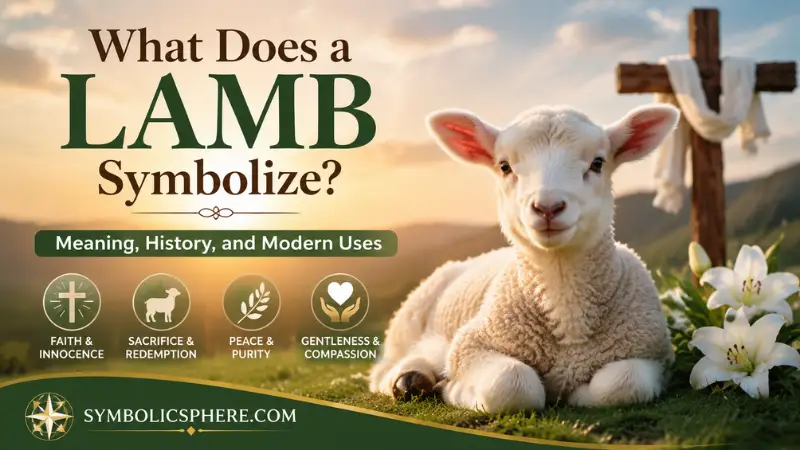
The lamb’s strongest symbolic association in Western culture comes from Christianity, where it represents Jesus Christ as the “Lamb of God” (Agnus Dei) — an image tied to sacrifice, forgiveness, and redemption. Christian artwork frequently depicts a lamb holding a cross or standing near religious figures to communicate themes of peace and spiritual commitment.
(Suggested outbound link: Britannica’s entry on Agnus Dei / Lamb of God — verify URL before publishing.)
Lamb symbolism also appears prominently in Jewish tradition through the Passover story, where the lamb is connected to remembrance, protection, and liberation.
(Suggested outbound link: an authoritative source such as My Jewish Learning on Passover — verify URL before publishing.)
Other cultures and belief systems interpret lamb imagery somewhat differently, but purity, offering, and spiritual responsibility are recurring threads across most traditions.
How Americans Interpret Lamb Symbolism Today
In the U.S., lamb imagery carries both religious and secular meaning depending on context. For many, it remains tied to Christianity, Easter, and church tradition. For others — including people with no religious affiliation — it simply represents kindness and innocence.
| Context | Common Meaning | Where You’ll See It |
|---|---|---|
| Religion | Faith and sacrifice | Christianity, Easter, church art |
| Children’s culture | Safety and innocence | Toys, books, nurseries |
| Personal identity | Gentleness and kindness | Tattoos, jewelry, personal art |
| Home design | Calm, peaceful atmosphere | Decor, illustrations |
| Nature themes | Simplicity and care | Farm and rural imagery |
The same animal can carry very different weight depending on where it appears — a church painting and a child’s stuffed lamb use identical imagery to say very different things.
The Emotional Side of Lamb Symbolism
Symbols work because they tap into emotion, and the lamb is no exception. Its gentle appearance often evokes childhood, protection, and simpler times, communicating:
- Openness instead of aggression
- Compassion instead of control
- Trust instead of suspicion
- Acceptance instead of judgment
The lamb also carries a more complicated meaning tied to vulnerability. Because lambs depend entirely on others for safety, the symbol can represent a need for care — but for many people, that vulnerability isn’t weakness. It reflects emotional honesty and the courage to stay gentle in a harder world.
Lamb Tattoos and Personal Expression
Lamb tattoos are a popular way to express faith, memory, and personal values. Common meanings include:
- Faith and spirituality
- Innocence preserved through hardship
- A connection to childhood
- Remembrance of a loved one
- Choosing kindness over anger
Design details change the message: a simple line-art lamb tends to read as soft and minimalist, while a lamb paired with religious imagery (a cross, halo, or scripture) carries a more overt spiritual statement.
Lambs in Holidays, Art, and Pop Culture
Lamb imagery is especially visible around Easter, where decorations, crafts, and religious displays use the animal to represent renewal and spiritual meaning. Artists also use lambs deliberately for contrast — placing a gentle lamb in a tense or dramatic setting to highlight innocence within difficulty.
In books, film, and advertising, a lamb is shorthand for trust, comfort, or vulnerability — audiences read the symbol instantly because the cultural association is so well established.
Lambs in Fashion, Jewelry, and Home Decor
Outside of religious contexts, designers use lamb imagery because it creates a soft, approachable aesthetic. You’ll commonly find it in:
- Necklaces and charms
- Clothing patterns
- Nursery decor
- Seasonal artwork
- Minimalist illustration
In these settings, the lamb usually signals comfort and simplicity rather than faith — a design choice more than a spiritual one.
Positive vs. Negative Interpretations
Lamb symbolism skews positive, but context can shift the meaning:
Positive: compassion, innocence, peace, loyalty, spiritual devotion
More complicated: vulnerability, passivity, being easily influenced, lack of independence
The phrase “follow like a lamb,” for instance, describes someone who goes along with others without question — a reminder that the same trait (trust) can read as either admirable or naive depending on the situation.
How the Symbol Has Evolved
In early agricultural societies, lambs were tied to survival and ritual practice. Religious traditions later expanded that meaning into sacrifice and devotion. Today, the symbol has broadened further — many people now associate it primarily with emotional sensitivity, kindness, and peaceful living, while the older religious meanings remain intact for those who hold them.
Common Misconceptions
“A lamb only symbolizes weakness.” Not quite — many traditions frame the lamb’s gentleness as a form of moral strength rather than a flaw.
“Lamb symbolism is purely religious.” Religion shaped the symbol heavily, but modern uses — personal expression, design, storytelling — are just as significant today.
Ultimately, a lamb’s meaning depends on the viewer’s background, the setting it appears in, and the symbols placed alongside it.
FAQs
What does a lamb symbolize spiritually?
A lamb typically symbolizes purity, devotion, sacrifice, and spiritual renewal, representing a connection between innocence and higher moral values across several religious traditions.
What does a lamb tattoo mean?
A lamb tattoo can represent faith, kindness, childhood memories, protection, or personal growth. The specific meaning depends heavily on the design and the wearer’s intent.
Why is a lamb associated with innocence?
Lambs are young, gentle, and fully dependent animals, and that peaceful, defenseless appearance has made them a widely recognized symbol of purity.
What does a lamb symbolize in American culture?
In American culture, lambs generally represent kindness, comfort, religious faith, and peacefulness — with the specific meaning shifting depending on whether it appears in art, holidays, or personal design.
Is lamb symbolism always positive?
Mostly, yes — but it can also suggest vulnerability or being easily influenced. Context ultimately determines whether the meaning feels comforting or limiting.
Why are lambs connected with Easter?
Lambs are tied to Easter through Christian tradition, which links the lamb to Jesus Christ and themes of sacrifice and resurrection.
What does a white lamb symbolize?
A white lamb typically represents purity, peace, innocence, and spiritual cleanliness — the color white reinforces the animal’s traditional association with goodness and renewal.
Conclusion
The lamb endures as a symbol because it holds several ideas at once: innocence, compassion, faith, and renewal. Whether it appears in a church, a tattoo, a nursery, or a piece of art, the meaning traces back to the same simple idea — that gentleness and softness can carry their own quiet strength.