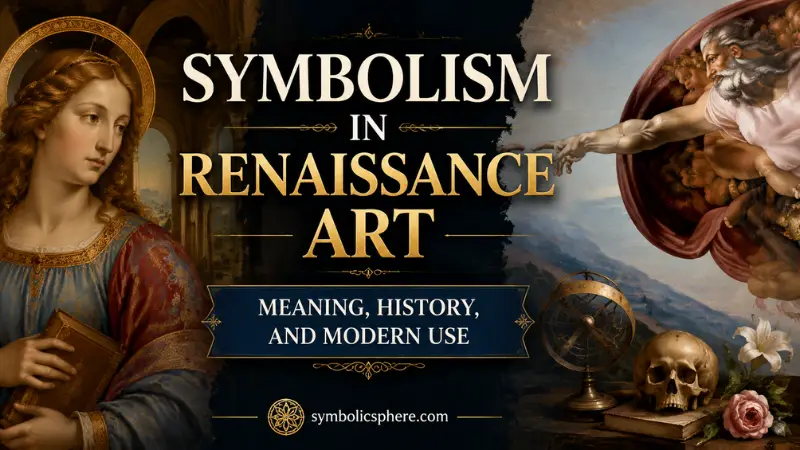
Look closely at almost any painting from the 1400s or 1500s and you’ll notice details that seem too specific to be decoration: a dog curled at someone’s feet, a half-peeled orange, a candle burning in daylight. None of that was filler. Symbolism in Renaissance art was a working visual vocabulary that painters and their audiences both understood, a way of loading a single image with religious meaning, moral instruction, and personal information about the people who commissioned it. For a viewer today, catching even a handful of these signals turns a pretty picture into something closer to a coded letter.
People keep coming back to this topic because the payoff is immediate. Once you know that a skull on a windowsill is a reminder of death, or that a particular flower points to the Virgin Mary, you can’t unsee it, and every future museum visit changes. The habit of reading paintings this way didn’t disappear when the Renaissance ended, either. It shaped how Western art handled meaning for centuries afterward and still shows up in the way Americans talk about classic art, use its imagery in design, and occasionally get it wrong in movies and bestselling novels.
This piece walks through what these symbols meant at the time, how they reached American culture, and where you’re likely to run into them now, whether that’s a museum wall label, a tattoo parlor flash sheet, or a home decor catalog.
Quick Answer
In modern American culture, symbolism in Renaissance art commonly refers to the religious and moral messages artists embedded in everyday objects, colors, and gestures, most recognizable today in reproductions of the Mona Lisa, The Last Supper, and Botticelli’s mythological scenes. Historically, these symbols were a shared visual language rooted in Christian theology, classical mythology, and household objects, allowing painters to communicate ideas about virtue, mortality, love, and status without writing a word.
Key Points
- Everyday objects like fruit, animals, and mirrors carried assigned religious meanings.
- Colors followed strict conventions tied to status, virtue, and divinity.
- Symbolism grew out of medieval Christian iconography and classical revival together.
- Americans mostly encounter it through museums, reproductions, and film.
- Modern misreadings often come from novels and internet lists, not scholarship.
- Interior design and tattoo culture now reuse these images for personal meaning.
What the Symbols Actually Look Like
Renaissance symbolism rarely announces itself. It hides inside the ordinary furniture of a scene: a bowl of fruit on a table, a bird perched in a corner, a particular fold of cloth. A painter would place a lily near the Virgin Mary, a skull on a scholar’s desk, or a small dog at the foot of a married couple, and a Renaissance audience would read those objects the way we’d read a caption. The symbols appear in devotional altarpieces, portraits of wealthy patrons, and mythological scenes alike, which is part of why they can be so easy to miss if you’re only looking at brushwork and composition.
The Core Meaning Behind the Symbols
At its heart, Renaissance symbolism was a way to pack extra information into a single image for viewers who already shared a common set of references. A painting could show a biblical event on the surface while quietly commenting on the patron’s virtue, wealth, or family alliances underneath. Fruit and flowers carried associations with paradise, temptation, or purity. Animals stood in for loyalty, lust, or courage depending on which creature appeared. Objects tied to specific saints let viewers identify a figure instantly, the way a lion signals Saint Mark or a set of keys points to Saint Peter. None of this required text, because the image itself did the explaining.
Where the Practice Came From
The roots of this symbolic language go back to medieval Christian art, where illuminated manuscripts and church decoration already used animals, plants, and objects to teach religious lessons to a largely illiterate population. Renaissance painters inherited that toolkit and expanded it, adding a fresh interest in classical mythology and humanist philosophy that had been rediscovered through newly translated Greek and Roman texts. That combination is what makes Renaissance symbolism distinct: a scene might use a pose borrowed from ancient sculpture to depict a Christian saint, blending old pagan visual grammar with new theological content. Patrons and scholars of the period actively guided this fusion, since many artists worked closely with humanist advisors who suggested which mythological or biblical references would flatter a commission.
How the Meaning Changed From Florence to Flanders
Not every region used symbolism the same way. Italian painters, especially in Florence and Rome, tended to idealize the human body and lean on classical proportion, geometry, and balanced composition to carry meaning, treating mathematical harmony itself as a kind of symbol for divine order. Painters working in the Netherlands and German-speaking lands took a more literal, object-based approach, hiding meaning inside meticulously rendered household items rather than idealized bodies. A discarded pair of shoes, a convex mirror reflecting the whole room, or a single lit candle could each carry theological weight in a Northern European interior scene. Both traditions were doing the same basic thing, just through different visual habits.
Symbolism in the United States
Americans generally encounter Renaissance symbolism secondhand, through museum collections, art history courses, and reproductions rather than the original devotional context that shaped it. Major U.S. museums built substantial Renaissance holdings over the twentieth century, and public television specials, coffee-table books, and college survey courses turned works like the Mona Lisa and the Sistine Chapel ceiling into shared cultural touchstones even for people who’ve never seen the originals. In that process, the religious specificity of the symbolism often gets flattened into a broader idea of “hidden meaning” or “secret codes,” which is part of why American audiences are especially receptive to claims about puzzles and mysteries buried in old paintings, whether or not those claims hold up to scholarship.
American design culture has also absorbed pieces of this symbolism on its own terms. Wedding decor borrows the lily’s association with purity, home offices hang prints of Renaissance scholars surrounded by books and skulls as a nod to intellect and mortality, and greeting cards recycle cherubs and doves without much awareness of their theological origin. The symbols survive; the theology mostly doesn’t.
Cross-Cultural and Religious Threads
Because Renaissance symbolism draws so heavily on Christian scripture, it shares meaning with earlier and later Christian art traditions across Europe, including Byzantine iconography that used similar animal and object symbols centuries earlier. It also borrows directly from Greek and Roman mythology, so a single painting might layer a classical figure like Venus or Mercury over a Christian moral point, a blending that would have felt natural to an educated Renaissance viewer trained in both traditions. Jewish and Islamic art from the same era generally avoided this kind of figural religious symbolism, relying instead on geometric and calligraphic decoration, which is one reason Renaissance-style symbolism reads as distinctly European and Christian rather than universal.
What These Symbols Communicate Emotionally
Beyond their theological function, these images tap into feelings that don’t need translation: the anxiety of mortality behind a skull, the comfort of loyalty behind a dog at someone’s feet, the melancholy of an hourglass or a wilting flower. That emotional legibility is a big reason the symbols still land with modern viewers who’ve never studied their religious background. A vanitas still life full of jewels and a candle burning down doesn’t require a theology degree to feel unsettling; the composition itself communicates that pleasure and time are working against each other.
Modern Usage: Tattoos, Jewelry, and Decor
Renaissance imagery shows up regularly in American tattoo culture, usually stripped of its original devotional purpose and repurposed around personal meaning. A skull references mortality or resilience rather than a specific saint’s meditation practice. A single rose or lily might commemorate a person rather than symbolize the Virgin Mary. Jewelry designers borrow ermine, serpent, and floral motifs from Renaissance portraiture for their visual richness rather than their iconographic content. Home decor follows a similar pattern, with framed reproductions of Botticelli or da Vinci chosen for elegance and cultural cachet rather than any interest in the underlying religious program.
Modern Usage: Pop Culture and Social Media
Social media has given Renaissance symbolism a strange second life. Accounts dedicated to art history post close-up crops of paintings pointing out hidden objects, and these posts travel well because the “spot the symbol” format works like a visual scavenger hunt. Film and fiction have leaned into this appetite too, sometimes responsibly and sometimes not. The idea of secret codes embedded in old master paintings entered mainstream American culture largely through popular fiction and the films it inspired, which is worth separating clearly from what art historians actually document.
Table: Renaissance Symbols and Their American Reception
| Symbol | Original Renaissance Meaning | Common American Association Today | Notes |
|---|---|---|---|
| Skull | Mortality, spiritual self-examination | Mortality, edge, rebellion (tattoos) | Religious context often dropped |
| Lily | Purity, the Virgin Mary | Purity, weddings, sympathy flowers | Meaning softened, not lost |
| Dog | Fidelity, loyalty | Loyalty, companionship | Meaning largely unchanged |
| Mirror | Truth, divine omnipresence | Vanity, self-reflection | Meaning has partly reversed |
| Serpent | Temptation, Satan, evil | Danger, transformation, medical symbols confused with it | Frequently conflated with unrelated symbols |
| Apple | Forbidden knowledge, the Fall | Health, knowledge (schools), temptation | Multiple modern meanings coexist |
Common Misunderstandings and Modern Misuse
The biggest distortion of Renaissance symbolism in American culture is the assumption that these paintings hide secret societies, coded prophecies, or messages meant only for a select few. Serious art historians generally reject these theories, pointing out that Renaissance symbolism was meant to be legible to educated contemporaries, not concealed from them. A famous example is the persistent claim that a figure in Leonardo’s Last Supper is secretly Mary Magdalene rather than the apostle John, an idea that gained huge public traction through a popular novel and film adaptation despite being dismissed by mainstream scholars as a misreading of a stylistic convention Leonardo used elsewhere in his work. It’s worth holding two things at once here: symbolism in Renaissance art is real, well documented, and intentional, while claims of buried secret codes usually are not.
A second, quieter kind of misuse is commercial. Advertising and branding have repeatedly borrowed instantly recognizable Renaissance images, stripping out their religious or moral content entirely and using them purely for the prestige and familiarity they carry, which can leave modern audiences with a vague sense that these works are “iconic” without much understanding of why.
How the Meaning Has Shifted Over Time
Symbolism didn’t stay frozen even within the Renaissance itself. Early in the period, symbols leaned heavily religious and instructional, aimed at reinforcing Christian doctrine for viewers in churches and private chapels. As the period matured and wealthy secular patrons commissioned more portraits and mythological scenes, the same symbolic vocabulary started serving personal and political purposes, flattering a patron’s virtue, marriage, or lineage as much as illustrating scripture. By the time you reach later Renaissance and Mannerist painting, symbolism had become dense enough that some scenes function almost like visual riddles for sophisticated audiences, a trend that laid groundwork for the more overtly symbolic and allegorical art movements that followed centuries later.
Why This Still Resonates With Viewers
Part of the lasting appeal is that decoding a symbol gives a viewer a small, satisfying sense of insider knowledge, the feeling of being let in on something. Renaissance painters built their work assuming an audience willing to look closely and think about what they were seeing, and that invitation still works on modern viewers standing in front of a canvas five hundred years later, even without the theological training the original audience had.
FAQs
What does symbolism in Renaissance art mean in a religious context?
It generally refers to objects, colors, and figures used to represent Christian doctrine, saints, or moral lessons, such as a lamb representing Christ or a set of keys representing Saint Peter’s authority. These symbols let artists communicate theology visually to audiences who often couldn’t read Latin scripture themselves.
Are Renaissance-style symbols common in tattoos?
Yes, images like skulls, roses, and serpents drawn in a Renaissance-influenced style are popular tattoo choices, though the meaning is usually personalized rather than tied to the original religious context. Someone might choose a Renaissance-style skull to represent resilience or the passage of time rather than a saint’s meditation on mortality.
Is it true that Renaissance paintings hide secret codes?
Mainstream art historians largely reject the idea of hidden codes or secret society messages in Renaissance paintings, viewing that claim as a product of modern popular fiction rather than historical evidence. The symbolism that genuinely exists was intended to be understood by educated viewers of the time, not concealed from them.
How is Renaissance symbolism different from medieval symbolism?
Medieval art used symbols mainly to teach religious doctrine to an illiterate audience, while Renaissance artists blended that same symbolic system with classical mythology and humanist ideas rediscovered from ancient Greek and Roman sources. The result was a richer, more layered visual language than medieval art typically used.
Do colors in Renaissance art really carry specific meanings?
Yes, color use followed fairly consistent conventions, with blue often reserved for the Virgin Mary and associated with heaven, and red frequently tied to passion, sacrifice, or status because of how expensive certain red pigments were to produce. Wealthy patrons sometimes chose colors partly to display what they could afford, adding a second layer of meaning beyond the purely religious one.
Why do Americans associate Renaissance art with mystery?
This impression comes largely from popular novels, films, and internet content that emphasize “hidden meanings” and secret puzzles, rather than from academic art history. It’s a case where entertainment shaped public perception faster and more widely than museum scholarship did.
What’s the most misunderstood Renaissance symbol?
The mirror is a strong candidate, since Renaissance painters typically used it to represent truth or the all-seeing presence of the divine, while modern audiences are more likely to read a mirror in art as a symbol of vanity or self-obsession. The visual object stayed the same; the assumed meaning flipped.
Conclusion
Symbolism in Renaissance art was never decoration for its own sake. It was a functioning language built from fruit, animals, colors, and gestures, designed to let painters say more than a single image usually could, whether that meant teaching doctrine, flattering a patron, or reminding a wealthy household that death comes for everyone regardless of what’s on the table. That language traveled forward into American culture unevenly, keeping some of its emotional force while losing much of its original theological precision along the way.
What’s left is a strange but workable inheritance: paintings that continue to reward close looking, symbols that get borrowed into tattoos and wedding flowers without their original context, and a public appetite for hidden meaning that sometimes outruns what the historical record actually supports. None of that diminishes the original achievement. If anything, it says something about how well these five-hundred-year-old images were built that they still have something to communicate to people who’ve never opened a theology textbook.


[…] tattoos and art usually symbolize overcoming rather than the emotion […]
[…] misunderstanding is treating Gabriel as female, largely due to soft, youthful depictions in Renaissance art and the frequent pairing with Mary. Scripture doesn’t assign Gabriel a gender, and most […]