The Ark of the Covenant was a sacred chest described in the Hebrew Bible as the central physical sign of God’s covenant with the Israelites. Ark of the Covenant symbolism begins there: divine presence, covenant, sacred law, protection, and the relationship between God and a community. But the Ark was never just a container — its meaning was built into how it was made, where it was kept, and who was allowed near it.
For most Americans today, the Ark is familiar through two very different channels. On one side are Jewish and Christian religious traditions, biblical art, and scripture. On the other is popular culture — films, novels, and documentaries that turned it into an icon of ancient mystery, often stripped of its original religious meaning.
Understanding the symbol means keeping those layers separate. The biblical Ark represents a sacred relationship with God. Later legends and entertainment have layered on ideas of lost treasure, supernatural power, and hidden history — additions worth recognizing as additions, not the source material.
Quick Answer
The Ark of the Covenant symbolizes God’s presence, covenant, and sacred law in Jewish and Christian tradition — it represented the binding relationship between God and the people of Israel. Historically, it also stood for holiness, divine authority, and the boundary between ordinary life and sacred space. In modern pop culture, it’s more often shorthand for mystery and lost treasure.
TL;DR
- The Ark symbolizes covenant, divine presence, sacred law, and holiness.
- Its design and origins trace back to ancient Israelite worship.
- The gold cover and cherubim mark its sacred, restricted status.
- Americans encounter it through Judaism, Christianity, art, and film — often with very different meanings attached.
- Its unexplained disappearance fueled centuries of legend.
- Popular culture tends to emphasize mystery over religious meaning.
What the Ark of the Covenant Actually Was
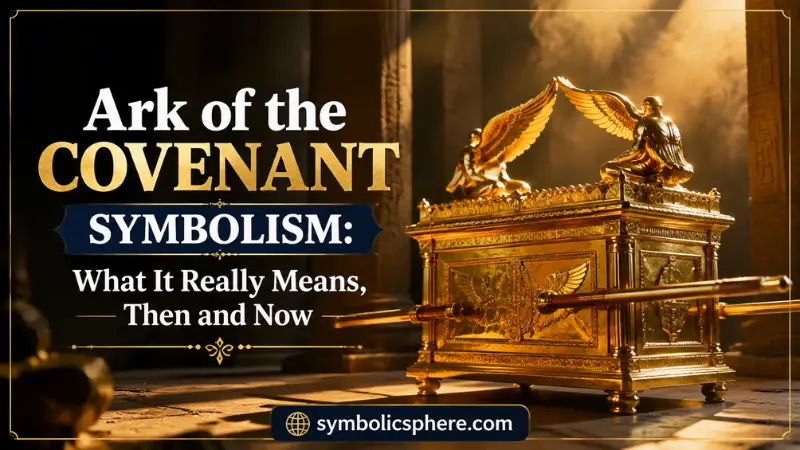
The Ark was a portable wooden chest, built from acacia wood and overlaid with gold. Rings and carrying poles let it be transported without direct contact. Its lid — traditionally called the mercy seat, or atonement cover — was topped by two facing cherubim.
Its most significant contents, according to the biblical account, were the tablets of the covenant: the commandments given to Moses. That’s what made the Ark more than furniture. It tied a physical object to a religious obligation — the covenant wasn’t an abstract promise, but something represented and carried within Israel’s worship.
The design itself communicated separation. This wasn’t a household item; it belonged to a restricted sacred space, later housed in the innermost chamber of the Jerusalem Temple. Reducing it to a “magic box,” as pop culture sometimes does, misses the point — its meaning comes from the covenant and relationship it represented, not the object itself.
The Core Meaning: Covenant Between God and People
The central idea behind the Ark is covenant — a binding relationship involving obligation, promise, identity, and loyalty.
That gives the symbol an unusual duality. It represents belonging and accountability. Protection and condition. Divine favor and a reminder of religious law. This tension is a large part of why the Ark still carries weight in biblical interpretation: it stands for a relationship, not just an artifact.
For modern readers, it can be understood more simply as a physical reminder of a promise that carries moral responsibility.
Divine Presence and Sacred Space
The Ark was also understood as a point of contact between God and the Israelites. Biblical descriptions place special emphasis on communication with Moses occurring above the Ark’s cover, between the cherubim — making it a symbolic meeting point between divine and human worlds.
That doesn’t mean the Ark was treated as a container for God. In Jewish interpretation, it was sacred because of its relationship to God and the covenant — not because the chest itself held independent divine power. Its symbolism, then, centers on presence, encounter, reverence, and sacred boundaries.
Why the Cherubim Matter
The two winged figures on the Ark’s cover are among its most recognizable features. They’re identified as cherubim — heavenly beings associated with God’s presence — positioned facing one another to create a visual focus above the sacred cover.
It’s worth separating these from the winged infant figures common in Renaissance-era European art; biblical cherubim come from an entirely different visual and theological tradition, tied to the ancient Near Eastern world of divine authority and sacred architecture. Combined with the gold and restricted access, the imagery reinforces one message: this was not ordinary furniture.
From the Wilderness to Jerusalem
The Ark’s symbolism shifted as its setting changed. It’s first described accompanying the Israelites through the wilderness. Later, under King David, it was brought into Jerusalem — the biblical narrative describes David celebrating its arrival — and it was eventually placed in the Holy of Holies, the innermost chamber of Solomon’s Temple.
That move changed what the Ark represented: no longer just a traveling people’s covenant, but a symbol tied to Jerusalem, kingship, and centralized national worship. In short, its meaning expanded from portable covenant to centralized sacred authority.
The Ark in Jewish Tradition
Within Judaism, the Ark belongs to the history and theology of the ancient Israelite Temple — not to contemporary religious practice. Unlike the Torah scroll, menorah, or mezuzah, it isn’t a present-day ritual object; it disappeared from the historical record long ago, and its fate is unknown.
That absence matters. Contemporary Jewish communities don’t generally treat the Ark as an artifact waiting to be recovered — its meaning survives through scripture, interpretation, and the broader concept of covenant, not through an expectation of physical rediscovery.
The Ark in Christianity
Christianity inherited the Ark’s story through the Hebrew Bible (Old Testament). Christian interpretation has often treated it as pointing toward later theological themes — God’s presence, holiness, obedience, redemption. Some traditions go further, drawing typological connections between the Ark and Mary, the Church, or Christ, though these belong to later Christian theology rather than the original Israelite context.
For most American Christians, exposure comes through Sunday school, sermons, biblical art, and film — which means the emphasis varies widely. A scholar might focus on covenant theology; a churchgoer might simply associate the Ark with faith and God’s protection.
Ark of the Covenant Symbolism Across Contexts
| Context | Meaning in the USA | Common Associations | Notes |
|---|---|---|---|
| Judaism | Ancient covenant and sacred history | Torah, Temple, Israelite worship | Primarily biblical/historical today |
| Christianity | God’s presence, covenant, holiness | Bible, faith, obedience | Often read through Christian theology |
| Biblical art | Sacred authority, divine presence | Gold, cherubim, Temple imagery | Frequently dramatized |
| Popular culture | Mystery, lost treasure | Archaeology, adventure, the supernatural | Often departs from biblical meaning |
| Personal symbolism | Faith, protection, covenant, heritage | Jewelry, tattoos, artwork | Meaning depends on the individual |
The Mystery of the Lost Ark
Much of the Ark’s modern fame comes from one simple fact: nobody knows what happened to it. The Bible gives no definitive account of its fate after the Babylonian conquest of Jerusalem in 586 BCE. Later traditions suggest it was captured, hidden, or destroyed — but none of these are confirmed.
The most prominent surviving tradition is Ethiopian. The Ethiopian Orthodox Church maintains that the Ark is preserved in Aksum, guarded as an exceptionally sacred object, its arrival linked to Menelik, a figure associated with Solomon and the Queen of Sheba. This is a significant and long-standing religious tradition — but historians distinguish it from independently verified archaeological evidence; no confirmed discovery has established the Ark’s survival or location. [Link opportunity: cite a reputable source on the Ethiopian Orthodox tradition, e.g., Encyclopaedia Britannica or a peer-reviewed history journal.]
That unresolved gap — an important sacred object described in ancient texts, then gone — is exactly the kind of vacuum that invites speculation, and it’s what modern entertainment has run with. Raiders of the Lost Ark did more than any other single work to reshape the Ark’s public image, recasting it as the centerpiece of an archaeological adventure charged with supernatural danger. That’s a useful story, but it’s worth remembering it isn’t the Ark’s original role — the biblical text centers on covenant and presence, not treasure-hunting.
Emotional and Personal Symbolism
Beyond religious doctrine, the Ark carries personal resonance for some people. Because it represents covenant, it can suggest commitment and keeping promises. Its connection to divine presence can evoke faith and reassurance; its restricted access can suggest reverence and respect for boundaries.
For those interested in ancestry or biblical history, it can symbolize continuity with an ancient tradition. Its disappearance adds another layer — a sense of longing for something sacred that can no longer be directly encountered, representing absence, memory, and the desire to recover what’s been lost.
These readings are personal, not universal. A tattoo or artwork featuring the Ark can mean very different things depending on someone’s religious background.
The Ark in Art, Tattoos, and Personal Design
The Ark isn’t among the most common tattoo symbols, but when chosen, designs typically emphasize the golden chest, cherubim, radiant light, the tablets, or the carrying poles. It might represent faith, biblical heritage, divine protection, a personal covenant, or simple fascination with ancient history.
In decorative art, it’s often depicted as an ornate golden chest surrounded by light — imagery that draws more from Christian artistic convention and pop culture than from a strict historical reconstruction. Anyone using the Ark in personal design should keep in mind it remains a living sacred symbol for Jews and Christians; treating it purely as an exotic treasure motif can read as dismissive in a religious context.
Common Misconceptions
A few claims about the Ark go beyond what evidence supports:
- “Its location has been found.” No universally accepted archaeological discovery confirms this — several traditions and theories exist, but none is settled fact.
- “Biblical accounts describe real technology.” Stories involving the Ark and events like the crossing of the Jordan or the fall of Jericho are theological and literary in nature, not historical-scientific reports.
- “The Ark was essentially a weapon.” Fiction often frames it this way, but the Bible’s emphasis is religious, not military — victories associated with the Ark occur within a theological framework centered on covenant and God’s presence.
How the Meaning Has Evolved
In ancient Israel, the Ark represented covenant, divine presence, and the holiness of worship. As it became tied to Jerusalem and the Temple, it also came to represent national religious identity and centralized worship. Jewish and Christian traditions preserved that story in different theological directions, while later legends — and eventually archaeology, novels, and film — added the layer of mystery that now dominates popular awareness.
The core hasn’t changed, even as the layers around it have: covenant and sacred presence remain the foundation; mystery and entertainment are later additions.
FAQs
What does the Ark of the Covenant symbolize?
Primarily, God’s covenant with Israel, divine presence, sacred law, and holiness. In popular culture, it has also become shorthand for lost history and archaeological mystery.
What did the Ark contain?
Biblical tradition most consistently associates it with the tablets of the covenant — the commandments given to Moses. Other passages reference additional sacred items in specific contexts.
Why is the Ark important in Christianity?
Christians inherit its story through the Old Testament and typically connect it to God’s presence, covenant, holiness, and redemption, with some traditions adding further theological symbolism.
What does an Ark of the Covenant tattoo symbolize?
Commonly faith, commitment, biblical heritage, divine protection, or personal covenant — though the specific meaning depends on the wearer.
Is the Ark of the Covenant in Ethiopia?
The Ethiopian Orthodox tradition holds that it’s preserved in Aksum. This is a significant religious tradition, but it hasn’t been independently confirmed through archaeological evidence.
Was the Ark really a supernatural weapon?
No — while biblical narratives link it to miraculous events and military victories, its central role is as a sacred sign of covenant and divine presence, not a weapon.
Why did the Ark disappear?
The Bible doesn’t record its final fate. It’s generally understood to have vanished from the historical record around the Babylonian destruction of Jerusalem, and its later history remains unknown.
Conclusion
At its core, Ark of the Covenant symbolism is about the relationship between God, covenant, sacred law, and divine presence — its gold, its cherubim, and its place within the Temple all reinforce that this was never just a container. In American culture, that meaning now coexists with newer layers: heritage, mystery, and adventure, depending on where you encounter it.
The Ark’s unresolved fate is part of what keeps it culturally alive, but its significance was never dependent on being found. It endures because it represents something still recognizable today — that a promise can be made visible through an object, and that sacred memory can outlast the object itself.