The oni mask has become one of the most recognizable images borrowed from Japanese culture — showing up in tattoos, streetwear, anime, video games, and home decor across the United States. With its horns, bared fangs, and glaring expression, it’s built to look fearsome at a glance. But the meaning behind that face is far less simple than “evil demon.”
In Japanese folklore, oni have represented danger, punishment, destructive impulses, and misfortune — supernatural beings people historically sought to repel, not worship. Yet the same fearsome image has also carried a defensive, almost protective undertone: something terrifying can be displayed, confronted, mocked, or driven away rather than feared indefinitely.
That tension is a big part of why the mask resonates so strongly today. An oni face can read as pure aggression on the surface while symbolizing something very different to the person wearing or displaying it — resilience, self-control, or victory over a personal struggle. This guide traces that meaning from its roots in Japanese religion and folklore through its modern life in American tattoo culture and pop media.
Quick Answer
An oni mask traditionally represents dangerous, punishing supernatural beings in Japanese folklore and religious tradition — figures people sought to repel rather than worship. In modern American culture, especially tattoos and Japanese-inspired art, the same imagery is more often reinterpreted as strength, resilience, protection, and the courage to confront personal struggles.
At a glance:
- Oni are supernatural figures tied to danger, punishment, and disruption — not a direct Japanese equivalent of the Western devil.
- Horns, fangs, wild hair, and glaring eyes make the mask instantly recognizable.
- The Setsubun festival uses oni imagery specifically to symbolically drive misfortune away.
- American tattoo culture commonly reinterprets oni as strength, resilience, or protection.
- Oni masks and Hannya masks are related in appearance but come from different traditions and carry different meanings.
- Modern anime, manga, and games have made oni far less uniformly “evil” than older folklore suggests.
What Does an Oni Mask Look Like?
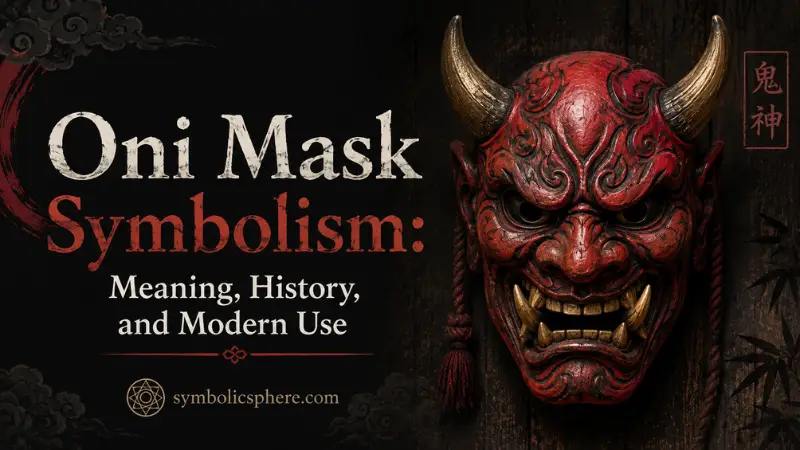
There’s no single standardized design, but certain features make an oni instantly recognizable: prominent horns, sharp fangs, a broad nose, deep furrowed brows, wild hair, glaring eyes, and an exaggerated, snarling mouth. Red and blue are the most familiar colors, though oni appear in other hues depending on the story, performance, or artwork.
The intimidating look is deliberate. Oni belong to a broader world of Japanese supernatural beings, and traditional artists gave them features that mark them as clearly inhuman. The British Museum’s collection notes on oni imagery point to their characteristic horns, fangs, claws, and monstrous proportions as consistent visual markers across centuries of Japanese art.
Modern tattoo and graphic design often push these features further — bigger horns, clenched teeth, flames, smoke, chrysanthemums, snakes, waves, or weapons — even when the combination doesn’t correspond to one specific traditional story.
What an Oni Mask Commonly Represents in the U.S.
American interpretations tend to focus on the feeling the mask projects rather than a single historical definition:
| Context | Common Modern Meaning | Worth Noting |
|---|---|---|
| Tattoos | Strength, resilience, protection | Often a personal, individual interpretation |
| Art & decor | Intensity, danger, supernatural power | Shaped by Japanese aesthetic traditions |
| Fashion | Rebellion, toughness, bold identity | Frequently more visual than religious |
| Anime & gaming | Demonic or superhuman character | Meaning shifts by fictional world |
| Personal symbolism | Confronting anger or adversity | A modern reading, not a fixed folk meaning |
“Fighting your inner demons” makes intuitive sense to a tattoo wearer, but it shouldn’t be presented as the ancient Japanese definition of the mask — it’s a contemporary layer added when older imagery moves into a new cultural context. That new meaning can be genuinely powerful without being historically accurate to the original folklore.
The Japanese Folklore Behind Oni
Oni have a long, tangled history that resists a tidy Western comparison. Scholars trace their development through overlapping influences — early Japanese beliefs about harmful supernatural forces, imported Chinese concepts, Buddhist cosmology, and centuries of evolving folk storytelling. Academic research on oni specifically warns against treating them as a direct equivalent of Western demons.
Over time, oni became associated with places outside ordinary social order: mountains, remote wilderness, supernatural realms, and Buddhist hells. Their behavior in folklore includes violence, kidnapping, punishment, and deception — but folklore isn’t always consistent. Oni could also be comic, foolish, repentant, or even sympathetic, a flexibility that later shaped their transformation in pop culture.
Oni, Buddhism, and Punishment
Buddhist imagery heavily shaped the most frightening oni depictions, particularly as terrifying attendants who punish sinners in hell. That association is where oni picked up their strong ties to consequence, judgment, and wrongdoing.
Calling an oni a “Japanese Satan,” though, is a misleading shortcut. Buddhism doesn’t give oni the theological role Satan holds in Christianity, and their identity shifts across religious art, local traditions, theater, and storytelling rather than sitting in one fixed category. For symbolic interpretation, this means an oni mask can suggest punishment or wrongdoing without representing a single supreme embodiment of evil.
Setsubun: Driving Evil Away
The clearest ritual use of oni imagery appears during Setsubun, the traditional observance marking the seasonal shift toward spring. In the custom of mamemaki (bean throwing), someone wears an oni mask while others throw roasted soybeans and call for oni to leave and good fortune to enter — a tradition practiced in homes as well as at Buddhist temples and Shinto shrines.
This is where an important distinction shows up: the oni represents something unwanted — misfortune, harmful forces, disorder — but the mask becomes part of a ritual for identifying and expelling those things, not inviting them in. Displaying and confronting a threatening figure can symbolize mastery over what it represents, even when the figure itself isn’t benevolent.
That’s a more historically grounded route to the modern idea of “protection” than claiming oni were traditionally protective spirits.
Oni in Medieval Legends and Warrior Stories
Oni loom large in medieval Japanese storytelling. The best-known example is Shuten Dōji, a legendary oni leader tied to Mount Ōe, defeated in one famous tale by warriors led by Minamoto no Yorimitsu after infiltrating his stronghold. Another well-known story involves Ibaraki Dōji and the warrior Watanabe no Tsuna, who severs the oni’s arm in combat — a confrontation later depicted in nineteenth-century woodblock prints.
Scholarship on Japanese demon lore identifies the medieval period as central to establishing oni as legendary enemies whose terrifying strength gave heroes a stage to prove their courage. That’s the root of a secondary meaning still present today: the mask can represent not just the monster, but the courage required to face it — which helps explain its compatibility with modern symbols of perseverance.
Fear, Anger, and the Psychology of the Mask
An oni’s face externalizes emotions people usually try to keep contained. Clenched teeth, widened eyes, and a distorted expression visually communicate rage, aggression, and loss of restraint — which is why some wearers use the mask to represent anger they’ve experienced, survived, or transformed.
This is a psychological interpretation rather than established folklore, but it fits the imagery well: the oni’s exaggerated face turns internal emotion into something visible. For one person, wearing it might mean acknowledging difficult emotions instead of denying them. For another, it simply says: I’ve faced frightening things, and they no longer control me.
Why an Oni Mask Can Represent Strength
Traditional oni are often portrayed as exceptionally powerful — carrying heavy iron clubs, overpowering ordinary humans, going toe-to-toe with legendary warriors. American tattoo culture reinterprets that raw power as personal toughness: strength earned by surviving a hard period, recovering from failure, leaving a harmful situation, or overcoming addiction.
The symbolic shift is straightforward. The wearer usually isn’t identifying with cruelty — the frightening creature’s power becomes a metaphor for the strength it took to survive something difficult. Context (the surrounding art, the wearer’s story) is what makes that reading land.
Does an Oni Mask Symbolize Protection?
This is one of the most common questions, and the honest answer needs some nuance.
Historically, oni were beings people feared and tried to repel — Setsubun literally involves driving them away, not inviting them in. The modern protective reading works differently: across many cultures, a frightening face can be used symbolically to intimidate danger away. An oni mask can operate on that same logic — it looks threatening enough to suggest hostile forces should keep their distance.
For an individual wearer, “protection” might also mean something more personal: stronger boundaries, a reminder of past hardship survived, or a refusal to be vulnerable to the same danger twice. Protection is a reasonable modern interpretation — just not the original or only one.
Oni Mask vs. Hannya Mask: What’s the Difference?
Oni and Hannya masks are frequently confused in Western tattoo culture, but they aren’t the same thing.
An oni is a broad supernatural figure from Japanese folklore, commonly portrayed as male (though female oni appear in some stories). A Hannya mask belongs specifically to Japanese Noh theater and represents a woman transformed by intense jealousy and resentment into a demonic form — used in plays like Aoi no Ue and Dōjōji.
Visually, both can have horns, sharp teeth, and fearsome expressions, which is where the confusion starts. But a Hannya design carries specific associations with jealousy, emotional suffering, and transformation, while an oni design points more broadly to supernatural danger, violence, punishment, or raw power. Using the correct term shows more respect for the traditions the imagery comes from.
Do Red and Blue Oni Masks Mean Different Things?
Red and blue oni are common, but the color symbolism gets oversimplified online. Red can suggest heat, aggression, blood, or intensity; blue can read as colder, calmer, or more otherworldly. Tattoo artists often lean on those associations — but there’s no universal historical rule assigning a fixed personality to every red or blue oni.
The twentieth-century children’s story Naita Akaoni (“The Red Oni Who Cried”) uses a red oni and a blue oni to explore friendship and sacrifice — a reminder that oni folklore includes surprisingly sympathetic figures alongside the monstrous ones. When interpreting a specific mask, the accompanying story, imagery, and artist’s intent usually matter more than color alone.
Oni Mask Tattoos and Personal Meaning
Tattoos are where many Americans encounter oni masks most often. Popular interpretations include endurance, controlled aggression, overcoming hardship, confronting personal flaws, and respect for Japanese visual tradition — but the surrounding artwork changes the message considerably:
- Oni + sword → conflict or warrior imagery
- Oni + flames → heightened anger or danger
- Oni + flowers → deliberate contrast between beauty and violence
- Oni + broken chains → liberation
- Calmer composition → self-control rather than rage
No tattoo dictionary can settle what a design means to the person wearing it. The most accurate reading combines cultural history with personal intention — a wearer can give the image individual meaning while still recognizing where it comes from.
Anime, Manga, and Games: The Modern American Image of Oni
Modern entertainment has expanded the meaning of oni far beyond their folklore roots. Across manga, anime, film, and games, creators have repeatedly reworked oni from purely frightening monsters into heroes, sympathetic outsiders, comic relief, tragic figures, and morally complex characters. Research on contemporary oni representation points to their growing prominence in Japanese media and rising familiarity in American pop culture.
This matters because many younger Americans meet the word oni through entertainment before ever encountering the older folklore — so a mask might just as easily evoke anime fandom and fantasy combat as older ideas of demons and punishment. Neither association tells the whole story on its own.
From Monster to Sympathetic Character
The oni image has never stayed static. During Japan’s early modern period, oni increasingly showed up in literature, art, and performance as entertainment rather than pure terror — a gradual “de-demonization” that made the figure familiar, amusing, or even sympathetic without erasing its older, darker meanings. New layers simply accumulated on top of the old ones.
That’s why a modern oni character can look terrifying while acting kindly in fiction — visually resembling a traditional monster while representing loneliness, loyalty, or compassion. It’s a running theme of appearance versus character: something frightening isn’t necessarily evil, and something labeled monstrous can still carry recognizable human emotion.
Outsiders and Social Boundaries
Oni have also functioned as symbols of “the other” — placed in folklore beyond settled communities, in mountains, hidden strongholds, or hell itself. That separation made them a convenient symbol for what a community feared, excluded, or refused to control.
This theme is worth approaching carefully. Turning another group of people into “demons” is a familiar method of dehumanization throughout history, and oni imagery has been adapted into political and national narratives at various points. For a modern audience, that history raises a useful question: who gets labeled dangerous or monstrous — and why?
Cultural Respect and Common Misconceptions
Using an oni mask in tattoos, fashion, or art doesn’t require treating every design as sacred — but it does call for accuracy. The most common mistakes:
- Calling every horned Japanese mask a “Hannya mask”
- Describing oni as a direct equivalent of the Christian devil
- Claiming all oni are uniformly evil
- Inventing rigid, fixed color meanings without context
- Describing the oni as an ancient “protection god”
A more respectful approach acknowledges the image’s Japanese origin, distinguishes it from related masks like Hannya, and separates traditional meaning from personal interpretation. Cultural influence in contemporary art is normal — accurate context just makes it more informed, not less creative.
How Oni Symbolism Keeps Evolving
The oni has moved through religious imagination, folklore, medieval legend, Noh and festival tradition, children’s stories, and now manga, anime, games, and tattoo culture. Each context highlights something different: a medieval audience focused on the monster threatening a warrior; a family at Setsubun encounters the oni as something playfully driven away; a modern tattoo wearer sees the same face as a symbol of endurance after hardship.
These meanings don’t cancel each other out — they show how a symbol keeps evolving as people retell, redraw, and reinterpret it across generations.
FAQs
Is an oni mask good or evil?
An oni mask is traditionally tied more to threatening supernatural forces than to goodness. But Japanese folklore and modern media also include comic, sympathetic, and even kind oni, so the image isn’t morally fixed.
Does an oni mask symbolize protection?
It can in modern tattoos and art, mainly as an intimidating image meant to project strength or ward off danger. Historically, traditions like Setsubun involve driving oni away rather than inviting them in, so protection is a modern, context-dependent interpretation rather than the original meaning.
What does an oni mask tattoo mean?
Common meanings include toughness, overcoming adversity, anger, protection, fearlessness, or confronting one’s darker impulses. The exact meaning depends on the wearer and any additional imagery in the tattoo.
Is an oni mask the same as a Hannya mask?
No. Oni are broad supernatural beings from Japanese folklore, while Hannya is a specific Noh theater mask representing a woman transformed by jealousy and emotional anguish.
Are oni part of Shinto or Buddhism?
Neither exclusively — oni appear across Japanese folklore and religious culture generally. Buddhist imagery strongly shaped their association with hell and punishment, while oni customs like Setsubun are observed at both Buddhist temples and Shinto shrines.
What do red oni masks symbolize?
Red can visually suggest anger, intensity, or physical strength in contemporary designs, but there’s no universal rule giving every red oni one fixed traditional meaning.
Why are oni masks so popular in American tattoos?
Their dramatic look works well in large, detailed compositions, and the folklore behind them supports modern interpretations around danger, resilience, strength, and personal struggle. Growing interest in anime, manga, games, and Japanese art has made the imagery increasingly familiar in the U.S.
Conclusion
Oni mask symbolism starts with the fearsome supernatural beings of Japanese tradition but now carries a much wider range of meaning. Danger, punishment, and uncontrolled forces remain part of its historical core, while modern American tattoos and art layer on strength, resilience, protection, and the courage to face adversity.
The most interesting thing about the mask is the contradiction built into its face: it looks threatening, yet that threat can be confronted, expelled, or even made sympathetic. Understanding both sides gives a far more accurate read than reducing the oni to either “evil demon” or “protective symbol” — its meaning ultimately depends on what the person wearing it has already survived.