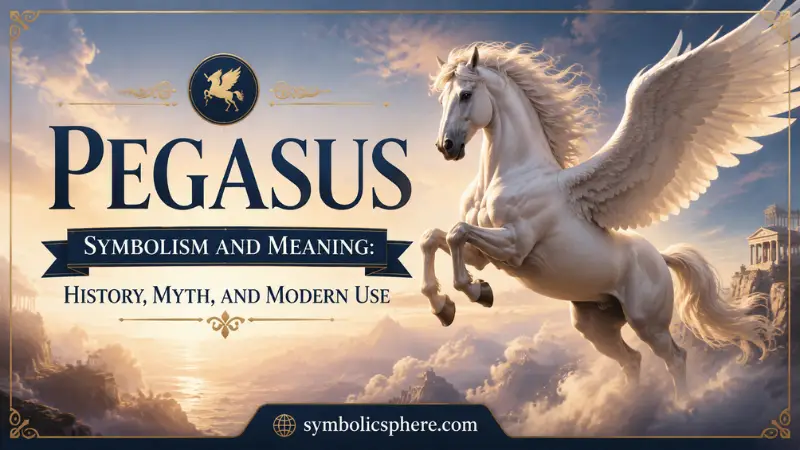
A white horse with enormous feathered wings, caught mid-leap toward the sky — that image needs no caption. Most people recognize Pegasus on sight, even if they couldn’t say exactly where the story comes from. Pegasus symbolism has outlived the myth that produced it, showing up on everything from oil company logos to shoulder tattoos to children’s book covers.
People keep coming back to this figure because it solves an old visual problem: how do you show freedom without showing chaos? A horse already suggests power and movement. Add wings, and you get power that has been lifted above the ground — controlled, aimed, purposeful. That combination is why the symbol still feels relevant in a country that prizes self-invention and upward mobility.
This article walks through what Pegasus has meant across different periods and places, then focuses on how the symbol functions in American life today — in design, personal identity, and popular culture.
Quick Answer: What Does Pegasus Symbolize?
In modern American culture, Pegasus most often symbolizes freedom, ambition, and creative inspiration — the sense of rising above ordinary limits through talent or effort. In ancient Greek mythology, the same figure carried more specific meanings tied to poetic inspiration, divine favor, and the taming of wild nature through heroism.
TL;DR
- Pegasus began as a specific figure in Greek myth, born from Medusa’s blood.
- The horse became linked to poetry through its connection to the Muses’ spring.
- American use strips away most of the original myth and keeps the flight.
- Corporate logos favor Pegasus for speed, motion, and aspiration.
- Tattoo culture reads Pegasus as personal transformation or breaking free.
- The symbol carries almost no negative connotation in current U.S. usage.
What Pegasus Actually Looks Like
Pegasus is depicted as a horse, almost always white, with a full set of bird-like wings attached at the shoulders. Classical Greek pottery shows a more compact, muscular animal than the slender, almost swan-like Pegasus common in modern illustration. Ancient artists were working from horses they saw every day, while today’s designers are usually working from other cartoons and logos — which explains why the modern version looks softer and more decorative.
People encounter this image constantly without registering the mythology behind it: on gas station signage, book logos, tattoo flash sheets, and children’s toy packaging. The wings are the part that never changes. Remove them and it’s just a horse; remove the horse and it’s just wings. Together, they read instantly as “Pegasus” even to someone who has never read a word of Greek mythology.
What Does Pegasus Symbolize Today?
Ask an American what Pegasus means and you’ll usually get some version of “freedom” or “rising above.” That’s the modern core meaning, and it stays fairly consistent across contexts, with a few more specific readings underneath it.
Pegasus often stands in for ambition with a creative or intellectual flavor, rather than purely financial success — less “I want to get rich” and more “I want to make something and be recognized for it.” This traces directly back to the myth’s old link to poetry, even among people who don’t consciously know that history.
The symbol also carries a sense of escape from constraint — a wild thing that cannot be fully tamed even though it can be ridden. That tension between wildness and cooperation is part of why the image feels aspirational rather than simply decorative.
Ancient Roots and Early Symbolism
The earliest surviving accounts place Pegasus’s birth at the moment the hero Perseus killed the Gorgon Medusa. According to the story, Pegasus and a warrior named Chrysaor sprang from her blood. That origin is unusually violent for a symbol now associated with lightness and grace, and it shows how far a symbol’s meaning can drift from its founding story.
Pegasus’s more famous role involves the hero Bellerophon, who tamed the horse with a golden bridle given to him by Athena and rode it into battle against the Chimera, a fire-breathing hybrid monster. This is where the “heroic flight” meaning takes shape: Pegasus isn’t just a magical animal, it’s a partner that lets a mortal accomplish something otherwise impossible. Bellerophon later tried to fly Pegasus all the way to Mount Olympus, overreaching his mortal station, and was thrown from the horse’s back for his arrogance — a detail modern retellings often drop because it complicates the purely triumphant image.
Pegasus also became connected to Mount Helicon, home of the Muses. One version of the myth credits a strike from the horse’s hoof with creating the spring Hippocrene, whose waters were said to inspire poets. That detail is the real root of Pegasus’s long association with artistic inspiration, well before “creativity” became a marketing buzzword. Readers who want the full primary-source detail on this myth can consult the Theoi Project, a widely cited reference for classical mythology sourced directly from ancient Greek and Roman texts.
Pegasus Symbolism in the United States
American use of Pegasus is lighter on mythology and heavier on branding. The symbol arrived in U.S. visual culture largely through European art history and classical education in the 19th and early 20th centuries, and later through commercial design.
The most visible example is the red Pegasus logo used by an American oil company for most of the twentieth century, chosen for connotations of speed and power rather than any deep classical reference. That single image did more to embed Pegasus in the American visual vocabulary than any textbook could, appearing on gas stations across the country for decades.
In sports and mascots, Pegasus occasionally stands in for dynamism — a team wanting to suggest speed without reaching for an eagle or a more common animal. In publishing and film, several studio and imprint logos use winged horses to suggest imaginative, larger-than-life storytelling, leaning on the flight rather than the Greek backstory.
There isn’t a single American holiday or civic tradition tied to Pegasus the way there is with, say, an eagle or a flag. Its American meaning has been built almost entirely through commercial and personal use rather than shared ritual, which is part of why the symbol feels flexible — nobody owns a strict definition of what it’s supposed to mean here.
Cross-Cultural and Religious Meaning
Outside its Greek origin, Pegasus doesn’t have deep independent roots in most other major world traditions, which sets it apart from symbols like the dove or the lion that recur across many cultures with their own local meanings. Where Pegasus does appear outside Greece, it’s typically an import — used in European heraldry starting in the medieval period as a symbol of speed, nobility, and swift messengers. It later appeared on regimental insignia for airborne military units, where the flying-horse image made an obvious fit for parachute troops.
Some 20th-century esoteric and New Age writing has folded Pegasus into broader “spirit animal” frameworks borrowed loosely from several traditions at once, treating it as a guide toward personal freedom or higher consciousness. This usage isn’t rooted in any single historical religious system — it’s a modern blending, worth noting as its own category rather than ancient doctrine.
Emotional and Psychological Signals
When someone chooses Pegasus deliberately — in a tattoo, a piece of jewelry, or a piece of art for their home — they’re usually communicating one of a few things about themselves. It can signal that they see themselves as having broken free from a difficult period, especially given the myth’s own theme of a wild creature that submits to guidance without losing its power.
It can also communicate aspiration toward a creative or intellectual identity, drawing on the Muses connection even if the person doesn’t consciously know that history. For others, it simply reads as “I refuse to be limited by circumstances” — an image of upward motion chosen precisely because it contrasts with feeling stuck.
Unlike symbols such as the skull or the raven, Pegasus carries almost no built-in menace or warning. It’s one of the rare mythological figures that reads as purely aspirational to a general audience, which is part of why it works well in commercial design — there’s very little risk of it being misread as dark or threatening.
Why Pegasus Appears in Tattoos and Personal Style
Pegasus tattoos are common enough to be their own recognizable category in tattoo shops. The reasons clients give tend to cluster around a few themes: recovery from a hard chapter of life, a love of horses combined with a desire for something more symbolic than a plain animal portrait, or an attraction to the visual balance of a muscular body paired with delicate wings.
Placement matters more here than with some symbols — people often choose the back or shoulder blades specifically because that’s where wings would attach on a human body, reinforcing the idea of personal flight rather than simply depicting an animal. Jewelry designers use Pegasus in a similar way, often on pendants meant as graduation or new-beginning gifts, playing on the “taking flight” idea directly.
Modern Usage in Design and Media
Beyond tattoos and logos, Pegasus shows up regularly in book series, animated films, and video games as shorthand for wonder and magical possibility — often alongside unicorns and dragons in fantasy branding aimed at younger audiences. Toy companies and children’s media lean on Pegasus because it combines a familiar, comforting animal (a horse) with a fantastical trait (flight), making it accessible even to very young viewers.
On social media, Pegasus imagery tends to appear paired with captions about personal growth, new jobs, moving to a new city, or finishing a difficult project — situations where someone wants to express “I’ve lifted off” without spelling it out. This use is almost entirely disconnected from Greek mythology; it’s built on the visual metaphor alone.
Controversies and Misuse
Pegasus has stayed relatively free of controversy compared to many ancient symbols, largely because it lacks the political or religious weight carried by images like national emblems tied to specific ideologies. Still, two points are worth separating out clearly.
One is a naming coincidence rather than a symbolic one: a widely reported piece of spyware used by governments for surveillance was named “Pegasus,” which briefly attached a negative connotation to the word in news coverage. That’s a branding choice for a piece of software, not a shift in what the mythological figure represents, and it hasn’t meaningfully changed how the symbol is used in art or design.
The other is a milder issue of oversimplification. Commercial use has stripped so much of the original myth away that the modern version loses its more cautionary elements — particularly Bellerophon’s fall after flying too high. That’s less “misuse” than “narrowing,” but it’s worth knowing if you want the fuller picture rather than the marketing version. For a scholarly overview of the full myth cycle, Encyclopaedia Britannica’s entry on Pegasus is a solid, citable starting point.
How Pegasus’s Meaning Has Evolved
In its earliest Greek context, Pegasus was closely tied to a specific hero’s story and a specific caution about mortal limits. By the Roman period, poets had already begun using Pegasus more loosely as a general emblem of poetic inspiration, detached from Bellerophon’s downfall. Medieval European heraldry picked up the speed-and-nobility angle for family crests, largely dropping the poetry association.
The twentieth century added a commercial layer, with corporate logos fixing “speed and power” firmly into the popular imagination. Most recently, self-expression culture — tattoos, social captions, personal branding — has pushed the meaning toward “individual transformation,” a layer that has almost nothing to do with the original myth beyond the shared image of flight. Each era kept the wings and the horse but reassigned what they were meant to represent.
Pegasus Symbolism at a Glance
| Context | Meaning in the USA | Common Associations | Notes |
|---|---|---|---|
| Corporate logos | Speed, power, momentum | Oil and gas, transportation, aviation units | Rooted in 20th-century branding, not mythology |
| Tattoos | Personal transformation, freedom | Recovery, new chapters, love of horses | Shoulder/back placement common for “wing” effect |
| Children’s media | Wonder, magic, gentleness | Unicorns, fairy tales, fantasy worlds | Mythology simplified for young audiences |
| Jewelry and gifts | New beginnings, aspiration | Graduation, career changes | Marketed around “taking flight” language |
| Classical/academic contexts | Poetic inspiration, heroism | The Muses, Bellerophon, Mount Helicon | Closest to the original Greek meaning |
| Military insignia | Airborne capability, swiftness | Parachute regiments, heraldry | Traces back to medieval crest traditions |
FAQs
What does a Pegasus tattoo symbolize?
Most people get a Pegasus tattoo to represent personal freedom or a period of transformation, often after overcoming a hard experience. It can also simply express a love of horses combined with a taste for fantasy or mythological imagery.
Is Pegasus a religious symbol?
Pegasus comes from Greek mythology rather than an active religious tradition practiced today, so it isn’t considered sacred in the way symbols tied to living faiths are. Some modern spiritual writing has adopted it loosely as a personal-growth symbol, but that’s a contemporary reinterpretation rather than historical religious doctrine.
Does Pegasus have a negative meaning in any context?
Not in its traditional or artistic use. Its only real negative association comes from an unrelated naming choice — a piece of government surveillance software — which hasn’t changed how the mythological figure itself is used in design or personal expression.
Why is Pegasus linked to poetry and inspiration?
According to Greek myth, a strike from Pegasus’s hoof created a spring on Mount Helicon believed to inspire poets who drank from it. That connection to the Muses is the historical source of Pegasus’s long-standing link to creative inspiration.
What’s the difference between how Americans and ancient Greeks understood Pegasus?
Ancient Greek audiences understood Pegasus within a specific story involving Bellerophon’s heroism and his eventual fall for flying too high, carrying a caution about human limits. American usage generally keeps the flight and drops the caution, treating Pegasus as a purely positive symbol of ambition and freedom.
Is Pegasus the same as a unicorn in terms of symbolism?
No — they’re often marketed together but symbolize different things. Unicorns are typically linked to purity and rarity, while Pegasus is tied more specifically to flight, speed, and creative or heroic achievement.
Why do so many companies use a winged horse in their logo?
A winged horse visually communicates speed and elevated performance without needing text, which makes it efficient shorthand in industries like fuel, transportation, and aviation. The image also carries positive, non-threatening associations, lowering the risk compared to more aggressive animal symbols.
Conclusion
Pegasus has managed something unusual for a mythological figure: it kept its core image intact — the horse, the wings, the leap skyward — while shedding almost all of its original narrative baggage. What started as one hero’s story about the limits of mortal ambition has become, in American culture, a nearly universal shorthand for the opposite idea: that ambition itself is worth celebrating.
That shift says less about the myth and more about what a modern audience wants a symbol to do for them. People don’t reach for Pegasus to be reminded of Bellerophon’s fall; they reach for it to mark a beginning, a change, or a hope for something better. The Pegasus symbolism that persists today is really a story about what a culture chooses to remember and what it chooses to leave out.
Whether it shows up on a gas station sign, a shoulder blade, or the cover of a children’s book, the winged horse keeps doing the same basic job: making the abstract idea of rising above your circumstances feel visible.