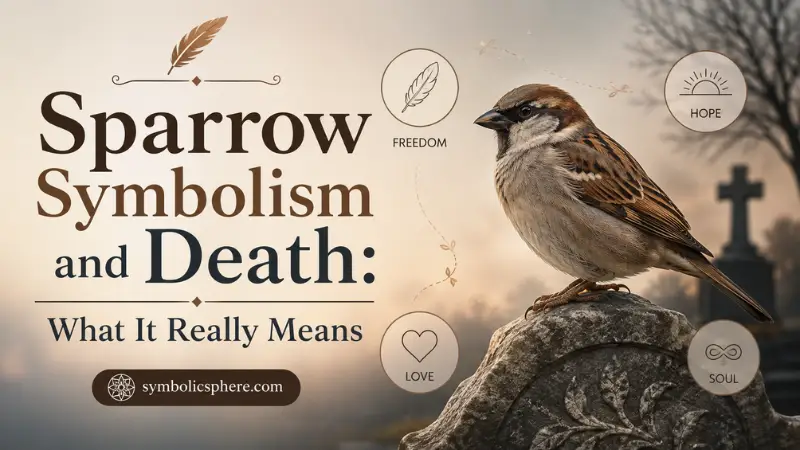
Spotting a sparrow near a hospital, a graveside, or a windowsill after a loss can feel like more than coincidence. Sparrows have carried symbolic weight for thousands of years, and death is one of the most common themes attached to them — but the meaning behind sparrow symbolism and death is far more layered than a simple omen.
The idea traces back through several distinct traditions rather than one shared belief. Christian scripture uses the sparrow to illustrate divine care for even the smallest life (Matthew 10:29-31). Shakespeare picked up that same image in Hamlet to explore mortality and fate. Separately, pockets of European folklore turned an unexpected sparrow sighting into a warning of death. Modern culture — American gospel music, memorial tattoos, personal grief rituals — draws from all of these sources at once, which is why the symbolism can feel both comforting and unsettling depending on the context.
This guide walks through where sparrow symbolism and death actually comes from, what it means in different settings, and where it collides with plain biology, so you can make sense of what you’re seeing or feeling.
Sparrow symbolism and death centers on mortality, grief, remembrance, and the fragility of everyday life — not a literal warning that death is coming. Christian tradition ties the sparrow to divine care, Shakespeare used it as an image of accepting fate, and some European folklore treated an unexpected sparrow as a death omen. Modern American culture draws on all three, most often using the sparrow for remembrance rather than prediction.
Quick Answer
Seeing a sparrow does not predict death. The connection comes from layered traditions — scripture, literature, and folklore — that treat the bird as a symbol of mortality, humility, and quiet remembrance rather than a supernatural warning.
Key associations at a glance:
- Mortality and fragility — a small life, easily lost
- Remembrance — a personal reminder of someone who died
- Divine care (Christian tradition) — even the smallest creature is seen
- Fate and acceptance (Shakespeare) — readiness for what can’t be controlled
- Death omen (some European folklore) — an unusual encounter as a warning
Why a Small, Ordinary Bird Carries So Much Meaning
Sparrows are compact songbirds with plain brown, gray, or streaked plumage and short, stout bills. The House Sparrow — the species most Americans picture — is actually a Eurasian bird introduced to the United States in the 19th century that went on to become one of the most common birds around homes, streets, and farms in the country (Cornell Lab of Ornithology).
That ordinariness is the whole point. An eagle signals power and grandeur; a sparrow signals the opposite — something small, common, and easy to overlook. In symbolism, the death of an unremarkable little bird becomes a stand-in for a bigger idea: that even a life with no grandeur still has value.
What a Sparrow Symbolizes When Death Is Involved
In a death-related context, sparrow symbolism tends to cluster around a few connected ideas:
- Mortality — a reminder that every living thing eventually dies
- Fragility — life can end or change without warning
- Remembrance — a small bird becomes a personal marker for someone lost
- Transition — the imagery can represent an ending rather than literal death
- Divine care — in Christian interpretation, even the smallest life is noticed
- Fate and acceptance — a literary framing for coming to terms with what can’t be controlled
None of these meanings requires believing a sparrow causes or predicts death. Context does most of the work.
Why a Dead Sparrow Reads Differently Than a Living One
A living sparrow is active and social — House Sparrows typically feed and move in noisy, crowded flocks. A dead sparrow flips every one of those qualities: movement becomes stillness, song becomes silence, and a bird tied to everyday bustle becomes a reminder that everyday life doesn’t last forever.
That contrast is why dead sparrows show up so often in poetry, memorial art, and personal reflection — the symbolism doesn’t need an old superstition behind it. People naturally read stillness and silence as absence. For someone grieving, the bird can represent a person who’s gone but still remembered; for someone facing a major change, it can mark the close of a chapter.
The Biblical Roots: A Sparrow That Falls Is Still Seen
The most influential source for sparrow symbolism in the West is the Gospel of Matthew, where Jesus describes sparrows as birds of little market value and says that not one falls to the ground outside God’s awareness — then reassures listeners that they, too, are valued.
The point of the passage isn’t that a sparrow predicts death. It’s the opposite: even a small, seemingly unimportant creature is noticed. Read through a lens of grief or mortality, the sparrow becomes a symbol of reassurance — that vulnerability and death don’t make a life meaningless or forgotten.
That idea carried directly into American religious culture through the gospel standard “His Eye Is on the Sparrow,” recorded by artists including Mahalia Jackson and closely associated with Ethel Waters. The song’s core message — that God’s attention to a small bird mirrors his attention to a person — gives the sparrow an emotional register that shows up during illness, loss, and hardship without functioning as a symbol of doom.
Shakespeare’s Sparrow: Mortality and Acceptance
Hamlet adds a second major literary layer. Near the play’s end, Hamlet invokes the idea of providence in “the fall of a sparrow” while facing the uncertainty ahead of him.
The line draws on the same biblical image, but its placement — right before a fatal confrontation — pulls it toward mortality and acceptance rather than comfort alone. The “fall of a sparrow” becomes shorthand for the unpredictability of life and a readiness to face death without needing to control the timing. Later writers have reused the same image without the religious framing attached.
Death Omens in European Folklore
The darker reading of sparrow symbolism comes mostly from folklore, not from the bird’s actual behavior. In some British and broader European traditions, a sparrow entering a house, or appearing unusually close to one, was read as an omen of death or misfortune — a belief pattern that shows up with other birds too, and was never universal across regions.
Their relevance today is cultural rather than predictive. They’re the reason horror films, ghost stories, and family superstitions sometimes treat an unexpected sparrow indoors as unsettling — not because it reflects anything documented about the birds themselves.
Do Sparrows Carry Souls to the Afterlife?
Some modern symbolism sites claim sparrows guide spirits or carry souls to the afterlife. These claims tend to blend folklore, sailor traditions, religious imagery, and newer spiritual interpretation rather than draw on one consistent historical source — there’s no single tradition where sparrows universally served as a guide for the dead.
A more accurate framing: birds in general are easy to associate with the passage between earth and sky, simply because they fly. The sparrow inherits a more personal version of that symbolism thanks to its small size and its biblical association with divine attention. Seeing one after a funeral can feel like a comforting reminder of someone who died — a meaning that’s personal rather than historically universal.
Sparrow Symbolism Wasn’t Always About Death
Death is only one chapter in a much longer symbolic history.
In ancient Greek literature, sparrows were linked to Aphrodite — in Sappho’s invocation of the goddess, sparrows pull her chariot, tying the bird to desire and love rather than mortality. Later Western tradition also used sparrows to represent ordinary people, humility, community, and persistence, reinforced by how closely the birds live alongside humans.
The takeaway: meaning shifts with condition and setting. A flock feeding in a yard doesn’t carry the same symbolism as a dead sparrow in a memorial painting.
Sparrow Symbolism in the United States
House Sparrows were deliberately introduced in New York in the 19th century and spread across the country, becoming closely tied to cities and human-built spaces. That familiarity shapes American symbolism: the sparrow reads as ordinary rather than exotic — a bird of sidewalks, parking lots, feeders, and train stations.
Add death to that everyday image, and the message becomes personal rather than abstract: mortality isn’t distant or reserved for dramatic circumstances. It’s part of daily life. American religious culture layers on the biblical and gospel tradition, so the same bird ends up symbolizing both mortality and reassurance at once.
Sparrows as Symbols of Grief and Remembrance
Sparrows work well as grief symbols precisely because they don’t make mourning dramatic. A small, unremarkable bird can carry the memory of a parent, spouse, friend, or child — suggesting that a private, ordinary life still mattered.
The symbolism often works through personal association rather than fixed rules: someone might notice sparrows because they were tied to a loved one’s garden, favorite song, or daily routine. That kind of meaning doesn’t need to match traditional folklore to be a valid form of remembrance.
Sparrow Tattoos and Memorial Art
In tattoo culture, a sparrow is commonly paired with names, dates, flowers, crosses, or banners to memorialize someone who has died. It’s worth noting that sparrows and swallows are easy to confuse here — traditional sailor tattoos give the swallow its own distinct meaning tied to a sailor’s travel and experience, separate from sparrow symbolism.
Design details shift the meaning: a flying sparrow suggests something different from a still one, a sparrow beside a cross leans toward faith, and a sparrow beside a date makes the memorial intent explicit.
Sparrows in Dreams and Unexpected Encounters
A sparrow in a dream doesn’t have one fixed meaning. A dead sparrow may reflect grief, fear of loss, or a sense that something has ended; a sparrow that revives or flies away often points toward recovery or release instead.
Window strikes deserve a practical note. Folklore sometimes treats birds entering a house as ominous, but a sparrow hitting a window has a physical explanation, not a supernatural one — birds frequently fail to register reflective or transparent glass as a barrier, and collisions are a major, well-documented cause of bird deaths in the U.S. (American Bird Conservancy). Finding a dead sparrow near a window is far more likely a collision than an omen.
Sparrow Meanings by Context
| Context | Common Meaning (U.S.) | Death Connection | Notes |
|---|---|---|---|
| Living sparrow | Ordinary life, community, resilience | Low | Usually positive or neutral |
| Dead sparrow | Mortality, loss, endings | Strong | Common in grief imagery |
| Fallen sparrow | Fragility, providence, fate | Strong | Rooted in scripture and literature |
| Sparrow in Christian art | Divine care, human worth | Moderate | Death emphasizes God’s awareness |
| Memorial sparrow tattoo | Remembrance, continuing connection | Strong | Meaning is usually personal |
| Sparrow entering a house | Folk omen or unexpected change | Variable | Superstition, not evidence of anything |
How the Symbolism Evolved
The sparrow didn’t start out as a death symbol. Ancient literature linked it to love; Christian teaching emphasized the worth of even the smallest creature; Shakespeare pulled that religious image toward mortality and fate; and regional folklore added ominous readings of unusual encounters. Modern culture layers all of it together — a dead sparrow in artwork can signal grief, while a living one nearby can just as easily read as hope, depending on who’s looking and why.
Common Misconceptions
“Seeing a sparrow means someone will die.” This is folklore, not a reliable pattern in bird behavior.
“Every culture assigns sparrows the same meaning.” Greek literature, Christianity, European folk belief, American gospel tradition, and modern memorial art all developed separate, sometimes contradictory associations.
“Every dead bird is a sign.” Birds die from ordinary biological and environmental causes, and window collisions alone account for a significant share of bird deaths in the U.S. Symbolism can shape how an experience feels — it shouldn’t replace a realistic account of what actually happened.
FAQs
Does seeing a sparrow mean death is coming?
No. There’s no factual basis for the belief that a sparrow sighting predicts death. It comes from specific folklore traditions, not a universal or evidence-based pattern.
What does finding a dead sparrow symbolize?
Commonly mortality, grief, vulnerability, or the end of something familiar. In personal or memorial symbolism, it can also represent honoring a life that might otherwise go unnoticed.
What does the Bible say about a sparrow dying?
Matthew 10 uses a falling sparrow to illustrate God’s awareness and human worth — the message is reassurance, not a warning that sparrows announce death.
Is a sparrow a bad omen?
Not inherently. While some European folk traditions treated a sparrow entering a house as ominous, other traditions connect sparrows with love, community, faith, and everyday life.
What does a sparrow symbolize after someone dies?
Often remembrance, continuing emotional connection, or comfort — the sense that even a quiet, seemingly small life remains meaningful. The interpretation is usually personal rather than tied to a fixed rule.
What does a sparrow tattoo mean when someone has died?
A memorial sparrow tattoo typically represents a deceased loved one, grief that’s been survived, remembrance, or faith. Surrounding elements — names, dates, crosses, flowers — usually clarify the specific meaning.
Conclusion
Sparrow-and-death symbolism draws on several distinct traditions rather than one universal rule. Christian scripture ties the fallen sparrow to vulnerability and divine care, Shakespeare strengthens its link to mortality and fate, and pockets of European folklore turned unusual sparrow encounters into warnings. In modern American use, sparrow symbolism around death is best read as a language of mortality, remembrance, and fragile life — a way of noticing what’s easy to overlook — rather than a sign that death is actually on its way.