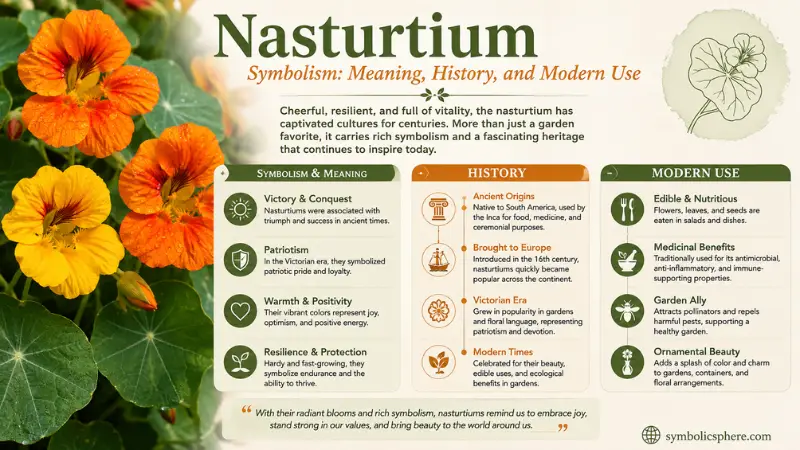
Nasturtium are bright, fast-growing flowers known for their round, shield-like leaves and warm red, orange, and yellow blooms. Nasturtium symbolism is most closely tied to courage, victory, patriotism, and spirited determination — meanings rooted in the plant’s unusual shape and in the Victorian “language of flowers” that assigned meanings to nearly every bloom.
Today, most people are more likely to encounter nasturtiums in a garden bed, a salad, or a tattoo than in a formal symbolic tradition. That shift has broadened what the flower represents. Beyond its historical ties to patriotism, it’s now just as often used to express resilience, confidence, independence, and the ability to flourish without perfect conditions.
Quick Answer
Nasturtium symbolism most commonly represents courage, determination, confidence, and personal victory. Historically, the flower was linked to patriotism and martial triumph — largely because its shield-shaped leaves and helmet-like flowers echoed the imagery of a battlefield trophy.
At a glance:
- Nasturtiums commonly symbolize courage, confidence, and personal victory.
- Victorian flower language assigned the plant the meaning of patriotism.
- Its shield-shaped leaves helped create the original connection to warfare.
- In modern use, the symbolism is usually personal rather than political or military.
- Its hardy, low-maintenance growth habit inspired newer associations with resilience.
- In tattoos, it usually signals boldness, perseverance, or unconventional beauty.
Why the Flower’s Shape Shaped Its Meaning
Garden nasturtiums are easy to recognize. Their nearly circular leaves attach near the center of the leaf, giving them the look of tiny shields or lily pads. Their five-petaled flowers, typically yellow, orange, scarlet, cream, or deep red, have a distinctive backward-pointing spur.
That resemblance to a shield isn’t incidental to the plant’s symbolism — it’s the origin of it. In the eighteenth century, botanist Carl Linnaeus named the genus Tropaeolum, drawing on the Greek tropaion and Latin tropaeum: both words for a trophy or monument commemorating a military victory. Missouri Botanical Garden’s Plant Finder confirms Linnaeus chose the name specifically for the leaves’ resemblance to a classical trophy — round shields and, in some readings, the bright flowers as helmets displayed alongside them.
Unlike many symbolic flowers, then, the nasturtium’s meaning didn’t emerge purely from poetic association or color — it started with what the plant physically looks like.
The Core Meanings of the Nasturtium
| Context | Common Meaning | Association | Notes |
|---|---|---|---|
| Personal symbolism | Courage and confidence | Bold action | Most common modern reading |
| Achievement | Victory and success | Overcoming difficulty | Rooted in the trophy imagery |
| Victorian flower language | Patriotism | Loyalty to country | Documented in 19th-century floriography |
| Gardening | Resilience | Thriving with few resources | Grown from the plant’s own habits |
| Tattoos | Independence and determination | Personal identity | Meaning is usually chosen by the wearer |
| Gifts and décor | Energy and encouragement | Warmth, optimism | Driven largely by the flower’s vivid colors |
The through-line: older meanings center on victory and patriotism; modern ones lean toward personal courage, persistence, and achievement. Someone getting a nasturtium tattoo today isn’t referencing military conquest — they’re usually borrowing that old vocabulary of “victory” as a metaphor for surviving something hard.
From Battlefield Trophy to Patriotic Emblem
The imagery builds in a fairly direct line: round leaves resemble shields, the bright flowers suggest decorative helmets or banners, and the genus name itself points straight to a trophy — and a trophy implies victory. Nineteenth-century flower-language writers inherited this imagery and condensed it into a single emotional message.
It’s worth being precise here: nasturtiums were not an established Roman or Greek victory flower in antiquity. The classical connection comes through the imagery behind the eighteenth-century scientific name, not from historical evidence that Romans used garden nasturtiums ceremonially.
How Victorians turned it into “patriotism”
During the nineteenth century, published flower dictionaries assigned emotions and social messages to individual plants — a practice known as floriography. Nasturtium was repeatedly listed as meaning patriotism; Kate Greenaway’s widely circulated Language of Flowers pairs the two directly, and other flower dictionaries of the era made the same association. Given the plant’s existing martial imagery, the leap to patriotism — with its own ties to courage, service, and sacrifice — made intuitive sense.
That said, floriography was never fully standardized. As the Smithsonian’s history of the language of flowers notes, multiple competing flower glossaries circulated at once, so a 19th-century recipient couldn’t always assume a single “correct” translation. Nasturtium’s link to patriotism is unusually well documented for the era, but it’s still best understood as a historical convention rather than a fixed, eternal meaning.
The association crossed the Atlantic quickly. One clear example survives from 1892: an American commercial trade card, part of a series on floral beauties, portrayed a nasturtium and explicitly labeled its meaning as patriotism — evidence the symbolism had moved well beyond specialist botanical writing and into everyday pop culture.
What Nasturtiums Mean in the U.S. Today
Contemporary American use doesn’t treat the nasturtium as having one official meaning — it depends on context. The strongest present-day interpretations are courage, perseverance, confidence, victory, and spirited independence.
These meanings tend to attach to personal milestones: finishing a difficult degree, recovering from a setback, leaving an unhealthy situation, or succeeding at something that once felt unlikely. The old idea of conquering someone else has softened into conquering something internal — fear, hardship, or self-doubt. Patriotism remains historically accurate, but it’s no longer the meaning most people reach for first.
Courage and a willingness to stand out
Nasturtiums aren’t a shy flower. Intense reds, oranges, and yellows against cool green foliage, plus trailing varieties that spill over walls and containers, make boldness and self-confidence an intuitive read. Symbolically, the flower reads less like solemn heroism and more like lively, unapologetic courage — “I acted despite the fear” rather than “I fought a war.” That playful edge is part of why it works well in art and tattoos representing regained confidence after a hard stretch.
Resilience and resourcefulness
Nasturtiums perform well in average or even poor soil — in fact, overly rich soil tends to produce lush foliage at the expense of flowers. They’re widely considered forgiving, low-maintenance plants, which has fed a newer, non-Victorian layer of meaning: making the most of what you have. This reading suits stories about adaptability, modest beginnings, or rebuilding — it’s modern symbolic reasoning drawn from how gardeners actually experience the plant, not a Victorian code. (Internal link opportunity: guide to low-maintenance annual flowers.)
Practical beauty
Nasturtium flowers and leaves are edible, with a peppery flavor often compared to watercress or arugula; unripe seed pods are sometimes pickled like capers. That dual role — ornamental and useful — gives the flower a modern symbolic layer of “practical beauty,” appealing to anyone who resists the idea that beauty has to be delicate or purely decorative. (Internal link opportunity: guide to edible flowers for the garden.)
Do Nasturtium Colors Carry Different Meanings?
There’s no historical, universally agreed code tying each nasturtium color to a specific meaning — this is one area where modern interpretation borrows from general color symbolism rather than floriography:
- Red — courage, determination, intensity
- Orange — enthusiasm, warmth, confidence
- Yellow — cheerfulness, optimism, celebration
- Deep burgundy/mahogany — maturity, individuality, quiet strength
- Cream/peach — gratitude, understated confidence
Treat these as design-driven interpretations, not tradition. A red nasturtium doesn’t automatically mean romantic love just because a red rose does — context matters more than color alone.
Nasturtium Tattoo Meaning
Nasturtium tattoos are popular partly because the flower carries recognizable symbolism without being as culturally fixed as a rose, lotus, or lily. People commonly choose one to represent:
- Personal victory after adversity
- Courage to start over
- Independence and unconventional beauty
- Pride in an achievement
- Resilience through imperfect circumstances
- A personal connection to gardening or nature
Design choices shift the emphasis: prominent shield-like leaves can lean into themes of protection, a trailing vine can suggest ongoing growth rather than a finished achievement, a single open bloom can emphasize confidence, and a cluster of buds and flowers can represent different stages of personal development. Because the symbolism isn’t rigidly fixed, the wearer’s own explanation usually matters more than any dictionary definition. (Internal link opportunity: flower tattoo meanings guide.)
Nasturtiums as Gifts, in Weddings, and in Décor
As a gift, the nasturtium works best when the message is encouragement rather than conventional romance — think graduations, career wins, recovery, a big move, or any new chapter, drawing on its historical link to victory.
For weddings, it’s less traditional than roses or peonies, which can be an advantage for couples leaning into garden-style or vivid seasonal arrangements; its edible nature also suits informal, garden-party-style events. In home décor, nasturtium imagery reads as energetic, abundant, and slightly unconventional — a clear departure from the formality of white lilies or restrained botanical prints.
Origins: South America, Not Europe
The cultural story of the flower doesn’t start in Europe. The genus Tropaeolum is native to Central and South America, and the familiar Tropaeolum majus is understood to be a cultivated plant associated with Peru, with related species spread across a wider stretch of the Americas.
Plants from the group reached Europe in the sixteenth century. English writers used names like “Indian cress,” reflecting both the American origin and the peppery, cress-like flavor; records show nasturtiums growing in England by the late 1500s after arriving via continental Europe.
Worth treating carefully: some modern articles attach elaborate “Inca meanings” to the common garden nasturtium without solid evidence. Andean peoples did use plants in the Tropaeolum genus — including edible species like mashua — but that doesn’t establish that today’s symbolic meanings for T. majus descend from an ancient Indigenous tradition. The best-documented symbolic thread — trophy, victory, patriotism — comes from European botanical naming and later Victorian flower culture, not South American origin.
A Few Common Misconceptions
“Nasturtiums have always meant victory.” Not quite — the victory imagery is tied to the classical trophy reference in the 18th-century scientific name and later European interpretation, not to an unbroken ancient tradition.
“Patriotism is still the flower’s main meaning.” Historically well-documented, yes — but today many people use nasturtiums with no patriotic intent at all.
“Nasturtium and watercress are closely related.” They share a peppery flavor and a common-name history, but garden nasturtiums belong to Tropaeolum, while true watercress belongs to the separate genus Nasturtium.
“Modern color meanings are ancient rules.” Claims like “orange nasturtium always means creativity” reflect contemporary interpretation, not documented historical symbolism.
One more nuance worth flagging: the word patriotism carries political weight in modern conversation, but in 19th-century floriography it functioned as an abstract virtue — loyalty, public duty, willingness to defend one’s country — not a reference to any specific party, movement, or campaign. Someone using the flower today might be nodding to service, family history, or personal bravery, or nothing political at all.
How the Symbolism Evolved, Step by Step
- The plant originates in the Americas and is used practically long before it’s symbolic.
- After reaching Europe, its shield-shaped leaves catch attention, and Linnaeus names the genus after a classical trophy.
- Victorian flower-language writers condense that imagery into one word: patriotism, which crosses into American popular culture by the 1890s.
- As formal flower codes fade in the 20th and 21st centuries, people reinterpret the plant through personal experience: victory becomes personal achievement, martial courage becomes emotional bravery, and its tolerance for poor soil becomes a symbol of resilience.
The result is a flower that keeps the strength of its older meanings while shedding most of their militarism.
FAQs
What does a nasturtium flower symbolize?
Most commonly, courage, personal victory, determination, and confidence. Historically, 19th-century flower language strongly tied it to patriotism.
Is nasturtium a positive symbol?
Generally, yes — its meanings center on achievement, bravery, perseverance, and enthusiasm rather than grief or warning.
What does a nasturtium tattoo mean?
Typically overcoming hardship, confidence, independence, or hard-earned victory; shield-shaped leaves in the design can add a theme of protection.
Does nasturtium symbolize patriotism?
Yes, historically. Nineteenth-century flower dictionaries repeatedly listed patriotism as its meaning, and it appeared in American commercial flower imagery by the 1890s.
Does nasturtium have a spiritual meaning?
There’s no single meaning shared across major spiritual traditions. In personal practice, people sometimes read it as courage, gratitude, or successful growth — but that’s an individual interpretation, not an established doctrine.
What does an orange nasturtium symbolize?
Enthusiasm, warmth, confidence, and energetic achievement — drawn from general color symbolism rather than a historical flower code specific to nasturtiums.
Is nasturtium associated with war?
Indirectly. Its botanical name and shield-like leaves created trophy-and-victory imagery that later fed into associations with patriotism and courage — but it wasn’t an ancient war emblem in its own right.
Conclusion
Nasturtium symbolism pairs an unusually well-documented history with a flexible modern meaning. Its shield-shaped leaves and trophy-derived botanical name connected the flower to victory early on, and 19th-century flower language turned that into one of its best-documented meanings: patriotism.
In modern use, those martial associations have largely turned personal. A nasturtium can now represent courage during hardship, confidence after self-doubt, resilience in imperfect conditions, or the satisfaction of a victory that had to be earned — a fitting range of meaning for a flower that’s bright, useful, and able to thrive without much fuss.