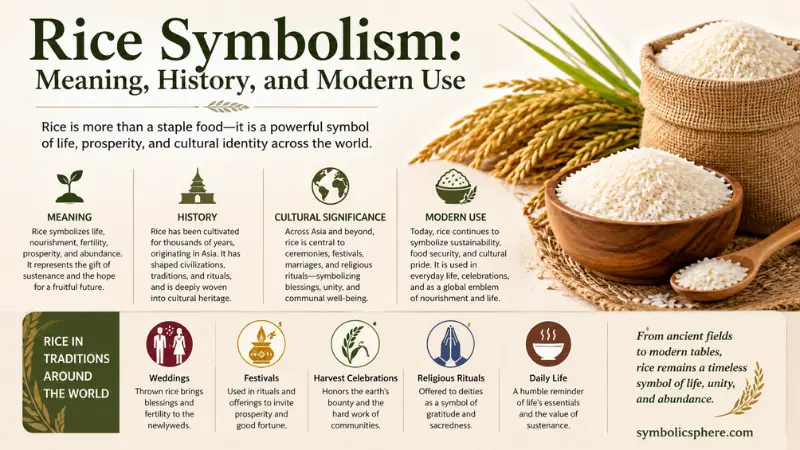
Rice looks ordinary — a small grain on dinner tables, at restaurants, and at family gatherings. But rice symbolism reaches far beyond food. Because rice has sustained large populations, supported farming communities, and appeared in ceremonies for generations, it commonly represents abundance, fertility, nourishment, prosperity, continuity, and shared life.
In the United States, many people first encounter rice symbolism through wedding traditions, where scattered grains express wishes for a prosperous future. For Asian American, South Asian American, Pacific Islander, African American, and other communities, rice often carries deeper, more specific meaning tied to family heritage, religion, migration, and memory.
There’s no single meaning that applies everywhere. What rice communicates depends on who’s using it — and whether it’s being eaten, offered, planted, thrown, or worked into a personal symbol like a tattoo.
Quick Answer
Rice symbolism commonly represents abundance, prosperity, nourishment, fertility, and a hopeful future in modern American culture, especially in wedding and family settings. Historically, rice has also carried religious, agricultural, and community meaning across many Asian cultures, while its American history includes vital connections to African agricultural knowledge, enslavement, and Gullah Geechee heritage.
At a glance:
- Rice commonly represents abundance, nourishment, prosperity, and continuity
- Wedding rice expresses blessings for a flourishing married life
- Religious traditions use rice as an offering or sacred food
- Rice can represent family, homeland, migration, and cultural identity
- American rice history also carries a difficult legacy tied to slavery
- Modern meaning depends heavily on cultural and personal context
What Rice Represents at a Glance
Rice is the edible grain of several cultivated grasses, most prominently Asian rice (Oryza sativa). It’s a primary staple for more than half the world’s population — a fact that helps explain how it grew into such a broad cultural symbol.
Its symbolic weight comes less from how it looks than from what a successful rice harvest provides: food, security, continuity, and a community’s ability to sustain itself. That gives rise to several recurring associations:
- Abundance — rice is harvested in enormous numbers of individual grains
- Prosperity — a successful crop historically meant food and economic security
- Fertility — a small amount of planted seed multiplies into a full harvest
- Nourishment — rice is an everyday staple, not a rare luxury food
- Continuity — planting, harvesting, cooking, and sharing repeat across generations
- Community — rice cultivation and shared meals often depend on cooperation
These meanings overlap but aren’t interchangeable. A bowl of rice at a family meal may suggest home and care, while rice tossed at a wedding leans more toward abundance and a couple’s future together.
Why Rice Became a Symbol of Abundance
The link to abundance follows naturally from agriculture: a small quantity of seed can eventually produce a field full of grain. That visual multiplication makes crops especially fitting symbols of growth and plenty, and rice adds another layer because people usually encounter it as hundreds or thousands of tiny grains gathered together.
Abundance here doesn’t necessarily mean luxury — it often means having enough: enough food for the household, enough harvest to survive the year, enough to share with others.
That distinction matters. In agricultural societies, prosperity wasn’t always pictured as piles of money or fine possessions. A full granary and a dependable harvest could be a far more meaningful measure of well-being — which is why rice can symbolize both prosperity and simplicity at once. It represents wealth in the older sense: resources that sustain life.
What Does Throwing Rice at a Wedding Mean?
The image of guests showering newlyweds with rice remains one of the best-known symbolic uses of the grain in the United States. The gesture is generally read as a blessing for prosperity, fertility, good fortune, and an abundant married life. Similar practices involving grains and other small objects appear in wedding customs worldwide, so the underlying idea is older and more varied than the American rice toss itself.
The symbolism works through multiplication — many grains falling around two newly married people express a visual wish that their household will flourish. Historically, “fertility” often referred literally to hopes for children. Modern couples don’t have to read it that way; today it can just as easily represent a productive marriage, growing love, new opportunity, or a future full of good things.
Rice throwing is also less universal at contemporary weddings than its familiar image suggests. Flower petals, bubbles, and biodegradable confetti are common alternatives, and some venues restrict loose rice over cleanup or slip hazards — not superstition (more on that below).
Sacred Offerings and Religious Meaning
Rice holds ceremonial importance across several religious traditions, but not in a single, interchangeable way.
In Japanese Shinto practice, rice has a particularly close relationship with gratitude, agriculture, divine provision, and seasonal ritual. At Ise Jingu, for example, major annual observances follow the rice-growing cycle, and the year’s first rice is ceremonially offered during Kanname-sai.
Across Hindu communities, rice appears in offerings, blessings, weddings, and other rites. Depending on the specific custom, it can convey auspiciousness, prosperity, purity, nourishment, or wishes for a household’s well-being.
The common thread is context: rice isn’t automatically a universal symbol of “spirituality.” Its sacred meaning comes from the ritual system it’s used within — when rice is placed before a deity, prepared as ritual food, or offered in a ceremony, it moves from ordinary nourishment into a relationship between food, gratitude, community, and belief.
Rice in East and Southeast Asian Cultural Life
Across large parts of East and Southeast Asia, rice has historically shaped far more than meals — cultivation has influenced calendars, settlement patterns, labor, water management, festivals, and the relationship between communities and their landscapes. That gives rice several meanings that can be hard to separate: sustenance, land, cooperation, ancestry, ecological balance, and collective identity.
In Bali, rice terraces are tied to the subak system of cooperative water management and temple culture — rice, irrigation, farming communities, and religious life form one interconnected cultural landscape rather than separate ideas.
Among the Ifugao communities of the Philippine Cordilleras, rice terraces likewise carry deep cultural and ancestral meaning, with farming traditions linked to ritual practice, inherited knowledge, community organization, and long-term care of the land.
These examples show why reducing rice to “good luck” misses much of its meaning. For some communities, it represents an entire relationship between people, land, water, work, ancestors, and survival.
What Rice Commonly Means in the United States
American interpretations of rice are unusually diverse, because the U.S. brings together so many cultural traditions built around it.
For someone who only encounters rice as a wedding symbol, it may simply mean prosperity or good fortune. For someone whose family regularly prepares jambalaya, arroz con pollo, biryani, jollof rice, sticky rice, or red rice, it can carry far stronger associations with ancestry, celebration, or home. Rice is also a significant U.S. agricultural commodity, so in farming regions it can represent land, harvest, livelihood, and rural identity.
| Context | Common U.S. Meaning | Associations | Worth Noting |
|---|---|---|---|
| Weddings | Prosperity, good wishes | Marriage, growth, future | Fertility doesn’t have to mean children |
| Family meals | Home, nourishment | Comfort, care, belonging | Meaning varies by household |
| Cultural celebrations | Heritage, continuity | Ancestors, migration, tradition | Interpretations are culture-specific |
| Farming imagery | Harvest, abundance | Labor, land, seasons | Can also reflect economic history |
| Religious settings | Blessing, offering | Gratitude, sacred practice | Meaning depends on the tradition |
Because American culture is multicultural, no single row in this table is the “correct” interpretation — context decides.
Rice, the American South, and Gullah Geechee History
American rice imagery also carries a difficult history that shouldn’t be flattened into purely positive symbolism.
Rice became enormously profitable in colonial South Carolina and the surrounding Lowcountry. Enslaved Africans and their descendants performed the dangerous labor of clearing wetlands, maintaining fields, planting, harvesting, and processing the grain — and historical evidence shows West Africans brought crucial agricultural knowledge and experience that made this cultivation possible in the first place. The story holds two very different realities at once: wealth for plantation owners, and exploitation for the people whose forced labor created it.
Rice is also woven into surviving Gullah Geechee culture along the southeastern coast. Gullah Geechee communities descend from enslaved West and Central Africans and preserved or adapted elements of African language, foodways, agriculture, craft, religion, and family life under extraordinarily difficult conditions.
In this context, rice can evoke African heritage, endurance, and cultural preservation — but those meanings should never be separated from the history of slavery that shaped rice production in the region.
Rice as Home, Hospitality, and Shared Identity
Not every symbolic meaning comes from formal ritual. Food acquires emotional weight simply through repetition — a dish made every week by a parent or grandparent can become shorthand for that person, that household, or a whole period of life.
Rice is especially suited to this kind of symbolism because it usually forms the foundation of a meal rather than its centerpiece. Offering someone rice can communicate something remarkably simple: you are welcome here, and there is food for you.
In immigrant and diaspora families, familiar rice varieties and dishes become links to places separated by thousands of miles. Aroma, cooking methods, serving vessels, and family recipes preserve cultural memory even when later generations live far from where the tradition began. Here, rice represents belonging more than prosperity.
Harvest, Labor, and the Cycle of Renewal
Rice fields follow a visible agricultural cycle — preparation, planting, growth, harvest, renewal — which makes rice a natural symbol for patience, repeated effort, seasonal change, and dependence on the natural world.
Unlike a symbol such as a crown or a gemstone, a rice stalk can’t be separated from work; it has to be planted and tended before it provides anything. That’s why images of ripe rice stalks tend to suggest earned abundance rather than effortless wealth — preparation eventually produces results.
The same cycle explains rice’s association with gratitude. Harvest celebrations aren’t just celebrations of possession — they acknowledge that food production depends on weather, water, soil, knowledge, and human cooperation.
Emotional and Psychological Meaning
On a personal level, rice can evoke security, comfort, familiarity, gratitude, patience, and connection. A full bowl can imply that basic needs are met. A shared meal can represent closeness. A rice field might evoke calm, childhood memory, farming heritage, or a remembered homeland.
But the associations aren’t always comfortable. For someone whose family experienced poverty or food insecurity, rice might symbolize necessity and survival rather than abundance. Someone raised on repetitive, inexpensive meals might associate it with hardship, while for another person the exact same bowl could mean a parent’s care and the safety of home.
Personal symbolism is shaped by lived experience — which is why emotional interpretations shouldn’t be treated as universal rules.
Rice in Tattoos and Personal Symbols
Rice isn’t among the most standardized tattoo symbols in American culture, which actually makes it well suited to highly personal designs. A rice stalk, grain, bowl, terrace, or farming scene might represent:
- Family heritage or agricultural roots
- Abundance or earned prosperity
- Patience and nourishment
- Gratitude or survival
- Connection to a homeland or respect for ancestors
The specific design matters: a single grain can suggest modest beginnings or the importance of small things; a mature stalk filled with grain emphasizes harvest and earned prosperity; a rice bowl leans toward family meals and nourishment; a rice terrace points to land, heritage, or collective labor.
Anyone drawing on rice imagery from a culture outside their own should take the time to learn what that specific design means — not assume all Asian rice imagery is interchangeable.
Rice in Art, Decor, Branding, and Digital Culture
Modern visual culture often simplifies rice into a handful of recognizable images: a bowl of white rice, golden stalks, a paddy field, chopsticks, a rice cooker, or scattered grains.
In home decor, agricultural imagery can suggest harvest, simplicity, or rural life. Food brands often use rice stalks to signal agricultural origin, tradition, or staple-food authenticity, while restaurants lean on bowls and grains to emphasize cooking and hospitality over farming. On social media, rice frequently operates as a marker of cultural food identity — recipes, family meals, and nostalgic food posts let a basic ingredient carry a much bigger conversation about heritage.
The symbolism is strongest when the surrounding visual context makes its intended meaning clear.
Does the Color or Form of Rice Change Its Meaning?
Sometimes — though these associations are contextual, not fixed rules:
- White rice can suggest simplicity, everyday nourishment, or ceremonial purity, depending on the tradition
- Golden or ripe stalks suggest harvest, maturity, and successful growth
- Green rice fields emphasize growth, cultivation, water, and the process before harvest
- A bowl of cooked rice tends to communicate nourishment, hospitality, or comfort
- Uncooked grains work well as symbols of potential and multiplication — tiny alone, but able to feed a household or seed another crop together
In most cases, the surrounding image matters more than color alone.
Common Misunderstandings About Rice Symbolism
The biggest mistake in discussing rice symbolism is treating every cultural tradition as one generic idea. Japanese Shinto offerings, Balinese rice cultivation, Indian wedding customs, Gullah Geechee foodways, and an American wedding toss all involve rice — but they don’t mean the same thing.
Does rice thrown at weddings hurt birds? No. The claim that uncooked rice swells dangerously inside birds and kills them is a well-documented myth. The Cornell Lab of Ornithology has publicly refuted it, and fact-checkers including Snopes have traced the rumor’s spread and debunking in detail. That doesn’t mean every venue allows rice — loose grains can still cause slipping, cleanup, or pest issues, so venue restrictions can be reasonable even without a bird-safety justification.
There’s also a real risk in presenting American rice only as a cheerful symbol of prosperity. In the Lowcountry, plantation wealth depended heavily on enslaved labor, and ignoring that history turns a complex cultural symbol into an incomplete — and inaccurate — one.
How Rice Symbolism Has Evolved
Rice gained much of its symbolic weight because it mattered materially. Where communities depended on rice cultivation, the crop could determine whether families ate well, whether farmers prospered, and whether a season ended in celebration or scarcity. Religious and communal practices grew directly out of those realities.
As rice traveled between regions, its meanings traveled too. In contemporary America, people often encounter these older meanings indirectly: wedding imagery keeps the prosperity association alive, restaurants and family cooking connect rice to cultural identity, diaspora communities preserve specific culinary and ceremonial traditions, and Southern history adds a separate, essential story of African agricultural knowledge, slavery, survival, and regional culture.
The modern meaning of rice is broader than “fertility” or “good luck.” It represents the basic conditions that allow life to continue: food, labor, land, family, memory, and renewal.
FAQs
What does rice symbolize spiritually?
Rice can symbolize gratitude, blessing, nourishment, sacred provision, or prosperity in religious practice. Its spiritual meaning depends on the specific tradition — there’s no single interpretation shared across all cultures.
Why is rice a symbol of prosperity?
Rice produces many grains from cultivated plants and has historically been essential to household food security, making it a natural image of abundance, growth, and having enough to sustain a family.
What does throwing rice at a wedding mean?
It traditionally expresses good wishes for prosperity, fertility, and a flourishing marriage. Modern couples often interpret “fertility” broadly, as growth and abundance rather than specifically children.
Is rice a symbol of good luck?
It can be. Wedding customs and some cultural traditions connect rice with favorable beginnings and blessings — but “good luck” is only one possible reading among several.
What does a rice tattoo symbolize?
A rice tattoo can represent heritage, nourishment, patience, prosperity, family, farming roots, or gratitude. Because there’s no universal meaning, the specific design and the wearer’s background matter most.
What does rice represent in Asian cultures?
There’s no single interpretation. Depending on the community, rice may relate to food security, ancestors, religion, land, agricultural cycles, prosperity, cooperation, or cultural identity.
Can rice have negative symbolism?
Yes, especially in historical or personal context. In American history, rice can evoke slavery and exploitation in the Lowcountry, while personal memories of poverty or food insecurity may attach it to hardship and survival.
Conclusion
Rice symbolism centers most often on abundance, nourishment, prosperity, continuity, and growth — but its meaning sharpens once its cultural context is respected. At a wedding, it offers hope for a flourishing future. In religious practice, it becomes an offering. At a family table, it represents home. Across agricultural landscapes, it points to land, labor, water, and collective responsibility.
Its American meaning is equally layered: rice connects modern households to global food traditions while also carrying the history of African agricultural knowledge, Gullah Geechee heritage, and the plantation economy of the Lowcountry.
A grain of rice is small — but that’s part of why the symbolism endures. One grain becomes many, and many grains become sustenance. Its most lasting meaning comes from that relationship between growth, work, food, and the continuation of everyday life.


