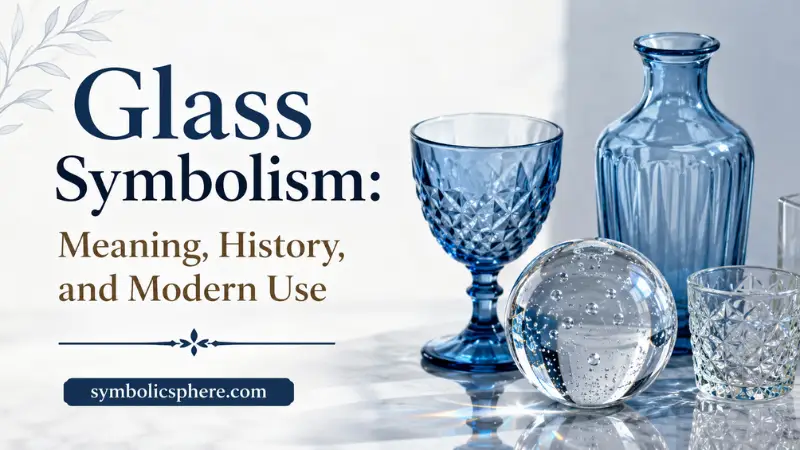
Glass is one of the most contradictory materials we live with. It’s transparent yet separating, beautiful yet breakable, protective yet vulnerable. A window lets you see through a wall without removing the boundary. A mirror hands your own image back to you. Those simple physical facts, combined with the long history of glass, are why glass symbolism shows up everywhere — in art, architecture, literature, memorials, tattoos, home decor, and everyday language.
In American culture, glass most often represents clarity, honesty, fragility, reflection, transformation, and invisible boundaries. But its meaning shifts with context: colored church windows suggest sacred light, a shattered window can mean damage or liberation, and a mirror can represent either self-awareness or vanity, depending on the story around it.
Quick Answer
Glass symbolism represents clarity, transparency, fragility, reflection, and transformation. Historically, it has also stood for luxury, craftsmanship, sacred light, and humanity’s ability to turn raw material into something extraordinary through fire and skill.
In short:
- Clear glass → honesty, openness, truth
- Fragile/cracked glass → vulnerability, instability
- Mirrors → identity, reflection, self-examination
- Stained glass → faith, memory, artistry
- Broken glass → loss, danger, or freedom, depending on context
- Art glass → transformation and individual craftsmanship
Why Glass’s Physical Nature Shapes Its Meaning
Glass lets you see through it while still being physically separated by it — visibility without full access. A clear window can feel open because nothing appears hidden, yet the pane is still a barrier. Someone on the other side may be visible and unreachable at the same time.
Glass also changes completely depending on how it’s treated: colorless or richly colored, paper-thin or structurally strong, polished into a mirror, shaped into a vessel, or shattered into fragments. That range lets glass hold opposing ideas without contradiction — strength and vulnerability, freedom and confinement, honesty and surveillance.
What Glass Commonly Symbolizes in the U.S.
Most everyday symbolism comes straight from lived experience with windows, mirrors, screens, drinking glasses, and broken objects.
| Context | Meaning in the USA | Common Associations | Notes |
|---|---|---|---|
| Clear glass | Transparency | Honesty, openness, truth | Common in architecture and metaphor |
| Mirror glass | Self-reflection | Identity, appearance, awareness | Can also suggest vanity |
| Broken glass | Disruption | Damage, danger, liberation | Meaning depends heavily on context |
| Stained glass | Sacred or artistic expression | Faith, memory, beauty | Common in religious architecture |
| Glass walls | Visible barriers | Exclusion, limitation, observation | Frequently used metaphorically |
| Art glass | Transformation | Creativity, craftsmanship, individuality | Strong ties to American studio art |
Because glass is part of daily life, its symbolism tends to feel intuitive rather than ceremonial — people understand it through physical experience more than tradition.
Clarity and Transparency: Glass as a Symbol of Truth
Clear glass lets light and vision pass through, which makes transparency one of its strongest modern meanings. A glass office wall suggests openness. A transparent container reveals exactly what it holds. Calling a person, process, or institution “transparent” implies nothing important is being hidden.
That gives clear glass a positive association with:
- Honesty
- Straightforward communication
- Accountability
- Emotional openness
But complete visibility has a cost — a glass room looks modern and open but offers little privacy. That’s why glass often symbolizes the tension between being known and being protected.
Fragility, Vulnerability, and the “Walking on Broken Glass” Idea
Everyone learns early that glass breaks — a dropped cup, a cracked window, a shattered frame. That makes fragility one of its most immediate meanings.
Symbolically, fragile glass often stands in for something valuable that needs careful handling: trust, emotional stability, innocence, reputation, or a relationship recovering from conflict. The phrase “walking on broken glass” pushes this further, suggesting a situation where every move carries risk.
Cracks matter too. A cracked pane may still hold together, but it no longer looks secure — a useful visual for a belief, relationship, or identity that’s been damaged without fully collapsing. This is also the idea behind glass as a symbol for vulnerability that stays visible after the injury.
Mirrors: Reflection and Identity
Once glass becomes reflective, its role changes. Instead of showing what’s beyond it, a mirror shows the viewer — which is why mirror glass connects so strongly to self-knowledge, identity, perception, and introspection.
In novels, films, and visual art, characters often meet mirrors during moments of doubt, transformation, aging, or identity conflict. The symbolism can turn negative too: constant attention to one’s reflection can suggest vanity, insecurity, or a distorted self-image.
Mirrors raise a useful question — does the reflection show reality, or only an image? That ambiguity is exactly why reflective glass works equally well in stories about self-discovery and stories about deception.
Transformation Through Fire and Craft
Glass starts as raw mineral ingredients and only becomes workable under intense heat — a physical transformation that makes it a natural symbol for change produced through pressure, skill, and difficulty.
Early glass wasn’t necessarily the clear substance we know today; ancient examples were often colored and opaque, and some early societies linked the material to valuable stone. Glassmaking history stretches back more than three millennia, with early production tied especially to Egypt, Mesopotamia, and the surrounding region. The Corning Museum of Glass, which holds the world’s largest glass collection, documents roughly 3,500 years of this history.
In personal symbolism, that transformation process can represent someone changed by demanding experience — not destroyed by it, but reshaped. The metaphor isn’t that suffering automatically improves a person; it’s that glass shows transformation that requires conditions strong enough to change form.
Windows and Invisible Boundaries
A window creates an opening without removing the wall, which is why window glass often symbolizes a threshold — between private and public life, home and the outside world, safety and danger, or observer and participant.
Someone standing at a window may be physically inside but mentally elsewhere, which is why windows show up so often in photography and storytelling during scenes of anticipation, loneliness, or longing.
Glass walls push the idea further — a barrier can be completely visible and still hard to cross. That’s the logic behind the American workplace term “glass ceiling”: the obstacle isn’t formally visible, but its effects are real.
Ancient Glass and the Meaning of Rarity
Modern households have so much glass it feels ordinary. Ancient societies experienced it very differently. Some of the earliest glass was colored in shades that resembled materials like lapis lazuli or turquoise, and historical evidence shows ancient people understood glass in relation to precious or semiprecious stone — not as a cheap substitute.
That history explains older associations with rarity, status, technical skill, beauty, and trade. As production improved over centuries, glass moved from rare luxury to a standard material in windows, containers, vehicles, electronics, and architecture — and its symbolism shifted right along with its availability.
Stained Glass: Sacred Light and Memory
Colored architectural glass created one of the material’s strongest religious associations. In medieval Europe, stained glass reached its height between roughly 1150 and 1500, appearing prominently in cathedrals, where colored light transformed the interior and windows told biblical stories to worshippers who often couldn’t read. According to the Met Museum’s Heilbrunn Timeline of Art History, most of what’s known about medieval glassmaking comes from a 12th-century monk, Theophilus, who documented the craft in detail. Stained glass wasn’t confined to churches — it also appeared in civic and domestic spaces.
American churches, synagogues, and memorial institutions continued and reinterpreted that tradition, commissioning stained-glass windows across the U.S. especially through the 19th and 20th centuries. So stained glass can represent more than religious belief — it often carries remembrance, community identity, and the preservation of stories.
American Art Glass and the Meaning of Beauty
In the late 19th and early 20th centuries, decorative glass became central to American design. Artists and workshops used variations in color, opacity, texture, and light to turn a window into a visual centerpiece rather than a plain opening.
Designers like John La Farge and Louis Comfort Tiffany helped connect glass with artistic luxury — some Gilded Age art-glass installations were explicitly tied to wealth, taste, and sophisticated interior design. That legacy still shapes how Americans see decorative glass today: a handcrafted window, sculptural vase, or art-glass lamp suggests individuality against mass-produced, standardized goods. In this sense, glass symbolizes beauty created through skilled human intervention.
The American Studio Glass Movement
A major shift happened in the 20th century when artists began treating hot glass as a medium for independent expression rather than a factory product. The American Studio Glass movement traces to workshops held in Toledo in 1962, where Harvey Littleton and Dominick Labino developed methods that let artists work with molten glass in small studio settings instead of industrial factories.
This widened what glass could symbolize. Contemporary artists began deliberately exploiting transparency, reflection, optical distortion, sharpness, bubbles, cracks, and apparent instability — glass stopped being merely something to look through and became the subject itself. Modern glass art often asks viewers to consider: what can be seen, what stays hidden, what looks strong but is fragile, and what changes when the light shifts.
Glass Symbolism Isn’t Universal — Context Matters
Different cultures have used glass for jewelry, vessels, beads, windows, ritual objects, and trade goods, developed under very different religious, economic, and artistic conditions. Ancient and medieval glass moved through extensive trade networks connecting Europe, Africa, the Middle East, and Asia, so it’s misleading to apply one fixed spiritual meaning to every glass object.
Color matters too — a blue trade bead, a red stained-glass panel, a mirrored ornament, and a clear drinking glass can carry entirely different meanings. When interpreting a specific piece, the safest approach is to consider where it came from, what it was used for, who made it, and what imagery goes with it.
Emotional and Psychological Associations
Glass works well as an emotional symbol because it combines visibility with uncertainty. People sometimes identify with glass when they feel:
- Exposed — others can see too much of their emotional life
- Fragile — a difficult experience has reduced their sense of security
- Guarded — visible, but still maintaining a barrier
- Reflective — reconsidering identity, decisions, or relationships
- Changed — reshaped by a demanding experience
- Clear-minded — confusion replaced by understanding
These are symbolic, not clinical, interpretations — glass has no scientifically fixed emotional definition. Its power comes from how easily physical experiences with it (seeing through, touching, breaking, or seeing your own reflection) translate into emotional language.
Glass in Tattoos, Jewelry, and Modern Decor
A broken-glass tattoo often represents surviving a painful transition or breaking away from restriction — an acknowledgment that life doesn’t always return to its previous form. A mirror tattoo tends to center on identity, self-awareness, or the gap between appearance and reality. Clear or transparent jewelry can suggest simplicity or openness, though the meaning usually depends more on the wearer than any fixed tradition. (Related: see our guide to [tattoo symbolism and meaning] if exploring this further.)
In home decor, large panes and transparent surfaces tend to signal modernity, openness, and light, while frosted glass allows light in while protecting privacy. In photography and film, reflections and shattered surfaces stay popular because a single image can suggest conflict, duplication, or fractured identity without any explanation.
Broken Glass: Damage, Freedom, or a New Beginning?
Broken glass doesn’t have one fixed meaning. Sometimes it clearly signals damage — a shattered family photo or a broken home window can suggest conflict or loss of safety. In other contexts, breaking glass represents escape from confinement: a barrier that once separated a person from freedom no longer exists.
It can also suggest irreversibility. You can repair a glass object, but the break usually stays visible — which makes shattered glass an effective symbol for events after which life continues but doesn’t return to exactly what it was. Broken glass shouldn’t be automatically romanticized as rebirth, though — in real life it’s hazardous, and in fiction, the surrounding story decides whether the destruction reads as tragic, liberating, or accidental.
Common Misconceptions About Glass Symbolism
- “Transparency is always positive.” Not quite — complete openness can also mean surveillance or lost privacy.
- “Broken glass always means bad luck.” Superstitions vary widely by culture; they shouldn’t be treated as universal.
- “Reflective glass always means vanity.” Mirrors can just as easily represent memory, aging, or careful self-examination.
- “All stained glass has the same meaning.” Interpret it through its actual imagery — the subject matters as much as the material.
The most accurate reading always considers the full context rather than assigning glass one fixed definition.
How Glass Symbolism Evolved Over Time
In ancient contexts, glass was relatively rare, colorful, and linked to luxury or stone-like beauty. As production improved, it became central to vessels, architecture, trade, and daily life. Religious architecture strengthened its ties to colored light and storytelling; American decorative artists later emphasized craftsmanship and individuality; and the 20th-century studio movement turned glass into a medium for exploring transparency, instability, and perception directly.
Today, glass carries traces of all of that history while still functioning as one of the most ordinary materials in American life — which is exactly what makes it symbolically powerful. Something this familiar suddenly becomes meaningful the moment it cracks, reflects a face, separates two people, catches colored light, or vanishes so completely that only the barrier remains.
FAQs
Is glass a positive or negative symbol?
Both. Clear, luminous glass tends to suggest honesty and openness, while cracked or shattered glass can suggest vulnerability, damage, or disruption.
What does broken glass symbolize spiritually?
There’s no single universal meaning. Depending on context, it can represent the end of a condition, freedom from restriction, emotional damage, or an irreversible transition.
What does a glass tattoo mean?
It usually centers on fragility, transparency, reflection, or transformation. Broken-glass designs often signal survival or change; mirror imagery leans toward identity and self-examination.
What does clear glass symbolize?
Transparency, honesty, visibility, and understanding — though its ability to reveal what’s behind it can also suggest exposure or reduced privacy.
Why is glass associated with fragility?
Because everyday experience makes it obvious: glass looks solid but can break instantly on impact, which makes it a natural symbol for trust and other valuable things that are hard to restore once damaged.
What does stained glass represent?
Sacred light, religious storytelling, remembrance, craftsmanship, or community identity — the precise meaning depends on the colors, figures, and setting of the individual window.
What do mirrors symbolize?
Reflection, identity, self-knowledge, and perception — and, depending on context, vanity, illusion, or the gap between someone’s public image and their inner self.
Conclusion
Glass symbolism centers on a set of contrasts: transparency and privacy, beauty and breakability, separation and visibility, reflection and distortion. Its meaning comes less from one fixed tradition than from the physical experiences people repeatedly have with it — looking through it, handling it, shaping it, breaking it.
Its history of glass adds further depth, from ancient luxury and colored glass, to sacred cathedral windows, to American decorative arts and modern studio sculpture. Today, a single pane can represent honest openness, an invisible barrier, emotional vulnerability, artistic transformation, or the difficult process of seeing yourself more clearly. Few everyday materials move so easily between being almost invisible and impossible to ignore.