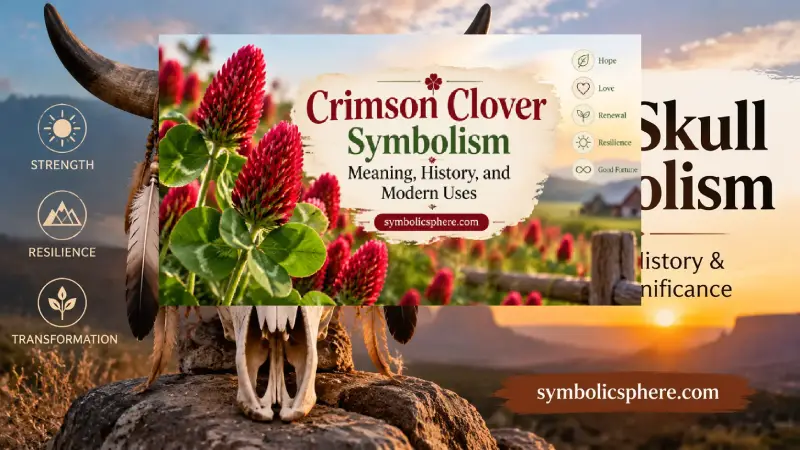
Crimson clover symbolism is easy to overlook at first glance — walk past a field in bloom during a mild American winter or early spring, and the plant itself is hard to miss: dense spikes of deep red rising above a carpet of green, often stretching across acres of farmland or a conservation planting. It’s a familiar sight to farmers, gardeners, and anyone who’s driven past a cover-cropped field, yet most people have never stopped to ask what the plant actually means.
That question turns out to be more interesting than it first appears. Crimson clover doesn’t come with the centuries of fixed romantic or religious symbolism attached to a rose or a lily. Instead, its meaning has been pieced together from several sources at once: the emotional weight of the color red, the folklore surrounding clover as a plant family, and — perhaps most importantly — its long, practical history as a workhorse of American agriculture.
This guide breaks down what crimson clover symbolizes, where those meanings actually come from, and how they show up today in gardens, tattoos, conservation programs, and personal symbolism — while also clearing up a few common mix-ups, like confusing it with the “lucky” four-leaf clover or its close botanical cousin, red clover.
Quick Answer
Crimson clover commonly symbolizes renewal, vitality, abundance, and commitment, especially in gardening and conservation contexts. Its red color adds associations with passion and energy, while its role as a farm cover crop connects it to fertility, sustainability, and stewardship of the land. It is not the traditional four-leaf “lucky” clover, and it’s a different species from red clover.
At a glance:
- Symbolizes renewal, vitality, abundance, and steady growth
- Red flowers add associations with passion and determination
- Broader clover folklore contributes ideas of luck and protection
- Valued by American farmers for soil health, forage, and erosion control
- Often used today as a symbol of sustainability and environmental care
- Distinct from both the Irish shamrock and the lucky four-leaf clover
What Is Crimson Clover?
Crimson clover (Trifolium incarnatum) is a cool-season annual legume native to Europe and the Middle East. In the U.S., it’s widely planted as a cover crop, forage plant, erosion-control ground cover, and pollinator habitat.
It’s easy to identify once flowering begins: densely packed, elongated flower heads made up of many small crimson florets, rising above leaves divided into the three leaflets typical of the Trifolium genus. Depending on growing conditions, plants typically reach one to three feet tall.
This practical, working-landscape context shapes its symbolism. Crimson clover isn’t a flower valued purely for beauty — it represents something that looks striking while also doing useful work, whether that’s feeding livestock, enriching soil, or supporting bees.
What Crimson Clover Symbolizes
Renewal stems from its growth cycle — establishing in cool weather, developing through winter in mild climates, then flowering conspicuously each spring before completing its annual cycle.
Vitality comes largely from color. Crimson is an intense shade of red, and red broadly signals life, warmth, courage, and energy across cultures.
Abundance reflects the plant’s agricultural role. As a nitrogen-fixing legume, clover has long supported livestock and improved soil fertility — making it a natural symbol of productive, self-sustaining growth.
Commitment is a more modern, interpretive layer. The plant’s quiet reliability — growing, working, and returning each year without fanfare — lends itself to metaphors about staying rooted in purpose.
Good fortune technically belongs to clover folklore more broadly, especially the rare four-leaf clover. Crimson clover can inherit some of that luck symbolism by association, but it isn’t the historical source of it.
Why Color Changes the Meaning
Color strongly shapes how people read flower symbolism. Red — and crimson specifically, toward the deeper end of the spectrum — can suggest love, courage, urgency, or celebration depending on context.
But crimson clover’s color rarely stands alone. Because the plant grows in working fields and meadows rather than formal gardens, its symbolism blends passion with practicality. A crimson clover image can suggest strong feeling or determination without carrying the formal romantic weight of a red rose — a useful distinction for anyone using it in art, tattoos, or garden design.
The Three-Leaf Connection to Broader Clover Tradition
Clover’s three-part leaf carries centuries of symbolic weight, most famously through the Irish shamrock and its association with the Christian Trinity — tied to the legend of St. Patrick using a three-leafed plant to explain the concept of Father, Son, and Holy Spirit. (The historical accuracy of that story is debated, and “shamrock” was never one single defined species.)
Crimson clover shares the genus but not the cultural lineage — its symbolism developed separately, through European agriculture rather than Irish religious tradition. Still, the three leaflets naturally invite modern interpretations of unity, balance, and cooperation — three parts functioning as one — making it a fitting symbol for family, partnership, or shared purpose.
Clover, Luck, and the Four-Leaf Exception
It’s worth separating crimson clover clearly from the four-leaf clover, since the two get conflated often.
The four-leaf clover’s luck symbolism comes specifically from its rarity — a genetic exception to the standard three-leaflet pattern. Crimson clover doesn’t typically produce four leaflets, and its cultural meaning isn’t built around that rarity at all. Its symbolism instead comes from its red flower, its agricultural usefulness, and its seasonal growth cycle.
So while crimson clover can carry some luck association through general clover folklore, describing it as a “lucky” plant in the four-leaf sense isn’t accurate.
Related reading: for a deeper dive into four-leaf clover mythology, or a side-by-side comparison of crimson clover vs. red clover, see our related guides.
Crimson Clover and Agricultural Abundance
The clearest way to understand this plant’s symbolism is to look at what it does. As a legume, crimson clover partners with soil bacteria to fix atmospheric nitrogen — a natural process that improves soil fertility. Farmers plant it as a cover crop to suppress weeds, reduce erosion, and add organic matter back into the soil. It also serves as livestock forage and wildlife habitat.
| Context | Common Meaning | Key Associations |
|---|---|---|
| Garden | Renewal, natural beauty | Growth, spring, pollinators |
| Agriculture | Abundance, stewardship | Fertile soil, forage, regeneration |
| Conservation | Environmental responsibility | Soil health, habitat, sustainability |
| Personal symbolism | Vitality, commitment | Perseverance, grounded growth |
| Clover folklore | Luck, prosperity | Good fortune (stronger for four-leaf clover) |
This gives crimson clover a symbolism of productive abundance — growth that exists to benefit something beyond itself. For more on how legume cover crops function agriculturally, the USDA Natural Resources Conservation Service offers detailed guidance on cover cropping practices.
What Crimson Clover Represents in the U.S.
American gardeners and farmers most often encounter crimson clover through cover cropping, conservation plantings, and pollinator gardens — a distinctly practical context that shapes its meaning here.
In this setting, crimson clover symbolizes responsible growth: improving the land while producing something visually striking. It aligns naturally with contemporary values around soil health, pollinator support, and regenerative agriculture — reflecting a broader American appreciation for plants that are useful and attractive, not delicate or purely ornamental.
Emotional and Personal Symbolism
Plant symbolism often starts with observable traits and becomes emotional metaphor from there. Crimson clover’s color suggests enthusiasm and intensity; its seasonal flowering suggests optimism after dormancy; its soil-building role suggests rebuilding after depletion.
As a personal symbol, people sometimes connect crimson clover to:
- Starting over after a difficult period
- Staying productive without seeking recognition
- Building something that benefits others
- Turning depleted ground into something fertile
- Balancing beauty with usefulness
Compared to more dramatic symbols — a phoenix’s sudden rebirth, a rose’s intense passion — crimson clover suggests something quieter: steady renewal that becomes visible when conditions are right.
Is Crimson Clover a Religious or Spiritual Symbol?
Not in any standardized sense. The broader clover family carries Christian symbolism through the shamrock-Trinity legend, but that tradition doesn’t extend specifically to crimson clover as a species.
In modern spiritual or nature-based contexts, people sometimes read the three leaflets as unity or balance, and the seasonal growth cycle as renewal — but these are personal or contemporary interpretations, not established religious doctrine.
Modern Uses: Tattoos, Art, and Decor
Crimson clover’s distinctive silhouette and color make it well-suited to contemporary nature-inspired design:
- Tattoos: Often chosen to represent renewal, groundedness, or personal growth — particularly after a period of change.
- Home decor: Fits rustic, cottage, farmhouse, and botanical themes, pairing well with grasses and wildflower motifs.
- Jewelry: Clover shapes generally suggest luck or prosperity; crimson coloring adds warmth and vitality to that association.
- Social/gardening content: Frequently appears in posts about pollinators, sustainable gardening, and seasonal change, usually with a personal rather than formal symbolic meaning.
Common Mix-Ups to Avoid
- “Crimson clover has one fixed meaning.” It doesn’t — its symbolism is assembled from botany, color psychology, folklore, and agriculture rather than one historical source.
- “Crimson clover and red clover are the same plant.” They’re not. Crimson clover is Trifolium incarnatum; red clover is Trifolium pratense. Related, but distinct species with different appearances and uses.
- “All clover references mean Irish luck.” Clover symbolism is broader than St. Patrick’s Day imagery, and crimson clover in particular has little to do with that tradition.
How the Meaning Has Evolved
Older agricultural cultures valued clover primarily for practical reasons — forage and soil fertility — while European folklore layered on ideas of luck and protection, and Christian tradition added the shamrock’s Trinity symbolism.
Today, Americans mostly encounter crimson clover through gardening, cover cropping, and conservation work, which has shifted its symbolism toward environmental responsibility and ecological renewal. The older meanings haven’t disappeared — they’ve simply been joined by new ones. A crimson clover field can still represent abundance while also representing soil health; its red flowers can still evoke vitality while its role in a conservation planting suggests stewardship.
FAQs
What does crimson clover symbolize?
Renewal, vitality, abundance, and commitment — with its red color adding associations of passion and energy, and its agricultural role reinforcing themes of fertility and stewardship.
Does crimson clover symbolize love?
It can, in a personal or modern context, mainly because of its red color. However, it doesn’t carry the standardized romantic symbolism of a red rose.
Does crimson clover mean good luck?
Only loosely, through general clover folklore. The primary luck symbol is the four-leaf clover, not crimson clover specifically.
Is crimson clover the same as red clover?
No. Crimson clover (Trifolium incarnatum) and red clover (Trifolium pratense) are different species, though both are used as forage and cover crops.
What does a crimson clover tattoo mean?
Commonly renewal, perseverance, or environmental connection, with the three-part leaf adding themes of unity or balance.
Conclusion
Crimson clover pairs striking color with genuine usefulness, giving it a distinctive place among plant symbols. Its red flowers suggest vitality and warmth, its three-part leaves connect it to broader clover tradition, and its agricultural role ties it to renewal, abundance, and stewardship — particularly through its widespread use as a cover crop, where it fixes nitrogen, suppresses weeds, and prevents erosion.
In the U.S. especially, crimson clover symbolism resonates with modern values around soil health, pollinators, and sustainable land use — a meaning grounded not in invented legend, but in what the plant actually is and does. Perhaps that’s its most fitting message: growth can be beautiful without being separate from usefulness.


