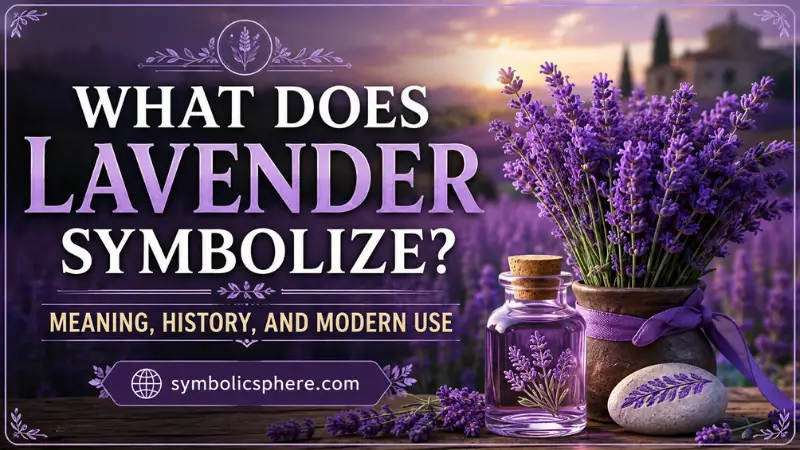
Lavender is both a fragrant herb and a soft purple color, which gives it an unusually wide symbolic range. In modern American culture, the symbolism of lavender centers on calm, comfort, gentle affection, cleanliness, remembrance, and personal renewal — associations reinforced by its familiar scent in soaps, candles, and relaxation products.
But lavender hasn’t always carried peaceful meanings. Its history spans bathing and fragrance traditions, nineteenth-century flower-language symbolism, and a complicated, important place in LGBTQ+ history. Depending on the setting, lavender can suggest serenity, devotion, nostalgia, individuality, or — in older texts — distrust.
Quick Answer
Lavender most commonly symbolizes calm, comfort, gentle affection, purity, and emotional renewal in modern American culture. Historically, it was tied to washing, fragrance, and nineteenth-century flower symbolism, while the color later took on significant meaning within LGBTQ+ identity and history. (NCCIH)
At a glance:
- Represents calm, comfort, cleanliness, and gentle affection today
- Its fragrance links it to rest and self-care
- Victorian flower books sometimes assigned it the meaning of distrust
- As a color, it suggests softness, individuality, and understated elegance
- Carries major LGBTQ+ historical significance in the U.S.
- Its exact meaning shifts depending on whether the flower, scent, or color is intended
Why Lavender’s Appearance Shapes Its Meaning
Lavender (genus Lavandula) is native to the Mediterranean and known for narrow gray-green leaves and upright spikes of small purple, violet, or blue-purple blooms. English lavender, Lavandula angustifolia, is the most widely cultivated variety. (NCCIH)
That appearance feeds directly into its symbolism. Lavender doesn’t have the scale of a sunflower or the romantic intensity of a red rose — its small blossoms form tidy, restrained spikes that read as soft rather than showy, especially paired with its silvery foliage. This visual restraint is part of why lavender signals composure and quiet refinement rather than drama.
Scent matters just as much as appearance. Because most people encounter lavender through fragrance — bath products, linens, spas — its symbolism is closely tied to memory and intimate, domestic spaces.
What Lavender Commonly Means in the U.S.
| Context | Common Meaning | Typical Associations | Notes |
|---|---|---|---|
| Lavender flowers | Affection and serenity | Gardens, bouquets, gifts | Gentle rather than passionate |
| Lavender scent | Rest and comfort | Candles, baths, bedrooms | Central to wellness culture |
| Lavender color | Softness and individuality | Fashion, decor, branding | Lighter than dark purple |
| Dried lavender | Memory and comfort | Sachets, keepsakes | Often nostalgic |
| Lavender in identity | Pride and visibility | LGBTQ+ history and culture | Meaning depends on context |
A bouquet may express affection while lavender-colored clothing simply reads as understated elegance — these meanings coexist without contradicting each other.
Why Lavender Became a Symbol of Calm
Lavender’s strongest modern association is tranquility, reinforced by decades of use in bedtime, bathing, massage, and relaxation products.
There’s a scientific thread here too: reviews of clinical research suggest lavender aromatherapy may reduce anxiety in some settings, though study methods and results vary considerably. That makes it an active area of research rather than settled proof of a universal calming effect. (PubMed)
Culturally, though, the association is already firmly established — a lavender-scented room or bath product reliably signals a deliberate shift away from stimulation and toward rest, which is why lavender tends to represent quiet rather than excitement.
Cleanliness: One of Lavender’s Oldest Meanings
Lavender’s name is traditionally linked to the Latin lavare (“to wash”), and the plant has long been used in scented bathing, soaps, perfumes, and household fragrance. (NCCIH)
This history explains why lavender still suggests freshness and purification today — though in most modern American contexts, that meaning is practical rather than spiritual: fresh sheets, a clean bathroom, freshly washed laundry. Compared to sharper “clean” scents that can feel sterile, lavender communicates cleanliness with warmth.
Lavender in Nineteenth-Century Flower Language
Lavender’s historical flower meaning is more complicated than most modern gift guides suggest.
Nineteenth-century “language of flowers” books assigned emotional meanings to plants, though the system was never standardized — different books often disagreed. Lavender is a notable example: several nineteenth-century flower dictionaries listed it as a symbol of distrust, a meaning confirmed in at least one digitized period volume. (Internet Archive)
This surprises modern readers, since today’s lavender symbolism is almost entirely soothing. The takeaway: Victorian flower meanings reflected changing literary conventions, not fixed rules. Few people today would read a gift of lavender as an accusation of dishonesty — but the “distrust” meaning deserves acknowledgment when historical accuracy matters.
Lavender as a Symbol of Love and Devotion
Lavender represents a quieter form of love than red (passion) or pink (sweetness) typically convey — affection that feels calm, thoughtful, and a little unconventional.
Its gentle character, rather than an intense romantic one, makes it well suited to:
- Close friendships and supportive relationships
- Quiet romantic affection
- Thoughtful, sentimental gifts
- Remembrance and long-term commitment
Tender love comes through in its soft color, which reads gentler than deep red. Steady affection is reinforced by dried lavender’s long-lasting scent, tying it to enduring bonds. Care follows naturally from lavender’s association with rest and well-being — giving it can imply concern for someone’s peace of mind.
This devotion symbolism is best understood as a modern, evolved association rather than a fixed historical rule, given that nineteenth-century sources record less flattering meanings.
What the Color Lavender Means
As a color, lavender sits within the purple family but reads lighter and less dominant than royal purple, plum, or violet — carrying some of purple’s associations with creativity and individuality, plus extra softness and accessibility.
In American fashion and design, lavender color meaning can include:
- Gentleness and calm sophistication
- Imaginative style and personal individuality
- Femininity — though increasingly used in gender-neutral design too
- Spring freshness and romantic softness
Its pale tone suits restful spaces rather than dramatic ones, though the color’s exact effect depends heavily on the palette surrounding it.
Lavender in LGBTQ+ History and Identity
Lavender holds an especially significant place in American LGBTQ+ history.
During the twentieth century, “lavender” was sometimes used as a coded or derogatory reference to homosexuality. In the U.S., the term became prominent through the Lavender Scare — the federal government’s Cold War–era campaign to identify and dismiss gay and lesbian employees, which damaged careers and lives while later fueling LGBTQ+ political organizing. (Library of Congress)
The word didn’t stay a hostile label. Activists later reclaimed it: the Lavender Menace, for instance, became associated with lesbian feminist activism around 1970. (Library of Congress Research Guides)
Because of this history, lavender can symbolize identity, visibility, resistance, and the transformation of stigma into pride — a meaning that’s relevant specifically in contexts involving LGBTQ+ history, activism, or cultural memory, not something applied to every lavender flower or object.
Lavender in Emotional and Psychological Symbolism
Lavender often communicates a state between withdrawal and openness — not aggressive, but not invisible either, thanks to its distinctive scent.
People use it to signal:
- Calmness — the most familiar interpretation
- Sensitivity — pale purple can suggest emotional softness
- Self-care — a fixture of rest-oriented personal routines
- Reflection — suited to journaling spaces, bedrooms, or contemplative decor
- Emotional recovery — moving toward calm after stress or upheaval
These are cultural interpretations, not psychological rules — someone can simply love lavender for its color or scent.
Lavender in Weddings, Mourning, and Keepsakes
Weddings. Lavender’s gentle, adaptable symbolism makes it a natural fit for bouquets, table settings, and favors — often suggesting devotion, tranquility, and hope for a peaceful partnership. It pairs easily with white, cream, sage green, gray, and blush, working in both rustic and formal settings.
Mourning and remembrance. Lavender’s memorial associations come less from formal American mourning tradition and more from its ties to memory and lasting fragrance — dried lavender can act as a sensory reminder of a person or place. In sympathy arrangements, it conveys care without the intensity of brighter flowers, though it isn’t a universal funeral flower; customs vary by family, religion, and region.
Tattoos and jewelry. Lavender tattoos usually emphasize calm, resilience, remembrance, or gentle identity, and the plant’s narrow, minimal form suits small designs well. Common personal meanings include finding peace after a hard period, honoring a loved one, or — in the right context — expressing LGBTQ+ identity. As with any tattoo, the wearer’s intended meaning outweighs any traditional interpretation.
Lavender in Modern Homes, Fashion, and Digital Design
Beyond gardens, lavender color shows up in bedrooms, bathrooms, nurseries, and textiles, typically to make a space feel softer and less visually demanding. In fashion, it can read as romantic, playful, or polished, sitting distinctively between conventional pastels and true purple.
Digital and wellness branding has leaned on lavender heavily too — think illustrations, beauty packaging, and the social-media aesthetic built around tea, candles, baths, and quiet interiors. This is a recent commercial development, not an ancient symbolic tradition, and it’s a good example of how everyday habits can reshape what a symbol means.
Spiritual Meaning — and a Common Biblical Misconception
Modern spiritual writing sometimes assigns lavender meanings like purification, protection, or healing. These can be meaningful personal interpretations, but they shouldn’t be presented as ancient religious doctrine.
One claim worth correcting: that biblical “spikenard” was simply lavender. Modern botanical classification identifies spikenard as Nardostachys jatamansi, native to the Himalayas — a different plant from Lavandula species entirely. (Plants of the World Online) Biblical references to nard, in other words, aren’t solid evidence of a specific biblical meaning for lavender itself. Using lavender in prayer or memorial practice today is a personal devotional choice, not an established scriptural one.
Common Misconceptions About Lavender Symbolism
- “Lavender has always meant peace.” Not true — nineteenth-century flower-language books recorded meanings as unflattering as distrust.
- “All purple shades symbolize the same thing.” Dark purple, violet, lilac, and pale lavender look related but carry different cultural associations.
- “Lavender has one universal spiritual meaning.” Religious, folkloric, commercial, and personal interpretations get blended together too often, despite coming from separate traditions.
- “Lavender’s calming effect is medically proven.” The National Center for Complementary and Integrative Health notes that research on lavender varies by preparation and condition, with evidence still limited for several proposed uses. (NCCIH)
How Lavender’s Meaning Evolved Over Time
Lavender’s symbolism built up in layers. Its earliest identity was practical — a fragrant plant tied to bathing, household use, and cultivated gardens, which encouraged associations with freshness and cleanliness. Nineteenth-century flower-language traditions then turned it into a coded emotional symbol, with some dictionaries assigning it the unexpected meaning of distrust.
In the twentieth century, lavender took on a major new layer through its use in language around homosexuality, the Lavender Scare, and later LGBTQ+ activism. Meanwhile, consumer culture kept strengthening its ties to sleep, spas, and relaxation.
All of these layers exist simultaneously today, but rarely at once — a sprig on a wedding invitation carries a very different meaning from a historical reference to the Lavender Scare. Context decides which meaning applies.
FAQs
What does lavender symbolize most commonly?
Calm, comfort, gentle affection, cleanliness, and peacefulness — associations shaped largely by its use in bathing and relaxation products.
Is lavender a symbol of love?
Yes. It represents tender or devoted love, offering a gentler message than the passion associated with red roses, and works for both romantic and platonic affection depending on context.
What does a lavender tattoo mean?
Commonly peace, healing, remembrance, individuality, or quiet resilience — and for some, LGBTQ+ identity or pride.
Does lavender have a negative meaning?
Historically, yes — some nineteenth-century flower-language books listed it as a symbol of distrust, though that meaning is rarely used in modern American flower-giving. (Internet Archive)
What does the color lavender symbolize?
Softness, calm, imagination, and individuality, with additional LGBTQ+ cultural significance in certain contexts.
Is lavender mentioned in the Bible?
Not directly — claims linking lavender to biblical “spikenard” are botanically inaccurate, since spikenard is identified as Nardostachys jatamansi, a different plant from the Lavandula genus. (Plants of the World Online)
Is lavender appropriate for sympathy or memorial flowers?
Yes. It conveys gentle remembrance and comfort without an overly dramatic tone, though appropriateness ultimately depends on family and personal tradition.
Conclusion
The symbolism of lavender comes down to calm, comfort, gentle affection, cleanliness, memory, and individuality — associations built from its fragrance, domestic uses, and pale purple color. Its history adds real complexity: nineteenth-century flower books once linked it to distrust, while twentieth-century American history gave it lasting significance within LGBTQ+ experience and activism. (Library of Congress)
There’s no single meaning that applies everywhere. As flower symbolism has changed across cultures and history, lavender’s symbolism shifts with the flower, scent, color, occasion, and community using it — and that context is what makes the symbol worth understanding closely.