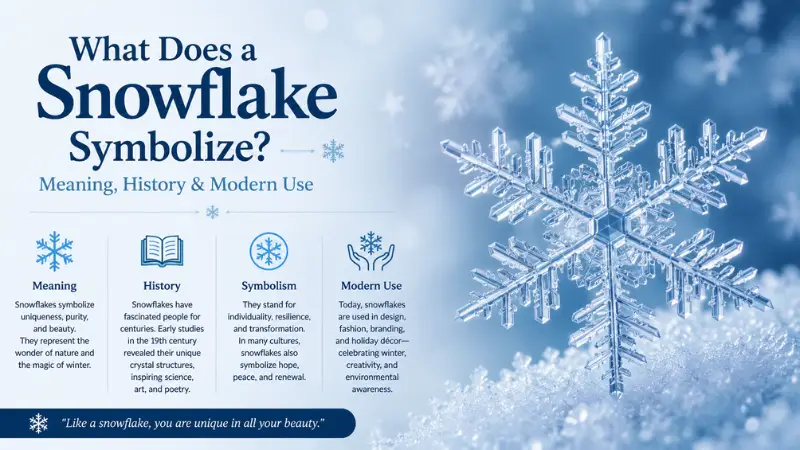
Snowflakes are tiny ice crystals, but their six-sided forms have come to mean far more than winter weather. Snowflake symbolism most often centers on individuality, purity, transformation, delicacy, and the fleeting nature of life.
In the United States, the snowflake is inseparable from winter culture — holiday cards, sweaters, ornaments, classroom crafts, weather graphics, jewelry, tattoos, and social media posts. Its meaning shifts with context: one person sees uniqueness, another sees Christmas, another sees renewal after a hard season.
The symbol also carries a newer, sharper edge. Since the 2010s, calling someone a “snowflake” has become a disparaging label for a person seen as overly sensitive or convinced of their own specialness — a meaning quite different from the snowflake’s older artistic and natural associations.
Quick Answer
Snowflake symbolism represents individuality, purity, change, and fragile beauty, because each complex ice crystal forms its own unique shape and disappears almost as quickly as it appears.
Key Takeaways
- Snowflakes commonly symbolize individuality because each complex crystal develops a distinctive form.
- Their white color links them to purity and fresh starts.
- Their brief existence represents impermanence and living in the present.
- Americans strongly associate snowflakes with winter and holiday imagery.
- Modern slang gives “snowflake” a separate, negative social meaning.
What a Snowflake Actually Is
A snowflake begins high in the atmosphere when water vapor freezes around a tiny particle. As the crystal grows and drifts through changing temperature and humidity, its structure branches out in different directions — no two paths are ever quite the same.
The familiar star shape is only one possibility. Snow crystals can also form as plates, columns, needles, or branched dendrites. Ice’s underlying molecular structure is what produces the sixfold symmetry people recognize most readily.
That physical structure is exactly what makes the snowflake symbolically powerful: it combines order and variation. It follows a strict natural rule (six sides), yet its final shape reflects the specific conditions it passed through — a near-perfect visual metaphor for human individuality. People share basic needs and biology, yet personal history shapes every life differently.
The Core Meanings of a Snowflake
Most interpretations trace back to a handful of observable features: whiteness, individuality, symmetry, coldness, transformation, and short existence.
| Context | Common Meaning | Association | Notes |
|---|---|---|---|
| Personal symbolism | Individuality | Uniqueness, identity | Popular in tattoos and jewelry |
| Emotional symbolism | Fragility | Sensitivity, vulnerability | Reads as positive or negative depending on tone |
| Seasonal symbolism | Winter | Snow, cold, holidays | Common in December decor |
| Spiritual symbolism | Purity | Cleansing, renewal | Often tied to white snow imagery |
| Natural symbolism | Transformation | Water becoming ice | Suggests change and adaptation |
| Modern slang | Oversensitivity | Fragility, entitlement | Usually used as an insult |
No single interpretation fits every use. A snowflake necklace chosen to honor someone’s individuality has little in common with a snowflake icon on an air conditioner — even though both use the same shape.
Why Snowflakes Became Symbols of Uniqueness
The claim that “no two snowflakes are alike” is largely responsible for the symbol’s modern emotional pull. Complex snow crystals form under constantly shifting atmospheric conditions; according to the Library of Congress, the odds of two large, intricate snow crystals developing as exact duplicates are effectively negligible.
The metaphor writes itself: people can share a family, school, or generation without living identical lives.
American photographer Wilson Bentley helped turn that scientific observation into something the public could actually see. Working on a Vermont farm, Bentley successfully photographed a snow crystal through a microscope in 1885, and went on to capture more than 5,000 snow-crystal images over his lifetime. His photographs revealed forms that vanish too quickly for the naked eye to study — proof that snowflakes weren’t just white specks, but visible examples of extreme variation within one shared structure.
That idea now shows up everywhere from graduation cards to personalized jewelry and tattoo designs.
Purity, Cleanliness, and Fresh Starts
Fresh snow can transform a landscape almost instantly, blanketing roads, roofs, and fields under one unbroken white surface. That visual effect is a big part of why snowflakes symbolize purity, cleanliness, and starting over.
Color plays a role too. In Western symbolism, white has long stood for cleanliness, innocence, peace, and ceremonial purity — and snow reinforces that association by seeming to cover flaws beneath a fresh layer.
Worth noting: this symbolism belongs more naturally to fresh snow as a whole than to a single crystal. Someone who adopts a snowflake as a symbol after a major life change may see it as a marker of a new chapter — but that’s a personal reading, not a universal rule.
Fragility and the Temporary Nature of Life
A snowflake can form through a remarkably complex process, then disappear seconds after landing on a warm hand. That contrast gives it a second major meaning: impermanence.
In art and personal symbolism, a melting snowflake can suggest that beautiful moments don’t need to last forever to matter — childhood, relationships, seasons, and life stages all pass. The tone can be bittersweet or simply appreciative: notice what’s here, because it will change.
This meaning suits photography, poetry, memorial art, and tattoos concerned with memory and time particularly well.
Fragility shouldn’t be mistaken for weakness, though. A single snowflake is delicate, but accumulated snow can reshape entire landscapes — which lets the symbol represent vulnerability and collective strength at once.
Transformation and Renewal
A snowflake is water in a temporary state. It forms from atmospheric moisture, becomes ice, falls, melts, and eventually rejoins the water cycle — a natural process that makes transformation a reasonable reading of the symbol.
In personal symbolism, a snowflake may represent:
- Leaving an old identity behind
- Adapting to changing circumstances
- Rebuilding after difficulty
- Accepting a temporary stage of life
- Recognizing that change doesn’t erase continuity
Unlike the phoenix, which represents dramatic destruction and rebirth, the snowflake suggests quieter, cyclical change rather than an explosive one — making it well suited to transitions that feel both beautiful and uncertain.
Symmetry, Order, and Balance
The sixfold structure of snow crystals points to another association: natural order. Snowflakes look intricately designed even though their shapes emerge from ordinary physical processes — their symmetry comes from ice’s molecular structure, while temperature and moisture shape how each crystal grows.
That mix of rule and variation can symbolize balance between structure and freedom. Designers often lean on snowflake geometry for this reason: the repeating branches create visual balance without making every design look identical.
The fascination isn’t new. Johannes Kepler devoted an entire essay in 1611 to the question of why snowflakes display sixfold symmetry — centuries before modern crystallography could fully explain it.
What Snowflakes Mean in American Winter Culture
In the U.S., snowflakes are first and foremost seasonal symbols. They appear when stores switch to winter displays, schools start December crafts, and weather forecasts predict snowfall. Paper snowflakes remain a classic children’s activity because folding and cutting paper naturally produces symmetrical designs.
The snowflake also does something useful: it evokes winter without requiring religious content. A Christmas tree, Nativity scene, or menorah signals a specific tradition; a snowflake just means winter. That’s why businesses, schools, and public spaces often lean on snowflakes for inclusive seasonal decor.
In snowy regions, the symbol may evoke sledding, ski trips, snow days, or childhood memories. In warmer states, it tends to function more as an imagined winter aesthetic than a lived experience.
Snowflakes as Symbols of Individuality and Identity
Modern American culture often encourages people to “be unique,” which makes the snowflake an easy identity symbol. A pendant might celebrate a child’s individuality; a tattoo might mark independence after a hard chapter; artwork with varied snowflakes might represent diversity within a family or group.
There’s a subtle but important distinction between individuality and isolation. Snowflakes are each different, yet snowfall itself is collective — one crystal is small, but millions together can change visibility, sound, and an entire landscape. That’s what makes the image work for groups who want to express “different individuals, shared community,” without implying that being unique means standing apart from everyone else.
Religious and Spiritual Interpretations
No single tradition assigns the snowflake one fixed meaning. In modern Christian interpretation, snowflakes are sometimes linked to purity, creation, divine order, or renewal — but it’s worth separating snow imagery in the Bible from any specific doctrine about snowflakes themselves.
Biblical passages use snow’s whiteness as imagery for cleansing and purity; some modern Christians extend that imagery to individual snow crystals, especially in devotional art or Christmas messaging. Outside formal religion, people also use the snowflake spiritually to represent change, stillness, or life’s impermanence — personal interpretations rather than established teaching.
Snowflake Meanings Across Cultures
Snow is experienced differently depending on geography, climate, and local tradition, so it’s risky to claim one worldwide meaning.
Japan offers a distinct example: during the Edo period, close observation of snow crystals inspired decorative snow patterns on kimono and accessories, appreciated as elegant seasonal motifs rather than symbols of cold. In Europe and North America, scientific interest in snow crystals — through microscopy and photography — did more to shape their aesthetic appeal, influencing illustration, printing, and seasonal design.
Across cultures, recurring threads include winter, transience, beauty, and natural pattern — but meaning is best tied to a specific tradition rather than treated as universal folklore.
Snowflake Tattoos and Jewelry
Snowflake tattoos tend to be highly personal. The most common intent is individuality — the wearer identifying with the idea that everyone’s experiences shape a different life. Other common motivations include change, resilience, winter memories, family, a love of cold climates, or remembrance of a specific place or time.
Design changes the tone: a small, minimalist snowflake suggests simplicity or quiet individuality; a detailed geometric crystal emphasizes structure; a melting snowflake leans into impermanence; and a cluster of different snowflakes can represent family members or a group of distinct people.
Snowflake jewelry generally carries lighter associations — popular as winter fashion and holiday gifting — though personalized pieces can still represent uniqueness or a meaningful winter memory. Neither tattoos nor jewelry follow a fixed rulebook; the wearer’s own reason matters more than any symbol dictionary.
Snowflakes in Decor, Fashion, and Digital Culture
The snowflake is one of the easiest visual shortcuts for “winter.” Retailers use it on sweaters, wrapping paper, ornaments, mugs, and packaging, where it usually just signals a festive atmosphere rather than anything spiritual.
Digital culture has extended that role. The ❄️ emoji can indicate cold weather, snowfall, winter sports, or holiday-season vibes, and Unicode includes it as a standardized character for text and messaging. Snowflake-style icons also appear on appliances and vehicle controls to indicate cooling or freezing settings — proof that, outside personal symbolism, context decides meaning far more than the shape itself.
How “Snowflake” Became an Insult
Modern American slang has attached a sharply different meaning to the word. Calling someone a “snowflake” can imply they’re overly sensitive, easily offended, entitled, or overly convinced of their own specialness — a sense now documented by Merriam-Webster.
The insult became especially visible in political and cultural arguments during the 2010s, often aimed at younger people, activists, students, or ideological opponents. Its history runs deeper than that recent usage, though: Merriam-Webster has traced an older American political use back to Civil War–era Missouri, where “Snowflake” referred to certain opponents of abolition — a highly specific historical use that shouldn’t be read as a direct ancestor of today’s slang.
Either way, the modern insult flips traditional symbolism on its head. Instead of treating uniqueness and delicacy as positive traits, it turns them into an accusation of self-importance or weakness — which is why calling someone a snowflake can land as dismissive or politically charged even without an explicit political argument attached.
How the Meaning Changed Over Time
Snowflake symbolism didn’t form all at once. For centuries, snow was mostly an environmental reality and seasonal image. Scientific observers gradually turned their attention to the individual crystal: Kepler examined sixfold symmetry in the early 1600s, microscopy later revealed finer detail, and photography — especially Wilson Bentley’s nineteenth- and early twentieth-century work — made that variety visible to the American public for the first time.
That visual evidence strengthened the link between snowflakes and individuality. Twentieth- and twenty-first-century advertising, holiday culture, jewelry, tattoos, digital icons, and social media then expanded the symbol further, layering meaning on meaning.
Today’s snowflake carries several associations at once: nature, winter, uniqueness, purity, transience, transformation — and, in certain conversations, oversensitivity. Context usually makes clear which one is intended.
FAQs
What does a snowflake symbolize spiritually?
A snowflake can spiritually represent purity, change, individuality, stillness, or life’s temporary nature. These are generally modern, personal interpretations rather than part of one universal spiritual tradition.
Is a snowflake a positive symbol?
Usually, yes. In art, jewelry, tattoos, and seasonal design, it typically suggests individuality, winter beauty, purity, or renewal. The main exception is the slang use of “snowflake” as an insult for someone seen as overly sensitive.
What does a snowflake tattoo mean?
A snowflake tattoo often represents uniqueness, personal change, independence, or appreciation for life’s fleeting moments. It can also commemorate winter, a cold-weather hometown, or a meaningful experience tied to snow.
What does a snowflake symbolize in Christianity?
Christians may associate a snowflake with purity, creation, renewal, or divine order. The Bible uses snow’s whiteness as imagery for cleansing, but it doesn’t establish a specific theological meaning for individual snowflakes.
Do snowflakes symbolize uniqueness because no two are alike?
Yes — this is the main reason uniqueness became linked to snowflakes. Complex crystals form under constantly shifting atmospheric conditions, making exact duplicates extraordinarily unlikely, and Wilson Bentley’s photography helped popularize that visible variety.
What does the snowflake emoji mean?
The ❄️ emoji usually signals snow, freezing temperatures, winter, winter sports, or holiday-season atmosphere — and sometimes an icy or wintry mood more generally.
Can a snowflake represent resilience?
Yes, though this is more of a modern personal reading than a traditional meaning. It can represent surviving difficult conditions, adapting through change, or the idea that many fragile individuals can build something much larger together.
Conclusion
A snowflake carries meaning because its physical traits naturally invite comparison to human experience: its distinctive form suggests individuality, its whiteness suggests freshness and purity, its changing state suggests transformation, and its brief existence makes it an effective symbol for impermanence.
In American culture, snowflake symbolism is also inseparable from winter — holidays, snow days, seasonal design, jewelry, tattoos, and digital communication all shape how the image is read. The modern slang insult adds a new layer, but it hasn’t erased the older, more generous associations.
Perhaps the simplest takeaway is also the most useful: nature can follow the same basic pattern without ever producing the same result twice.


