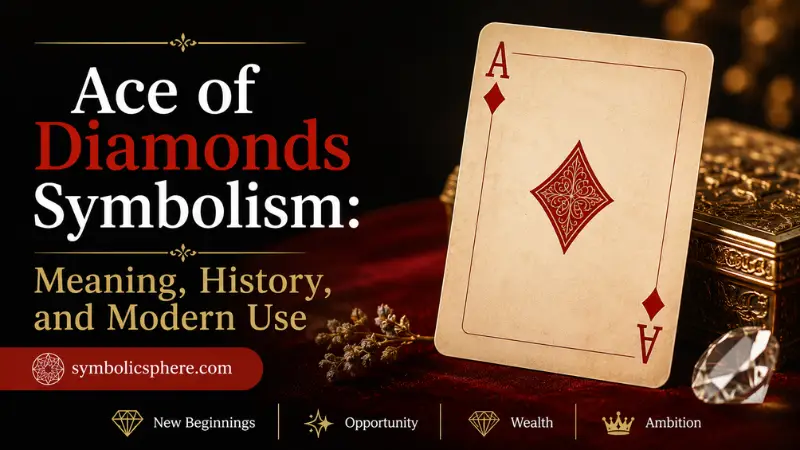
Pull an ace of diamonds out of a deck and it doesn’t look like much — a single red pip on a plain white card. But that plainness is deceptive. Of the four aces, it’s the one most consistently tied to money, whether someone is reading it across a card table, laying it out in a cartomancy spread, or picking it as a tattoo design. The ace of diamonds is one of the four aces in a standard 52-card deck, and its meaning has shifted quite a bit depending on who’s reading it — a gambler, a fortune teller, or someone getting a small tattoo. In American card culture, the ace of diamonds symbolism most often points to money, ambition, and new beginnings tied to material gain, while in older European cartomancy traditions it carried a mix of warnings about greed alongside promises of good fortune. This article breaks down where that meaning came from, how it’s understood in the U.S. today, and where it shows up outside the card table.
Quick Answer
The ace of diamonds commonly symbolizes wealth, new financial opportunity, and personal ambition in modern American card reading and pop culture, especially in gambling contexts and tattoo art. Historically, in European cartomancy it was tied to messages arriving, money changing hands, and — depending on the surrounding cards — either prosperity or a warning about greed.
In short:
- Diamonds suit generally represents money, value, and material concerns
- Ace of diamonds specifically signals a fresh start involving finances
- American gambling culture reads it as a lucky, high-value card
- European cartomancy traditions link it to news or a letter arriving
- Tattoo culture uses it to represent ambition or a turning point
- Meaning shifts depending on nearby cards in a reading
What the Ace of Diamonds Looks Like
The card shows a single, usually large, red diamond pip centered on the card face, sometimes accompanied by decorative flourishes around the border depending on the deck manufacturer. Unlike the ace of spades, which is often the most artistically elaborate card in a deck (frequently carrying the manufacturer’s logo), the ace of diamonds tends to be visually simple: one bold red shape on a white background. That plainness is part of why its symbolism leans so heavily on the meaning of diamonds as a suit rather than any unique imagery on the card itself.
People encounter this card most often at the poker table, in casual card games like rummy or hearts, in tarot-adjacent cartomancy decks, and increasingly in tattoo flash art and jewelry design where a single diamond pip is rendered in ink or metal.
Core Meaning of the Ace of Diamonds
At its most basic, the ace of diamonds represents value — specifically, value that can be counted, exchanged, or gained. Because diamonds as a suit are linked to money, business, and material resources, the ace intensifies that theme into something more pointed: a new financial chapter, a windfall, or the start of a business venture.
In many reading traditions, aces represent beginnings across all four suits — hearts for emotional beginnings, clubs for beginnings tied to work or creativity, spades for beginnings tied to challenge or transformation, and diamonds for beginnings tied to money or practical matters. So the ace of diamonds is frequently read as “the start of something involving finances or material gain,” rather than a fixed, single-word meaning like “luck” or “wealth” on its own.
Historical Origins of Diamond Symbolism in Cards
Playing cards as we know them arrived in Europe in the late 14th century, likely transmitted through trade routes connecting the Islamic world to Italy and Spain. The four-suit system used in France by the 15th century eventually settled into the hearts, clubs, spades, and diamonds still used in English-speaking countries today.
The diamond shape itself is generally believed to have originated as a stylized representation of a paving tile or a merchant’s coin-like token, which is part of why diamonds became associated with the merchant class and material wealth rather than the nobility (represented by hearts) or the clergy and military (represented by clubs and spades in some historical suit systems). French cardmakers standardized the diamond, or “carreau,” as one of four suits by the late 1400s, and English card producers adopted the French suit system rather than the earlier Italian or German suit designs, which used coins, cups, swords, and batons instead.
Because the earlier Italian and Spanish decks used actual coins as a suit, some historians trace the diamond’s money-related symbolism directly back to that coin imagery, even though the visual shape changed from a circle to a diamond somewhere in the transition to French suit design.
Symbolism in the United States
In the U.S., the ace of diamonds shows up most visibly in gambling culture, where it’s often treated as a high-value, favorable card — not because of any rule that makes it stronger than other aces, but because of the cultural association between diamonds and money. Saying someone “drew the ace of diamonds” in casual speech can imply they caught a lucky break financially.
American card-reading traditions, which borrowed heavily from European cartomancy brought over by immigrant communities, kept the diamond suit’s connection to money and communication. A reading that pulls the ace of diamonds is often interpreted as a signal that a financial opportunity, a piece of important news, or a new deal is on the horizon.
The card also appears in American military and biker culture in a more unusual way: some units and clubs have used the ace of diamonds as an unofficial patch or insignia, borrowing the “ace” framing (top card, best in its category) rather than any deep symbolic reading. This usage is closer to slang — “ace” meaning “the best” — than to cartomancy.
| Context | Meaning in the USA | Common Associations | Notes |
|---|---|---|---|
| Poker & card games | Lucky, high-value card | Money, winning hands | No official rule advantage, purely cultural |
| Cartomancy readings | New financial opportunity | Money, news, deals | Meaning shifts with surrounding cards |
| Tattoo culture | Ambition, fresh start | Risk-taking, self-made success | Often paired with dice or dollar signs |
| Military/club insignia | “Best of” branding | Status, distinction | Uses “ace” slang, not card symbolism |
| Jewelry & fashion | Bold personal statement | Confidence, individuality | Popular in minimalist diamond-pip designs |
Cross-Cultural Meaning
Outside the U.S., the ace of diamonds carries somewhat different weight depending on the tradition. In French cartomancy, where the modern suit system originated, the diamond ace (“As de Carreau”) is frequently read as a message or a piece of correspondence — a holdover from a time when receiving an actual letter was itself a notable event tied to business or family matters.
In Romani and Eastern European fortune-telling traditions, which have their own long history with card reading, the diamond suit is sometimes linked more directly to travel and practical matters than to money specifically, with the ace signaling the start of a journey or a significant decision.
In Russian cartomancy traditions, diamonds are often associated with official documents, contracts, and formal business dealings, making the ace of diamonds a card connected to paperwork, signatures, and binding agreements rather than pure luck.
Emotional and Psychological Meaning
People drawn to the ace of diamonds as a personal symbol often connect it to ambition and self-reliance rather than luck alone. Because the card represents a beginning tied to material resources, it resonates with people who see themselves as self-made, or who are actively working toward financial independence.
There’s also a risk-taking undertone. Diamonds as a suit are tied to gambling and calculated risk, so the ace can represent someone’s willingness to bet on themselves — starting a business, taking a financial leap, or backing their own judgment in a high-stakes situation.
Modern Usage
Tattoos: The ace of diamonds is a popular small tattoo, often placed on the wrist, hand, or behind the ear. It’s frequently chosen by people who want to represent a turning point tied to money, independence, or a fresh start after a financial struggle. It’s also common in gambling-culture tattoo sets alongside dice, chips, or the phrase “all in.”
Jewelry: Diamond-pip pendants and rings, distinct from actual gemstone jewelry, use the card symbol itself as a design element, often marketed around themes of luck, confidence, or “playing your own hand.”
Decor: Playing card motifs, including single diamond-ace prints, show up in game rooms, bars, and casino-themed home decor, usually leaning on the card’s association with Vegas-style luck rather than deeper cartomancy meaning.
Social media and pop culture: The card occasionally appears as a symbol in music videos, album art, and streetwear branding tied to themes of hustle, risk, and self-made wealth — again drawing more from the “ace = best” and “diamonds = money” shorthand than from historical card-reading traditions.
Common Misunderstandings About the Symbol
A frequent misconception is that the ace of diamonds has some fixed, universal meaning across every card tradition — it doesn’t. Its meaning depends heavily on which system is being used: gambling slang, French cartomancy, Romani tradition, or modern tattoo symbolism all read it somewhat differently.
Another misunderstanding is that the card is inherently “luckier” than other aces in actual gameplay. In most standard card games, all aces have equal or game-specific value; the diamond ace’s “lucky” reputation is cultural, not mechanical.
Some people also conflate the ace of diamonds with actual diamond gemstones, assuming the symbolism is about romance or engagement because of the word “diamond.” In card symbolism, the connection is to money and material value broadly, not specifically to romantic commitment — that association belongs more to diamond gemstones and jewelry marketing than to the card suit itself.
Controversies and Misuse
Because diamonds are tied to money in card symbolism, the ace has occasionally been used in branding tied to gambling addiction messaging or predatory financial schemes, leaning on its “lucky windfall” association in ways that misrepresent the actual odds involved. Responsible gambling advocates have pointed out that leaning on lucky-symbol marketing, including ace-of-diamonds imagery, can downplay the financial risks of gambling.
There’s also a smaller, more niche history of playing card symbols, including the ace of diamonds, being used in fringe numerology and pseudo-mystical contexts that claim far more specific predictive power than any documented cartomancy tradition actually supports. Genuine cartomancy traditions treat card meanings as one input among many in a reading, not a standalone fortune-telling formula.
Evolution of Meaning Over Time
The ace of diamonds started as a fairly plain, functional card within a suit system built around a merchant-coin motif. Its money-related symbolism is one of the more consistent threads across centuries, but the specific flavor of that meaning has shifted — from formal cartomancy readings about correspondence and business dealings in earlier European traditions, to a looser, more casual association with luck and gambling in 20th-century American card culture, to its current life as a tattoo and design motif representing ambition and self-made success.
What’s changed most is the context in which people encounter the symbol. Where it once appeared almost exclusively in the hands of card readers or gamblers, it now shows up just as often on skin, jewelry, and streetwear, carrying a more personal, identity-driven meaning than its historical, transactional one.
FAQs
What does the ace of diamonds mean in a tarot or cartomancy reading?
In most cartomancy traditions, it points to a new financial opportunity, an important piece of news, or the start of a business matter. The exact meaning shifts depending on which cards surround it in the spread.
Is the ace of diamonds a lucky card?
It’s culturally associated with luck and money in American gambling slang, but this isn’t based on any actual rule advantage in card games. The “lucky” reputation comes from the diamond suit’s long-standing link to wealth.
What does an ace of diamonds tattoo symbolize?
It typically represents ambition, a financial fresh start, or a willingness to take calculated risks. It’s popular among people who see themselves as self-made or who want to mark a turning point tied to independence.
Does the ace of diamonds have a religious meaning?
Not in the way suits like hearts or spades sometimes get tied to broader moral or spiritual themes in folk traditions. Its symbolism stays fairly consistently tied to money, business, and material matters across most traditions.
Why is the diamond suit connected to money in the first place?
The suit is believed to descend from coin-based suits used in earlier Italian and Spanish decks, later restyled into the diamond shape by French cardmakers. That coin origin is part of why the entire suit, and especially its ace, carries financial symbolism.
Is the ace of diamonds the same as the ace of spades in meaning?
No. The ace of spades is more often tied to fate, mortality, or high stakes in cultural symbolism (including its historical use in wartime psychological messaging), while the ace of diamonds stays focused on money and material beginnings.
Can the meaning of the ace of diamonds be negative?
Yes, depending on the reading system and surrounding cards, it can point to greed, financial risk, or a deal that isn’t as good as it appears, rather than straightforward good fortune.
Conclusion
Ace of diamonds symbolism comes down to a fairly consistent thread across centuries: money, material beginnings, and calculated risk, dressed up differently depending on whether you’re at a poker table, in a cartomancy reading, or looking at tattoo flash art. Its meaning was never about mysticism so much as about practical concerns — deals, opportunities, and the start of something involving resources — and that grounded, money-focused core is exactly what’s carried it from 15th-century French card decks into modern American card culture. Whether you encounter it in a reading, on a tattoo, or across a card table, the same underlying idea holds: a new chapter tied to what you build, earn, or risk.d, money-focused core is exactly what’s carried it from 15th-century French card decks into modern American card culture.


