White rose symbolism around death carries a specific emotional logic built up over centuries, blending old European mourning customs, religious tradition, and the flower’s long-standing association with purity and remembrance. A single white rose laid gently on a casket or woven into a memorial wreath communicates something words often can’t. It’s one of the most recognizable images connected to loss in American culture, yet most people who choose one couldn’t fully explain why it feels right.
People turn to flower symbolism during hard moments because grief often leaves language feeling inadequate. A white rose becomes a stand-in for feelings that are hard to say out loud — respect, tenderness, finality, hope. Understanding where that meaning came from, and how it’s used today, explains why this particular flower keeps showing up at wakes, gravesites, and memorial services across the country.
As Americans increasingly personalize funerals rather than follow one fixed tradition, knowing what a white rose actually represents — and where its meaning diverges from other flowers like lilies or red roses — makes it easier to choose flowers that reflect what you actually want to say.
This guide traces where that meaning came from, how it plays out specifically in the United States, and how people continue to use white roses to process grief, honor memory, and mark the end of a life.
Quick Answer
A white rose at a funeral symbolizes reverence, purity, and a peaceful farewell — the most common meaning in modern American mourning culture, especially in casket sprays, sympathy bouquets, and memorial wreaths. Historically, the flower has also represented spiritual purity, new beginnings, and eternal love, meanings rooted in Christian symbolism and formalized further during the Victorian era’s “language of flowers.
Key Takeaways
- White roses signal reverence and a peaceful farewell at funerals.
- The meaning traces back to ancient purity symbolism and Christian tradition.
- Victorian-era floral customs cemented white roses as a mourning flower in the West.
- Americans often pair white roses with religious services and military honors.
- Modern use extends to memorial tattoos, keepsake jewelry, and social media tributes.
- Flower color at funerals still carries real emotional meaning for many families.
What a White Rose Looks Like in a Funeral Setting
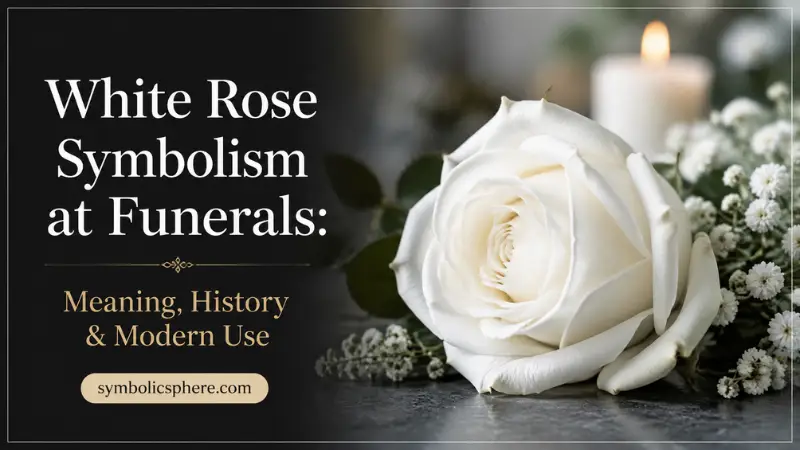
White roses appear in mourning contexts in fairly consistent ways: single stems placed on a casket lid, small bouquets tucked into a wreath, or clusters arranged in standing sprays near a memorial photo. Their pale, unblemished petals stand out against dark clothing, wood caskets, and green foliage, which is part of why funeral directors and florists reach for them so often. The rose’s classic form — layered petals opening from a tight bud — also reads as gentle rather than dramatic, unlike flowers with bolder color or structure.
What a White Rose Commonly Means Today
Choosing a white rose for a funeral or memorial is usually a way of expressing respect rather than raw sorrow. Red roses lean toward romantic love, and lilies often signal restored innocence in an explicitly religious sense; white roses sit in a quieter register between the two. They suggest a dignified goodbye — an acknowledgment that a life mattered, offered without excess sentiment. That’s part of why they’re a common default even for people unfamiliar with flower symbolism: the color itself does most of the communicating, which is also why white roses turn up so consistently at American funeral homes, military services, and mixed-faith memorials (more on that below).
Ancient Roots and Early Symbolism
Roses carried symbolic weight long before Christianity reshaped their meaning. In ancient Greek and Roman culture, roses were tied to Aphrodite and Venus, but white varieties specifically were sometimes associated with young or unmarried women who died before marrying — an early link between the pale rose and a life cut short. Funerary customs in parts of the ancient Mediterranean world included scattering rose petals over graves, a practice tied less to romance and more to honoring the dead.
By the medieval period, the white rose had picked up strong Christian symbolism, largely tied to the Virgin Mary and the idea of spiritual purity untouched by sin — a religious layer that later shaped how white flowers were used in Christian funeral rites across Europe.
How Victorian Floriography Shaped Modern Meaning
Much of what Americans associate with white roses and death traces back to the Victorian era, when flower symbolism became a formalized social language known as floriography. According to Smithsonian Gardens, Victorians published entire guidebooks assigning specific meanings to individual flowers, though the guides often contradicted each other. White flowers broadly became associated with innocence and the soul’s purity after death, while roses were prized because they were already established as emotionally significant flowers.
This era also strengthened the earlier link between white roses and young or unmarried deaths, tying the flower to the idea of a “pure” soul returning to God. American funeral customs, heavily influenced by British Victorian practices through immigration and shared print culture, absorbed much of this symbolism directly.
How Americans Use White Roses in Mourning
In U.S. funeral culture, white roses show up most visibly in three settings: funeral homes, memorial services, and military honors. Funeral directors commonly recommend them for casket sprays because the color reads as neutral across religious backgrounds — a practical, low-risk choice for mixed-faith families or when the deceased’s specific beliefs aren’t known.
At military funerals and memorial ceremonies, white roses often appear alongside American flags and formal wreaths, reinforcing themes of honor and sacrifice rather than personal romantic loss. In Christian services, they’re sometimes placed near the altar or casket as a visual echo of resurrection and the soul’s return to grace. Outside formal religious settings, white roses have also become common at secular “celebration of life” events, where families want something solemn without ties to a specific faith.
Cross-Cultural Meaning Beyond the United States
White flowers carry different — sometimes opposite — meanings elsewhere. In several East Asian cultures, including parts of China, Korea, and Japan, white is the traditional color of mourning itself, and white flowers are used almost exclusively at funerals rather than celebrations. In parts of France and Italy, white roses carry a folk superstition that they’re bad luck to give as a living gift, precisely because of their strong association with death. American interpretation is more flexible, treating white roses as appropriate for weddings, sympathy, and general purity symbolism depending entirely on context.
The Emotional and Psychological Pull of White Flowers
Psychologically, the appeal of a white rose during loss has less to do with the flower itself and more with what pale, unadorned colors tend to communicate: calm, restraint, and closure. Bright or saturated colors can feel emotionally loud in a moment that calls for quiet. A white rose lets mourners express care without performing grief in a way that feels theatrical, and it signals that the sender is honoring the deceased’s dignity rather than centering their own reaction to the loss.
There’s also a subtler identity signal at play. Choosing white over red tells other mourners something about the nature of the relationship — white generally reads as appropriate from a wider circle of acquaintances, colleagues, or distant relatives, while red can feel too intimate unless the sender was very close to the deceased.
Modern Usage Beyond the Funeral Home
White roses have moved well beyond arrangements and casket sprays. Memorial tattoos featuring a single white rose, sometimes with a name, date, or short script phrase, have become a common way to carry a lost loved one’s memory permanently. Rose-shaped jewelry — pendants, rings, lockets — is frequently gifted to grieving family members as a keepsake.
Social media has added a newer layer: white rose emojis and images now appear regularly in memorial posts, anniversary tributes, and comment sections under news stories about a death, functioning as a quick, widely understood symbol of respect. Memory-keeping decor, like pressed white roses in frames or shadow boxes holding dried funeral flowers, has also grown as a way for families to preserve a physical reminder of a service.
Common Misunderstandings About the Symbol
One frequent misunderstanding is that white roses are exclusively a funeral flower, when they’re just as commonly used at weddings, baptisms, and anniversaries because of their broader purity symbolism — context, not the flower itself, determines the meaning. Another misconception is that sending white roses to a grieving family implies a lack of closeness. In practice, the opposite is often true: many funeral etiquette guides specifically recommend white as the safest, most universally appropriate choice regardless of how close the relationship was.
Controversies and Distorted Uses
White rose symbolism has occasionally been separated from its mourning or purity roots. The name was famously adopted in 1942 by a small group of German university students — including Hans and Sophie Scholl — who distributed leaflets opposing the Nazi regime. As the U.S. Holocaust Memorial Museum’s Holocaust Encyclopedia documents, the White Rose movement gave the flower an added, unrelated layer of meaning tied to moral courage and quiet defiance rather than death specifically. This historical use is sometimes conflated with funeral symbolism in casual conversation, even though the two meanings developed independently.
More recently, some commercial marketing has stretched white rose imagery to suggest vague “spiritual energy” or generic positivity, diluting the flower’s more specific historical associations. It’s worth separating genuine mourning tradition from marketing language that borrows the flower’s visual gravity without much grounding in its actual history.
How the Meaning Has Shifted Over Time
White rose symbolism has moved from a relatively narrow set of ancient associations — youth, purity, early death — toward a broader, more flexible modern meaning centered on respect and peaceful remembrance. Victorian formalism gave the flower its strongest funeral association, while twentieth-century events, like the German resistance movement, added complexity outside of mourning altogether. Today’s American usage reflects that layered history: people reach for white roses instinctively, even if they only consciously recognize one or two of the meanings behind that instinct.
White Rose Meaning at a Glance
| Context | Meaning in the USA | Common Associations | Notes |
|---|---|---|---|
| Funeral casket spray | Reverence, dignified farewell | Respect, peace | Preferred for mixed-faith services |
| Military memorial | Honor, sacrifice | Duty, national service | Often paired with flags, formal wreaths |
| Sympathy bouquet sent to family | Respectful condolence | Purity, calm | Considered appropriate regardless of closeness |
| Wedding (non-death context) | New beginnings | Innocence, unity | Shows how meaning shifts entirely with setting |
| Memorial tattoo | Permanent remembrance | Love, loss, tribute | Often combined with dates or names |
Why White Roses Remain the Default Choice for Many Families
Part of the reason white roses persist as the go-to funeral flower in the U.S. is practical as much as symbolic. Florists keep them reliably in stock year-round, they photograph well for memorial cards and programs, and their neutral color doesn’t clash with other arrangements at a service. But the emotional reasoning matters too — families often describe wanting something that feels “clean” or “peaceful” rather than overtly sad, and white roses deliver that tone more consistently than most other flower choices.
White Roses vs. Other Funeral Flowers
Lilies, chrysanthemums, and carnations all carry their own mourning associations in American culture, but white roses feel less formally religious than lilies and less tied to specific cultural groups than chrysanthemums, which carry heavier death symbolism in parts of Europe and Asia. That relative neutrality is often exactly why people choose roses when they’re unsure what would feel appropriate. (If your blog covers individual flower meanings, this is a natural spot to link to dedicated lily symbolism or chrysanthemum symbolism pages.)
FAQs
What does a white rose mean at a funeral?
A white rose at a funeral signals respect, reverence, and a peaceful farewell to the person who died. It’s considered appropriate across most religious and cultural backgrounds in the U.S., which is part of why it’s used so widely.
Is a white rose tattoo specifically about death?
Not necessarily. White rose tattoos can represent purity, new beginnings, or a loved one’s memory, and the exact meaning usually depends on added details like a name, date, or accompanying imagery.
Do white roses have a specific religious meaning?
In Christian tradition, white roses have long been associated with the Virgin Mary and spiritual purity, which carried over into their use in church funerals and memorial services. Other faiths don’t attach the same specific religious weight to the flower, though white as a color often still reads as respectful.
Is it ever inappropriate to send white roses to a grieving family?
No — white roses are widely considered one of the safest flower choices for expressing sympathy, regardless of how close the sender was to the deceased. Some cultural traditions outside the U.S. treat white flowers differently, so it’s worth considering the family’s specific background if it’s known.
Why are white roses used at military funerals?
White roses at military services reinforce honor, sacrifice, and formal respect rather than personal romantic loss, fitting the ceremonial tone of those events. They’re typically arranged alongside flags and formal wreaths rather than as standalone bouquets.
What’s the difference between white rose and red rose symbolism in mourning?
Red roses at a funeral typically signal deep personal or romantic love and are usually reserved for immediate family or a spouse. White roses carry a more general tone of respect and are considered appropriate from a wider range of relationships, including coworkers and distant relatives.
Did white roses always symbolize death, or is that a newer association?
It’s newer than many assume. While ancient cultures linked white roses to purity and early death in specific cases, the strong, widespread funeral association mostly solidified during the Victorian era’s formalized flower symbolism — before that, white roses were more broadly tied to purity and love than to mourning specifically.
Conclusion
White rose symbolism reflects a long accumulation of meaning rather than a single fixed tradition — ancient purity symbolism, Christian religious imagery, and Victorian mourning etiquette all layered on top of each other to produce the flower’s modern funeral association. What Americans read into a white rose today is really a blend of all three: respect, peace, and a quiet acknowledgment of loss that doesn’t demand explanation.
Choosing a white rose, whether for a casket, a sympathy bouquet, or a memorial tattoo, taps into that inherited emotional shorthand even when the person choosing it doesn’t know the full history behind it. That’s arguably the flower’s real strength — it communicates something sincere without requiring anyone to find the exact right words.