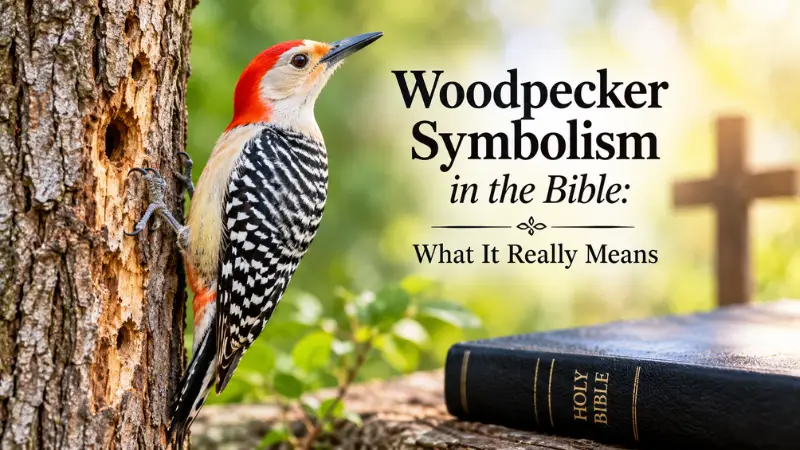
A woodpecker is easy to recognize: a compact bird gripping a tree trunk, striking the bark at remarkable speed, and returning again and again to the same spot. For readers curious about woodpecker symbolism in the Bible, that persistence is exactly why the bird gets connected to ideas like diligence, perseverance, attention, and seeking what lies beneath the surface.
The important caveat up front: the woodpecker is not specifically named in Scripture. Its Christian symbolism today comes from interpreting the bird’s observable behavior alongside broader biblical themes — perseverance, seeking, work, and God’s care for creation — not from a direct biblical passage.
One reminder: verify that search link actually returns zero/no relevant results before publishing, since Bible Gateway’s search behavior can vary slightly by translation and phrasing — you want the click-through to back up the claim, not undercut it.
Quick Answer
Woodpecker symbolism in the Bible is not a direct scriptural teaching — the bird isn’t named in the text. Instead, modern Christian interpretation draws on its persistent pecking to illustrate perseverance, diligence, and steadfast faith. The meaning is devotional, not doctrinal.
At a glance:
- Woodpeckers commonly symbolize persistence and patient effort.
- The Bible never specifically identifies the woodpecker as a symbol.
- Christian interpretations link its behavior to perseverance and seeking.
- Some historical traditions gave it protective or ominous meanings instead.
- American symbolism today leans toward work, resilience, and determination.
- Modern Christian use is reflective, not a claim about biblical doctrine.
What the Woodpecker Represents in Nature
Understanding the symbolism starts with the bird’s biology, since so much of the meaning is drawn straight from its behavior.
Woodpeckers are built for a lifestyle that looks almost symbolic on its own. Their bills are shaped for striking wood, their feet grip vertical bark, and stiff tail feathers help brace the body against a tree trunk. Depending on the species, they excavate cavities, probe beneath bark for insects, communicate through calls and drumming, and create nesting holes that later shelter other animals (a detail well documented by ornithologists at the Cornell Lab of Ornithology).
The repeated tapping is the key to the symbolism. A woodpecker rarely strikes once and stops — it works through sustained, repetitive effort, which makes persistence the most natural metaphor to draw from it. It also searches beneath an outer layer to find food, which lends itself to a second metaphor: looking past appearances and continuing until something hidden is found.
Both meanings are interpretations drawn from natural behavior — not biblical definitions.
Is the Woodpecker Actually Mentioned in the Bible?
No. Scripture references many birds, but the woodpecker isn’t clearly identified by name anywhere in the biblical text.
That matters because plenty of articles online describe a fixed “biblical meaning of the woodpecker” as if Scripture assigns the bird a specific symbolic role. It doesn’t. Biblical symbolism itself is very real — the Bible uses animals, colors, numbers, and natural events symbolically throughout — but that doesn’t mean every creature has an assigned meaning. Birds in Scripture illustrate God’s provision, freedom, vulnerability, sacrifice, or judgment depending on the passage, not by species-specific rule.
So a Christian can reflect on the woodpecker through a biblical lens without claiming Scripture explicitly teaches “the woodpecker symbolizes perseverance.” That distinction keeps the interpretation honest.
How Christians Connect the Woodpecker With Perseverance
The strongest Christian association comes from persistence. A woodpecker keeps striking a tree even though the bark is hard and the payoff isn’t immediate — a fitting natural illustration of biblical teachings about remaining faithful, not growing weary in doing good, and continuing to seek God even without visible results.
In this reading, the woodpecker becomes a reminder that meaningful work is usually incremental. Faith, prayer, service, and character growth tend to require repeated effort rather than one dramatic breakthrough. For someone in a difficult season, the bird can represent choosing to keep going without pretending the difficulty isn’t real.
The Woodpecker as a Symbol of Seeking
A related interpretation comes from what the bird is doing when it pecks: searching for insects hidden beneath bark or inside wood. The visible action serves an unseen objective — which maps naturally onto biblical language about seeking, asking, and searching for wisdom.
Here too, it’s best understood as a devotional analogy rather than a hidden code in Scripture. The image is especially useful for someone processing a hard experience, since it suggests patience with the process of discovery — what’s valuable isn’t always visible right away.
Why the Woodpecker Can Represent Diligence
Persistence and diligence are related but not identical. Persistence means continuing despite obstacles; diligence adds care, consistency, and purposeful effort. The woodpecker illustrates both — it doesn’t peck randomly, but works with behavior adapted to specific environments and physical structures.
In Christian contexts, that supports an ethic of steady, careful work: do what needs to be done, do it with attention, and don’t measure every worthwhile effort by immediate results. It’s less “success at any cost” and more faithful consistency.
What Its Drumming Can Mean Spiritually
Drumming is one of the woodpecker’s most distinctive behaviors — the sound can carry across a whole neighborhood, making the bird noticeable even when it’s hidden in the branches. Some spiritual writers frame this as a metaphor for a message demanding attention; a simpler Christian reading treats it as a reminder to pay attention — to notice something overlooked, slow down enough to listen, or check whether actions match convictions.
It’s worth resisting the urge to turn ordinary bird behavior into a guaranteed supernatural sign. Christian traditions of discernment exist precisely because not every unusual event is a divine message. A woodpecker can prompt reflection without being treated as an omen.
Woodpecker Symbolism in the United States
In the U.S., woodpeckers are familiar backyard and woodland birds — spotted on tree trunks, utility poles, feeders, and nature trails. That everyday familiarity gives the bird a more grounded symbolic character than animals known mainly through mythology or religious art.
Americans commonly associate the woodpecker with:
- Persistence and hard work
- Craftsmanship and attention to detail
- Patience and natural intelligence
- Resilience and curiosity
- Connection with the outdoors
It’s a noisy, physical, visibly active bird — which makes it a particularly fitting image of determination rather than something delicate or ornamental.
Common Contexts and Meanings
| Context | Meaning in the USA | Common Associations | Notes |
|---|---|---|---|
| Christian reflection | Perseverance, faithful effort | Prayer, diligence, seeking | Devotional, not direct Scripture |
| Nature symbolism | Resilience, adaptation | Forests, wildlife, survival | Based on observable behavior |
| Personal symbolism | Persistence through difficulty | Patience, determination | Common in tattoos and artwork |
| Home decor | Connection with nature | Woodland life, craftsmanship | Usually secular |
| Cultural folklore | Protection, warning, special powers | Omens, storytelling | Varies by tradition |
Earlier Religious and Cultural Associations
The woodpecker carried symbolic weight long before modern Christian interpretation. In ancient Roman tradition, it was associated with Mars and appeared in stories tied to the protection of Romulus and Remus — linking the bird to strength, protection, and divine favor. Other European traditions treated it as an unusual or prophetic bird.
These traditions belong to separate religious and cultural systems and shouldn’t be blended into biblical Christianity.
North American Indigenous traditions add further complexity. Archival materials from the Smithsonian Institution document woodpecker stories among several Indigenous peoples — including the bird appearing as a helper figure and carrying ceremonial significance. Because hundreds of distinct Indigenous nations exist, each with its own history and traditions, there is no single “Native American meaning” for the woodpecker — only diverse traditions best understood within their own cultural contexts.
Does a Woodpecker Symbolize Protection?
Sometimes, but the biblical basis is indirect at best. A woodpecker creates and uses tree cavities, which lends itself symbolically to shelter and security, and some cultural traditions have given the bird protective roles outright. Protection is a major biblical theme — but Scripture never assigns that role specifically to the woodpecker.
The more accurate framing: a woodpecker can remind a believer of protection, rather than serving as a biblical symbol of it. That’s the difference between personal symbolism and invented doctrine.
Positive and Negative Meanings
Woodpecker symbolism isn’t universally positive. Modern interpretations usually emphasize perseverance and diligence, but older Christian symbolic traditions — particularly in medieval literature — sometimes read the bird’s drilling as an image of undermining or destruction.
That split shows symbolism depends heavily on context. Breaking into a tree can represent purposeful persistence from one angle, or destruction from the tree’s perspective. There’s no universal rule that a woodpecker sighting means something good or bad.
The Red-Headed Woodpecker and Christian Interpretation
Color adds another layer. The red-headed woodpecker’s vivid red, black, and white pattern leads some contemporary Christian writers to connect the red with sacrifice, devotion, or the Holy Spirit — but this is an interpretive leap, not a biblical statement. Biblical color symbolism varies by passage and tradition, and a bird’s feathers don’t automatically inherit every meaning historically tied to a color.
The most defensible approach: let the color prompt personal reflection on an existing belief, without treating the bird itself as establishing doctrine.
What a Woodpecker Can Symbolize Emotionally
The emotional pull of the woodpecker comes from its mix of toughness and focus. It can represent the feeling of having to keep working when circumstances resist — relevant for anyone rebuilding after disappointment, learning a hard skill, or holding onto faith during uncertainty.
Importantly, it represents sustained effort, not a guarantee of success. Persistence sometimes means continuing responsibly; other times it means changing direction after learning something important.
Woodpecker Symbolism in Tattoos, Art, and Decor
As a tattoo, the woodpecker can represent resilience, an appreciation for wildlife, connection to a place, or a period of life that demanded patience. Christians sometimes pair it with a cross or verse reference to sharpen the religious meaning.
In home decor, the symbolism is usually more straightforward — carved birds, paintings, and garden pieces suggesting forests, rural life, or craftsmanship, with no religious dimension required. That flexibility is one of the more useful features of modern symbolism: an image doesn’t have to belong exclusively to one tradition to carry personal meaning.
The biggest misunderstanding is treating modern interpretation as direct biblical teaching — Scripture never says woodpeckers symbolize persistence, prayer, protection, or divine messages. Those are later interpretations layered onto the bird’s behavior.
Common Misunderstandings About Biblical Woodpecker Symbolism
A second misunderstanding is assuming every woodpecker sighting is an omen. Usually, a woodpecker on a tree is just a woodpecker on a tree; personal meaning is fine, but it isn’t a universal religious rule. And Christian symbolism shouldn’t be confused with divination — the two sometimes overlap in popular culture, but they aren’t the same thing.
Is the Woodpecker a Christian Symbol Today?
It can be, but it’s not among Christianity’s core recognized symbols. The cross, fish, dove, lamb, bread, and wine all carry well-established biblical histories; the woodpecker occupies a much less formal place — better described as devotional or illustrative symbolism.
A believer might see persistence in its behavior as a reminder of faithful endurance, or simply appreciate it as part of creation. Neither view requires claiming the Bible assigns the woodpecker a fixed symbolic identity.
FAQs
What does a woodpecker symbolize in Christianity?
Modern Christian interpretation commonly links the woodpecker to perseverance, diligence, seeking, and steadfastness — drawn from its behavior and broader biblical themes, not a direct scriptural passage.
Is the woodpecker mentioned in the Bible?
No. The woodpecker isn’t named in Scripture, though later Christian writers have used its characteristics to illustrate biblical virtues.
What does a woodpecker symbolize spiritually?
Persistence, focused effort, patience, and looking beneath the surface — best treated as reflective symbolism rather than a fixed spiritual rule.
Does seeing a woodpecker mean God is sending a message?
Not as a general rule. Someone may personally treat the encounter as a nudge to pray or pay attention, but that’s personal interpretation, not biblical doctrine.
What does a woodpecker tattoo mean?
Typically resilience, persistence, patience, or overcoming hardship. Paired with Christian imagery, it can specifically represent steadfast faith or continuing to seek God during difficulty.
Is woodpecker symbolism positive or negative?
Usually positive in modern American culture (determination, resilience), though historical traditions have sometimes cast it negatively — meaning depends on cultural and artistic context.
What does the red-headed woodpecker symbolize?
Vitality, persistence, or striking individuality, drawn from its appearance and behavior. Christian writers sometimes tie its red coloring to religious themes, but that’s interpretation, not biblical teaching.
Conclusion
The most honest way to understand woodpecker symbolism in the Bible is to keep Scripture and later interpretation separate. The Bible doesn’t assign the woodpecker a specific meaning, but its persistence, focus, and search for nourishment work well as natural illustrations of perseverance and diligence, themes Scripture addresses directly even without mentioning the bird itself.
In American culture more broadly, the woodpecker’s identity is even wider — determination, resilience, craftsmanship, or simple appreciation for wildlife. Its meaning comes through clearest when you consider the cultural or personal context, rather than assuming every woodpecker carries the same message. Sometimes the most useful symbolism isn’t a secret code hidden in an ordinary creature — it’s letting that creature’s ordinary behavior point to something worth practicing.