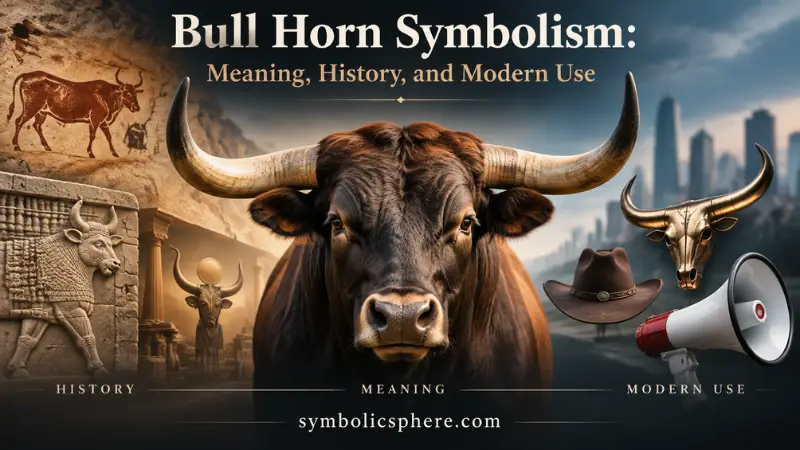
Bull horns have an unmistakable visual presence. Curving outward from an animal’s head, they signal strength, confrontation, protection, and endurance before a viewer knows anything about the culture behind the image. In the United States, bull horn symbolism is closely tied to the American West — cattle ranching, Texas identity, sports mascots, and the self-reliant spirit associated with frontier life.
That said, a bull horn doesn’t carry one fixed meaning. How it reads depends on the image: an actual bull, a pair of mounted horns, a longhorn skull, a ceremonial horn, or the modern device called a bullhorn. Ancient religious traditions, agricultural societies, Western folklore, and contemporary American design have each layered their own meaning onto the symbol over time.
Quick Answer
Bull horn symbolism most often represents strength, determination, protection, authority, and independence in modern American culture — especially through Western, ranching, sports, and Texas imagery. Historically, animal horns have also carried associations with fertility, power, ritual authority, warfare, and communication.
Key Takeaways
- Bull horns commonly symbolize strength, resilience, and determination.
- In the U.S., Western imagery ties horns to ranching, cattle culture, and independence.
- Longhorn imagery has become deeply associated with Texas identity specifically.
- Older, cross-cultural horn traditions connect the symbol to authority, fertility, ritual, and communication.
- The exact meaning shifts a lot depending on context — a horn tattoo doesn’t read the same as a horn in a religious carving.
What a Bull Horn Looks Like
A bull horn is the hard, keratin-covered projection that grows from the skull of cattle and related animals. Depending on the breed, horns can curve upward, outward, forward, or backward, and their shape has a lot to do with how the symbolism developed.
The Texas Longhorn is the clearest example of how a specific horn shape becomes cultural shorthand. Its dramatically extended horns — descended from Spanish and English cattle brought to Texas in the early 1800s — became one of the most recognizable images of the American Southwest, and the breed remains the state’s official large-mammal symbol.
That physical shape drives the symbolism directly. A horn is a natural defensive weapon, hard to ignore, and visibly tied to an animal’s ability to stand its ground against a threat. That’s why the image so easily reads as resistance and physical power. A pair of horns also creates a strong, symmetrical silhouette — part of why horns show up so often in logos, wall décor, jewelry, tattoos, and Western-inspired design.
What Bull Horn Symbolism Means in the U.S. Today
In contemporary American culture, bull horns most often communicate strength, toughness, independence, and Western identity.
The strength association is the most literal: horns are a defensive weapon attached to one of the most physically powerful parts of the animal. A horned bull becomes visual shorthand for something difficult to intimidate or move.
Independence comes from a different cultural thread. In American Western mythology, cattle, ranchers, open range, and longhorns became linked with self-reliance and frontier life. The longhorn eventually grew into a full-blown American icon — and in Texas specifically, its image remains tightly bound to regional identity, appearing everywhere from state symbols to university mascots.
Ancient and Ritual Symbolism of Horns
Long before horns meant “Texas” or “toughness,” they meant something closer to divinity. In Minoan Crete (roughly 2000–1450 BCE), stylized bull horns known as “horns of consecration” were carved into palace rooflines and altars at sites like Knossos, marking a space as sacred and linking earth to the divine. Bull-leaping frescoes from the same culture show the animal treated as a ritual partner as much as a beast of burden.
Further east, Mesopotamian cultures associated bull horns with the crescent moon, and horned crowns marked a figure as divine rather than human — a visual code borrowed by several Bronze Age Near Eastern religions. Ancient Egypt had its own bull cult centered on Apis, worshipped as a symbol of fertility and royal power. In Greek mythology, Zeus took the form of a bull to abduct Europa, tying the horned bull to raw, barely-contained natural force. Hinduism carries a related thread today: Nandi, the bull who serves as Shiva’s mount, represents strength, loyalty, and devotion, and Nandi statues remain common at Shiva temples.
Across these traditions, the throughline is consistent even where the specific gods differ: horns marked power that was bigger than an individual human — divine, cosmic, or reproductive force made visible.
Bull Horns in Sports and Team Identity
Horns translate easily into logos because they’re bold, symmetrical, and instantly readable at a distance — exactly what a sports brand needs. The Chicago Bulls built an entire NBA identity around a snorting bull head, using it to signal aggression and dominance on the court. College athletics lean on the same imagery: the University of Texas Longhorns take their name and hand gesture directly from the cattle breed, and the “Hook ’em Horns” sign has become one of the most recognizable gestures in American sports. Other programs, from the University of South Florida Bulls to minor-league baseball’s Durham Bulls, use the animal for the same reason — it reads as forceful and hard to beat before a fan reads a single word of copy.
Bull Horn Tattoos and Personal Meaning
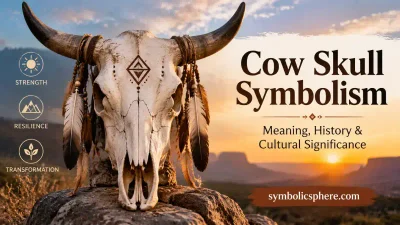
Bull and bull-skull tattoos are common in Western, biker, and rock subcultures, and the meaning tends to track the older symbolism rather than replace it. People commonly choose the design to represent strength, resilience, and an ability to push through hardship; a skull-and-horns combination in particular is often read as a marker of survival — life and death held in the same image. Others use it to signal personal or cultural heritage, especially in Southwestern and Western contexts where the longhorn skull is shorthand for the region itself. Because the design is so open to interpretation, the “correct” meaning is really whatever the wearer intends — which is part of why it stays popular across such different subcultures.
Bull Horns in Home Décor and Western Design
Mounted horns and longhorn skulls are a staple of Western and ranch-style interiors, where they function less as trophies and more as a shorthand for heritage and rugged authenticity. A skull over a mantel or a set of horns above a doorway signals the same qualities the symbol has carried for centuries — strength and endurance — translated into a design object rather than a religious or tribal marker. The look has also crossed over into broader “modern rustic” and Southwestern interior trends well outside of Texas or working ranches, often paired with leather, reclaimed wood, and warm, earthy tones.
FAQs
What does a bull horn tattoo symbolize?
Most commonly strength, resilience, and the ability to overcome hardship, though meanings shift with cultural context and personal intent — heritage, protection, and toughness are all common readings.
Why are bull horns used in sports logos?
Their bold, symmetrical shape reads instantly as aggressive and powerful, which is exactly the impression sports brands want fans and opponents to associate with the team.
Are bull horns a religious symbol?
Historically, yes. Cultures including Minoan Crete, ancient Mesopotamia, Egypt, Greece, and Hinduism all used horned bull imagery to represent divine or cosmic power, though the specific meaning varied by tradition.
Conclusion
Bull horn symbolism has never really settled on one meaning — it shifts with the culture holding it. Bronze Age worshippers saw divinity; American ranchers and Western mythology saw self-reliance; sports franchises see aggression they can put on a jersey; someone getting a tattoo might mean any of the above, or something entirely their own. What stays constant is the physical shape doing the symbolic work: a horn is unmistakably a weapon and unmistakably powerful, which is exactly why it keeps getting reused, generation after generation, to say the same basic thing — this is strong, and it isn’t backing down.