Burrowing owl symbolism starts with an unusual fact about the bird itself: unlike most owls, it spends much of its life close to the ground and nests underground. Small, long-legged, and often active during daylight, the burrowing owl looks and behaves nothing like the classic image of an owl perched high in a tree.
That difference is exactly why the bird carries such distinct symbolic meanings — adaptability, watchfulness, humility, independence, protection, and resourcefulness. Its survival depends on making use of what’s already available, including burrows abandoned by prairie dogs, ground squirrels, and other digging animals.
In the United States, the burrowing owl is also closely tied to open landscapes — prairies, deserts, grasslands, farmland, and even urban lots. As these habitats shrink, the bird has become as much a symbol of conservation and vanishing open space as it is of personal meaning.
Quick Answer
Burrowing owl symbolism commonly represents adaptability, watchfulness, independence, and finding security in unexpected places. This meaning comes directly from the bird’s biology: it nests underground, stays alert in open, exposed terrain, and is active during the day rather than only at night — traits that set it apart from typical owl folklore.
Key Takeaways
- Burrowing owls commonly symbolize adaptability and practical independence.
- Their underground homes connect them to protection, privacy, and security.
- Daytime activity gives them associations with alertness and clear-eyed awareness.
- American folklore leans toward resilience in changing landscapes rather than mysticism.
- In tattoos and art, they often represent individuality and unconventional identity.
- Modern conservation work has added meanings of stewardship and environmental responsibility.
What Makes the Burrowing Owl Different From Other Owl Symbols
The typical mental image of an owl involves darkness, trees, and nighttime hunting. The burrowing owl breaks almost every part of that picture.
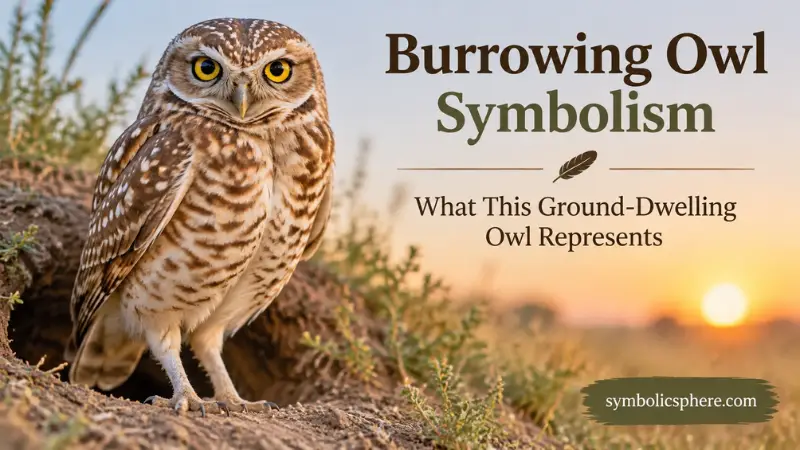
It’s a small owl with long legs, a compact body, bright yellow eyes, and brown-and-white plumage that blends into soil and dry grass. Rather than staying in trees, it spends much of its time walking or running along the ground. During breeding season, it’s frequently active in daylight, which makes it far easier to observe than most other owl species.
Its home is just as unusual. Burrowing owls typically move into underground shelters dug by other animals instead of building a traditional nest. That makes the bird a fitting symbol for people who associate strength with practicality rather than appearance — its meaning comes less from mythology and more from direct observation of how it actually survives: staying alert, choosing its surroundings carefully, and using available resources well.
What the Burrowing Owl Commonly Symbolizes in the U.S.
In American symbolism, the burrowing owl often represents adaptability without losing individuality. It doesn’t fit the expected image of an owl, yet it’s unmistakably still an owl — a contrast that resonates with people who feel comfortable living outside conventional norms.
| Context | Meaning in the U.S. | Common Associations | Notes |
|---|---|---|---|
| Personal identity | Independence | Individuality, self-direction | Fits unconventional personalities well |
| Home and family | Protection | Shelter, privacy, security | Tied to underground burrows |
| Personal growth | Adaptability | Flexibility, resourcefulness | Reflects use of changing environments |
| Observation | Alertness | Awareness, attention, caution | Linked to its exposed, open-country lifestyle |
| Nature | Stewardship | Grasslands, wildlife, conservation | Increasingly relevant in environmental culture |
| Art and tattoos | Unconventional wisdom | Originality, grounded intelligence | Chosen for its unusual appearance |
This gives the burrowing owl a more grounded meaning than the stereotypical “owl as abstract wisdom” symbol. It suggests practical awareness: seeing what’s happening, staying prepared, and knowing when to retreat to safety.
Underground Burrows: A Symbol of Protection
The burrow is one of the bird’s strongest symbolic features. An underground home naturally suggests shelter, privacy, safety, and retreat, creating a contrast between the exposed world above ground and a protected space below it.
Because of this, the burrowing owl can represent the idea that security doesn’t have to look impressive from the outside. Someone might value a quiet home, a private life, or a small circle of trusted people without needing public recognition — the burrow symbolizes a boundary as much as a hiding place, a secure base from which life continues: raising young, resting, storing food, and escaping danger when needed. That idea maps neatly onto modern ideas about personal space and emotional boundaries.
Adaptability and Resourcefulness
One of the clearest meanings tied to the burrowing owl is adaptability. The species often takes over burrows dug by other animals rather than requiring a specific type of nest, and it has adapted well to human-altered environments — agricultural fields, airports, vacant lots, and roadsides among them.
Symbolically, this reads as a practical form of resilience. It isn’t about passively accepting whatever happens; it’s about recognizing available opportunities and using them intelligently. Choosing the burrowing owl as a personal symbol often reflects a belief that survival depends more on flexibility than control — which is why the bird works particularly well as a symbol for relocation, career changes, personal reinvention, or adjusting to unfamiliar circumstances.
Watchfulness and Clear-Eyed Awareness
Owls are generally linked to observation because of their eyes and hunting skill, but the burrowing owl adds something more specific: constant environmental awareness. Life in open country leaves little room for carelessness. Burrowing owls often perch near their burrows or on low objects to monitor their surroundings, and their distinctive bobbing motion only adds to that watchful impression.
Symbolically, this creates an association with noticing what others overlook — someone who watches before acting, pays attention to small changes, and values staying informed. It isn’t necessarily about suspicion; in a healthier reading, it’s attentiveness without unnecessary alarm.
Why the Burrowing Owl Can Symbolize Humility
Unlike most owl imagery, the burrowing owl isn’t an imposing bird. It’s small and often close to the ground, standing beside a burrow entrance or walking across open soil rather than dominating a landscape from a high branch.
That physical posture lends itself to symbolism around humility, groundedness, and practical intelligence — the subtle message that wisdom doesn’t always announce itself. In American culture, where birds of prey often symbolize strength and dominance, the burrowing owl offers a different model: one where survival depends on awareness and cooperation with the environment rather than looking formidable.
Ancient Roots and Broader Owl Symbolism
The burrowing owl doesn’t have one universally recognized ancient symbolic tradition the way some mythological animals do, and that distinction matters. It’s easy to assume every owl species inherited the same meanings from mythology, but most traditional owl associations concern owls generally — not this specific species.
In ancient Greek culture, for instance, owls were linked to Athena and became associated with wisdom and knowledge. Other traditions carry more complicated meanings, including ties to darkness, death, or the unseen world. These broader traditions offer useful background, but they shouldn’t be treated as historical proof that ancient cultures assigned a specific meaning to the modern burrowing owl. Its more distinctive symbolism comes from its actual behavior and habitat.
Burrowing Owl Symbolism in Native and Western American Contexts
North American Indigenous cultures hold diverse traditions regarding birds and animals, and there’s no single Native American interpretation of the burrowing owl — broad claims that flatten many distinct cultures into one belief system don’t hold up.
Western American folklore offers a more documented connection: burrowing owls were sometimes called “howdy birds” for their habit of bobbing at burrow entrances, a motion early observers interpreted as a greeting. That nickname gives the bird a distinctly American folk character — less ominous, more neighborly — and helps explain why it’s often associated with friendliness and curiosity alongside its more serious symbolism of watchfulness.
The Symbolism of Daytime Activity
Burrowing owls are often active during the day, especially in breeding season — unusual for a bird typically imagined as strictly nocturnal. That habit shifts the symbolic picture: instead of representing hidden knowledge alone, the burrowing owl suggests awareness in plain sight.
It can represent recognizing what’s happening around you without waiting for darkness or secrecy — openness, attentiveness, and a willingness to confront circumstances directly. That’s part of why the bird works so well as a modern symbol of clear-headed observation rather than purely mysterious wisdom.
What the Burrowing Owl Symbolizes in Modern American Culture
Today, Americans mostly encounter burrowing owls through wildlife photography, conservation campaigns, nature centers, and social media. Their long legs, large eyes, compact bodies, and upright posture give them an almost cartoon-like quality that makes them instantly recognizable.
Modern interpretations tend to emphasize:
- Resilience — surviving despite environmental change
- Adaptability — using available resources
- Individuality — standing apart from conventional expectations
- Protection — maintaining a safe personal space
- Awareness — observing before responding
- Groundedness — staying connected to practical realities
- Environmental responsibility — protecting vulnerable habitats
That last point has grown more significant as burrowing owl populations face habitat pressure across parts of their range. Wildlife biologists point to habitat loss and declining populations of burrowing mammals as major concerns for the species — a factor covered in more detail by the U.S. Fish & Wildlife Service.
Emotional and Psychological Meaning
The burrowing owl tends to appeal to people who value quiet strength over outward dominance — someone who’s been through a major transition, learned to protect their privacy, or discovered that flexibility beats stubbornness.
Several psychological themes tend to come up:
- Need for safety — the burrow as a secure personal environment
- Healthy independence — self-reliance without requiring isolation
- Situational awareness — paying attention to one’s surroundings
- Adaptation — flexibility when circumstances shift
- Quiet confidence — no need for imposing size to survive
These are interpretations, not fixed rules. A person’s own experience with the symbol usually determines which meaning feels most relevant.
Burrowing Owl Tattoos and Personal Style
A burrowing owl tattoo often carries a different meaning than a generic owl tattoo — commonly individuality, resilience, adaptability, protection, or a connection to the American Southwest. Adding desert grasses, prairie landscapes, stars, or other wildlife to the design can shift the meaning toward place, nature, or personal memory.
Its unusual silhouette — long legs, compact frame — also works well in minimalist or illustrative tattoo styles. For some people, the design simply commemorates a personal encounter with the bird rather than any broader symbolism, and that personal meaning can matter more than any established tradition.
Burrowing Owls in Art, Decor, and Digital Culture
In home decor, the burrowing owl creates a nature-oriented feel without the heavier associations sometimes attached to birds of prey. It fits especially well with desert, prairie, Southwestern, rustic, and wildlife themes.
Online, photos and short videos tend to highlight the bird’s expressive eyes, unusual posture, and bobbing movement — traits that read as curious, alert, or personable rather than ominous. That shift has softened older assumptions about owls in general, pushing the burrowing owl’s identity toward a mix of intelligence and personality.
Conservation Has Added a New Layer of Meaning
An animal’s symbolism often shifts once its survival becomes a public concern. In the U.S., burrowing owls face habitat pressure from development, agricultural change, and declining populations of the burrowing mammals whose abandoned homes they depend on. Some conservation groups have responded by building artificial burrows to create nesting opportunities where natural ones are scarce — an approach detailed by the Cornell Lab of Ornithology.
Florida offers a clear example of this dynamic: burrowing owls there occupy pastures, farmland, golf courses, airports, and vacant lots, even as habitat loss remains an ongoing concern. As a result, the bird now symbolizes stewardship alongside survival — an encounter with one can prompt a bigger question about what happens to the open spaces that support animals dependent on them.
Common Misunderstandings About Burrowing Owl Symbolism
A few myths are worth clearing up:
- Not every owl tradition applies to this species. Historical owl symbolism is much broader than the cultural history of the burrowing owl specifically.
- Seeing one isn’t a fixed omen. There’s no universal American rule assigning it a supernatural meaning.
- It isn’t purely nocturnal. Burrowing owls are unusually active during the day, especially during breeding season.
- It doesn’t always dig its own home. Most use burrows created by other animals, which makes adaptability — not solitary self-sufficiency — the more accurate symbolic theme.
Positive and Negative Interpretations
The burrowing owl skews positive in modern American symbolism, but context matters.
Positive interpretations include adaptability, protection, awareness, individuality, humility, resourcefulness, and environmental stewardship.
More cautious interpretations might lean toward withdrawal, secrecy, isolation, or excessive vigilance. These negative readings aren’t inherent to the bird — they surface when its underground lifestyle gets read as hiding, or its alertness as suspicion. The same image can express either healthy privacy or avoidance, depending on the story around it.
How the Symbol Has Evolved
Burrowing owl symbolism reflects a shift from generalized owl folklore toward observation of one specific species. Earlier owl traditions offered broad ideas about wisdom, darkness, and the unknown. American observers then encountered a very different bird — one that lived underground, walked across open ground, appeared in daylight, and seemed to bob in greeting.
Modern culture has added another layer, framing the bird within conversations about habitat loss, urban development, and the value of open landscapes. As a result, its symbolism has become more practical: rather than just representing hidden knowledge, the burrowing owl now stands for the ability to adapt, stay alert, protect what matters, and survive without conforming to expectations.
FAQs
What does a burrowing owl symbolize spiritually?
There’s no single accepted spiritual meaning. In contemporary symbolism, it typically represents awareness, protection, adaptability, humility, and finding safety in unexpected places.
Is seeing a burrowing owl a good omen?
There’s no established American tradition calling it good or bad luck. Many people simply take it as a personal reminder to pay attention, stay adaptable, or appreciate the natural world.
What does a burrowing owl tattoo mean?
Commonly individuality, resilience, independence, protection, or adaptability. Adding elements like a desert, prairie, burrow, or stars can sharpen the meaning further.
What does the burrow itself symbolize?
Shelter, privacy, security, and a protected foundation — a safe place to return to while navigating a demanding world outside.
Are burrowing owls associated with wisdom?
They inherit some general owl wisdom symbolism, but their ground-level lifestyle makes practical awareness and adaptability more fitting themes than abstract wisdom alone.
What does the burrowing owl symbolize in Native American culture?
There’s no single meaning, since Indigenous nations hold distinct cultural traditions. Claims that one meaning applies universally should be treated with caution.
Why does the burrowing owl matter in modern symbolism?
Its conservation status has tied the bird to habitat protection and environmental stewardship, making it a visible reminder of how land-use changes affect wildlife.
Conclusion
The burrowing owl represents a distinctive kind of strength: adaptability without losing individuality. Its underground home suggests protection and privacy, its behavior suggests alertness, and its knack for using changing environments reflects practical resourcefulness.
In modern American culture, burrowing owl symbolism has grown beyond traditional owl associations with wisdom to represent grounded independence, careful observation, resilience, and responsibility toward the landscapes that support wildlife. Its simplest lesson may be its most useful one: survival doesn’t always require standing above everything else. Sometimes it just means paying attention, using what’s available, and knowing where home is.