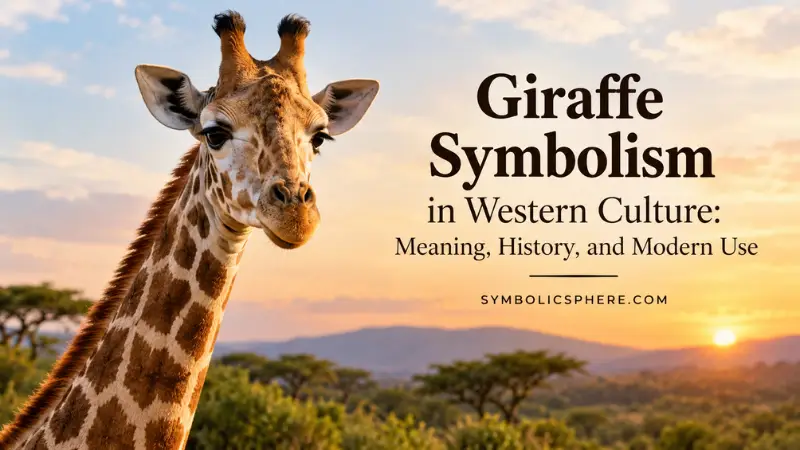
Giraffe symbolism in Western culture centers on individuality, perspective, grace, patience, and the ability to see beyond immediate obstacles. With its long neck, spotted coat, and towering height, the giraffe is one of the easiest animals to read as a metaphor. Its meanings come from its appearance, its African origins, and the way Western societies have represented wildlife in art, books, zoos, and popular culture.
Unlike symbols tied to a specific religion or tradition, the giraffe has no single official meaning. Its height invites associations with vision and awareness, and its distinctive look makes it an appealing emblem of standing out. In the United States and across the West, giraffes appear in children’s books, nursery decor, wildlife photography, conservation campaigns, fashion, and tattoos. The meaning shifts depending on whether you meet the animal in a dream, a painting, a story, or a design you choose for yourself.
What Do Giraffes Symbolize in Western Culture?
In Western culture, giraffes most commonly symbolize individuality, grace, perspective, patience, and the ability to see beyond immediate challenges. These meanings are interpretive, built from the animal’s physical traits and shaped by European encounters with African wildlife and later appearances in art, literature, zoos, and popular culture.
Key takeaways
- Individuality: The giraffe’s distinctive look represents embracing what makes you different.
- Perspective: Its height suggests seeing a situation from a broader viewpoint.
- Grace: Long legs and unhurried movement evoke elegance and quiet confidence.
- Patience: Its calm demeanor can represent a thoughtful approach to challenges.
- History: European fascination with African wildlife helped make giraffes recognizable symbols.
- Modern use: Giraffes appear in tattoos, nursery decor, fashion, and conservation imagery.
Why Are Giraffes Seen as Positive Symbols?
The giraffe’s appearance explains much of its appeal. It stands above its surroundings, its patterned coat makes every animal look unique, and its silhouette is recognizable even in a simple drawing.
These traits translate naturally into symbolic ideas. A giraffe looking over a tree canopy suggests awareness and the ability to spot opportunities others miss. A giraffe standing quietly in a field suggests composure. Its spotted coat can stand for the beauty of being different.
For American audiences especially, the giraffe is friendly and approachable. Unlike lions or wolves, it is rarely used to represent aggression or dominance, so it can carry a positive message without feeling heavy-handed.
Giraffe Symbolism of Individuality
Individuality is probably the clearest modern meaning of the giraffe. It looks different from almost every other land animal, which makes it a natural image for celebrating personal identity without seeming threatening.
In American culture, individuality is closely tied to self-expression and independence. You can see this symbolism in everyday contexts:
- Personal artwork: A giraffe illustration can celebrate someone comfortable being different.
- Children’s gifts: A giraffe toy often accompanies messages about confidence and self-acceptance.
- Fashion: Giraffe-print accessories express a playful interest in wildlife or bold patterns.
- Keepsakes: A giraffe figurine may represent a friend or relative whose personality stands out.
Individuality here does not mean rejecting other people. Giraffe symbolism suggests that belonging to a community doesn’t require everyone to look, think, or act alike. For anyone who has felt overlooked because of an unusual personality or background, the giraffe is a reminder that being different is not automatically a disadvantage.
Giraffe Symbolism of Perspective and Vision
The long neck is the giraffe’s most recognizable feature, and it anchors another strong association: perspective. In nature, height lets a giraffe reach leaves high in the trees. Symbolically, that becomes the ability to see a situation from a wider angle instead of fixating on what is directly in front of you.
This reading shows up in personal artwork and motivational imagery:
- A manager might use a giraffe illustration to represent strategic thinking.
- A student might link the animal to looking past a temporary setback.
- An artist might place a giraffe above a forest to suggest awareness of a larger situation.
- Someone in a life transition might take it as encouragement to consider new possibilities.
Height doesn’t mean a giraffe knows everything or can predict the future. The symbol stands for the possibility of a wider view, not perfect knowledge. Sometimes a problem simply gets easier to understand when you change where you’re standing.
Giraffe Symbolism of Grace and Quiet Confidence
Giraffes have a distinctive elegance. Their long limbs, upright posture, and measured stride give them a graceful look, particularly when they walk across open grassland.
In Western visual culture, this makes the giraffe a symbol of dignity and quiet confidence. It doesn’t need to be shown fighting or displaying strength to draw attention, because its form is noticeable on its own. In decor, fashion illustration, and decorative art, it can represent elegance with a playful edge, which suits people who prefer understated confidence to conspicuous status.
Its seemingly unhurried movement also reads as calm, though real giraffes certainly experience stress and danger. The symbolism comes from how people interpret their stance, and it offers an alternative to the idea that strength must always look forceful.
History of Giraffe Symbolism: From African Art to European Courts
Giraffe symbolism did not begin in modern America. Giraffes appear in African rock art, ancient imagery, and local stories, and some engravings and paintings are thousands of years old. In ancient Egypt, the animal also appeared in visual culture and had a place in hieroglyphic writing. Giraffes carried meaning long before they became familiar in Western homes.
European encounters added another layer. Live giraffes drew enormous attention because their proportions were unfamiliar to most viewers:
- Late 15th century: A giraffe presented to Lorenzo de’ Medici in Florence became a celebrated attraction.
- 1826–1827: A giraffe sent from Egypt to France arrived in Paris and generated widespread public interest.
These animals were more than curiosities. Their presence signaled diplomatic ties, wealth, prestige, and access to distant parts of the world. That fascination helped establish the giraffe as an emblem of the unusual and extraordinary. These European readings reflect particular circumstances, such as elite collecting and interest in African wildlife, and shouldn’t be mistaken for the animal’s original or universal meaning.
How Giraffe Symbolism Has Changed Over Time
| Period or setting | Main association | Context |
|---|---|---|
| Ancient African imagery | Wildlife and the natural world | Giraffes appeared in early art and visual traditions |
| Renaissance Europe | Wonder, rarity, and prestige | Live giraffes attracted attention at elite courts |
| 19th-century Europe and America | Exotic wildlife and public spectacle | Menageries increased public exposure |
| 20th-century popular culture | Familiarity and friendliness | Zoos, toys, books, and merchandise made giraffes widely recognizable |
| Contemporary culture | Individuality, perspective, and conservation | Personal expression and environmental awareness shape interpretation |
These are broad patterns, not strict stages. Older associations didn’t vanish; the prestige of the court giraffe was joined by newer meanings tied to childhood, self-expression, and wildlife appreciation. Modern Americans don’t need to know about a Renaissance menagerie to understand a giraffe illustration, but that history explains how an animal once treated as a marvel became an everyday cultural image.
What Do Giraffes Symbolize in the United States?
In the U.S., giraffes are most often encountered through zoos, children’s media, educational materials, toys, and wildlife imagery. Their symbolism tends to be accessible and positive rather than formal or religious.
| Context | Common meaning | Why it fits |
|---|---|---|
| Children’s rooms | Curiosity, friendliness, growth | Familiar, visually distinctive animals |
| Personal artwork | Individuality and perspective | Height and patterned coat stand out |
| Workplace or educational imagery | Broader thinking and awareness | Elevated viewpoint invites metaphor |
| Gifts and keepsakes | Affection, playfulness, uniqueness | Recognizable shape suits personal gifts |
| Wildlife conservation | African biodiversity and habitat protection | Strongly associated with African savannas |
Interpretations vary. A wildlife enthusiast may see a remarkable mammal, a parent may think of a child’s early years, and an artist may use the same animal to explore loneliness, beauty, or being different. The giraffe is recognizable enough to communicate a general idea and open-ended enough to hold personal meaning.
Giraffes in Children’s Books and Popular Culture
Giraffes are staples of children’s books, cartoons, stuffed toys, and educational entertainment. Their tall bodies make them memorable, and their familiar image helps young audiences engage with stories about friendship, courage, and belonging.
In children’s literature, an animal’s role depends on the story, not a universal code. A giraffe character might be shy, adventurous, clumsy, wise, or funny. The popular picture book Giraffes Can’t Dance uses a giraffe’s struggle to dance to explore self-confidence, personal expression, and finding an approach that suits your abilities. In animated films and TV, a giraffe’s height often serves visual comedy, so the symbolism may be secondary to entertainment.
Giraffes are also common nursery motifs and baby products, where they’ve become associated with early childhood, tenderness, and a welcoming environment. That is a modern development, not evidence that giraffes have always symbolized childhood. It shows how repeated appearances in popular media can give an animal new meanings.
What Does a Giraffe Symbolize Emotionally?
People often use animals to express complicated feelings, and the giraffe can carry several emotional meanings:
- Feeling different: Someone who has struggled to fit in may identify with the giraffe’s unusual proportions and find it a gentle image of self-acceptance.
- Wanting a wider perspective: In uncertain times, a giraffe can remind you to pause and weigh alternatives before deciding.
- Seeking calm: Its graceful look can evoke a desire for composure and patience.
- Feeling visible: Because giraffes stand out, they can represent being noticed, which feels good when you want recognition and uncomfortable when you don’t.
These are personal interpretations, not psychological diagnoses. Seeing or choosing a giraffe doesn’t prove you have a particular trait or emotional condition.
What Does a Giraffe Mean in a Dream?
There is no scientifically established meaning for a giraffe dream, but the usual themes are perspective, individuality, and visibility. A giraffe looking over a landscape might point to a situation that needs a broader view. A lone giraffe might reflect independence, isolation, or feeling different. A friendly giraffe may evoke curiosity or comfort, while a frightened or trapped one may connect to your own sense of vulnerability or restriction.
These questions can help you reflect:
- What was the giraffe doing?
- Did its height feel helpful, strange, or intimidating?
- Were you observing it or interacting with it?
- What emotion stayed with you after waking?
- Does the scene resemble something in your current life?
Dream dictionaries offer popular interpretations, but these are not predictions. Dreams draw on personal experiences, memories, and emotions, and some giraffe dreams may have no special significance at all.
Is There a Spiritual or Biblical Meaning of Giraffes?
Giraffes have no universally accepted meaning in Western religions. Unlike the dove in Christian imagery or the lamb in many biblical contexts, the giraffe is not a central symbol in mainstream Christian teaching, and a giraffe in Christian art doesn’t automatically signal a biblical message. Its meaning depends on the surrounding imagery, the artist’s intention, and the historical context.
Individuals may still assign spiritual meaning to the animal. Its height can suggest looking beyond immediate concerns, and its calm appearance can evoke patience and thoughtful observation. For someone who uses nature for reflection, a giraffe may become a personal reminder to meet challenges with greater awareness. That is different from claiming a religion teaches that giraffes mean spiritual awakening or divine guidance, and a belief that seeing a giraffe is a supernatural sign is a personal conviction, not an established fact.
Giraffe Symbolism Beyond the West
Giraffes appear in the art and traditions of several African societies, but no single African interpretation applies to the whole continent. Communities have developed their own relationships with local wildlife, shaped by geography, oral traditions, livelihoods, and spiritual practices. Rock art shows how long people have observed and depicted giraffes, though the exact meaning of an individual image can remain uncertain.
In 15th-century China, a giraffe brought to the Ming court from East Africa was associated with the mythical qilin, an auspicious creature connected with good government and favorable signs. That was a specific historical interpretation, not a universal Chinese belief about giraffes. The comparison shows how the same animal can mean different things within different cultural frameworks.
Giraffe Symbolism in Tattoos, Jewelry, and Home Decor
Today, giraffe imagery appears in tattoos, jewelry, wall art, clothing, and decor. The meaning usually comes from the owner’s intention rather than a fixed tradition.
- Tattoos: A giraffe tattoo may represent individuality, a broader perspective, love of wildlife, or a personal memory. Some people choose a small minimalist outline, while others prefer detailed artwork in a natural habitat. Added elements like stars, a landscape, or a meaningful date can carry a story the giraffe alone can’t.
- Jewelry and accessories: Pendants, earrings, and patterned accessories often express a playful personality or interest in animals. Their meaning tends to be sentimental rather than spiritual.
- Home and nursery decor: Figures, prints, and soft toys are popular for children’s spaces and suggest curiosity, warmth, and a connection to nature.
The surrounding design changes the message. A realistic giraffe in a conservation-themed painting emphasizes wildlife, while a cartoon giraffe in a bright nursery communicates playfulness.
Are There Negative Meanings of Giraffe Symbolism?
Giraffes are generally viewed positively in the West, but not always flatteringly. Cartoons often exaggerate their long legs and necks to suggest awkwardness, and a giraffe can represent someone who feels conspicuous or out of place. The same traits that suggest distinction can suggest social discomfort. A giraffe looking down from above is sometimes used to portray detachment, though that is a creative interpretation, not an inherent quality of the animal.
Cultural sensitivity also matters. Using a giraffe to stand for Africa is understandable because it is one of the continent’s most recognizable animals, but Africa contains many countries, languages, histories, and traditions, and no single animal represents all of them. It’s also worth separating symbolism from conservation. Giraffes face real threats, including habitat loss and human activity, in parts of their range, so using their image to promote wildlife protection links a familiar symbol to a real issue. To learn more, see the Giraffe Conservation Foundation , or for general animal facts, Britannica’s giraffe entry
FAQs
What does a giraffe symbolize spiritually?
A giraffe may symbolize perspective, awareness, patience, or personal growth in an individual’s spiritual practice. These are personal interpretations, not universal teachings shared by all religions.
Is a giraffe a symbol of good luck?
Some people see giraffe imagery as a positive sign linked to growth, opportunity, or a wider perspective. However, no universal Western tradition establishes the giraffe as a standard good-luck symbol.
What does a giraffe tattoo mean?
A giraffe tattoo can represent individuality, grace, confidence, or a desire to see life from a broader perspective. Its specific meaning depends on the wearer’s intentions and the other elements in the design.
Why are giraffes popular in children’s rooms?
Their recognizable shape, friendly appearance, and association with wildlife make them appealing nursery decorations. Toys, books, and baby products have strengthened their connection with childhood and curiosity.
What does it mean when a giraffe appears in a dream?
A giraffe in a dream may prompt reflection on visibility, independence, or the need to view a situation from another angle. Dreams have no fixed meanings, so the emotions and circumstances around the dream matter more than a generic interpretation.
Do giraffes have a biblical meaning?
Giraffes are not a major established symbol in mainstream Christian teaching, and their appearance in religious artwork doesn’t automatically indicate a biblical message. Any interpretation should consider the particular text, artwork, or tradition involved.
Why do giraffes symbolize individuality?
Their unusual height, long neck, and spotted coat make them visually different from other animals. People often turn these features into a metaphor for accepting differences and expressing one’s identity.
Conclusion
So, what is the symbolism in west with giraffes? Giraffe symbolism in Western culture commonly stands for individuality, perspective, grace, and curiosity. Those meanings are easy to grasp because of the animal’s physical traits, and European history, American children’s culture, personal artwork, and conservation campaigns have each added layers.
No single definition fits every context. A giraffe in a nursery may communicate warmth and childhood, one in a tattoo may mark independence or a personal milestone, and one in wildlife imagery may simply celebrate an African animal. Its appeal lies in a recognizable appearance that invites different readings without demanding one fixed explanation. It can remind us to value our individuality, consider a broader perspective, and appreciate the natural world without losing sight of the real animal behind the symbol. If you want to support that real animal, organizations like the Giraffe Conservation Foundation work on giraffe conservation and management in the wild across Africa.