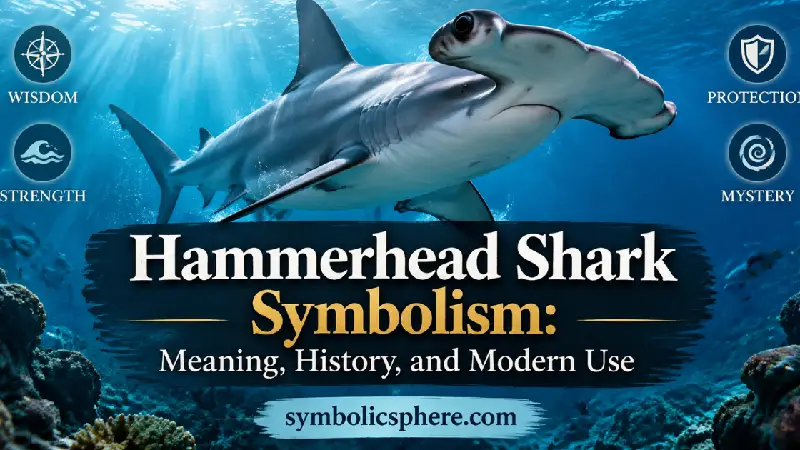
Few ocean animals are as instantly recognizable as the hammerhead shark. Its wide, T-shaped head sets it apart from every other predator in the water, and that visual strangeness is exactly why people keep reaching for it as a symbol. Hammerhead shark symbolism has become a fixture in tattoo studios, jewelry cases, and coastal gift shops across the United States, but the meanings attached to it didn’t appear out of nowhere.
Part of that meaning is biological: hammerheads see and sense their surroundings differently than other sharks, and that difference reads naturally as heightened awareness. Part of it is cultural, inherited from Pacific traditions that gave the shark’s shape a name and a story long before it appeared on a surf shop wall. And part of it is newer, shaped by what Americans now know about the animal’s vulnerability in the wild.
This article covers what the hammerhead actually looks like, where its symbolism started, how it’s used and understood in the U.S. today, and where that meaning runs into real controversy.
Quick Answer: What Does a Hammerhead Shark Symbolize?
A hammerhead shark symbolizes sharp awareness, confidence, and composure under pressure — meanings drawn directly from its unusually wide field of vision and keen sensory ability. In Pacific Island traditions, particularly Māori culture, it carries a more specific meaning tied to tenacity, disciplined strength, and protection.
TL;DR
- Represents alert perception, tied to the shark’s wide-set eyes and senses
- Māori tradition uses the hammerhead shape (mangōpare) to signal tenacity and leadership
- Native Hawaiian belief treats some hammerheads as respected guardian spirits
- In the U.S., it mostly appears in tattoos, surf and dive culture, and coastal design
- Endangered status has added a newer layer of meaning tied to fragility and urgency
- Meaning shifts by context: strength in one setting, vigilance or guardianship in another
What the Hammerhead Shark Actually Looks Like
The feature that makes the hammerhead unmistakable is its cephalofoil — the flattened, mallet-shaped extension of the skull that carries the eyes and nostrils out to the far edges. Depending on the species, this head can look like a smoothly rounded mallet or have a scalloped front edge, ranging from about a foot across on smaller species to several feet wide on the great hammerhead. The body behind it is fairly typical shark anatomy: gray or brownish on top, pale underneath, with a tall dorsal fin.
Most people encounter this shape in one of three ways: divers and snorkelers see it in warm coastal waters, sometimes in large schools of juveniles; coastal communities across the Pacific and the Americas have long used it as an artistic motif; and everyday Americans mostly meet the hammerhead through images — nature documentaries, aquarium exhibits, tattoos, and beach-town merchandise.
Core Meaning: What Hammerhead Symbolism Commonly Represents
At its center, hammerhead symbolism pairs perception with composure. The shape of the head spreads the shark’s eyes far apart, giving it a wider field of vision than most sharks, while its head also carries an unusually dense array of electroreceptors that detect faint electrical signals from prey hidden in the sand. Symbolically, this reads as an animal built to notice what other predators miss.
That biological trait translates into fairly consistent human terms: awareness, clear-headedness under pressure, and confidence that doesn’t need to be loud. Unlike symbols built around raw aggression, the hammerhead leans toward watchfulness and control. Choosing it as a personal symbol usually signals attentiveness and self-possession, not dominance for its own sake.
Historical Origins: How the Symbolism Took Shape
Sharks in general carry ancient symbolic weight simply because they predate most other ocean life by tens of millions of years, making them established apex predators long before humans built the first coastal settlements. The hammerhead family specifically appears in the fossil record as far back as the early Miocene, giving it a long run as a fixture of ocean ecosystems.
Human symbolism around the hammerhead is far more recent and far more local, though. Coastal and island communities that lived alongside sharks daily were the first to attach specific cultural meaning to its odd shape, drawing on direct observation of its schooling patterns and hunting style. Those early, place-based interpretations are the root of most meanings still attached to the shark today, and they only spread into wider popular use much later, as global trade, travel, and media carried Pacific and coastal imagery far beyond its origin.
Symbolism in the United States
In American culture, the hammerhead functions less as an inherited mythological figure and more as a modern personal and design symbol. It shows up heavily in three overlapping spaces: ocean and surf culture, tattoo culture, and conservation-minded branding.
In coastal states especially, the hammerhead has become shorthand for a particular relationship with the ocean — respect for its power without treating it as purely dangerous. It appears on dive shop signage, boat names, and beachwear, usually paired with a message of quiet confidence rather than threat.
In American tattoo culture, the hammerhead is frequently chosen by people connected to diving, surfing, military service, or coastal identity generally. It’s also picked simply for its visual boldness, since the head shape translates well into striking linework. Because the U.S. doesn’t have its own long-standing hammerhead mythology, most Americans are essentially borrowing and reinterpreting older Pacific meanings, whether or not they know the specific tradition behind them. (Internal link opportunity: a broader “shark symbolism” pillar page.)
Māori Tradition and the Mangōpare
The clearest, best-documented traditional meaning of the hammerhead shark comes from Māori culture in Aotearoa New Zealand, where it’s known as the mangōpare. The mangōpare pattern is a major motif in Māori art, appearing in tā moko (traditional tattooing), in kōwhaiwhai rafter patterns inside meeting houses, and in carving. It’s tied to a well-known proverb — roughly, “die like a shark, not like an octopus” — which praises people who commit fully to a difficult task rather than giving up.
In this tradition, the mangōpare represents strength, tenacity, agility, and disciplined determination, and it’s often used to honor an ancestor known for giving everything to their responsibilities. The symbol remains genuinely active today, appearing on sports uniforms, coins, and contemporary jewelry, not just as a historical reference.
Hawaiian Shark Reverence
Native Hawaiian tradition holds that sharks can be ʻaumākua — family guardian spirits believed to be the transformed presence of an ancestor watching over living relatives. Not every shark carries this status, and it varies by family, but the scalloped hammerhead, known in Hawaiian as manō kihikihi, is generally regarded as one of the more respected and non-threatening sharks in these waters, distinct from species considered dangerous man-eaters.
This tradition frames the hammerhead less as a symbol of raw power and more as a presence tied to protection, guidance, and continuity between generations — a meaningfully different emphasis than the Māori tradition’s focus on tenacity. That’s part of why hammerhead symbolism doesn’t collapse into one single “correct” meaning even within the Pacific.
Emotional and Psychological Meaning
Psychologically, people tend to project two related ideas onto the hammerhead: seeing clearly and staying grounded. Because the animal’s defining trait is its unusual field of vision, it’s an easy stand-in for reading a situation accurately, noticing what’s beneath the surface of a conversation or circumstance, and trusting instinct over panic.
This is also why the hammerhead appears in dream interpretation and personal-symbol contexts as a marker of facing something difficult without losing composure. It’s rarely used to represent chaos or blind aggression; the symbolism consistently points toward controlled strength rather than volatility.
Why It Appears in Tattoos and Personal Style
Tattoo culture is probably the single biggest driver of hammerhead symbolism in everyday American life, for a few reasons. The shape is graphically striking and works well in both bold blackwork and detailed realism. It also lets the wearer claim a specific identity — diver, surfer, ocean lover, someone who’s weathered rough experiences — without needing an aggressive shark image. And for people aware of the Māori tradition, choosing the mangōpare pattern specifically signals tenacity and follow-through, though this deserves a thoughtful approach rather than pure decoration, since the design carries real cultural weight within Māori communities.
Jewelry, Decor, and Fashion
Outside of tattoos, the hammerhead shows up in silver and gold pendants, beach-house decor, surfwear logos, and dive gear branding. Here the symbolism is usually lighter and more lifestyle-oriented — a signal of ocean affinity, adventurousness, or laid-back confidence rather than anything deeply personal. It’s common to see the shape simplified into a clean silhouette, trading some of the deeper cultural meaning for pure visual identity.
Pop Culture and Digital Spaces
Documentaries and aquarium programming have made the hammerhead one of the more familiar “strange but not scary” sharks to the American public, which is part of why it hasn’t picked up the same fear-based reputation as the great white. On social media, hammerhead footage tends to circulate around awe and curiosity rather than danger, often alongside conservation messaging about declining shark populations. This has quietly shifted the symbol’s public tone over the past couple of decades, from purely “cool predator” toward “cool predator that needs protecting.”
Common Misunderstandings and Controversies
The biggest misunderstanding around hammerhead symbolism is treating it as interchangeable with generic shark imagery tied to menace or violence. In its actual traditional sources, the hammerhead is almost never a symbol of unchecked aggression — it’s tied to discipline, awareness, and respected strength. Using it as shorthand for pure danger flattens most of the meaning it carries in the cultures that developed it.
A more sensitive issue is the casual use of Māori mangōpare patterns as generic tattoo flash, with no acknowledgment of where the design comes from. The visual style is widely available online, but the pattern carries lineage and achievement significance within Māori communities specifically, and treating it as an anonymous “tribal shark” design strips out that context. Anyone drawn to the design has reasonable alternatives: choosing a more generic hammerhead silhouette, or learning the tradition and, where appropriate, working with an artist connected to it.
Conservation and the Modern Meaning of the Symbol
One of the more significant recent shifts in hammerhead symbolism has nothing to do with ancient tradition and everything to do with current science. Several hammerhead species, including the scalloped hammerhead, are now classified as endangered or critically endangered, with population declines in some regions estimated at well over 90% since the 1990s, driven mainly by demand for shark fins and incidental capture in commercial fishing gear.
This has added a newer layer to the symbol specifically in the U.S.: the hammerhead increasingly appears in conservation branding, ocean advocacy campaigns, and environmentally minded design, where it stands for fragility and urgency alongside its older associations with strength. It’s an unusual case of a symbol’s meaning being actively reshaped in real time by the animal’s real-world status. (Internal link opportunity: an “ocean animal symbolism” hub page.)
How the Meaning Has Evolved Over Time
Traced in sequence, the hammerhead’s symbolic arc runs from close, practical observation by the coastal communities who lived alongside it, to specific cultural encoding in traditions like the Māori mangōpare and Hawaiian shark reverence, to a much broader and looser adoption as a design element in American ocean and tattoo culture, and now to a conservation-inflected meaning shaped by the shark’s endangered status. Each layer hasn’t replaced the one before it — they sit stacked on top of each other, which is why the same image can mean tenacity to one person, guardianship to another, and vulnerability to a third.
Hammerhead Symbolism at a Glance
| Context | Meaning in the U.S. | Common Associations | Notes |
|---|---|---|---|
| Tattoo culture | Confidence, ocean identity | Diving, surfing, personal resilience | Sometimes borrows Māori mangōpare styling |
| Māori tradition | Tenacity, disciplined strength | Warfare, leadership, ancestry | Original source of the most specific meaning |
| Hawaiian tradition | Guardianship, protection | Family ʻaumākua, respected (non-niuhi) shark | Meaning varies by family and species |
| Jewelry and decor | Ocean affinity, adventurousness | Beach lifestyle, surf brands | Lighter, more decorative use |
| Conservation branding | Fragility, urgency | Endangered species advocacy | A newer, fast-growing layer of meaning |
FAQs
What does a hammerhead shark tattoo mean?
Most commonly, it signals confidence, sharp awareness, and a connection to the ocean, diving, or surfing culture. For people drawing on Māori tradition specifically, it can also represent tenacity and giving full effort to a difficult undertaking.
Is the hammerhead shark a symbol of good or bad luck?
No — it isn’t traditionally tied to luck in either direction. In the cultures where it carries the most specific meaning, it’s associated with respected strength or guardianship rather than fortune.
Does the hammerhead shark have religious symbolism?
It isn’t a major figure in most world religions, but it holds spiritual significance in Native Hawaiian belief, where certain sharks — including some hammerheads — can be regarded as ʻaumākua, or ancestral guardian spirits watching over a family.
Why is the hammerhead shark associated with awareness or perception?
This comes directly from its biology. Its wide, flattened head spreads its eyes apart for a broader field of vision and packs in extra electroreceptors that detect faint signals from hidden prey, which translates symbolically into heightened perception and instinct.
Is it disrespectful to get a Māori-style hammerhead tattoo?
The mangōpare pattern specifically carries lineage and achievement meaning within Māori culture, so using it without any awareness of that context can come across as careless. A generic hammerhead design avoids that issue, or you can research the tradition and consider working with an artist connected to it.
Has the meaning of the hammerhead shark changed recently?
Yes. Alongside its older associations with strength and awareness, the hammerhead has picked up a newer meaning tied to vulnerability, since several hammerhead species are now endangered due to overfishing and finning.
Conclusion
Hammerhead shark symbolism holds together because it’s built on something real: an animal whose shape genuinely changes how it senses the world, observed closely enough by coastal cultures that its strangeness turned into specific meaning rather than vague mystique. That’s why the throughline across traditions isn’t fear or chaos — it’s controlled strength paired with sharp perception.
In the United States, hammerhead symbolism today is mostly personal and aesthetic rather than inherited from a single tradition, borrowed loosely from Pacific sources and reshaped by tattoo culture, ocean lifestyle branding, and growing concern for the species’ survival. Understanding where that meaning actually comes from doesn’t reduce its usefulness as a symbol — if anything, knowing the specific traditions behind it, and the real pressure the species is under, gives the image more weight than a generic ocean icon ever could.


