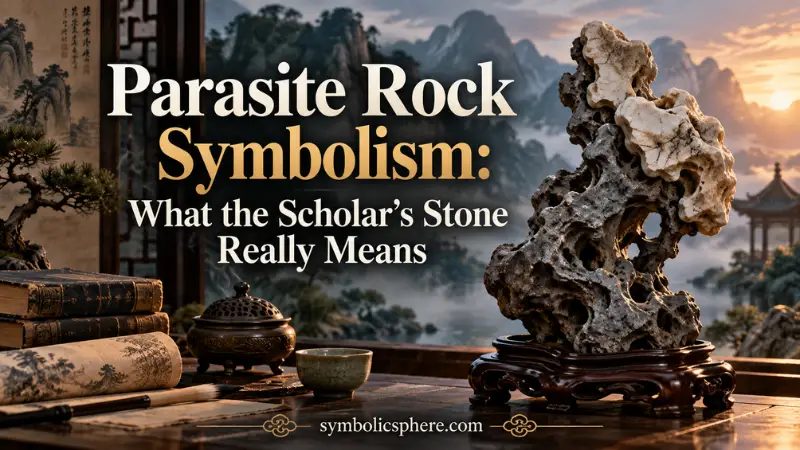
In Bong Joon-ho’s 2019 film Parasite, the heavy decorative stone given to the Kim family becomes far more than a household object. Parasite rock symbolism centers on ambition, prosperity, and social mobility, and on the uneasy gap between dreaming of wealth and living inside a rigid class system.
The stone is a scholar’s rock, known in Korea as suseok. What first looks like a gift promising good fortune becomes tied to disappointment, violence, and the limits of trying to climb the social ladder. The rock’s meaning is never simply “luck.” It shows how an ordinary object can carry someone’s hopes, expectations, and assumptions about success.
Quick Answer
The rock in Parasite symbolizes ambition and the desire for upward social mobility. Ki-woo believes the stone will bring his family prosperity. As the story darkens, its meaning reverses: it becomes a burden, then a weapon, reflecting how his dream collapses under the weight of class inequality. The object draws on the Korean suseok tradition of appreciating natural stones.
Key Takeaways
- The rock represents Ki-woo’s dream of wealth and social advancement.
- It comes from the Korean tradition of appreciating naturally formed viewing stones.
- The gift first suggests prosperity, luck, and opportunity.
- The flooded stone reflects the collapse of the Kim family’s hopes.
- Its use as a weapon reverses its original promise.
- The dark symbolism belongs to the film, not to scholar stones in general.
What Is the Rock in Parasite?
The stone is a substantial, irregularly shaped rock that resembles a miniature landscape. It is clearly not a garden stone or a random piece of geology.
Ki-woo’s friend Min-hyuk brings it to the Kims’ semi-basement (banjiha) apartment as a gift, explaining that his grandfather collected scholar’s rocks. From its first appearance, the object carries cultural and aesthetic value beyond its physical form.
Its shape matters. Scholar stones are admired because natural formations can suggest mountains, valleys, cliffs, or islands; their beauty lies in recognizing an image within something nature made. That makes the rock a fitting symbol for Parasite. It is literally a piece of nature, but the characters project an imagined future onto it. Ki-woo doesn’t just see an attractive stone. He sees a way out. Tellingly, his first reaction is to call it “so metaphorical.”
The Tradition Behind the Stone: Korean Suseok
The rock’s symbolism becomes clearer when you understand where it comes from.
In Korea, suseok refers to viewing stones or scholar stones. The practice is related to wider East Asian traditions of stone appreciation, including Chinese gongshi and Japanese suiseki. These stones are valued for their shape, texture, color, surface, and resemblance to landscapes. Their appeal lies less in geological rarity and more in how they invite contemplation of mountains and natural scenery.
Korean scholar-stone culture became associated with educated, cultivated settings. During the Joseon period, literati displayed such stones as part of the visual world of study and intellectual life.
This background matters. The stone in Parasite isn’t a symbol invented for the movie. It is an established cultural object already linked to aesthetic appreciation, cultivation, nature, and social status. That is exactly why it works as a marker of the world Ki-woo wants to enter.
What the Rock Symbolizes
Hope and the promise of prosperity
At first, the rock stands for hope of financial improvement. The Kims are struggling, folding pizza boxes and taking any work they can find. The stone arrives at the same moment Min offers Ki-woo a job tutoring Da-hye, the daughter of the wealthy Park family.
The timing invites Ki-woo to connect the two. A better future can’t be held in your hands, but a rock can. Ki-woo can carry it, look at it, and grow attached to it, so his ambition gains something concrete to cling to.
Access, not just luck
The gift also comes from someone more privileged than Ki-woo. Min already has access to the Park household and can open the door to the tutoring job. The stone therefore represents access as much as fortune: luck combined with networking, privilege, and opportunity.
Social mobility and the film’s vertical world
Parasite constantly frames class through height: stairs, walls, elevated houses, and underground rooms. The Kims’ semi-basement sits physically below the Parks’ hillside home, and a hidden bunker lies even deeper.
The stone travels through all of these spaces. It enters the Kims’ half-underground apartment, surfaces in the flood, and is finally carried into the bunker. Its movement mirrors the family’s fortunes. The characters want to go up, and the story keeps pulling them down. [Internal link: Parasite staircase and vertical symbolism]
How the Rock’s Meaning Changes Throughout the Film
The stone’s symbolism evolves in stages:
Gift → Hope → Ambition → Burden → Violence → Release
The gift: an illusion of good fortune
The Kims’ success turns out to be temporary. Access to the Park household doesn’t create real security, and their growing deception brings them into conflict with others who are also fighting to survive. The stone becomes ironic: introduced as a promise of prosperity, it is followed by consequences no one can control.
The film doesn’t ask us to believe the stone is cursed. Its power comes from the contrast between what the characters believe it promises and what actually happens.
The flood: hope meets material reality
After a torrential rainstorm, the Kims’ apartment floods. They lose their belongings and spend the night in an emergency shelter with other displaced residents. Amid the wreckage, the stone rises into view in the water.
The image is a pointed contradiction: an object tied to prosperity, surrounded by ruin. It exposes the gap between symbolic hope and material reality. A lucky object can’t stop a flood, and it can’t replace stable housing, financial security, or social protection.
The bunker: from gift to weapon
Near the climax, Ki-woo carries the stone down into the hidden bunker beneath the Parks’ home, intending to confront the man living there. Instead, the stone is turned against him.
The transformation is deliberately unsettling. The object that once promised upward movement now causes physical harm, and its meaning shifts from hope to ambition entangled with desperation. Its weight becomes part of the point: Ki-woo carried it because of what it represented, and that burden proves dangerous, both literally and symbolically.
The ending: letting go
After the tragedy, Ki-woo returns the stone to a stream, placing it back among ordinary rocks. The object loses its symbolic authority. What once seemed to hold a better future becomes simply a stone again, while Ki-woo’s dream of rising remains just that: a dream.
Summary: the rock’s meaning scene by scene
| Scene | Symbolic meaning | Common associations | What changes |
|---|---|---|---|
| Gift to the Kims | Hope and opportunity | Luck, prosperity, access | Its original promise is positive |
| Ki-woo’s attachment | Personal aspiration | Wealth, achievement, status | The object becomes emotionally loaded |
| The flood | Lost security | Failure, instability | Its meaning begins to reverse |
| The bunker | Burden and danger | Desperation, violence | The “lucky” object becomes a threat |
| The ending | Release from the illusion | Acceptance, uncertainty | Its symbolic journey comes full circle |
The Rock and Class Inequality
The stone can’t be separated from the film’s larger examination of class. Parasite contrasts those with financial security against those living one disaster away from ruin, through houses, stairs, smells, clothing, food, and space. [Internal link: Parasite smell symbolism and class]
The rock condenses that theme into one object. It doesn’t simply symbolize being rich. It represents the desire to become rich, and the uncertainty surrounding that desire. An object rooted in a culture of refinement and status ends up in the hands of a family whose real concerns are rent, work, food, and survival.
There is a psychological layer too. People often attach large hopes to tangible things: a keepsake, a diploma, a lucky charm. Ki-woo’s attachment works the same way. The stone gives his ambition an outside focus, which is why its shift from gift to burden hits so hard. A dream can motivate someone and weigh on them at the same time.
What the Rock Means for American Viewers
American audiences often read the stone through the lens of the American Dream. In U.S. popular culture, symbols of success tend to be flashy: cars, watches, big houses. The Parasite rock is deliberately modest and culturally specific.
Its message isn’t simply that wealth is desirable. It highlights the tension between individual ambition and economic structure. Ki-woo is clever and resourceful, but his opportunities are shaped by forces he doesn’t control. That makes the stone resonate with American conversations about education, housing, employment, and inequality, while it remains rooted in its Korean setting rather than becoming an American symbol.
Common Misunderstandings About the Parasite Rock
“The rock is magical or cursed.” The film links the stone to good fortune, but its meaning comes from the characters’ beliefs and the story’s irony, not from any supernatural power.
“The rock just represents wealth.” It represents the desire for wealth, the hope of advancement, and the psychological weight of believing that advancement is within reach.
“All Korean scholar stones carry this meaning.” They don’t. The film borrows a real tradition and reshapes it for a fictional story. The dark symbolism belongs to Parasite, not to suseok as an art form.
Why the Rock Still Matters in Film Culture
The stone remains one of Parasite‘s most recognizable images because it turns a complex social issue into something you can see. The house symbolizes class, the stairs symbolize hierarchy, and the flood symbolizes unequal vulnerability. The rock adds one more dimension: what people choose to believe about their future.
It also shows how international cinema can introduce audiences to unfamiliar traditions. Viewers can appreciate the stone as part of Korean artistic culture while understanding the specific metaphor Bong Joon-ho builds around it. [Internal link: Bong Joon-ho’s use of symbolism]
FQAs
What does the rock symbolize in Parasite?
The rock symbolizes Ki-woo’s hope for prosperity and upward social mobility. As the story unfolds, it also comes to represent the burden and instability of chasing that dream.
Is the rock in Parasite a real Korean cultural object?
Yes. It is based on Korean suseok, or viewing stones, part of a broader East Asian tradition of appreciating naturally shaped stones. The film adapts it for its own story.
Is the rock in Parasite a real Korean cultural object?
Yes. It is based on Korean suseok, or viewing stones, part of a broader East Asian tradition of appreciating naturally shaped stones. The film adapts it for its own story.
Does the rock symbolize good luck?
At first, yes. The stone is presented as a bringer of prosperity, but the film deliberately complicates that meaning as events unfold.
Why does the rock appear floating during the flood?
The image creates an ironic contrast: an object associated with prosperity rises amid the destruction of the family’s home, suggesting the promise attached to it has failed.
Why does the rock become a weapon?
The reversal shows how Ki-woo’s pursuit of advancement has become tangled up with desperation and conflict. Something meant to lift him up ends up causing harm.
What happens to the rock at the end of Parasite?
Ki-woo returns it to a stream, symbolically letting go of the illusion it carried.
Does the rock represent the American Dream?
It shares themes with the American Dream, especially the wish to improve one’s economic position. But the film’s context is Korean, so treating it purely as an American symbol overlooks its setting.
Are scholar’s rocks considered unlucky?
No. The negative symbolism belongs to the rock’s role in Parasite. Scholar stones have their own long artistic and cultural tradition.
Conclusion
The stone in Parasite begins as an object of beauty, prosperity, and possibility, and its meaning shifts as Ki-woo’s hopes collide with the realities of class and economic insecurity. It becomes a physical form of ambition: something he can hold onto even when the future he imagines stays out of reach.
In the end, Parasite rock symbolism is less about a magical stone than about the human urge to make hope tangible. The rock’s journey from gift to burden to weapon shows how an object’s meaning changes when circumstances do, and how dreams of a better life can carry both motivation and weight.
The rock never stops being an ordinary stone. What changes is what the characters expect it to mean. Even Bong Joon-ho has described the stone as an intentionally unusual choice, leaving much of its meaning to the characters and the audience.