Bite into an unripe persimmon and you’ll understand its symbolism instantly — the tannins pucker your mouth so intensely that patience stops being an abstract virtue and becomes a physical lesson. Wait a few more weeks, though, and that same fruit turns soft, glossy, and honey-sweet. Few foods make the difference between “too soon” and “just right” so vivid, which is exactly why the persimmon has become such a durable symbol of timing, maturity, and reward across cultures as different as rural China and the American Midwest.
This guide walks through what the persimmon symbolizes today, where those meanings come from, and how they shift across Chinese, Japanese, Korean, and American tradition — from harvest imagery and folk weather-telling to tattoos, gifts, and contemplative art.
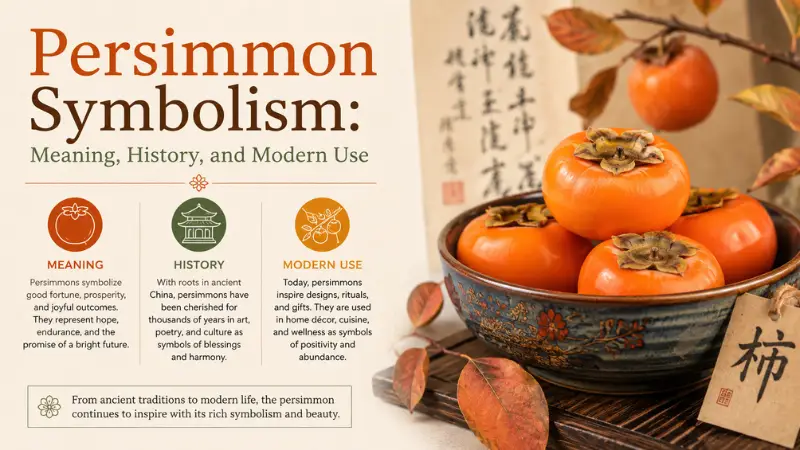
Persimmon symbolism centers on autumn abundance, patience, maturity, and good fortune. The fruit’s glowing orange color, late-season ripening, and dramatic shift from mouth-puckering astringency to sweetness give it a natural, almost built-in connection to ideas about timing and transformation.
That said, exact meaning depends heavily on culture. In China, the persimmon appears in auspicious art and wordplay tied to prosperity. In Japan, it’s inseparable from late autumn, seasonal beauty, and traditional foodways. Korea has its own persimmon customs, from dried fruit to a well-loved tiger folktale. In the United States, meaning is more layered: a native persimmon species has long been part of the eastern landscape, and modern interpretations often blend that local heritage with Asian associations carried through art, gardening, food, and immigrant traditions.
What Does a Persimmon Symbolize? Quick Answer
In modern American use, a persimmon most often represents abundance, patience, and maturity — largely because the fruit only becomes sweet once it reaches the right stage of ripeness. Historically, it has also stood for prosperity and good fortune in parts of East Asia, with strong seasonal ties in China, Japan, and Korea.
At a glance:
- Patience and ripeness — the fruit rewards waiting, not rushing
- Abundance and autumn — bright fruit against a bare, late-season tree
- Prosperity — especially in Chinese decorative art and wordplay
- Seasonality — central to Japanese autumn imagery and food culture
- Heritage and folklore — dried persimmons in Korean tradition and storytelling
- Place — the native American persimmon and its ties to the eastern U.S.
Common Meanings by Context
| Context | Common Meaning in the U.S. | Association | Notes |
|---|---|---|---|
| Ripe fruit | Maturity | Readiness, fulfillment | Sweetness arrives only at the right stage |
| Autumn imagery | Abundance | Harvest, gratitude, plenty | Orange color fits fall visuals naturally |
| Personal symbolism | Patience | Timing, self-development | Rooted in the ripening process itself |
| East Asian–inspired art | Good fortune | Prosperity, celebration | Meaning shifts with cultural context |
| Native American persimmon | Place and heritage | Eastern U.S. landscape | A historical food source, not one fixed spiritual meaning |
A persimmon works best as a symbol when the message is about something that becomes valuable through time, maturity, care, or seasonal change.
Why Persimmons Suggest Patience and Maturity
Few fruits demonstrate the value of timing as clearly as an unripe persimmon. Before it’s ready, tannins give it an intensely dry, puckering quality — the native American persimmon is especially known for this. As it softens, that harshness fades and sweetness takes over.
That biological process, more than any legend, is why patience has become one of the fruit’s most convincing modern meanings. A persimmon can communicate:
- waiting without forcing an outcome
- personal maturity and growth
- learning through direct experience
- trusting proper timing over speed
- becoming more generous or open with age
That makes it a fitting symbol for tattoos, gifts, artwork, or personal writing about entering a new stage of life.
The American Persimmon and Its Native Roots
The United States has its own persimmon species, Diospyros virginiana, native across a wide swath of the eastern and central U.S. It has long fed both people and wildlife, and archaeological evidence places persimmons among the wild fruits gathered by pre-Columbian communities in North America, including groups from the Woodland period. Even the word “persimmon” comes from an Algonquian language rather than a European fruit term — a detail confirmed by Missouri Botanical Garden’s plant profile.
These facts give the fruit a legitimate tie to place, continuity, and seasonal food knowledge in the eastern American landscape. One caution is worth noting: evidence that Indigenous communities ate and valued persimmons doesn’t mean every Native nation attached the same spiritual meaning to it. Claims that persimmons “universally symbolized sacred wisdom to Native Americans” deserve skepticism unless tied to a specific, documented tradition.
What Persimmons Mean in Modern American Culture
Unlike a bald eagle or a red rose, the persimmon isn’t a fixed national symbol in the U.S. Its meaning is quieter and more contextual.
For gardeners and those familiar with native plants, it may evoke regional identity, wildlife, or old orchards. For cooks and farmers-market regulars, it often marks the shift from fall into early winter. Asian persimmon varieties add another layer — their presence in California agriculture, Asian American food traditions, home gardens, and still-life art lets American interpretations overlap comfortably with Chinese, Japanese, and Korean associations.
Put together, Americans are most likely to read the persimmon as a symbol of autumn, abundance, warmth, patience, and heritage rather than one fixed emblem.
Chinese Symbolism: Good Fortune and Prosperity
The persimmon holds a firmly auspicious role in Chinese decorative culture. Museum collections identify it as a symbol of prosperity, and its meaning extends through wordplay: the Chinese word for persimmon, shi, can combine with other images in rebus-style compositions to express wishes for favorable circumstances.
That’s why persimmons turn up regularly in decorative objects, paintings, ceramics, and auspicious art. In this context, the fruit can suggest:
- prosperity and favorable outcomes
- wishes being fulfilled
- household happiness
- general abundance
These associations belong to a specific artistic and linguistic tradition — worth knowing, but not something to apply automatically to every image of the fruit.
Japanese Meaning: Autumn and Everyday Beauty
<!– Internal link opportunity: link “autumn” or “moon-viewing” to a broader piece on Japanese seasonal traditions if available –>
In Japan, persimmons are one of the season’s clearest signals. Fresh kaki appear in autumn, while peeled fruit hung to dry creates a distinctive late-season look in some regions. Japanese art and literature pay close attention to seasonal change, so the persimmon communicates late autumn, harvest, transience, and rural life without needing an elaborate symbolic code.
The fruit shows up repeatedly in Japanese art, too — persimmon trees appear in Rinpa painting, and prints and still lifes preserve it as a familiar artistic subject. Traditional moon-viewing customs may also include persimmons among the season’s foods, reinforcing its tie to the calendar.
Dried Persimmons: The Meaning of Preservation
Drying changes the fruit’s symbolism in its own way. In Japan, hoshigaki are made by peeling and hanging select persimmon varieties; in some regions, rows of drying fruit are themselves considered characteristic late-autumn scenery.
Symbolically, preservation suggests:
- Preparation — food readied for later use
- Care — drying takes ongoing attention, not instant consumption
- Continuity — traditional methods that link generations
- Transformation — a harsh fruit becoming concentrated and sweet
A dried persimmon, then, represents something slightly different from fresh fruit: patience paired with deliberate work.
Korean Culture and Folklore
Dried persimmons, or gotgam, hold an important place in Korean seasonal culture, tied to autumn, traditional food preparation, and community life.
One of the fruit’s most memorable appearances is in the folktale often translated as “The Tiger and the Dried Persimmon.” A tiger overhears a crying child go quiet the moment it’s offered a dried persimmon, and mistakenly assumes the persimmon itself must be something terrifying — a misunderstanding that drives the story’s humor. The tale doesn’t make the persimmon a literal symbol of fear; it simply shows how an everyday food became woven into storytelling. Today, Korean persimmon imagery tends to evoke autumn, childhood stories, and family memory.
Persimmons in Art and Contemplative Imagery
A simple arrangement of persimmons can carry more weight than abundance alone. One famous example is the Chinese ink painting known as Six Persimmons, traditionally attributed to the monk-painter Muqi. Its sparse composition later gained particular admiration in Japan and is frequently discussed today in connection with Zen aesthetics — you can see the painting’s lineage and scholarship summarized on The Metropolitan Museum of Art’s collection notes.
Modern viewers often read such images as representing simplicity, attention, or stillness. Those readings are meaningful, but they shouldn’t be flattened into a universal claim like “persimmons always symbolize enlightenment in Buddhism.” The connection is more specific: certain artworks, and the viewing traditions that grew around them, have encouraged that contemplative reading — not the fruit itself, everywhere, always.
Harvest, Abundance, and Gratitude
Persimmons ripen as many growing seasons wind down, which places them naturally within harvest imagery. A tree full of orange fruit can look abundant even as its leaves fall — a striking contrast between a barer landscape and fruit that remains.
That visual supports readings of:
- having enough
- receiving the results of earlier effort
- gratitude after hard work
- resources that persist when other things fade
In American fall decor, these meanings sit comfortably alongside pumpkins, apples, and dried leaves — though persimmons are less conventional, which can make them feel more personal or elevated in botanical design.
The Emotional Register of a Persimmon
Emotionally, the fruit tends to communicate warmth without excitement. Its orange and reddish-orange tones echo autumn foliage and late-afternoon light, and its rounded shape adds a calm, welcoming quality.
Someone choosing the persimmon as a personal symbol might be expressing:
- Contentment — appreciating what has ripened rather than always wanting more
- Readiness — reaching a stage where experience can finally be used
- Patience — refusing to force a process before its time
- Resilience — continuing to bear something valuable late in the season
- Home and memory — gardens, grandparents, or autumn meals
These are interpretive readings, not fixed rules — personal context matters more with fruit symbolism than with most other symbols.
Why the Orange Color Matters
A ripe persimmon ranges from golden orange to deep reddish-orange, and that color does real symbolic work. Against brown branches, fading leaves, or gray skies, it reads as visual warmth — which is why persimmon imagery so often signals comfort, hospitality, seasonal change, or creative vitality.
The color also reinforces abundance: a tree covered in bright fruit is hard to overlook, especially as the surrounding vegetation goes dormant. That’s part of what sets the persimmon apart from pale winter fruit or delicate spring blossoms — its message leans less toward beginnings and more toward ripeness near the end of a cycle.
Persimmon Tattoos and Personal Symbols
<!– Internal link opportunity: link to a dedicated “persimmon tattoo meaning” article if you have or plan one –>
A persimmon tattoo can carry real meaning without leaning on invented mythology. For someone who identifies with the fruit’s ripening process, it can represent patience or personal growth. A branch bearing several fruits can suggest family or the results of long-term effort. A Japanese-inspired design may lean into autumn and seasonal awareness; a Chinese-inspired one may draw on prosperity and good fortune — though culturally specific artistic elements are worth using thoughtfully.
Other common interpretations include:
- surviving a difficult period before finding sweetness
- honoring a family garden or hometown
- celebrating East Asian heritage
- accepting aging and maturity
- marking an autumn event or person
The strongest tattoo meaning is usually the one tied to a real experience, not a list of supposedly universal properties.
Persimmons in Decor, Gifts, and Digital Culture
Persimmon motifs work well in interiors and decorative art because they add color without leaning on floral imagery. A bowl of persimmons makes a dining space feel seasonal; botanical prints suggest autumn without defaulting to maple leaves or pumpkins; ceramic and fruit-shaped ornaments read as hospitality and plenty.
As gifts, real or persimmon-themed items carry different weight depending on the recipient’s background — simple seasonal generosity in a general American setting, or added associations with fortune and celebration within East Asian traditions. Online, the fruit also fits neatly into the visual language of slow living, seasonal cooking, and traditional food preparation, where its symbolism centers on attention to season and process.
American Folklore: Persimmon Seeds and Winter Weather
The persimmon holds an unusual place in American weather folklore. In parts of the Midwest and Ozarks, people split persimmon seeds and read the shape of the embryo inside — comparing it to a spoon, fork, or knife to predict the coming winter. The specific forecast tied to each shape varies by teller, though versions commonly link them to snow, cold, or milder conditions. Agricultural extension educators continue to discuss the custom as folklore, not reliable meteorology.
Symbolically, this tradition ties the fruit to folk weather knowledge, rural observation, and community storytelling — a good example of symbolism built from repeated local practice rather than formal religion.
Common Misunderstandings About Persimmon Meaning
The biggest mistake is treating every symbolic claim found online as settled history. Statements that persimmons universally represent enlightenment, immortality, or protection from evil often blend unrelated traditions or present modern interpretation as ancient fact.
A clearer approach separates the layers: Chinese auspicious symbolism has specific cultural and linguistic roots; Japanese meaning is shaped by seasonality, food, and art; Korean tradition brings its own food culture and folklore; American associations combine a native species with regional foodways and weather folklore. Meanings like patience and personal transformation are genuinely useful modern interpretations precisely because they reflect the fruit’s actual ripening behavior — they don’t need to be dressed up as ancient doctrine to hold value.
How the Meaning Evolved
The persimmon’s symbolism grew because different societies encountered it in different ways. In agricultural communities, it was first and foremost food — gathered, dried, preserved, and shared, with seasonal repetition tying it to autumn and harvest. Art then turned it into an aesthetic subject: language and decorative tradition gave it prosperity associations in China, while Japanese poetry and foodways cemented its identity as an autumn marker, and Korean storytelling gave it a lasting role in folk culture.
In the U.S., the native species stayed part of regional landscapes and food traditions, while Asian varieties introduced additional layers. Modern symbolism now blends all of this with personal interpretation — a reminder to wait, mature, or appreciate what arrives late, as long as that meaning’s modern origin is acknowledged rather than mistaken for ancient universal belief.
FAQs
Is a persimmon a symbol of good luck?
It can be, especially in Chinese cultural contexts, where persimmons appear in auspicious designs tied to prosperity. In general American use, good luck is one possible reading rather than a universally recognized meaning.
What does a persimmon tattoo symbolize?
Most often patience, maturity, abundance, or autumn — and for some, a nod to Chinese, Japanese, Korean, or American heritage and personal memory.
Does the persimmon have a spiritual meaning?
It can, within specific artworks and personal practices, but there’s no single universal “persimmon spirituality.” Claims about enlightenment or sacred transformation should be tied to a specific tradition rather than treated as a shared global fact.
Why are persimmons associated with autumn?
They typically ripen in fall, and their bright orange color stays visible even as the season advances — especially in Japan, where kaki are closely tied to late-autumn food and scenery.
What does a persimmon tree symbolize?
Abundance, patience, and continuity. Because a mature tree fruits across many seasons, it can also symbolize family continuity or a lasting attachment to place.
Are persimmons associated with prosperity?
Yes, particularly in Chinese decorative symbolism. In other cultures, abundance or harvest is often the more fitting interpretation than financial prosperity specifically.
What does dreaming about persimmons mean?
There’s no established universal interpretation. If one appears in a dream, its meaning is better understood through personal association — waiting, food, family, autumn, or whether the fruit was ripe or unripe.
Conclusion
Persimmon symbolism ultimately combines autumn abundance, patience, maturity, good fortune, and cultural memory — not from one universal tradition, but from the fruit’s distinctive ripening process and the different ways communities across North America and East Asia have grown, eaten, preserved, painted, and told stories about it.
For a modern audience, the most grounded takeaway is simple: the persimmon represents something that becomes rewarding once it’s allowed to reach its proper time. Whether it shows up in a tattoo, an artwork, a gift, or a seasonal decoration, it’s a fitting reminder that ripeness isn’t the same as speed.


