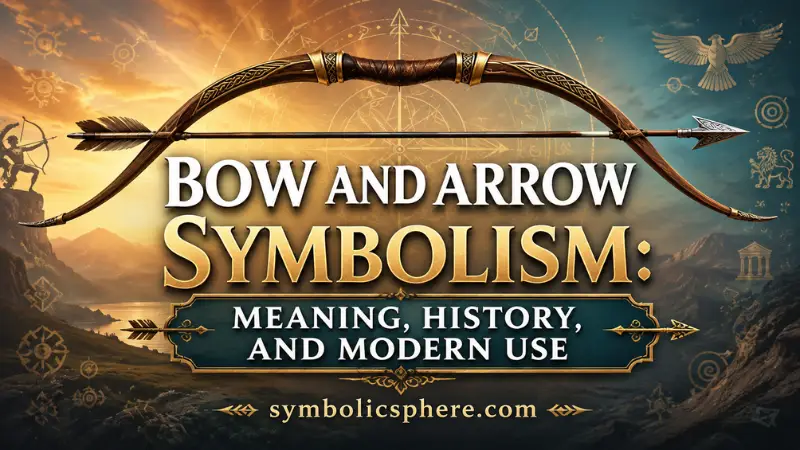
A drawn bow and a pointed arrow communicate something before a single word is added: tension, direction, intent. That’s the core of bow and arrow symbolism — an image built around focus, readiness, protection, skill, and the controlled use of strength. But depending on the setting, the same image can just as easily suggest hunting, warfare, romantic attraction, or personal independence.
That range comes from the bow’s long practical history. Humans used archery for hunting and combat long before it became a competitive sport, an artistic motif, or a personal emblem. Because an archer has to choose a target, draw the string, hold steady, and release at exactly the right moment, the equipment naturally lends itself to ideas about purpose and self-control.
Today, in the United States, bows and arrows show up everywhere — archery ranges, tattoos, jewelry, outdoor brands, Valentine’s Day cards, movies, video games, and graphic design. What the image means in any given case depends on whether it emphasizes the target, the weapon, the hunter, the arrow’s motion, or the person holding the bow.
Quick Answer
Bow and arrow symbolism most commonly represents focus, purpose, determination, protection, and movement toward a chosen goal in modern American culture. Historically, it has also stood for hunting, warfare, survival, divine power, disciplined skill, and romantic desire — most famously through the myth of Cupid’s arrow.
Key points to remember:
- A drawn bow signals focus, readiness, and controlled strength.
- A flying arrow suggests direction, momentum, or commitment to a path.
- Historically, archery served hunting, survival, warfare, and ceremony.
- Cupid is why arrows became shorthand for romantic attraction.
- Indigenous meanings vary by nation and shouldn’t be generalized.
- In tattoos, the image usually leans toward goals, resilience, or protection.
What the Bow and Arrow Represent as a Visual Symbol
The bow and arrow work as a pair, but each piece contributes something different to the image.
The bow stores energy. Before the arrow can move, the archer has to pull the string back and build tension — which makes the bow a natural metaphor for preparation, patience, restraint, and untapped potential.
The arrow gives that stored energy a direction. Once released, it travels toward a destination, so it tends to represent a goal, a decision, a path, or forward movement.
Together, they describe a sequence: choose, prepare, aim, release. That sequence is why modern designs so often use the bow and arrow to suggest deliberate action rather than raw physical force. A resting bow can read as potential or peace; a fully drawn bow creates urgency because action feels imminent; a flying arrow shifts the focus from preparation to consequence.
What It Commonly Means in the United States
In contemporary American culture, most interpretations fall into a handful of recognizable categories.
| Context | Common U.S. Meaning | Typical Association |
|---|---|---|
| Personal symbolism | Purpose and determination | Staying focused on a goal |
| Outdoor imagery | Skill and self-reliance | Hunting, wilderness, survival |
| Romantic imagery | Love and attraction | Cupid and Valentine’s Day |
| Athletic imagery | Precision and discipline | Competitive archery |
| Warrior imagery | Defense or conflict | Readiness, courage, danger |
| Tattoos and jewelry | Direction and resilience | Moving forward after difficulty |
These meanings frequently overlap. Someone wearing an arrow necklace might see it as a reminder to keep moving forward, while a competitive archer may associate the same shape more with concentration and technique.
Unlike a fixed traffic sign, a decorative bow and arrow doesn’t carry one official meaning. Direction, style, and the imagery around it all shape how a viewer reads it.
Why It Became a Symbol of Focus and Discipline
Archery rewards precision over uncontrolled force. An archer has to coordinate posture, breathing, alignment, timing, and release — which is exactly why the sport is so tightly associated with concentration.
The target reinforces the metaphor: it represents an objective, and aiming represents the process of directing attention toward it. Missing doesn’t have to mean failure — it can just as easily represent adjustment, learning, or another attempt.
The bow’s tension adds a further layer. Pulling backward before the arrow can move forward has become a popular modern metaphor for setbacks preceding progress. That reading is a contemporary one rather than an ancient universal doctrine, but it works because it maps so closely onto how the equipment actually functions — which is exactly why the image shows up so often in graduation gifts, motivational design, athletic branding, and tattoos about persistence or ambition.
Prehistoric Origins: Survival Before Symbolism
The bow and arrow began as technology, not as an abstract logo. Archery is extremely old, though pinning down an exact invention date is difficult — wooden bows, fibers, and other organic materials rarely survive thousands of years in the archaeological record.
Evidence for early projectile technology stretches deep into prehistory, and surviving arrowheads and later bows confirm that archery became widely used first for hunting and eventually for warfare. Different societies developed their own bow designs based on available materials, environment, prey, and military need.
That practical origin still shapes the symbol today. Hunting ties the bow to food, patience, tracking, and survival. Warfare ties it to danger, defense, military skill, and the ability to strike from a distance. Modern ideas like “purpose” or “goal-setting” came much later, building on something much older: an arrow is only useful when it’s aimed.
Ancient Egypt and the Mediterranean World
Ancient societies gave the bow meanings that went well beyond everyday hunting.
Egyptian archaeological collections preserve bows, images of archers, wrist guards, and other equipment tied to both military and funerary contexts — some surviving bows date to Egypt’s New Kingdom, while depictions of archers appear far earlier. The bow also carried political weight: in ancient Egyptian royal symbolism, the “Nine Bows” represented groups regarded as enemies of Egypt, expressing domination over hostile peoples rather than anything close to modern personal ambition.
Greek and Roman traditions expanded the range further still. Archer deities and mythological figures linked the bow with hunting, divine punishment, desire, and supernatural influence — laying the groundwork for one of the symbol’s biggest transformations (see below).
These examples matter because they show how much historical context changes the reading. A weapon that symbolizes concentration today could just as easily represent military authority, hunting skill, or divine power in an ancient setting.
How Cupid Made the Arrow a Symbol of Love
One of the biggest shifts in the arrow’s meaning came through Greek and Roman mythology.
Eros — the Greek god associated with love and desire — and his Roman counterpart Cupid were both depicted with bows and arrows. In classical imagery, Eros uses his arrows to spread love among mortals and gods alike, transforming the arrow from a physical weapon into a metaphor for attraction: love could “strike” unexpectedly, pierce emotional defenses, and change a person’s behavior much the way an arrow physically penetrates its target.
That idea outlived the religion that produced it. In American culture, Cupid’s bow and arrow is now closely tied to Valentine’s Day, romantic cards, heart graphics, candy packaging, and advertising — the weapon largely loses its threatening edge and becomes playful shorthand for falling in love.
That distinction still matters for reading the symbol correctly: an arrow piercing a heart usually suggests romance, longing, or emotional vulnerability, while an arrow next to a shield or a warrior sends a very different message entirely.
Indigenous North American Contexts Require Care
Bows and arrows were essential technology for many Indigenous peoples of North America, particularly for hunting and warfare. Museum collections preserve examples connected to peoples including the Hupa, Comanche, Blackfoot, Tohono O’odham, and Apache, among others, and historical records show archery remained in use well after firearms became available.
It would be misleading, though, to claim an arrow has one universal “Native American meaning.” Indigenous nations have distinct languages, histories, artistic systems, religions, and traditions — a design tied to one community can’t be automatically extended to hundreds of others. Even where bows and arrows served similar practical purposes, the ceremonies, stories, and social meanings attached to them varied.
Modern tattoo guides sometimes make sweeping claims — “two arrows always mean friendship,” “a broken arrow universally means peace in Native American culture” — that should be treated with real skepticism unless they’re tied to a specific nation, historical object, or documented tradition. For respectful use, it’s more accurate to describe a generic arrow tattoo as a modern personal symbol, unless the design knowingly draws on a particular Indigenous tradition.
The Symbol in American Culture and Archery
In the U.S., the bow lives in several cultural worlds at once.
For hunters, it can represent outdoor skill, patience, wildlife knowledge, and self-reliance. Recreational archery shifts the emphasis toward accuracy, technique, and competition — and the sport has a long Olympic history, appearing in early modern Games, dropping off the program, and returning permanently in 1972. The U.S. has its own chapter in that story too: St. Louis hosted Olympic archery in 1904, notable for including women’s events at an unusually early point in Olympic history. (For more on the sport’s competitive history, World Archery’s official history page is a good starting point.)
Outside organized archery, American film and TV repeatedly use skilled archers as characters who rely on accuracy rather than overwhelming force — reinforcing associations with competence, independence, patience, and grace under pressure. At the same time, hunting imagery means the bow can carry very different weight depending on the viewer: one person reads it as heritage and outdoor tradition, another sees primarily a weapon.
Cross-Cultural Meanings Beyond the United States
The bow’s symbolic range becomes even clearer outside American culture.
Japanese kyudo — commonly translated as the “Way of the Bow” — grew out of older Japanese archery traditions into a modern martial art centered on discipline, form, etiquette, and mental training. During the relatively peaceful Edo period, archery increasingly developed as an art form alongside its martial roots, and modern kyudo organizations describe practice as involving not just hitting a target but cultivating mind and body. That gives the bow associations with composure, self-examination, and courtesy quite different from a purely military reading. (The Smithsonian’s collections on archery and material culture offer useful cross-cultural context here.)
Elsewhere, bows have belonged to cavalry traditions, royal imagery, hunting cultures, martial training, folklore, and religious ceremony — traditions distinct enough that they shouldn’t be flattened into a single claim like “the bow means spirituality in Eastern cultures.” What the object signifies always depends on the specific tradition using it.
Emotional and Psychological Meaning
As a personal symbol, the bow and arrow usually communicates a mindset rather than a historical tradition:
- Focus — aiming at one point while excluding distractions
- Readiness — the drawn bow, where stored tension signals preparedness to act
- Patience — waiting for the right moment instead of releasing impulsively
- Resilience — the modern metaphor of being pulled back before moving forward
- Confidence — trusting training enough to release without hesitation
There’s also a psychological distinction between holding and releasing. Drawing the bow is an act of control; releasing is an act of commitment. Once the arrow leaves, its path can’t be taken back — which is exactly why, in personal symbolism, it so often represents making a decision and accepting the consequences.
Bow and Arrow Tattoo Meanings
Tattoos are where this image has picked up the widest range of personal meaning.
A single arrow usually represents direction, progress, or commitment to a path; adding a bow tends to emphasize preparation and the ability to act, not just movement. A drawn bow can express determination, readiness, or protection, capturing the instant before a decision becomes action. A heart and arrow typically points toward love, passion, or heartbreak, thanks to Cupid’s lasting influence. A target and arrow often represents ambition or concentration on a specific goal. An archer figure may signal independence, hunting identity, athletic pride, or admiration for a favorite fictional character.
That said, personal meaning matters more than any generic tattoo dictionary. The surrounding imagery, the arrow’s direction, the bow’s style, and the wearer’s own reason for choosing the design tell you more than a supposedly universal definition ever will.
Jewelry, Decor, Fashion, and Digital Culture
In jewelry, arrow pendants tend to soften the weapon’s military edge — small, minimalist designs usually read as reminders of direction, strength, friendship, or personal growth rather than anything threatening. Home decor uses similar shorthand: an arrow on a sign can simply point the way, while rustic or outdoor-themed pieces suggest adventure, hunting, or wilderness life.
Digital culture has pushed the arrow even further from its original function — arrow icons now tell users where to click, swipe, return, or navigate, keeping only the core idea of movement toward a direction. Fashion and branding borrow that same simplicity: a clean arrow feels active because the eye naturally follows its point, and adding a bow reintroduces the idea of effort — something has to generate the force that sends the arrow forward.
Positive and Negative Meanings
The bow and arrow shouldn’t be treated as automatically positive.
On the positive side, it can represent precision, self-discipline, courage, protection, patience, independence, achievement, or romantic attraction. On the negative side, it can just as easily represent warfare, aggression, threat, hunting and death, revenge, emotional wounding, or hostile intent.
Context usually settles the difference. An arrow flying toward a heart reads as romantic or emotional. An arrow pointed at a person reads as threatening. A bow hanging unused suggests peace or retirement. A hunter drawing a bow emphasizes pursuit and survival. That ambiguity is part of the symbol’s staying power — the same discipline that hits a sporting target can also be turned toward combat.
How the Meaning Evolved Over Time
The biggest misconception about this symbol is treating every bow-and-arrow design as if it comes from one single ancient system. It doesn’t.
For most of human history, bows were functional tools first. Their meanings grew out of the activities around them: hunting brought associations with survival and patience, warfare added power and danger, mythology added gods, fate, and love, ceremonial practice added ritual significance, and modern sport emphasized accuracy. American culture later turned the object’s physical mechanics into metaphor — aiming became focus, the target became a goal, flight became progress, and drawing back became preparation before advancing. Meanwhile, Cupid kept an entirely separate symbolic branch alive, making the arrow one of the most recognizable images of romantic attraction.
The result isn’t one fixed meaning but a cluster of connected ideas built around direction, tension, skill, and impact.
FAQs
What does a bow and arrow symbolize spiritually?
There’s no single universal spiritual meaning. In personal or modern spiritual contexts, people often use it to represent intention, discipline, protection, or directing one’s life toward a chosen purpose — while established religious traditions may interpret archery quite differently.
Is a bow and arrow a symbol of strength?
Yes, but usually controlled strength rather than brute force. A successful shot depends on technique, patience, and knowing when to release — making the image well suited to disciplined or purposeful strength rather than raw power.
What does a bow and arrow tattoo mean?
Most commonly focus, direction, independence, resilience, protection, or commitment to a goal. The exact meaning shifts depending on whether the bow is drawn, where the arrow points, and what other imagery surrounds it.
What does an arrow through a heart symbolize?
Romantic love, attraction, desire, or emotional vulnerability — an association that comes largely from the classical tradition of Eros and Cupid using arrows to spark love and desire.
Does a bow and arrow have a Native American meaning?
Bows and arrows were important across many Indigenous nations, but there’s no single meaning shared by all of them. Specific designs should be tied to a documented community or tradition before being described as carrying Indigenous symbolic meaning.
What does a drawn bow symbolize?
Readiness, tension, concentration, or the moment just before action. Because the stored energy hasn’t been released yet, it can also suggest restraint and controlled potential.
Is bow and arrow symbolism positive or negative?
Both, depending on context. It can represent purpose, discipline, protection, love, or progress — but military and hunting contexts can just as easily give it meanings tied to conflict, injury, or death.
Conclusion
The bow and arrow has stayed visually meaningful because its physical action already tells a complete story: prepare, aim, commit, release. Modern Americans most often connect it with focus, direction, determination, protection, and disciplined strength — while romance, hunting, warfare, mythology, and sport all add their own layers of meaning.
Its significance shifts widely across cultures, and ancient military imagery, classical stories of Eros, Indigenous hunting traditions, Japanese martial practice, and modern competitive archery each deserve to be understood on their own terms rather than folded into one invented “ancient” definition.
At its core, bow and arrow symbolism expresses the relationship between intention and action: strength is gathered first, direction is chosen, and only then does movement begin.