The hamsa hand is one of the most recognizable protective symbols in the world, yet many people who wear it as jewelry or hang it near their front door know little about where it comes from. It appears on necklaces at boutique markets, in home decor shops, and increasingly in tattoo studios — often stripped of the cultural and religious context that gave it meaning in the first place.
Hamsa hand symbolism spans several overlapping traditions rather than a single origin story. Jewish, Muslim, and broader Middle Eastern and North African communities have each shaped the symbol around their own customs of protection, blessing, and luck. That shared, layered history is also why the symbol still sparks debate today, particularly when it’s sold as a disconnected fashion accessory.
In the United States, the hamsa has moved from a culturally or religiously specific object into a mainstream wellness and fashion symbol. That shift has brought wider appreciation, but also confusion about what the symbol actually means and to whom. This guide covers what the hamsa represents, how it developed, and how Americans wear and interpret it now — handled with the same care the topic deserves.
Quick Answer: What Does the Hamsa Hand Symbolize?
The hamsa hand symbolizes protection from negative energy and misfortune, most commonly recognized in the U.S. as a charm against the “evil eye” on jewelry, wall art, and home decor. Historically, it also represents blessing and strength across Jewish and Islamic tradition, where it’s known as the Hand of Miriam and the Hand of Fatima.
Key Takeaways
- The hamsa is a palm-shaped amulet believed to guard against the evil eye.
- It predates both Judaism and Islam, with roots in ancient Mesopotamia and North Africa.
- Jewish tradition calls it the Hand of Miriam; Islamic tradition calls it the Hand of Fatima.
- In the U.S., it’s mainly worn as protective jewelry rather than a religious statement.
- It’s a popular choice for minimalist tattoos and bohemian-style home decor.
- Critics argue its use as a disconnected trend flattens its cultural meaning.
What Is a Hamsa Hand? (Description and Design)
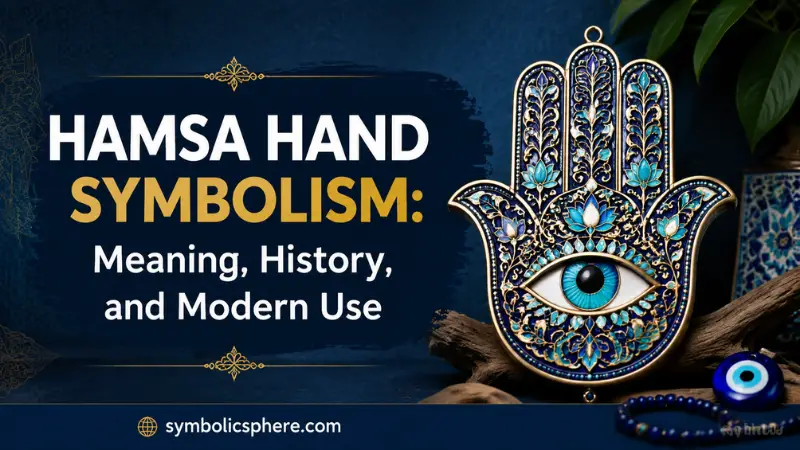
The hamsa is a stylized image of an open right or left hand, palm facing outward, fingers spread or held together. Most designs are symmetrical — the thumb and pinky mirror each other — so the hand looks the same right-side up or upside down. Many versions place an eye in the center of the palm, a detail tied directly to the symbol’s protective purpose.
You’ll typically see the hamsa as a pendant on a necklace or bracelet, as a wall hanging near a home’s entrance, or printed on textiles like scarves and tapestries. It’s usually rendered in metal, ceramic, or enamel, often paired with blue coloring, evil-eye beads, or Arabic and Hebrew script.
Core Meaning of the Hamsa Hand
At its core, the hamsa functions as a protective charm. The word “hamsa” comes from the Arabic root for the number five, referring to the hand’s five fingers — a number some traditions extend into deeper meaning, such as the five books of the Torah or the Five Pillars of Islam.
The most consistent thread across cultures is defense against the evil eye: the widely held folk belief that envy or ill will, often transmitted through a look or glance, can cause real harm. The hamsa is meant to intercept that harm before it reaches the wearer. Beyond protection, it also represents blessing and good fortune, which is why it shows up at weddings, births, and housewarmings across several cultures.
Ancient Roots and Early Symbolism
The open-hand motif predates every religion currently associated with it. Archaeologists trace hand-shaped amulets to ancient Mesopotamia, where the goddess Inanna, later Ishtar, was linked to a protective hand symbol. Similar hand imagery appears in ancient Carthaginian culture in North Africa, connected to the goddess Tanit (more on the hamsa’s pre-religious origins).
Because trade routes and migrations moved through the Middle East and North Africa for millennia, the symbol was absorbed and reshaped by successive cultures rather than invented once and copied. By the time Judaism and Islam rose to dominance in these regions, the hand symbol was already embedded in local folk practice — which is why both faiths eventually adopted their own version of it rather than treating it as foreign.
The Hand of Miriam in Jewish Tradition
In Jewish tradition, the hamsa is often called the Hand of Miriam, named for Miriam, sister of Moses and Aaron in the Hebrew Bible. Miriam is associated with strength, prophecy, and protection of her people, making her a natural namesake for a protective symbol; the five fingers are sometimes linked to the five books of the Torah (My Jewish Learning has a detailed look at this history).
This version is common among Sephardic and Mizrahi Jewish communities, particularly those with roots in North Africa and the Middle East. It’s widely recognized in Israel as a folk symbol of protection and good luck, appearing on jewelry, home decor, and even architecture.
The Hand of Fatima in Islamic Tradition
In Islamic tradition, especially across North Africa and parts of the Middle East, the same hand shape is called the Hand of Fatima, honoring Fatima Zahra, daughter of the Prophet Muhammad. Fatima represents patience, strength, and devotion, and the symbol invokes those virtues alongside protection from harm. Here, the five fingers are sometimes linked to the Five Pillars of Islam.
The Hand of Fatima is especially prominent in Moroccan, Algerian, and Tunisian folk culture, where it appears on doors, textiles, and pottery in addition to jewelry.
How Americans Interpret the Hamsa Today
(Suggested internal link: your guide to evil eye jewelry meaning)
In the U.S., the hamsa is rarely worn as a marker of a specific faith. It’s been absorbed into a broader American vocabulary of protective and “good energy” symbols, often sold alongside evil-eye charms, crystals, and other spiritually themed accessories. This is how most Americans first encounter the symbol.
Within American Jewish and Muslim communities, though, the hamsa still carries its original religious weight — purchased and gifted around weddings, baby namings, and new homes. There’s often a real gap between how the symbol is marketed to a general audience and how it’s understood within the communities it came from, which is worth knowing before choosing one.
The hamsa also appears in American design contexts with no religious connection at all, including bohemian-style home decor, festival fashion, and wellness branding, where it functions more as visual shorthand for “protection” than a specific cultural reference.
| Context | Meaning in the U.S. | Common Pairings | Notes |
|---|---|---|---|
| Jewish community use | Protection, heritage, Hand of Miriam | Weddings, baby namings | Often shown with Hebrew text or a Star of David |
| Muslim community use | Protection, devotion, Hand of Fatima | Family blessings, home entryways | Often shown with Arabic calligraphy |
| Mainstream jewelry | General protection, good luck | Evil-eye beads, layered necklaces | Rarely tied to a specific faith |
| Home decor | Positive energy, warding off negativity | Boho and eclectic interiors | Common near front doors |
| Tattoos | Personal protection, meaningful ink | Eyes, mandalas, florals | Meaning often personalized by the wearer |
Cross-Cultural Meaning Beyond Judaism and Islam
While the Hand of Miriam and Hand of Fatima are the most commonly cited versions, the protective hand concept also appears in Christian communities across the Middle East, where similar amulets have circulated for generations without a specific religious label. In parts of South Asia influenced by Hinduism, open-palm symbolism overlaps with mudras — ritual hand gestures — though these developed along a separate cultural path and aren’t a direct match to the hamsa.
This overlap is part of why the symbol resists a single tidy definition. It functions less as one religious icon and more as a shared visual language for protection that different faiths filled with their own meaning.
The Emotional Pull of a Protective Symbol
Independent of any specific tradition, the hamsa taps into an old, very human impulse: wanting a tangible object that represents safety. Wearing or displaying one often works the way a lucky charm does psychologically — offering a small sense of control in situations that otherwise feel unpredictable, like travel, illness, or a new venture.
For people connected to its religious origins, the hamsa can carry a stronger emotional charge tied to family and identity, especially when it’s gifted at significant life events rather than bought as a standalone accessory.
Why the Hamsa Is a Popular Tattoo Choice
(Suggested internal link: your tattoo symbolism guide)
The hamsa works well as a tattoo because it combines a clean, symmetrical shape with an easily understood protective meaning, even for people not drawing on a specific religious tradition. It’s commonly placed on the wrist, forearm, or upper back, and often paired with an eye at the center of the palm, small flowers, or fine linework.
For many wearers, the appeal has less to do with exact origin and more with personal meaning: guarding against bad luck, marking a hard period they’ve moved through, or simply liking the aesthetic. That personal, somewhat detached use is exactly where debates about the symbol’s meaning tend to surface.
Common Misunderstandings About the Hamsa
One frequent misconception is that the hamsa belongs to a single religion. In reality, multiple traditions claim it, and neither the Jewish nor Islamic version is technically the “original” — the hand-shaped amulet predates both faiths by a wide margin. Another mix-up is treating the hamsa and the evil eye (nazar) as the same symbol; they share a purpose but look different, since the evil eye is typically a blue-and-white circular eye rather than a hand shape.
People also sometimes assume finger orientation carries one fixed, universal meaning — fingers up meaning one thing, fingers down another. In practice, orientation varies by region and maker, with no single agreed-upon rule.
Controversies and Modern Misuse
The hamsa’s popularity in mainstream American fashion has drawn criticism, particularly from people within Jewish and Muslim communities who feel it’s sold without any acknowledgment of its religious or cultural weight. This mirrors a broader pattern of cultural symbols becoming decorative trends once they enter a mass market, often displayed alongside unrelated items with zero context at the point of sale.
There’s also occasional tension around the hamsa’s shared claim by both Jewish and Muslim tradition, especially in the context of the broader Israeli-Palestinian conflict, where some try to frame the symbol as belonging exclusively to one side. Most historians reject that framing — the archaeological and religious record shows overlapping origins, not single ownership.
None of this means people outside its originating cultures can’t wear it respectfully. Understanding where it comes from, rather than treating it as purely decorative, is generally what separates casual use from dismissive use.
The Hamsa at American Milestones and Holidays
The hamsa isn’t tied to a specific American holiday, but it does appear at recurring life-event moments within communities that carry its original meaning — Jewish weddings and baby-naming ceremonies, and comparable milestones in Muslim American families. Outside those communities, it’s more likely to show up as a housewarming gift or a personal talisman for someone starting a new chapter, such as a move, new job, or recovery from illness — reflecting its “new beginnings” association rather than any fixed calendar date.
FAQs
What does a hamsa hand tattoo mean?
A hamsa tattoo generally represents personal protection against bad luck or negative energy. Many wearers choose it after a difficult period, using it as a lasting symbol of safety rather than a religious statement.
Is the hamsa a religious symbol?
It can be, depending on who’s using it. Within Jewish and Muslim communities it often carries specific meaning tied to Miriam or Fatima; in mainstream American use, it’s typically worn as a general good-luck or protective charm.
Is it disrespectful for non-Jewish or non-Muslim people to wear a hamsa?
Most cultural commentators say respectful use — some awareness of its background rather than treating it as a random trinket — is the key distinction, and wearing one with that awareness isn’t generally seen as offensive.
What’s the difference between the hamsa and the evil eye symbol?
They serve a similar protective purpose but look different: the evil eye (nazar) is a circular blue-and-white eye shape, while the hamsa is a hand shape that sometimes includes an eye at its center.
Does the direction the fingers point change the hamsa’s meaning?
No universally agreed-upon rule ties finger direction to a fixed meaning — interpretations vary by region and maker, making it largely a stylistic choice.
Why is the hamsa associated with the number five?
“Hamsa” derives from the Arabic root for five, referencing the hand’s five fingers. Different traditions layer additional five-based meanings onto it, such as the five books of the Torah or the Five Pillars of Islam.
Can the hamsa symbolize anything negative?
No major tradition assigns the symbol itself a negative meaning. Criticism aimed at the hamsa today is usually about how it’s marketed or worn — stripped of cultural context — rather than about what it represents.
Conclusion
The hamsa hand endures because it answers a need that hasn’t gone away: the wish for protection against harm we can’t always see coming. Whether it’s called the Hand of Miriam, the Hand of Fatima, or simply a good-luck charm from a local shop, hamsa hand symbolism has always centered on guarding against negativity and inviting blessing in its place.
In the United States, that meaning has broadened well beyond its religious roots, turning the hamsa into familiar everyday protective imagery. That visibility makes it worth remembering the specific communities and stories that shaped the symbol long before it reached a jewelry counter or tattoo parlor.
Understood in full, the hamsa isn’t a single fixed icon — it’s a shared human instinct, expressed across cultures, for turning fear of the unknown into something you can actually hold onto.
Understood in full, the hamsa isn’t a single fixed icon — it’s a shared human instinct, expressed across cultures, for turning fear of the unknown into something you can actually hold onto.