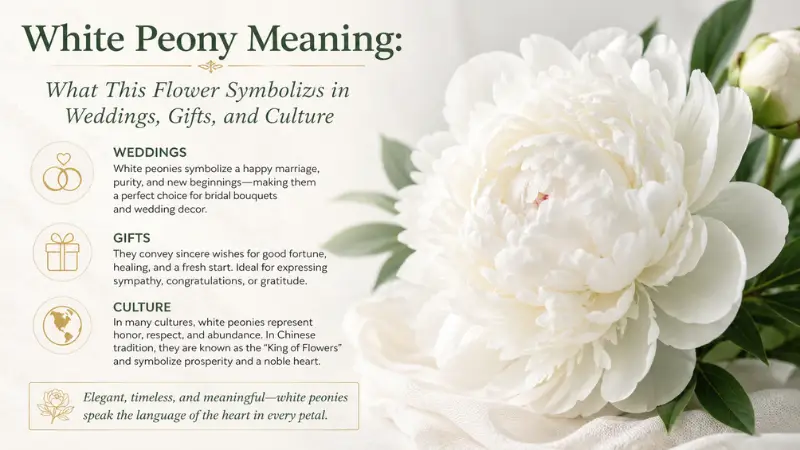
White peony meaning blends two things: the color associations Americans already attach to white flowers — purity, sincerity, remembrance, new beginnings — and older meanings tied to the peony itself. With their large, layered blooms and short flowering season, peonies tend to feel more ceremonial than an average garden flower, and that shapes how people read them.
Today white peonies show up in bridal bouquets, anniversary arrangements, sympathy flowers, home decor, botanical art, tattoos, and social feeds. The same flower can signal romantic happiness at a wedding and quiet remembrance at a memorial — the meaning depends entirely on context.
To understand it properly, it helps to separate modern Western color symbolism from older peony traditions rooted in Chinese art, Greek mythology, and centuries of garden history.
What Does a White Peony Symbolize? (Quick Answer)
White peonies most commonly represent purity, sincere love, new beginnings, modesty, and graceful remembrance in American culture, especially around weddings and meaningful gifts. Historically, the peony has also stood for bashfulness in Western flower language, and for wealth, honor, rank, and prosperity in Chinese tradition.
In short:
- Purity, sincerity, and fresh starts — the dominant modern reading
- Especially popular for weddings and romantic gifts
- Bashfulness, per Victorian-era flower language
- Wealth, status, and prosperity, per Chinese tradition
- Peaceful remembrance in sympathy and memorial settings
- Meaning shifts with culture, occasion, and surrounding imagery
Why Appearance Shapes the Symbolism
Peonies belong to the genus Paeonia and are known for large flowers ranging from simple, open forms to densely layered doubles. White varieties run from snowy white to ivory or cream, sometimes with a faint blush of pink, and many are fragrant with golden-yellow centers.
They typically bloom from late spring into early summer, depending on variety and climate. That brief window adds to their sense of occasion — the flowers arrive dramatically, open into full blooms, and are gone again within weeks.
This appearance drives the interpretation. White keeps the palette restrained, while the dense petal layers give the bloom a feeling of fullness and abundance. The result is a flower that reads as pure without looking austere, and luxurious without looking showy.
There’s also a visual arc worth noting: a tightly closed peony bud looks nothing like the fully opened flower. That shift from contained to expansive lines up neatly with the older association between peonies and bashfulness, discussed below.
What White Peonies Mean in the U.S., by Context
There’s no single official meaning for white peonies in American culture — the symbolism comes from several overlapping traditions layered on top of each other.
| Context | Common U.S. Meaning | Typical Setting | Note |
|---|---|---|---|
| Weddings | Pure love, commitment, new beginnings | Bouquets, ceremony decor | Chosen for meaning and appearance alike |
| Romantic gifts | Sincerity, affection, admiration | Partners, anniversaries | Softer than red-flower symbolism |
| Apologies | Humility, regret, reconciliation | Personal floral gifts | A modern reading, not a fixed rule |
| Memorials | Peace, respect, remembrance | Sympathy arrangements | Not an exclusively funeral flower |
| Home decor | Calm elegance, refinement | Prints, arrangements | Meaning is mostly aesthetic here |
| Tattoos | Renewal, dignity, personal growth | Botanical body art | Depends on surrounding symbols |
For most Americans, the simplest reading is sincere affection expressed with elegance rather than intensity. A red rose reads as passionate romance; a white lily can strongly evoke purity or funerals. White peonies sit between those extremes — adaptable enough to work at weddings, in gifts, in interiors, and as personal symbolism.
Purity, Sincerity, and New Beginnings
White has long carried associations with cleanliness, innocence, and ceremonial beginnings across Western culture. Applied to a peony, that usually reads as emotional sincerity rather than literal innocence — clean intentions, honesty, or a fresh start without baggage from the past.
That makes white peonies a natural fit for:
- Starting a marriage
- Moving into a new home
- Repairing a relationship
- Beginning a new chapter after a hard period
- Marking personal change
- Honoring a meaningful transition
The layered petals keep the symbolism from feeling too simple — visually, the flower suggests that something sincere can still be complex. As a personal emblem, it can represent moving forward with clearer intentions while still carrying the experiences that shaped you.
Romance, Weddings, and Marriage
No setting has shaped the modern American image of white peonies more than weddings. Peonies remain a go-to for U.S. weddings, where florists use them in bouquets, centerpieces, and ceremony installations — current wedding-industry coverage still treats them as a classic choice for romantic, elegant arrangements.
White varieties fit easily into traditional bridal palettes because they combine white’s established wedding symbolism with the peony’s generous, full-bodied form. In this setting, they tend to suggest:
- Sincere love — white softens the romantic message compared with red’s intensity
- A shared beginning — the flower’s fresh, seasonal character suits a life transition
- Prosperity — an echo of the peony’s Asian cultural history, meaningful to couples who know it
- Abundance — a fully opened bloom’s many petals read as generous and full
None of this is a rule. Plenty of couples simply choose peonies for the fragrance, shape, color, or seasonal timing — no symbolism required.
Bashfulness and Modesty in the Language of Flowers
One of the best-documented Western meanings of the peony is bashfulness. Nineteenth-century flower dictionaries — part of the Victorian tradition known as floriography — assigned specific sentiments to plants, and a well-known compilation from that era lists the peony beside “bashfulness.” Notably, this meaning applied to the peony generally, not to white peonies specifically.
Modern writers often explain the symbolism through the closed bud, which conceals the flower until it opens — an appealing image, but not a proven historical origin for the meaning, so it’s worth treating as interpretation rather than fact.
For contemporary use, bashfulness reads more positively as:
- Modesty
- Quiet affection
- Emotional reserve
- Tenderness
- Feelings that are hard to say out loud
A white peony works especially well as a symbol of affection that’s sincere but understated.
Do White Peonies Symbolize Apology?
They can — but the claim needs a caveat. Contemporary flower guides often recommend white peonies for apologies, linking them to humility, regret, and reconciliation. That makes intuitive sense: white suggests sincerity, and the older bashfulness meaning fits the vulnerability of admitting a mistake.
There was never one universal historical flower code that fixed “white peony” as meaning “I’m sorry.” The apology association is better understood as a modern combination of several older meanings, not an ancient, fixed definition.
Given thoughtfully, a white peony can still communicate:
- “I want to make this right.”
- “I regret what happened.”
- “I’m approaching you sincerely.”
It can support an apology — it shouldn’t replace the actual words when those are what’s needed.
Remembrance, Sympathy, and Memorial Meaning
White peonies also work well in settings involving loss or reflection. White flowers generally appear in American funeral and sympathy arrangements because their restrained color communicates peace and respect without demanding attention — white peonies fit that visual language, especially paired with roses, hydrangeas, lilies, or greenery.
In memorial settings, the meaning usually centers less on death itself and more on:
- Peaceful remembrance
- Admiration for the person who died
- Sincere sympathy
- Dignity
- Affection that continues through memory
Peonies aren’t exclusively mourning flowers, though, so receiving them shouldn’t automatically be read as a reference to loss. The same bouquet could just as easily belong at a spring wedding, an anniversary dinner, or on someone’s kitchen table — context decides the message.
Chinese Symbolism: Wealth, Honor, and Rank
Any complete account of peony meaning has to include the flower’s importance in Chinese visual culture, where it has long been an emblem of rank, wealth, prosperity, and nobility. Historical works link the flower to phrases translated roughly as “king of flowers” and “flower of wealth and rank.”
That history changes how a white peony can be read. Interpreting it only through Western ideas like innocence or apology risks missing the prestige the flower itself carries. A white peony motif in Chinese-inspired art may combine several ideas at once:
- Prosperity
- Cultivated beauty
- Social distinction
- Good fortune
- Ceremonial refinement
Color matters, but so does the identity of the flower — “white equals purity” doesn’t explain every historical image that features a white peony.
White Peonies Across East Asian Contexts
Color symbolism doesn’t transfer cleanly between cultures. White can signal purity in both Chinese and Japanese settings, but it carries other ceremonial weight too — in China, for instance, white clothing has a long association with mourning. That’s a sharp contrast with American weddings, where white reads almost exclusively as bridal, fresh, and celebratory.
A white flower in an East Asian-inspired design shouldn’t be assumed to carry Western wedding symbolism. Context still decides the meaning:
- A peony paired with auspicious motifs may emphasize prosperity or status
- A white arrangement used in mourning communicates respect and grief
- A white peony in contemporary Japanese-style tattooing may be a visual-balance choice rather than a strict traditional code
Cultural symbolism works through combination, not a single dictionary definition.
Greek Mythology, Paeon, and the Idea of Healing
The botanical name Paeonia carries its own history. The genus is traditionally linked to Paeon, a physician to the gods in Greek mythology — a connection botanical references still note when explaining the plant’s scientific name.
That link gives peonies a secondary association with healing or restoration, though it’s worth treating carefully — “healing” isn’t as firmly established a peony meaning as prosperity is in Chinese art, or bashfulness is in Western floriography. It’s better understood as an association that grew out of the plant’s mythological name and its long medicinal history.
For personal symbolism, though, a white peony can reasonably stand for recovery, emotional renewal, or leaving a difficult period behind.
The Peony in American Public Life
Peonies aren’t only an imported symbol in the U.S. — they hold a distinct place in American regional identity. Indiana adopted the peony as its official state flower in 1957, without specifying a particular color, so white varieties are included alongside pink and red. Indiana’s own historical materials also note the flower’s traditional role in decorating gravesites for Memorial Day.
That combination — springtime beauty, remembrance, family tradition, cultivated gardens — gives the peony a domestic, nostalgic quality that formal symbolism guides tend to skip. For many Americans, especially in the Midwest, peonies are less exotic ceremony and more:
- Grandparents’ gardens
- Old farmhouses
- Cemetery plantings
- Late-spring gatherings
- Flowers cut from the family yard
Emotional and Psychological Meaning
Flowers communicate partly because people project emotional qualities onto their shape, color, and life cycle. White peonies strike an interesting balance: the pale color reads as controlled and quiet, while the dense petals read as abundant and expressive.
That contrast lets the flower represent someone reserved without being emotionally empty — it can suggest:
- Gentleness with substance — soft in color, but physically full
- Privacy — a closed bud hiding what becomes a large bloom
- Emotional openness — the dramatic expansion as it matures
- Calm confidence — restrained color, but real visual presence
Someone drawn to white peonies as a personal symbol might be reaching for the idea of becoming more open without losing sensitivity or privacy. That’s a personal reading rather than a universal one, but it fits the flower’s visual character.
White Peonies in Tattoos, Jewelry, and Personal Style
In tattoo culture, peonies appear across styles from delicate line work to large Japanese-inspired pieces. A tattoo can’t literally reproduce a fresh white bloom unless skin tone, negative space, pale ink, and shading create that effect — but symbolically, a white peony can represent renewal, dignity, sincere love, healing, or a new beginning.
Paired imagery shifts the meaning:
- A peony with a wedding date can represent marriage
- A peony with a memorial name expresses remembrance
- A peony with a snake creates tension between softness and danger
- A peony beside Japanese-style lions or waves draws on an established East Asian visual vocabulary rather than modern Western meanings
In jewelry and fashion, the symbolism is lighter — a peony pendant or floral print usually just signals femininity, botanical beauty, or romantic style, unless the wearer attaches something more personal to it.
White Peonies in Home Decor and Digital Culture
White peonies have become a familiar decorative choice because their neutral color works with almost any interior style. Fresh arrangements are common in spring decor, artificial versions get used year-round, and peony motifs show up on wallpaper, ceramics, bedding, stationery, and social graphics.
In these settings, the meaning tends to shift from formal symbolism toward mood. White peonies can make a space feel:
- Romantic
- Polished
- Calm
- Soft
- Traditional
- Luxurious without bright color
On social platforms, the flower often functions as visual shorthand for an elegant or gentle aesthetic — placed beside perfume, jewelry, candles, or bridal accessories, it signals sophistication more than any historical meaning.
Common Misconceptions About White Peony Symbolism
The biggest mistake is treating flower symbolism as a fixed, universal code. It isn’t. A white peony doesn’t always mean purity, doesn’t always mean apology, and isn’t automatically a wedding flower, funeral flower, or religious symbol.
Another frequent error is applying meanings that belong to peonies in general — like Victorian bashfulness or Chinese wealth symbolism — as if they were specific to the white variety. Color can modify those meanings, but it doesn’t erase them. It’s also worth being skeptical of modern florist interpretations presented as ancient tradition; flower meanings evolve as people reinterpret old customs and apply them in new contexts.
How the Meaning Has Evolved Over Time
The modern meaning of the white peony is best understood as layered traditions rather than one continuous story:
- Chinese visual culture established the peony as a symbol of prosperity, status, and courtly beauty.
- Western flower-language traditions later added bashfulness as a recognizable meaning.
- American gardening gave peonies a domestic identity tied to family homes and, in places like Indiana, regional heritage and Memorial Day remembrance.
- Modern weddings strengthened the association with romance, marriage, and new beginnings.
- Digital culture added a purely aesthetic layer — softness, refinement, understated luxury.
None of these meanings replaced the ones before it — they accumulated. That’s why the same flower can feel equally at home in a centuries-old Chinese painting, a Midwestern garden, a bridal bouquet, a memorial arrangement, and a contemporary tattoo.
FAQs
What does a white peony symbolize spiritually?
There’s no universal spiritual definition. People may personally connect white peonies with purification, renewal, peace, gratitude, or healing, but these are individual interpretations rather than part of a single established religious tradition.
Are white peonies good luck?
They can carry fortunate associations, since peonies have long represented prosperity, honor, and status in Chinese tradition. In the U.S., though, people are more likely to read white peonies as romantic or celebratory than as a formal good-luck symbol.
What do white peonies mean in love?
In romantic contexts, they suggest sincere affection, commitment, tenderness, and the start of a shared future — generally softer and more restrained than the passion typically attached to red flowers.
What does a white peony tattoo mean?
Commonly renewal, sincere love, personal growth, dignity, remembrance, or emotional healing. Japanese-inspired designs may draw from a different artistic tradition, so surrounding imagery matters for interpretation.
Do white peonies symbolize apology?
Often used today for humility, regret, or reconciliation. The connection partly reflects the older peony association with bashfulness, but it’s a modern floral interpretation rather than a fixed historical rule.
Are white peonies appropriate for funerals?
Yes. Their pale color and elegant form communicate peaceful remembrance, sympathy, and respect — though peonies aren’t exclusively funeral flowers and are just as common at weddings and spring celebrations.
Why are white peonies popular for weddings?
Their large blooms create visual impact, and their white or ivory color fits traditional bridal palettes. Add in the broader associations with romance, abundance, and happy beginnings, and they’re a natural fit for marriage celebrations.
Conclusion
White peony symbolism is best understood as a mix of color, cultural history, and context rather than one fixed meaning. In the U.S., the flower most often communicates sincere love, purity, new beginnings, modesty, and understated elegance, while older traditions layer in bashfulness, prosperity, honor, and status.
No single interpretation covers every case. A bridal peony, a flower left at a memorial, a Chinese peony painting, and a botanical tattoo can look nearly identical while carrying very different messages — and that flexibility is part of what keeps the peony meaningful across so many different moments.gful across so many different moments.


[…] Meaning shifts by culture, but the core idea — small beginnings, big outcomes — stays consistent […]
[…] left is a strange but workable inheritance: paintings that continue to reward close looking, symbols that get borrowed into tattoos and wedding flowers without their original context, and a public appetite for hidden meaning that sometimes outruns […]
[…] Today it appears widely in tattoos, wedding themes, and gift culture. […]