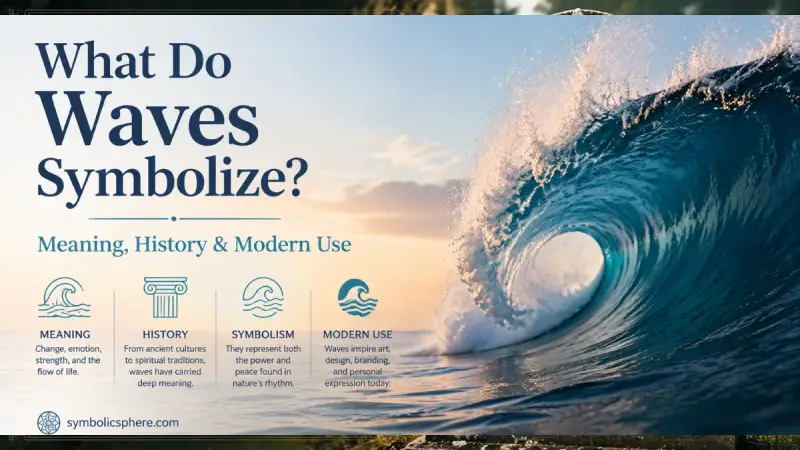
A wave rises, curls, breaks, and disappears — only to be followed by another. That simple, endless cycle is why wave symbolism carries such rich meaning: change, resilience, freedom, danger, renewal, and the movement of life itself.
In the United States, waves show up everywhere — beach photography, coastal architecture, tattoos, jewelry, paintings, clothing, and memorial art. Depending on context, a wave can feel cheerful and calming (a reminder of summer or travel) or more serious, representing forces beyond human control.
Meaning shifts even more once a wave is separated from the ocean itself. A small, simple line can suggest peace or adaptability, while a towering wave can signal danger, ambition, emotional upheaval, or nature’s power to overwhelm.
Quick Answer
Waves commonly symbolize change, resilience, freedom, and the ability to move through life’s challenges in modern American culture. Historically, they’ve also represented nature’s unpredictable force, the cycles of life, spiritual or mythological power, and the tension between human vulnerability and the natural world.
Key takeaways:
- Waves generally represent change, movement, resilience, and freedom.
- Ancient traditions linked the sea to gods, creation, and danger.
- Japanese art — especially Hokusai’s Great Wave — shaped how waves are visually understood worldwide.
- Wave tattoos often express adaptability, endurance, identity, or a connection to nature.
- A wave’s specific meaning depends on its size, setting, and surrounding imagery — there’s no single fixed definition.
What a Wave Represents Symbolically
A wave is an unusual symbol because it’s defined entirely by movement. A mountain represents permanence; a wave exists through continual change — rising, peaking, breaking, and becoming part of the water again. That makes it a natural metaphor for life’s changing circumstances.
A calm wave can suggest peace or emotional control. A breaking wave often represents a turning point. A massive storm wave can communicate danger, pressure, or an obstacle that feels larger than the person facing it.
Waves also symbolize resilience in a specific way: the individual wave disappears, but the ocean keeps producing more. That rhythm expresses the idea that setbacks are temporary while movement continues.
Why Wave Symbolism Is So Flexible
Waves are constantly changing shape, yet they follow recognizable patterns — gentle enough for swimming, powerful enough to damage coastlines. That contrast between beauty and danger is exactly why wave imagery carries seemingly opposite meanings depending on context.
| Context | Common Meaning (USA) | Typical Associations |
|---|---|---|
| Calm ocean wave | Peace, relaxation | Beaches, vacations, meditation |
| Breaking wave | Change, transition | New beginnings, personal art |
| Large storm wave | Overcoming adversity | Strength, danger, endurance |
| Japanese-style wave | Nature, impermanence | Art, tattoos, design (Hokusai influence) |
| Small minimalist wave | Freedom, simplicity | Jewelry, tattoos, logos |
The same wave can read as serenity to one person and struggle to another — the meaning lives in the details.
Ancient Roots of Wave Symbolism
Human beings have lived beside rivers, lakes, and oceans for millennia, so water naturally worked its way into mythology and religion.
In ancient Greek tradition, the sea was associated with Poseidon, whose domain included both the ocean and earthquakes — a pairing that captured the sea’s dual role as provider and destroyer. It supported travel and fishing but could turn dangerous without warning.
Other maritime cultures developed their own relationships with ocean forces, often linking water to creation, fertility, journeys, transformation, and the unknown. These traditions shouldn’t be flattened into one universal “wave meaning” — significance varied by local religion, geography, and each culture’s relationship with the water around it.
One idea does recur across many traditions, though: the sea is larger than the individual. Waves make that relationship visible.
Waves as a Symbol of Change
The most straightforward interpretation of a wave is change. Its crest develops, breaks, spreads, and disappears — a useful metaphor for moving to a new city, starting a relationship, changing careers, or entering a new life stage.
This symbolism doesn’t suggest change is easy. A wave can represent the necessity of adapting when circumstances are outside your control — not stopping the wave, but learning to move with it. That’s part of why waves work so well in personal symbolism: they acknowledge uncertainty without treating it as failure.
Why Waves Symbolize Resilience
Resilience is a common interpretation in contemporary tattoos and personal art — but it’s a specific kind of resilience. A wave survives by moving, not by staying the same. It rises and falls according to forces larger than itself.
For someone who chooses a wave as a personal symbol, that can express:
- I can adapt when circumstances change.
- Difficult periods eventually pass.
- I don’t need to control everything around me.
- I can recover and keep moving forward.
This is flexible strength, distinct from symbols built around rigid, unyielding resistance — which is why minimalist wave tattoos and jewelry often emphasize adaptability over toughness.
Waves, Freedom & American Beach Culture
In the U.S., waves carry a particularly strong connection to coastal life. California, Hawaii, Florida, the Pacific Northwest, and the Gulf Coast each have their own relationship with the ocean, and surfing culture has attached waves to freedom, skill, adventure, and independence.
For many Americans, a wave evokes a beach before it evokes mythology — vacation, summer, relaxation, or a specific coastal hometown. You don’t need to know the history of Japanese printmaking to understand why a blue wave suggests the ocean.
The “freedom” association also comes from how uncontrolled a wave looks — shaped by wind, tide, and geography rather than by design. Surf culture reinforces this: surfers don’t just watch waves, they learn to read and respond to them. In that sense, a wave symbolizes freedom that comes from working with natural forces, not ignoring them.
The Great Wave and Its Influence on Modern Symbolism
No discussion of wave imagery is complete without Katsushika Hokusai’s Under the Wave off Kanagawa, better known as The Great Wave. Created around 1830–32 during Japan’s Edo period, the woodblock print shows an enormous wave curling over three boats, with Mount Fuji visible in the distance.
The composition’s power comes from scale: the wave looms enormous while the boats and people appear small, with Mount Fuji providing a stable counterpoint. Modern viewers often read the image as a confrontation between humanity and nature — emphasizing danger, impermanence, or vulnerability. Those are reasonable interpretations, but they shouldn’t be treated as Hokusai’s single intended message; the print belongs to a specific Japanese artistic and cultural context, and its meaning has expanded considerably since.
Today, the Hokusai-style wave functions as instantly recognizable visual shorthand for Japanese-inspired ocean imagery across American design, tattoos, and art.
Japanese Wave Patterns and Good Fortune
Japanese wave symbolism extends well beyond The Great Wave. The seigaiha (“blue sea and waves”) is a traditional repeating pattern made from overlapping semicircular arcs, used across textiles, ceramics, and decorative arts.
Unlike the threatening wave in Hokusai’s print, seigaiha’s repeated arcs suggest continuity, peace, and favorable conditions — a visual rhythm built on stability rather than danger. Not every Japanese wave motif represents threat; some communicate calm precisely because the pattern keeps repeating.
This is the core rule of wave symbolism in any tradition: visual treatment changes meaning. A violent wave crashing toward a boat tells a different story than a series of evenly repeating blue arcs on fabric.
Waves as a Metaphor for Emotion
People naturally describe feelings as coming “in waves.” Grief, anxiety, excitement, and nostalgia can arrive intensely and then recede — which makes wave imagery well-suited to emotional experiences that are hard to put into words directly.
A calm wave can represent emotional peace; a turbulent ocean, distress or uncertainty; a wave moving toward shore, the arrival of a memory or realization. The underlying idea — that feelings rise and fall rather than staying at their peak forever — is a familiar visual language, not a clinical or therapeutic claim.
Wave Tattoos: Common Meanings
Wave tattoos are popular partly because the image can be extremely simple — a few curved lines can communicate an ocean connection without a large, detailed composition. More elaborate designs add surfboards, boats, sea creatures, mountains, the moon, flowers, or Japanese-inspired patterns.
Common personal meanings behind wave tattoos include:
- Connection to the ocean or surfing
- Freedom and adaptability
- Resilience or overcoming a difficult period
- Travel or a coastal hometown
- Acceptance of change
- Remembrance of someone tied to the sea
Two people can choose nearly identical wave designs for entirely different reasons — the surrounding imagery is usually the real clue. A wave with a compass often points to travel; a wave beneath a mountain can suggest balance between movement and stability; a wave paired with a memorial date typically signals remembrance.
Waves in Jewelry, Home Decor & Fashion
Wave imagery works well in consumer design because it’s both decorative and symbolic. In jewelry, a small wave can represent travel or a personal connection to coastal life without looking overly literal. In home decor, wave motifs are a staple of relaxed coastal interiors — appearing in wall art, ceramics, textiles, and glasswork. In clothing and surf brands, waves signal an outdoor lifestyle or connection to the water.
The same design often works on two levels at once: decoration for the viewer, personal symbolism for the owner.
Waves in Mourning and Remembrance
Waves also appear in memorial art, especially for someone with a strong connection to the ocean. A wave may represent a loved one’s favorite place, a shared memory, or a sense of continuing connection — the movement of water suggesting that life changes while memory remains part of a person’s story.
This shouldn’t be mistaken for a universal religious belief about waves and the afterlife; there’s no single established American tradition asserting that meaning. In mourning contexts, a wave’s significance is usually personal, often clarified by accompanying elements like a name, date, lighthouse, or seabirds.
Religious and Spiritual Interpretations
Water carries major religious significance across traditions, though a wave itself doesn’t always have one fixed doctrinal meaning.
In Christianity, water is associated with baptism, cleansing, renewal, and spiritual transformation, including biblical accounts of storms calmed at sea. In Hindu traditions, rivers and sacred waters hold important religious roles, and broader South Asian traditions include many stories involving oceans and divine beings. In Japanese religious and cultural life, the sea has been interpreted through both Shinto and Buddhist frameworks, with meaning varying by context and period.
In modern American spiritual use, wave symbolism often blends these older water associations with contemporary ideas about renewal, mindfulness, and personal transformation.
Waves and Human Vulnerability
One of the more serious meanings behind wave imagery is a simple recognition: nature can’t always be controlled. A person on the beach may feel calm watching waves; a person in a small boat during a storm experiences that same ocean very differently.
Hokusai’s Great Wave captures this tension clearly — the tiny boats emphasize the scale gap between people and the natural world, communicating exposure and uncertainty as much as strength. In modern culture, similar imagery appears in conversations about hurricanes, tsunamis, coastal disasters, and climate-related risk, with the wave serving as a visual reminder of forces beyond individual control.
Positive vs. Negative Wave Symbolism
Waves aren’t inherently positive or negative — meaning depends on context, scale, and surrounding symbols.
Positive interpretations: freedom, renewal, adventure, adaptability, resilience, peace, emotional release, connection with nature.
More difficult interpretations: instability, danger, loss of control, emotional turmoil, destruction, uncertainty, human vulnerability.
A calm shoreline and a storm surge are both waves — but they tell radically different symbolic stories.
Common Misunderstandings About Wave Symbolism
A few mistakes come up often when interpreting wave imagery:
- Assuming one fixed meaning. A surfing logo, a Hokusai-inspired tattoo, a seigaiha textile, and a memorial sculpture can all feature waves while communicating completely different ideas.
- Treating modern interpretations as ancient fact. Popular online content sometimes assigns highly specific spiritual meanings to waves without distinguishing personal symbolism from documented history.
- Reducing Japanese wave imagery to “strength.” Japanese art contains many distinct wave motifs, each shaped by its specific period, pattern, and context.
- Assuming drama equals trauma. A dramatic wave isn’t automatically a symbol of struggle or instability — sometimes it’s simply an image of the ocean.
Waves as a Symbol of Life’s Cycles
The recurring nature of waves gives them one more layer of meaning: cycles. An individual wave rises and disappears, but the movement continues — a fitting metaphor for seasons, generations, or the repeated patterns of daily life.
Unlike a circle, though, a wave never simply returns to its starting point; each one is shaped by changing conditions. That makes it a useful symbol for a life that includes recurring challenges without exact repetition — people often face similar struggles more than once, but as different versions of themselves. It’s part of why wave imagery feels appropriate for milestones: it acknowledges that life keeps moving even after a chapter ends.
Wave Symbolism in Modern American Culture
Today, waves function as a flexible symbol that moves easily between settings. At the beach, they represent recreation and leisure. In surfing, skill and opportunity. In tattoos, identity and memory. In art, nature’s scale or emotional turbulence. In minimalist design, simplicity and motion.
Digital culture has only expanded this flexibility — a stylized wave now works as a profile graphic, brand mark, illustration, or social-media visual. Modern interpretation tends to be less fixed than older religious or mythological symbolism, largely because people increasingly choose symbols based on personal experience rather than shared tradition.
What keeps the wave recognizable across all these uses is its basic visual idea: movement, rhythm, and return — understandable even as the personal meaning behind it changes.
FAQs
What does a wave symbolize spiritually?
A wave often symbolizes renewal, transformation, emotional movement, or acceptance of change in contemporary spiritual interpretations. These meanings are generally personal rather than tied to one universal religious doctrine.
What does a wave tattoo mean?
A wave tattoo can represent the ocean, freedom, resilience, adaptability, travel, or a meaningful connection to a coastal place. The exact meaning usually comes from the wearer’s personal experience and the other elements in the design.
Are waves a symbol of strength?
They can be — but wave symbolism aligns more closely with adaptable strength than rigid strength. A wave demonstrates persistence and the ability to respond to changing conditions, not resistance to them.
What does a wave symbolize in Japanese art?
Depending on the artwork and period, Japanese wave imagery can represent nature, movement, danger, impermanence, or good fortune — as seen in patterns like signina.
Do waves symbolize change?
Yes. Their constant motion makes waves a natural metaphor for change and transition, often emphasizing adaptation rather than resistance.
Can waves symbolize grief or remembrance?
Yes, particularly when the ocean mattered to a person or family. In memorial art, a wave can represent a shared place, a memory, or an ongoing sense of connection.
Are waves a positive or negative symbol?
Either — it depends entirely on context. Calm waves tend to suggest peace and freedom; large or destructive waves can suggest danger or overwhelming circumstances.
Conclusion
Waves are compelling symbols because their physical behavior already tells a story: movement, change, rising, breaking, and continuing. In American culture, they commonly represent freedom, resilience, personal transformation, and the ability to adapt when circumstances shift.
Their history runs deeper than that, though. Ancient maritime traditions connected the sea to divine forces and danger, Japanese art developed layered wave motifs like seigaiha, and modern American culture has reshaped waves into symbols of recreation, identity, emotional experience, and memory.
Ultimately, wave symbolism works because it leaves room for interpretation. A wave can mean calm after a hard period, a love of the coast, the courage to face uncertainty, or simply the beauty of the ocean — and its truest meaning is usually the one grounded in the person who chooses it.


