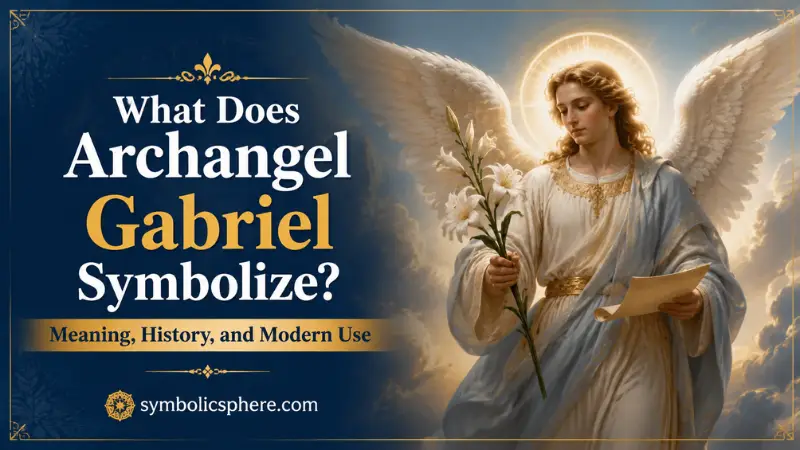
Archangel Gabriel is one of the most widely recognized spiritual figures in Western culture, known chiefly as a messenger who delivers pivotal news at turning points in sacred history. Archangel Gabriel symbolism centers on announcement, revelation, and the moment when something hidden becomes known.. The figure resonates because receiving news that changes the course of a life is something almost everyone can relate to, whether or not they follow a specific faith.
In the United States, Gabriel shows up far beyond church walls. The name and image appear in nursery decor, wedding readings, tattoos, military tradition, and holiday cards each December. Some of this comes from direct religious devotion; some comes from a broader cultural shorthand for hope, protection, or a turning point. Understanding where these associations originated explains why Gabriel still feels relevant to people who may never open a Bible or Quran.
This guide traces Gabriel’s symbolism from its earliest religious roots to its current place in American life, distinguishing meanings with real historical grounding from those shaped more recently by art, tattoos, and pop culture.
Quick Answer: What Archangel Gabriel Symbolizes
Archangel Gabriel symbolizes divine announcement and the arrival of important, life-changing news — most famously in the Annunciation to Mary in Christianity. Historically, Gabriel has also served as an interpreter of visions in Judaism and as the angel who revealed the Quran to Muhammad in Islam, making the figure a shared symbol of revelation across three major faiths.
Key Takeaways
- Represents divine messages and turning-point announcements
- Rooted in Jewish, Christian, and Islamic scripture
- Central to the Annunciation story in Christianity
- Known as Jibril in Islam, credited with revealing the Quran
- Popular in American nursery, wedding, and memorial symbolism
- Frequently reinterpreted in tattoos as a symbol of protection and guidance
What Gabriel Looks Like and Where the Symbol Appears
Gabriel is typically shown as a winged figure carrying a trumpet, a lily, or a scroll. The trumpet ties to apocalyptic imagery describing a final, unmistakable announcement. The lily, a constant in Renaissance paintings, signals purity and appears in nearly every classical depiction of the Annunciation. The scroll represents Gabriel’s role as a messenger of spoken or written revelation rather than a warrior or judge.
This imagery appears in stained glass, Renaissance paintings, greeting cards, jewelry, and church statuary. Unlike Michael, who is almost always shown armed and in combat, Gabriel is rarely depicted fighting — the visual language consistently points toward communication rather than confrontation. [Internal link opportunity: archangel Michael symbolism explained]
The Core Meaning Behind Gabriel
At the center of Gabriel’s symbolism is the delivery of consequential news. In the biblical narrative, Gabriel explains a vision to Daniel, announces the birth of John the Baptist to Zechariah, and tells Mary she will bear a child called the Son of God. Each appearance marks a hinge point in a larger story rather than the story’s resolution.
Because of this pattern, Gabriel has come to represent the moment before major change — the announcement that precedes transformation, not the transformation itself. This is part of why the figure resonates with people navigating their own life transitions, even when they aren’t thinking about the original scriptural context.
Historical Origins and Early Religious Roots
Gabriel first appears by name in the Hebrew Bible, in the Book of Daniel, where the figure explains the meaning of Daniel’s visions. This established Gabriel early on as an interpreter, not just a courier — the role was to make divine meaning understandable to a human mind.
Later Jewish apocalyptic and rabbinic writings expanded Gabriel’s role further, linking the figure to judgment, fire, and the recording of human deeds. Some traditions place Gabriel at God’s left hand, paired with Michael on the right, reflecting a structure in which different angels carry distinct responsibilities.
This layered history matters: Gabriel’s symbolism wasn’t created once and frozen in place. It was built gradually across centuries of Jewish thought before Christianity and Islam each added their own emphasis.
Gabriel in Christian Tradition
Christian symbolism narrows Gabriel’s role sharply around one event: the Annunciation, when Gabriel tells Mary she will conceive Jesus. This single scene became one of the most painted moments in Western art history, appearing in the work of artists across centuries and countries, according to Encyclopaedia Britannica.
Because of the Annunciation, Gabriel became linked with themes of consent, calling, and the start of a sacred plan. Christian tradition also credits Gabriel with announcing the birth of John the Baptist to Zechariah, reinforcing a pattern: Gabriel is the angel who opens major biblical narratives rather than closing them. Catholic and Orthodox teaching count Gabriel among the archangels with the closest access to God, though scripture itself doesn’t rank angels explicitly. For more on Catholic teaching regarding archangels, see the USCCB’s overview of angels.
Gabriel in Islamic Tradition (Jibril)
In Islam, Gabriel is known as Jibril and holds an even larger role than in Christianity. Jibril is identified as the angel who delivered the revelations of the Quran to the Prophet Muhammad over more than two decades — arguably making Gabriel, under this name, the most consequential angelic figure in Islamic theology, since the entire scripture is understood to have arrived through this channel.
Jibril also appears in accounts of Muhammad’s night journey and ascension, tying the figure to both revelation and spiritual transition. Islamic tradition treats Gabriel less as a supporting character in someone else’s story and more as a central instrument of divine communication itself.
Gabriel Across Judaism, Christianity, and Islam at a Glance
Gabriel is one of the few angelic figures named explicitly across all three Abrahamic faiths, though each tradition emphasizes a different function:
- Judaism — interpreter of visions (Book of Daniel)
- Christianity — messenger of the Annunciation
- Islam — deliverer of the Quran (as Jibril)
This shared recognition, rather than one denomination’s exclusive claim, is a major reason Gabriel symbolism carries broad familiarity in American culture instead of being tied to a single church or community.
What Gabriel Commonly Means in the United States
American use of Gabriel symbolism draws heavily from Christian tradition but has broadened into more general use. Gabriel appears in nursery-themed decor and baby announcements, a direct nod to the Annunciation and Gabriel’s association with birth news. Wedding ceremonies sometimes include readings referencing Gabriel when couples want to invoke themes of calling and covenant.
Military and public-safety culture use Gabriel differently. Because of the trumpet imagery tied to the Book of Revelation, “Gabriel’s horn” or “blowing the trumpet” became American idioms for a final, unmistakable signal — a phrase still heard in military bugle traditions and occasionally borrowed for alert-system naming.
Gabriel is also common in American memorial contexts. Headstones, sympathy cards, and memorial tattoos sometimes use Gabriel imagery to represent a soul being guided or called home, blending scriptural meaning with a more personal, comforting interpretation of loss.
Emotional and Psychological Symbolism
Psychologically, Gabriel represents the moment of being told something you cannot unknow. This is why the figure resonates during pregnancy, major diagnoses, career turning points, or grief — Gabriel symbolism isn’t really about the outcome of the news but about the clarity and weight of the announcement itself.
For many people, invoking Gabriel is a way of asking for the courage to hear difficult or life-altering information, echoing Mary’s initial fear before acceptance in the Annunciation story. This gives Gabriel symbolism an emotional honesty that purely comforting symbols often lack, since it acknowledges that important news isn’t always easy to receive.
Archangel Gabriel Tattoo Meaning
Gabriel tattoos are common among people who want to represent protection, faith, or a specific turning point in their life — recovery from addiction, survival of an illness, or the birth of a child. The trumpet and wings are the most requested visual elements, often paired with a name, date, or scripture reference personal to the wearer.
Because Gabriel isn’t tied to combat imagery the way Michael is, these tattoos tend to lean softer in tone, emphasizing guidance and comfort over strength or battle. This makes Gabriel a frequent choice for memorial tattoos honoring a parent, child, or sibling. [Internal link opportunity: guide to angel and religious tattoo symbolism]
Modern Usage in Design, Jewelry, and Digital Culture
Gabriel appears frequently in jewelry as a pendant paired with a trumpet or lily, often marketed around baptisms, confirmations, or sympathy gifts. In home decor, Gabriel statuary is common in gardens and entryways, generally chosen for a sense of watchfulness rather than decoration alone.
On social media, Gabriel is often referenced during pregnancy announcements or major life updates, frequently without explicit religious framing. Users borrow the announcement symbolism — Gabriel as the bearer of significant news — even without identifying with any specific faith tradition, a clear example of a religious symbol adapted into everyday, secular communication.
Common Misunderstandings About Gabriel
One frequent misunderstanding is treating Gabriel as female, largely due to soft, youthful depictions in Renaissance art and the frequent pairing with Mary. Scripture doesn’t assign Gabriel a gender, and most religious traditions describe angels as beings without physical sex — but artistic convention has shaped popular assumption regardless.
Another point of confusion is conflating Gabriel’s role with Michael’s. Because both are described as archangels, some assume they serve similar functions, when historically Michael has been tied to protection and conflict while Gabriel has been tied to communication and revelation.
Commercial use of Gabriel imagery, particularly in mass-produced décor and jewelry, has also drawn criticism from some religious communities who feel the figure has been reduced to a generic “angel” aesthetic disconnected from its scriptural weight — a tension common to many religious symbols once they enter mainstream retail.
How Gabriel’s Symbolism Has Evolved
Gabriel’s symbolism began narrowly, as an interpreter of visions in Jewish scripture, before expanding into a central messenger figure in Christianity and the primary conduit of revelation in Islam. In more recent centuries, especially in the United States, the meaning has broadened further into cultural shorthand for major life announcements, whether related to birth, death, or personal transformation.
Each tradition added a layer without erasing the one before it. Across every shift, Gabriel has stayed tied to one consistent idea: a message that changes what comes next.
Gabriel Symbolism at a Glance
| Context | Meaning in the USA | Common Associations | Notes |
|---|---|---|---|
| Christian worship | Divine announcement | Annunciation, Mary, birth | Central to Christmas-season imagery |
| Islamic tradition | Revelation | Quran, Jibril, Muhammad | Referred to as Jibril, not Gabriel |
| Weddings | Calling, covenant | Readings, blessings | Less common than baptism use |
| Memorials | Guidance, comfort | Headstones, sympathy cards | Trumpet often tied to final rest |
| Tattoos | Protection, turning points | Wings, trumpet, scripture | Softer tone than Michael tattoos |
| Nursery decor | New life, hope | Baby announcements | Draws on Annunciation symbolism |
FAQs
What does the archangel Gabriel symbolize in Christianity?
Gabriel symbolizes divine announcement, most notably through the Annunciation to Mary. The figure represents the moment a major spiritual plan is first revealed to a human being.
Is Gabriel considered male or female?
Scripture doesn’t assign Gabriel a gender, and most theological traditions describe angels as without physical sex. The common perception of Gabriel as feminine comes from artistic style, not doctrine.
What does a Gabriel tattoo usually represent?
Gabriel tattoos typically represent protection, guidance, or a significant personal turning point, such as recovery, survival, or the loss of a loved one. They tend to carry a gentler tone than tattoos of warrior angels like Michael.
Is Gabriel the same figure in Islam and Christianity?
Gabriel and Jibril refer to the same angelic figure, though the emphasis differs. In Islam, Jibril delivers the entire Quran to Muhammad, making the role more central than in Christian scripture.
Why is Gabriel associated with trumpets?
The trumpet comes from apocalyptic imagery describing a final, unmistakable announcement at the end of time. Over the centuries, this became shorthand in Western culture for any decisive, attention-demanding signal.
Does Gabriel appear in Judaism as well?
Yes — Gabriel appears by name in the Book of Daniel, where the role is to interpret visions rather than simply deliver messages. This is the earliest textual appearance of Gabriel among the three major traditions.
Why is Gabriel popular in nursery and baby-related decor?
This connects directly to the Annunciation, where Gabriel announces an upcoming birth. Parents and gift-givers borrow this association even when the choice is more sentimental than religious.
Conclusion
Archangel Gabriel symbolism ultimately centers on one consistent idea across three major faiths: the delivery of news significant enough to change what happens next. Whether interpreting Daniel’s visions, announcing Jesus’s birth to Mary, or revealing the Quran to Muhammad, Gabriel’s role has always been about making the unknown known at exactly the right moment.
In American life today, that core meaning has stretched into more personal territory — nurseries, tattoos, weddings, and memorials — often stripped of specific doctrine but still carrying the emotional weight of an announcement that matters. That flexibility, rather than diluting the symbol, is part of why Gabriel has stayed recognizable and meaningful for so long.
Gabriel’s lasting relevance comes down to something simple: nearly everyone, religious or not, understands what it feels like to be handed news they cannot unhear.


