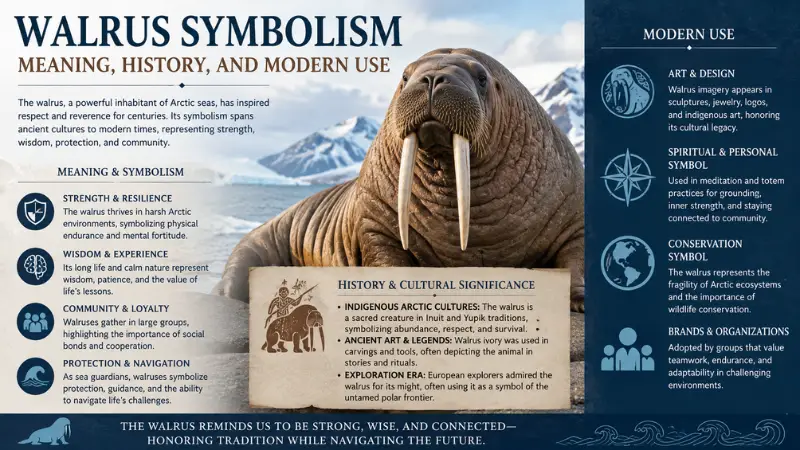
Walruses are among the most recognizable animals of the Arctic: massive bodies, sensitive whiskers, long tusks, and a habit of gathering closely with others. Walrus symbolism today draws on those visible traits, linking the animal to endurance, protection, community, patience, and the ability to survive demanding conditions.
But the walrus carries more than a modern list of personality traits. For Indigenous peoples of the Arctic — particularly communities along the Bering and Chukchi seas — walruses have long been tied to food, materials, craftsmanship, knowledge, and relationships with the marine environment. These living cultural connections shouldn’t be flattened into a generic symbolism dictionary entry.
In the wider United States, the walrus has also become a shorthand for Arctic wildlife and environmental change. So its meaning shifts with context: a tattoo might emphasize resilience, a wildlife photo might signal concern for the Arctic, and an Indigenous carving can carry cultural significance that outsiders shouldn’t casually reinterpret.
What Does a Walrus Symbolize? (Quick Answer)
In modern American interpretation, a walrus typically symbolizes strength, endurance, protection, community, and calm confidence. Culturally and historically, walruses also hold deep importance in Arctic Indigenous subsistence, craftsmanship, and storytelling — meanings that are specific to each community rather than one universal symbol.
At a glance:
- Walruses often represent strength, endurance, protection, and social connection.
- Herd behavior encourages associations with community and belonging.
- Arctic Indigenous meanings are culturally specific, not universal symbolism.
- Tusks suggest defense, maturity, authority, and survival.
- Modern imagery increasingly connects walruses with Arctic environmental change.
- In tattoos, walruses often represent resilience, individuality, or loyalty to one’s group.
What a Walrus Represents at a Glance
Most symbolic interpretations start with what people can directly observe about the animal. A walrus is physically imposing but not constantly aggressive — it spends much of its time resting, traveling, feeding, and gathering with others.
That combination creates an unusual symbolic profile: strength without constant action. Rather than representing speed or relentless ambition, the walrus tends to convey steadiness — the capacity to remain secure and capable without needing to prove power every moment.
Its social nature also lends itself to ideas of belonging. Walruses packed closely together suggest a group that finds security through proximity, shared space, and collective awareness.
| Context | Common U.S. Meaning | Main Association | Note |
|---|---|---|---|
| Wildlife imagery | Endurance | Arctic survival | Based on the animal’s environment |
| Tattoos | Resilience | Personal strength | Meaning depends on the wearer |
| Group imagery | Community | Belonging and loyalty | Drawn from social behavior |
| Tusks | Protection | Defense and authority | Not inherently a symbol of aggression |
| Environmental art | Vulnerability | Arctic change | Increasingly common in conservation contexts |
| Indigenous art | Cultural relationship | Arctic lifeways | Varies by community and artist |
Why the Walrus’s Appearance Shapes Its Meaning
Few animals look quite like a walrus. Both males and females have tusks, and the face is covered in stiff, highly sensitive whiskers. The heavy body, thick skin, and flippers are all adapted to life in northern marine environments.
Symbolically, those features shape several interpretations:
- The large body creates an impression of stability and physical confidence.
- Tusks suggest the ability to defend oneself and navigate difficult surroundings.
- Whiskers introduce a different idea entirely: sensitivity and awareness.
That combination matters. The walrus doesn’t have to symbolize brute force alone — it can represent someone who appears formidable but also pays close attention to subtle information, making it a fitting symbol for strength balanced by perception.
Strength That Doesn’t Need to Rush
A walrus is unlikely to become a standard symbol of speed, and that’s part of its appeal. Its symbolic strength comes from durability rather than quickness — in personal imagery, it can represent the idea that progress doesn’t have to look graceful or fast to be effective.
Someone drawn to the walrus may identify with persistence: staying functional under pressure, moving at a sustainable pace, and conserving energy until action actually matters. This sets it apart from animals like the cheetah or falcon, which typically suggest rapid movement and precision. The walrus instead fits themes of staying power, physical presence, and deliberate action.
Endurance in a Difficult Environment
Walruses live across Arctic and sub-Arctic marine regions, where ice, cold water, seasonal movement, and access to feeding areas shape their lives. Pacific walruses in Alaska depend heavily on the marine habitats of the Bering and Chukchi seas.
That ecological reality has shaped a modern symbolic association with endurance. A walrus image can serve as a reminder that survival isn’t always dramatic — it often depends on adapting routines to the environment, finding resources, resting when necessary, and remaining capable over long stretches of time.
Psychologically, this interpretation can resonate with people navigating a demanding stage of life. The walrus becomes less a symbol of conquering everything and more a symbol of being difficult to dislodge.
Community, Belonging, and Staying Close
Walruses commonly rest together, sometimes forming dense groups on sea ice or coastal haul-out sites — a behavior that’s become familiar through wildlife photography and one of the most natural associations attached to the animal: community.
In symbolic use, a group of walruses may represent:
- loyalty to family or friends
- safety through cooperation
- comfort with close relationships
- shared endurance during difficult circumstances
- belonging without losing individual strength
This isn’t the same as saying walruses traditionally represent family in every culture — it’s a contemporary interpretation based partly on observable social behavior. For a tattoo or illustration featuring several walruses, companionship may carry more weight than strength alone.
Tusks as Symbols of Protection and Authority
The tusks are the walrus’s defining visual feature, and because they’re prominent and potentially formidable, modern viewers frequently read them as signs of protection, defense, maturity, or authority.
Walruses actually use their tusks in several practical and social contexts, including interactions with other walruses and movement around ice — so they shouldn’t be interpreted simply as weapons. Symbolically, this creates a useful distinction between aggression and preparedness: a walrus can communicate the ability to defend its place without constantly seeking conflict.
That interpretation makes the animal a fitting personal emblem for boundaries — strength as the ability to protect what matters while avoiding unnecessary confrontation.
Sensitivity Behind a Tough Exterior
Walrus whiskers, known as vibrissae, are specialized sensory structures used to investigate the seafloor and locate food. That biological detail creates an interesting contrast with the animal’s imposing appearance: a walrus looks heavy and rugged, yet part of its success depends on sensitivity to its immediate surroundings.
This supports a modern psychological interpretation — being tough doesn’t require being insensitive. A walrus can represent someone who has developed a strong exterior while remaining perceptive, emotionally aware, or attentive to small changes. It’s one of the animal’s more nuanced meanings, since it challenges the assumption that physical toughness and sensitivity are opposites.
Walruses in Alaska Native Cultural Life
In Alaska, the walrus can’t be understood only through generalized animal symbolism. For thousands of years, walrus hunting has supported the food security, economy, knowledge, and cultural life of Indigenous communities along the Bering and Chukchi sea coasts. Walrus ivory and other materials have also been central to traditional tools and craftsmanship.
This relationship is practical, social, artistic, and cultural all at once — which means walruses participate in specific systems of cultural meaning rather than fitting one fixed definition like “courage” or “wisdom.” Different communities, families, artists, and stories can emphasize different relationships with the animal.
For non-Indigenous readers, that distinction matters: a generic “spirit animal” definition copied across websites isn’t equivalent to living Indigenous knowledge.
Inuit Traditions, Marine Life, and Storytelling
Across Inuit cultural regions, relationships between people and animals traditionally extend far beyond modern wildlife symbolism. Animals appear in stories, art, hunting traditions, spiritual understandings, and everyday survival.
In versions of stories concerning the sea being often called Sedna in English-language retellings, seals, whales, walruses, and other marine animals can be connected to the spiritual ordering of the sea — though details vary considerably across Arctic communities and narrative traditions. This doesn’t make the walrus a universal emblem of a single deity or spiritual principle; instead, its presence reflects how central marine animals are to Arctic life.
Historic and modern Inuit artworks depict walruses alongside other animals, hunters, transformations, and scenes from community experience. These works are best interpreted through the artist and cultural context rather than assigned a standardized Western meaning.
Walrus Ivory, Art, and Material Culture
Walrus ivory has long been used in Arctic material culture for tools, practical objects, and carving traditions. Smithsonian collections documenting St. Lawrence Island Yupik culture, for example, show how important walrus materials are to everyday and artistic life.
In modern American discussions, this subject requires care, since many people hear “ivory” and think only of elephant poaching. U.S. federal rules distinguish marine mammal materials and Alaska Native handicrafts under specific legal frameworks: authentic Native handicrafts made from appropriately obtained marine mammal materials can be legally sold under certain conditions, while unaltered walrus ivory can’t simply be sold to non-Native buyers as an ordinary commodity. (For current regulations, see the U.S. Fish & Wildlife Service’s marine mammal guidance.)
Symbolically, carved ivory can communicate cultural continuity, skill, livelihood, family knowledge, or an artist’s individual subject matter — meanings that shouldn’t be flattened into decorative “Arctic symbolism.”
From Hunted Resource to Conservation Emblem
American perceptions of the walrus have shifted significantly over time. During the nineteenth century’s intensive commercial exploitation, walruses were killed for economically valuable materials, including hides, oil, and ivory. Today, the Pacific walrus is managed as a protected marine mammal, while specific Alaska Native subsistence and handicraft provisions remain in place.
At the same time, wildlife photography and environmental communication have reshaped what many Americans associate with the animal. A crowded walrus shoreline image no longer signals only wildlife abundance — it can also raise questions about habitat loss, sea ice decline, disturbance, and ecological change.
The symbolic emphasis has moved, in part, from resource and exotic Arctic animal toward survivor of a rapidly changing northern environment.
What the Walrus Commonly Means in the United States
Outside Alaska, most Americans encounter walruses indirectly — through zoos, documentaries, children’s media, museums, nature photography, environmental campaigns, or Arctic-themed design. As a result, modern U.S. interpretations tend to be broad rather than culturally specific:
Strength — The animal’s enormous size creates an immediate impression of physical capability. Resilience — Its Arctic habitat encourages associations with surviving difficult conditions. Community — Groups resting close together lend themselves to themes of social support. Protection — Tusks make defensive strength visually obvious. Calm confidence — Its resting posture suggests security rather than frantic activity. Northern wilderness — The walrus has become a recognizable stand-in for the Arctic itself.
These are modern associations, not a single inherited American symbolic tradition.
Climate Change and the Modern Environmental Meaning
The walrus has become increasingly tied to discussions of Arctic environmental change. Pacific walruses use sea ice as a resting platform between feeding periods. As seasonal ice conditions shift, larger numbers now rely on coastal haul-outs instead, where dense aggregations can face added disturbance and trampling risks — a trend tracked by NOAA Fisheries.
Because of this, a walrus in modern environmental art can symbolize more than toughness. It may represent:
- vulnerability despite physical strength
- dependence between animals and habitat
- rapid Arctic change
- the consequences of environmental disruption
- the need for conservation grounded in ecological knowledge
This creates a striking paradox: the animal looks exceptionally robust, yet its future is tied to environmental conditions far beyond any individual walrus’s strength.
Walrus Tattoo Meanings
There’s no single, universal meaning for a walrus tattoo — the most reliable interpretation is always the one chosen by the person wearing it. Still, several themes fit naturally with the animal:
- A single walrus may represent independence, grounded confidence, or endurance.
- A walrus with prominent tusks can emphasize defense, courage, or personal boundaries.
- A mother-and-calf design may represent protection, caregiving, or family attachment.
- A group of walruses can symbolize loyalty, friendship, community, or strength found through others.
- An Arctic landscape tattoo may emphasize love of northern environments or concern for wildlife.
People without an Indigenous Arctic background should be cautious about adding culturally specific sacred imagery simply to make a tattoo feel more “spiritual.” Personal symbolism and cultural borrowing aren’t the same thing.
Walruses in Art, Decor, and Popular Culture
Walruses occupy a curious place in visual culture — they can appear dignified, intimidating, awkward, humorous, or affectionate depending on the artist. Their whiskered faces and oversized tusks make them easy to stylize: children’s illustrations often turn the walrus into a friendly elder or comic character, while wildlife art tends to emphasize mass, texture, ice, and the scale of the Arctic environment.
Literature and popular music have contributed to the animal’s unusual cultural presence, too. Works like The Walrus and the Carpenter and the Beatles’ I Am the Walrus helped make the word “walrus” culturally recognizable far beyond natural-history contexts — though these references don’t add up to one consistent symbolic definition. They simply show how an animal can accumulate meaning through repeated artistic reinvention.
Emotional and Psychological Associations
Psychologically, the walrus works especially well as a symbol for people who identify with quiet durability. It suggests a personality that doesn’t rely on speed, glamour, or constant competition — the symbolic walrus is comfortable occupying space.
This makes it a useful symbol for:
- accepting one’s physical presence
- developing firm personal boundaries
- protecting close relationships
- conserving energy instead of reacting to everything
- finding community during difficult periods
- remaining sensitive without appearing fragile
There’s a playful side, too. Because walruses look so distinctive, choosing one as a personal symbol can communicate humor and a willingness to embrace traits that are unconventional rather than polished.
Common Misunderstandings About Walrus Symbolism
Mistake #1: Assuming one ancient meaning shared by all Arctic Indigenous peoples. It doesn’t exist. “Inuit,” “Yupik,” and “Iñupiat” refer to distinct peoples and cultural traditions, and local histories matter. Even within a single community, an animal’s significance can shift depending on whether the context is hunting, storytelling, art, family knowledge, or ceremony.
Mistake #2: Treating walrus ivory as equivalent to elephant ivory. The legal and cultural situations differ substantially in the United States, including specific provisions protecting Alaska Native subsistence and authentic handicraft traditions.
Mistake #3: Seeing the animal as purely comic. That view misses its ecological and cultural importance — the same animal that appears humorous in a cartoon remains central to real Arctic ecosystems and communities.
How Walrus Meaning Has Evolved
The walrus has never had only one identity. For Arctic peoples, it has long existed within practical and cultural relationships involving food, materials, knowledge, movement, art, and the sea. For outsiders, perceptions have repeatedly shifted: commercial hunters once emphasized economic value, museums and collectors highlighted ivory and Arctic material culture, children’s media emphasized the animal’s unusual appearance, and wildlife documentaries turned attention toward behavior and ecology.
More recently, climate change has added another layer. In contemporary American culture, the walrus can now signify both extraordinary resilience and environmental vulnerability — a contradiction that may be its most relevant modern meaning. Being strong doesn’t mean being unaffected by changing surroundings.
FAQs
What does a walrus symbolize spiritually?
There’s no universal spiritual meaning for the walrus. In modern personal symbolism, people may connect it with endurance, protection, community, or grounded strength, while Arctic Indigenous spiritual traditions should be understood within their own specific cultural contexts.
Is a walrus a symbol of good luck?
The walrus isn’t widely established as a general American good-luck symbol. Someone can use it personally to represent qualities like resilience or protection, but that meaning shouldn’t be presented as an ancient universal tradition.
What does a walrus tattoo mean?
A walrus tattoo often represents toughness, endurance, protection, individuality, or loyalty to family and friends. The design shifts the emphasis — tusks tend to highlight boundaries, while several walruses together lean more toward community.
Does a walrus symbolize family?
It can, in modern interpretation. Because walruses are social animals often photographed resting together, people sometimes use them as symbols of belonging, caregiving, close relationships, or mutual protection.
What do walrus tusks symbolize?
In contemporary imagery, tusks often suggest defense, authority, maturity, and the ability to protect oneself. Biologically, tusks serve multiple functions, so reading them only as weapons oversimplifies the animal.
What does the walrus represent in Indigenous cultures?
There’s no single Indigenous interpretation. In various Arctic communities, walruses connect to subsistence, craftsmanship, knowledge, storytelling, and marine traditions — meaning depends on the particular people, place, artist, or story.
Can a walrus symbolize climate change?
Yes, especially in contemporary environmental imagery. Because changing sea-ice conditions affect where Pacific walruses can rest and gather, the animal increasingly appears as an emblem of both Arctic ecological change and resilience.
Conclusion
The walrus combines qualities that don’t always appear together in animal symbolism: enormous physical strength, and a strongly social nature, social closeness, sensitivity, deliberate movement, and dependence on a demanding environment. Those characteristics explain why modern interpretations frequently connect it with endurance, protection, community, calm confidence, and strong personal boundaries.
At the same time, walrus symbolism should never overshadow the animal’s living cultural importance to Arctic Indigenous communities. Its meaning is most accurate when modern personal interpretations are kept separate from specific Indigenous traditions, histories, and artistic practices.
Perhaps the most fitting contemporary lesson of the walrus is simple: resilience is not the same as invulnerability. Even an animal built for Arctic survival remains connected to its community, its habitat, and conditions beyond its control.


