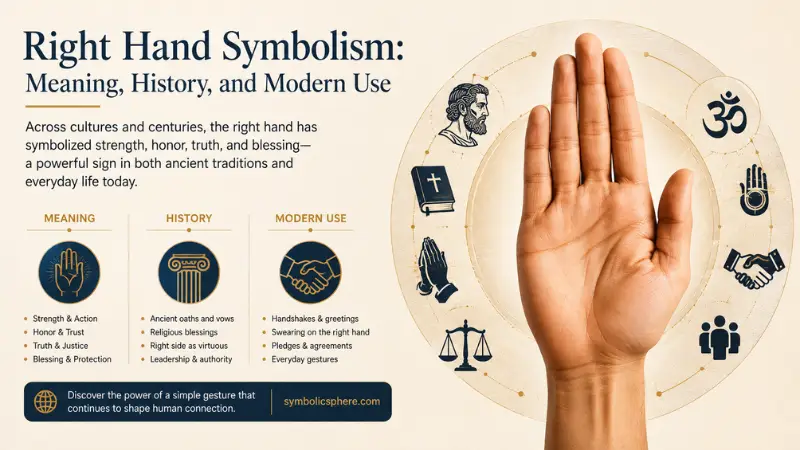
The human hand carries built-in meaning — action, work, touch, protection, skill, connection. Add the distinction between right and left, and that meaning sharpens. In the United States, right hand symbolism most often points to trust, authority, loyalty, commitment, and honorable action.
Most people encounter these meanings without ever labeling them “symbolism.” Someone raises their right hand to take an oath. Two strangers shake right hands to seal an agreement. A boss calls a trusted employee their “right hand.” Religious art and biblical language layer on older associations with honor, divine authority, protection, victory, and favor.
These meanings aren’t universal laws, though. Different cultures built their own systems for reading right and left, and the historical preference for the right hand has sometimes fueled unfair attitudes toward left-handed people — a bias modern readers should recognize rather than repeat.
Quick Answer
Right hand symbolism commonly represents trust, authority, loyalty, commitment, and honorable action in modern American culture. Historically, the right side has also carried associations with status, divine favor, protection, blessing, and auspicious action across several religious and cultural traditions.
Key Takeaways
- The right hand commonly represents trust, authority, loyalty, and commitment.
- A raised right hand is strongly tied to oaths and public promises.
- Biblical tradition connects the right side with honor, power, and favor.
- Handshakes make the right hand a symbol of agreement and cooperation.
- Calling someone your “right hand” describes a trusted, dependable ally.
- Historical right-side symbolism should never be read as a judgment on left-handed people.
What the Right Hand Commonly Symbolizes
The clearest way to understand the symbol is to look at what the right hand does. It signs, greets, gives, receives, promises, points, works, and protects. Because most people are right-handed, the right side accumulated associations with ability, correctness, order, and preferred action across many societies.
In everyday American life, the exact meaning shifts with the gesture:
| Context | Common U.S. Meaning | Typical Association |
|---|---|---|
| Raised right hand | Commitment | Oath, promise, testimony |
| Right-handed handshake | Trust and cooperation | Greeting, agreement |
| “My right hand” | Loyalty | Trusted assistant or partner |
| Religious imagery | Honor and authority | Divine favor, protection |
| Open right palm | Openness | Greeting, reassurance |
| Working right hand | Capability | Skill, action, responsibility |
Context decides the meaning. A raised hand in a classroom just means “I have something to say.” Symbolism depends on gesture, setting, culture, and intent — not the hand alone.
Why the Right Side Became the Favored Side
There’s no single moment when humanity decided the right side was “good.” The pattern emerged independently across cultures.
Handedness is one practical driver: since most people favor their right hand, it naturally became the hand used for precise, public, and socially significant actions. Anthropologists also note that societies tend to organize meaning through paired contrasts — right and left, high and low, light and dark, sacred and ordinary — and the right side often lands on the privileged end of those pairs.
Once a custom takes hold, it reinforces itself. If a community consistently greets, blesses, swears, or eats with one hand, that hand accumulates meaning well beyond physical convenience — which is how the right hand ends up signifying both practical competence and moral approval, even though the two aren’t biologically connected.
How Language Preserved the Right-Left Divide
English still carries fingerprints of this old bias. The Latin word dexter meant “right” or “on the right side,” and it’s the root of dexterity — a word now used for physical skill and ease of movement. Its opposite, sinister, traces to a Latin term for the left side and picked up ominous, threatening connotations in English over time. (See the Oxford English Dictionary’s etymology notes for more on how these terms evolved.)
These word histories reflect old cultural bias, not scientific fact about handedness. But they explain why phrases like “right choice,” “right way,” and “right-hand person” still register as positive to English speakers — direction, correctness, skill, and social approval have merged so thoroughly in the language that they can feel like one idea, even though they’re logically separate.
Right Hand Symbolism in the Bible
For many Americans — especially those shaped by Christian culture — the strongest right-hand imagery comes straight from scripture.
In biblical language, the right hand commonly represents strength, victory, protection, authority, and an honored position. Psalm 110 places an important figure at God’s right hand to signal elevated status, and several other passages describe God’s right hand as victorious or mighty.
The New Testament builds on this through descriptions of Christ seated at the right hand of God — understood in Christian interpretation not as a note about physical handedness, but as an image of exaltation and authority. Matthew 25 reinforces the association by placing the sheep on the right and the goats on the left in its judgment scene, further cementing the right side’s positive standing in Christian art and teaching.
Early Christian writing also uses the phrase “the right hand of fellowship” to describe acceptance, partnership, and shared purpose — a phrase still echoed in some church traditions today.
The Right Hand in Jewish Tradition
Jewish symbolism carries its own right-left distinction, though meaning shifts by text, era, and practice.
Biblical Hebrew imagery frequently ties the right side to strength, support, victory, and honored position, and later rabbinic interpretation expanded on that contrast. One recurring theological pattern associates the divine right side with mercy, while judgment is linked to the opposite side.
The broader takeaway matters more than treating every reference as identical: across Jewish text and tradition, the right side often functions as a symbolic position of favor or precedence. Because Jewish and Christian traditions share much of the Hebrew Bible, this imagery became deeply embedded in Western religious language and art — including the cultural fabric of the United States.
Right-Hand Etiquette in Islamic Practice
In many Muslim traditions, the right hand plays a defined role in daily etiquette and ritual. Custom commonly reserves the right hand for eating, giving, receiving, greeting, and other respectful interactions, while the left is set aside for hygiene-related tasks. Practice varies by community, but the underlying distinction ties the right hand to cleanliness, respect, and appropriate conduct.
For readers unfamiliar with these customs, it’s worth noting this isn’t superstition — it functions as a genuine code of etiquette within its cultural context. It’s also a reminder that hand symbolism can’t be fully explained through American Christian tradition alone; similar right-hand preferences show up across religions for different underlying reasons.
Hindu and Buddhist Uses of the Right Hand
South Asian religious traditions offer another example of the right side treated as auspicious, though the symbolism varies considerably by tradition.
In Hindu practice, pradakshina — ritual circumambulation — traditionally keeps the honored person, shrine, or sacred object on the worshiper’s right side, expressing reverence and auspicious orientation. Hindu and Buddhist art also uses elaborate hand-gesture systems called mudras, where meaning depends on precise finger and palm position rather than simply which hand is used. Certain mudras use a raised or extended right hand for gestures tied to blessing, teaching, reassurance, protection, or generosity.
The lesson here: a right hand in sacred art should be read through its specific gesture and tradition — not one universal meaning applied everywhere.
Why Americans Raise the Right Hand for Oaths
One of the clearest modern uses of right-hand symbolism shows up in oath-taking.
A raised right hand signals entering a formal promise, giving sworn testimony, accepting public responsibility, or pledging allegiance. U.S. naturalization ceremonies are a prime example — official USCIS materials describe applicants raising their right hands while taking the Oath of Allegiance.
The gesture signals more than “I’m speaking” — it visually separates ordinary speech from a statement carrying public accountability. That’s why the raised right hand reads so clearly in photographs, films, political ceremonies, and courtroom scenes: even without hearing the words, viewers instantly recognize themes of promise, truthfulness, duty, or formal commitment.
The Handshake: Trust, Recognition, and Cooperation
The right hand also drives one of America’s most common social rituals: the handshake.
In U.S. culture, a handshake commonly signals recognition, greeting, agreement, sportsmanship, congratulations, or professional respect — marking the start of a relationship or confirming that two people have reached an understanding.
Its symbolic power comes partly from reciprocity. Unlike a salute directed at someone, a handshake requires both people to participate — each person extends a hand and accepts contact — making it a natural image for mutual trust and cooperation.
That said, handshakes are customs, not moral tests. Health concerns, disability, religious practice, personal boundaries, or shifting social etiquette can all affect whether someone wants to shake hands, and a declined handshake doesn’t automatically signal disrespect.
What “Right-Hand Person” Really Means
The symbolic right hand isn’t always a literal hand.
When someone is called a “right-hand person,” it usually means a highly trusted assistant, deputy, partner, or adviser — the person relied on when important work needs to get done. The metaphor works because the hand is an instrument of action: calling someone your right hand essentially says, “This person helps me carry out my intentions.”
The phrase can suggest:
- Loyalty
- Dependability
- Competence
- Closeness
- Delegated authority
- Practical support
In fiction, the phrase turns morally neutral — a villain can have a right-hand person just as easily as a hero. In that context, it emphasizes loyal service and proximity to power, not goodness.
Right Hand Tattoos, Jewelry, and Personal Symbols
In tattoos and personal design, the right hand often carries a more individual meaning. A tattoo placed there may emphasize action, agency, promises, protection, work, or outward identity, simply because hands are visible and constantly interacting with the world. Religious designs can add layers of blessing, faith, or biblical meaning.
Rings, bracelets, and hand-shaped charms work similarly — placement alone doesn’t fix the message. For one person, decorating the right hand might commemorate a vow; for another, it might represent craftsmanship tied to their profession; for someone else, the choice is purely aesthetic. The most reliable read combines the image, the gesture, the wearer’s background, and the placement.
Emotional and Psychological Meaning
As a personal symbol, the right hand often expresses a desire to be seen as someone who acts rather than merely intends. Hands build, write, comfort, defend, create, repair, sign, give, and receive — which is why right-hand imagery so often reads as capability, responsibility, self-reliance, readiness, and control.
A raised hand adds another layer, suggesting “I commit,” “I testify,” or “I accept responsibility.” An extended hand signals something different — connection or assistance. A clenched right fist shifts the message again, often toward determination, solidarity, resistance, or force, depending on context. Position matters at least as much as which hand is shown.
Right Hand vs. Left Hand Symbolism
Traditional symbolism often frames right and left as opposites, but that contrast deserves a careful read today.
Historical cultures sometimes assigned positive qualities to the right and negative ones to the left, and language still preserves traces of that hierarchy. Research on handedness documents real, longstanding stigma toward left-handed people as a result.
That symbolism should never be mistaken for evidence that right-handed people are more moral, capable, trustworthy, or fortunate. Hand preference is not a measure of character. The useful distinction for modern readers is between historical symbolic systems and actual people — explaining why an old text honors the right side doesn’t require carrying that bias forward.
Common Misunderstandings About the Right Hand
The right hand doesn’t always mean “good.” A right hand holding a weapon communicates force or threat. A right-hand adviser can be loyal to an unethical leader. A raised right hand can symbolize a promise — but says nothing about whether that promise gets kept.
Right-hand symbolism isn’t the same as the political right. The political use of “right” comes from a different historical convention tied to legislative seating arrangements. A hand appearing on the right side of an image isn’t automatically conservative political imagery.
It’s not one universal rule. Religious practice, etiquette, iconography, and regional custom can all assign different meanings to the same physical gesture.
FAQs
Is the right hand a positive symbol?
Usually, yes. In American and Western contexts, the right hand is generally associated with trust, honor, skill, commitment, authority, and support — though the exact meaning still depends on the gesture and situation.
What does the right hand symbolize in the Bible?
It commonly represents strength, victory, favor, protection, or an honored position. Christ seated at God’s right hand is understood as an image of exaltation and authority, not physical positioning.
What does a raised right hand symbolize?
In the U.S., it typically represents an oath, pledge, testimony, or acceptance of responsibility — most visibly in citizenship ceremonies and courtroom settings.
What does a right-hand tattoo mean?
There’s no single meaning. Depending on the design, it can symbolize action, personal agency, faith, protection, work, commitment, or a specific personal promise.
Why is the right hand important in some religions?
Several traditions give the right hand precedence in blessing, greeting, giving, sacred orientation, or ritual action — though the reasoning differs by tradition, so it’s best interpreted in its specific religious context.
Does right hand symbolism mean left-handedness is bad?
No. Historical traditions sometimes assigned negative symbolism to the left side, but that reflects old cultural bias, not a meaningful judgment about left-handed people today.
What does it mean when someone calls you their right hand?
It means they see you as trusted, capable, and dependable — someone who helps them handle important responsibilities.
Conclusion
Right hand symbolism draws on a long, layered history of meaning — honor, victory, blessing, authority, favor, and ritual propriety — shaped by religion, language, and the long human habit of organizing the world through contrasts like right and left. Across biblical tradition, Jewish thought, Islamic etiquette, and Hindu and Buddhist practice, the right hand has repeatedly stood for what a culture considers trustworthy, capable, and worthy of honor.
But that inherited symbolism has limits, and modern readers should hold it carefully. The right hand’s positive associations are a product of history and custom, not evidence of any real difference in character, skill, or morality between right- and left-handed people. A raised right hand, a handshake, or the phrase “right-hand person” all point to the same underlying idea: trusted, deliberate action.
In the end, the right hand works best as a symbol of trusted action — what someone promises, supports, or chooses to do — not a judgment about which hand a person naturally prefers.