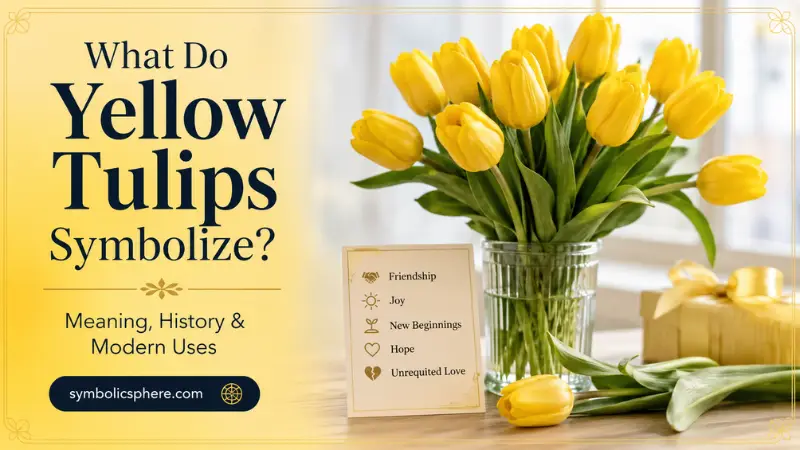
Few flowers announce spring quite like a bunch of yellow tulips. Their bright, upright blooms show up in gardens, gift shops, and bouquets all season long — but what do they actually mean when you give or receive them? Yellow tulips carry a distinct symbolism separate from other tulip colors, rooted in centuries of horticultural history and shaped further by more recent flower-language traditions. This guide breaks down what yellow tulips represent today, where that meaning comes from, and when they make the best gift.
Quick Answer
Yellow tulips symbolize friendship, happiness, optimism, and cheerful affection in modern American culture, making them a popular choice for spring bouquets, congratulations, and gifts between friends. Historically, tulips were linked to beauty, prestige, and garden culture — the specific “friendship” meaning of yellow developed later, through European flower symbolism and popular floral tradition.
At a glance:
- Represent friendship, happiness, and optimism above all
- Bright color reinforces ties to sunlight, spring, and warmth
- Originated in Central Asia, flourished in Persian and Ottoman garden culture
- Victorian-era “language of flowers” shaped today’s color-based meanings
- In the U.S., often chosen for affection without romantic weight
- Common for congratulations, encouragement, and celebrating new beginnings
What Yellow Tulips Look Like
Yellow tulips are cup-shaped spring flowers ranging from pale butter yellow to deep gold, with some varieties showing orange, red, or green accents along the petals.
Their appearance shapes their symbolism. Yellow is one of the most attention-grabbing colors in a spring garden, and the tulip’s upright, simple shape gives it a clean, energetic look — the opposite of flowers traditionally linked to mourning or formality. That’s part of why they show up everywhere from Easter displays to graduation bouquets to everyday gift-shop arrangements.
What Yellow Tulips Symbolize in the U.S. Today
In contemporary American flower-giving, yellow tulips are most closely associated with friendship, happiness, optimism, warmth, and encouragement — a way to express affection without the romantic weight of something like red roses.
| Context | Common Meaning | Best For |
|---|---|---|
| Friendship | Appreciation, companionship | Close friends, casual gifts |
| Spring | Renewal, fresh starts | Seasonal decor, new beginnings |
| Congratulations | Shared happiness | Graduations, new jobs |
| Encouragement | Hope, support | Life transitions, tough moments |
| Romance | Cheerful affection | Early relationships, light gestures |
Flower symbolism isn’t a fixed dictionary — it shifts with context and relationship. Yellow tulips given to a close friend may read as appreciation; the same bouquet given to a partner may simply express happiness.
Why Yellow Signals Happiness and Optimism
Color does a lot of the symbolic work here. In American visual culture, yellow is tied to sunlight, energy, and positive attention — a pattern that shows up in advertising, design, and seasonal decor.
There’s also a straightforward botanical reason: yellow tulips bloom in spring, just as gardens are waking up from winter. That pairs two ideas — yellow (brightness) and tulip (renewal) — into an especially strong sense of optimism.
Color psychology isn’t universal, of course. Yellow can suggest caution or even jealousy in certain contexts. But in a fresh floral arrangement, the interpretation skews overwhelmingly positive.
The Long History Behind the Tulip
Yellow tulip symbolism can’t be fully separated from the tulip’s much older cultural history.
Tulips originated across Central Asia and became especially important in Persian and Ottoman garden culture. By the 1500s, cultivated tulips were prominent in the Ottoman Empire, appearing in gardens, textiles, and decorative art (Nature). From there, ornamental tulips tied to the Ottoman world spread into Western Europe during the sixteenth century, while some wild species arrived separately via the Mediterranean (Nature).
This matters because the tulip was never just an ordinary garden flower — it became a symbol of cultivation, rarity, and social status.
In seventeenth-century Netherlands, tulip enthusiasm reached a fever pitch. The episode now known as Tulip Mania made the flower one of the most recognizable symbols in Dutch horticultural history (The Fitzwilliam Museum). Modern yellow tulips still carry a trace of that legacy, even though most people today encounter them simply as a cheerful spring flower.
Tulips in Ottoman Culture
The Ottoman chapter of tulip history is arguably the most significant. Tulips were cultivated extensively in Ottoman gardens and became a recurring motif in ceramics, textiles, manuscripts, and architecture. Historical scholarship also identifies religious symbolism tied to tulips in Ottoman culture (Nature).
The eighteenth-century era often called the Tulip Period became associated with elite enthusiasm for gardens, art, leisure, and cultural exchange.
It’s worth noting: Ottoman tulip culture was far more layered than any modern “one color, one meaning” flower chart suggests. Its historical importance comes from its role in gardening, art, and court culture — not from a single symbolic definition.
How Victorian Flower Language Shaped Modern Meaning
Much of today’s flower symbolism traces back to the nineteenth-century language of flowers, a tradition where specific flowers and colors were assigned emotional messages — turning bouquets into a kind of coded communication.
Over time, popular floral guides and commercial flower culture reinforced color-based interpretations, and yellow flowers were frequently linked to friendship and cheerfulness — though historical flower dictionaries were never fully consistent with each other.
That inconsistency matters: there’s no single ancient authority that declared yellow tulips mean friendship. The meaning developed gradually, through overlapping traditions in flower language, horticulture, and gift-giving.
Yellow Tulips and Friendship
This is probably the most useful modern read on yellow tulips. Where red flowers carry an unmistakable romantic charge, yellow tulips are lighter and less exclusive — closer to “I’m happy you’re in my life” than a declaration of passion.
That makes them a natural fit for birthdays, friendship anniversaries, thank-you gestures, or an unprompted gift. They also work well between family members — a parent receiving yellow tulips from an adult child, for instance, without any romantic subtext.
Yellow Tulips and Spring Renewal
Few flowers are as visually tied to spring as tulips. Their emergence after winter gives yellow tulips an obvious metaphorical role: a new season beginning.
That makes them a fitting symbol for:
- Fresh starts and personal growth
- Renewed hope
- Leaving a difficult period behind
- Optimism about what’s next
This is why they work so well for life transitions — a new job, a new home, a graduation, or simply the start of a new chapter.
Yellow Tulips for Holidays and Occasions
- Easter — Spring timing and bright color fit naturally into Easter displays, though the tulip has no exclusive religious symbolism.
- Mother’s Day — Expresses appreciation and affection without the romantic implications of red flowers.
- Graduations — Optimistic and celebratory, well suited to marking an achievement.
- Housewarmings — Their warmth and freshness make them an easy choice for a new home.
- Birthdays — Communicate cheerfulness and personal appreciation.
- Get-well gifts — Bright and encouraging without the heaviness some other flowers carry.
Yellow Tulips in Romantic Relationships
Yellow tulips aren’t anti-romantic — they just shift the emphasis. Where a red rose foregrounds passion, a yellow tulip foregrounds happiness and warmth, making it a good fit early in a relationship, for anniversaries tied to shared experiences, or for a partner who prefers something brighter and less formal.
Pairing yellow tulips with pink, white, or red flowers can shift the message toward something more explicitly romantic, if that’s the goal.
Yellow Tulips Across Cultures
Tulip symbolism outside the U.S. is equally rich. In Ottoman history, tulips became central to garden culture and visual art. In the Netherlands, the flower is closely tied to horticultural and national identity (Nature). Persian literary and garden traditions predate both — historical accounts place tulip cultivation in Persia centuries before the flower reached fashionable status in Western Europe (Europeana).
These traditions shouldn’t be flattened into one universal meaning. A flower’s symbolism shifts by religion, family tradition, and personal experience — even within a single country. The most accurate framing is that yellow tulip symbolism is culturally shaped, not universally fixed.
Common Misconceptions About Yellow Tulips
“Yellow tulips have one official meaning.” They don’t — flower symbolism is a cultural tradition, not a fixed classification system, and meanings shift across time and place.
“Yellow flowers automatically mean jealousy or rejection.” That association exists in some historical flower-language traditions, but it isn’t the default modern American interpretation of yellow tulips.
“Tulip symbolism starts and ends with Tulip Mania.” The 1600s Dutch craze is a major chapter, but tulips already carried cultural and artistic significance across Central Asia and the Ottoman world well before their European commercial boom (Nature).
FAQs
Do yellow tulips symbolize friendship?
Yes. In contemporary American flower symbolism, yellow tulips are commonly associated with friendship, happiness, and appreciation — a natural choice when a gift should feel affectionate without being strongly romantic.
Are yellow tulips romantic?
They can be, but their romantic message is lighter than red roses. Yellow tulips lean toward happiness, admiration, and companionship rather than intense passion.
What do yellow tulips mean in a relationship?
They can represent happiness, affection, and appreciation for shared experiences. The meaning depends more on the couple and occasion than on a fixed floral code.
Are yellow tulips appropriate for a funeral?
They can be, especially when a family wants to celebrate someone’s personality and life rather than follow traditional mourning symbolism. Family and cultural preferences should always take priority over general flower symbolism.
What do yellow tulips symbolize spiritually?
There’s no single universal spiritual meaning. Depending on the tradition, they may connect to broader ideas of renewal, light, or gratitude — but these shouldn’t be treated as fixed religious teachings.
What does a yellow tulip tattoo mean?
Commonly friendship, optimism, personal renewal, or a fresh chapter — though tattoo meanings are often personal, so the individual’s story matters more than a standardized symbol chart.
Are yellow tulips associated with jealousy?
Some historical flower-language traditions linked yellow flowers to less positive emotions, including jealousy. That’s not the common modern interpretation — today, yellow tulips are understood almost entirely in a positive light.
When to Give Yellow Tulips
Yellow tulips work well when you want a gesture that feels warm and personal without being formal or overtly romantic — think birthdays, graduations, new jobs, housewarmings, Mother’s Day, thank-you gifts, or simply brightening someone’s day. In a romantic context, they still work beautifully; they just tend to communicate happiness and affection rather than intense passion.
Conclusion
Yellow tulips remain one of the clearest floral symbols of springtime optimism in American culture — friendship, happiness, encouragement, and new beginnings, all wrapped into one flower. Their story runs far deeper than the modern bouquet suggests, stretching from Central Asian and Persian roots through Ottoman gardens and Dutch horticulture to today’s local flower shop (Nature).


