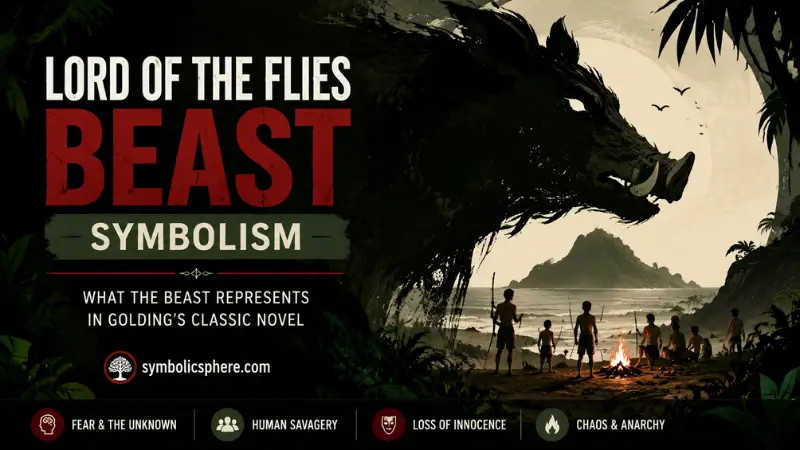
Lord of the Flies beast symbolism is one of the most debated topics in American literature classrooms, and for good reason: when a group of stranded boys in William Golding’s 1954 novel start whispering about a “beast” hiding in the jungle, the story shifts from a survival tale into a psychological study. The creature the boys fear has been discussed in classrooms for seventy years because it’s never actually a monster at all — it’s a stand-in for something they carry inside themselves.
Americans in particular have made this novel a fixture of high school English curricula, which has turned the beast into one of the most widely discussed symbols in literary education. Its meaning isn’t locked to one reading, either: teachers, critics, and general readers approach it as a religious allegory, a political warning, or a study of adolescent psychology, often all three at once.
This article traces where the beast comes from, what it has meant to different readers over time, and why it still surfaces in essays and cultural commentary decades after the book’s publication.
Quick Answer
The beast in Lord of the Flies symbolizes the human capacity for cruelty and violence that surfaces once social order breaks down. It is not a literal monster but a projection of the boys’ own fear, and eventually their own savagery. Golding built the idea on postwar anxieties about human nature and on biblical imagery, particularly the concept of an inner evil sometimes called the “beast within.”
TL;DR
- The beast is never a real creature; it’s a psychological projection.
- Golding used it to argue that evil originates inside people, not outside.
- American classrooms treat it as a symbol of lost innocence and civilization’s fragility.
- The dead parachutist scene shows fear attaching itself to a false external threat.
- Simon’s death links the beast directly to human violence, not myth.
- The symbol still appears in essays and commentary as shorthand for hidden cruelty.
Is the Beast a Real Creature in the Story?
No — and that’s the point. The beast never appears as a single, consistent creature. Different boys describe it differently: some think it’s a sea monster, others imagine a ghost, and the youngest boys simply sense “a beastie” without being able to name it. Golding gives the beast no fixed form because its power comes from being unknown and endlessly reshaped by fear, not from any physical trait.
The closest thing to a literal beast in the book is the corpse of a dead parachutist that drifts onto the island and gets tangled in rocks above the boys’ camp. From a distance, its shifting silhouette looks alive, and this misidentification convinces the boys that a real monster is watching them from the mountain. The irony is deliberate: the actual threat on the island is a dead soldier, physical evidence of the war and violence the boys are supposedly safe from.
What Does the Beast Symbolize? Fear Given a Shape
At its center, the beast represents the human capacity for violence once social restraints are removed. Golding was writing in the years following World War II, and he set out to challenge the assumption that children are naturally innocent and that societal breakdown comes from some outside evil. Instead, the novel argues that the “monster” the boys fear is a version of themselves.
Golding states this almost directly in the novel’s most quoted scene, when Simon has a feverish, hallucinatory conversation with a pig’s head mounted on a stick — the “Lord of the Flies” — which tells him the beast can’t be hunted because it lives inside each boy. That scene reframes the entire novel: the real mystery was never what the beast is, but why the boys need one at all.
Historical Origins of the Symbol
Golding’s idea didn’t come from nowhere. He served in the Royal Navy during World War II and was present for the D-Day landings, an experience that left him skeptical of any story claiming ordinary people are incapable of extreme violence. Earlier British adventure fiction, including R.M. Ballantyne’s The Coral Island, had depicted stranded boys behaving with noble self-discipline. Golding wrote Lord of the Flies largely as a rebuttal to that tradition, imagining a more realistic outcome. You can read more about Golding’s wartime background and how it shaped his fiction on Britannica’s biography of William Golding.
The name “Lord of the Flies” is an English translation of “Beelzebub,” a name tied to a demonic figure in Christian tradition. By naming the pig’s head after this figure, Golding connected his fictional beast to an older idea: that evil isn’t an external monster to be defeated but an internal force that has to be recognized and managed.
How American Classrooms Interpret the Beast
In American schools, the beast is most often taught as a symbol of civilization’s fragility and the dangers of mob psychology. Because the novel is commonly assigned in ninth or tenth grade, it’s often a student’s first serious encounter with the idea that fear can be manufactured and exploited by group dynamics — a theme that connects naturally to later lessons on propaganda, scapegoating, and crowd behavior in history and civics classes.
The beast also shows up in broader American cultural commentary. Political columnists and social critics sometimes invoke Lord of the Flies imagery to describe a group turning on a vulnerable member or abandoning agreed-upon rules under stress, using the beast as shorthand for how quickly fear can turn destructive in any organized group, not just children on an island.
Cross-Cultural and Religious Readings
Beyond the American classroom, the beast invites comparison to older traditions. In Christian theology, the Beelzebub connection links the beast to temptation and inherited sin, echoing the idea of a fallen human nature that exists before any external corruption. Some readers connect it to Jungian psychology, treating it as a literary version of the “shadow self” — the darker, hidden aspects of personality a person normally represses.
Other critics compare the beast to totemic fears in various folklore traditions, where communities invent a guardian or feared entity to explain what they can’t otherwise process. What separates Golding’s version is that the beast is explicitly revealed as false — there’s no supernatural resolution, only the boys’ own choices.
The Psychology Behind the Beast
Psychologically, the beast represents projection: the boys take an uncomfortable internal feeling — fear of what they’re becoming — and externalize it onto an imagined creature. This mirrors a recognizable pattern in real group psychology, where anxiety or guilt gets displaced onto a scapegoat rather than examined directly.
The beast also tracks the boys’ descent from rational thought into instinct-driven behavior. Early on, older boys dismiss it as a story for “littluns.” By the middle of the book, even the leaders take the threat seriously, and by the end, fear of the beast becomes justification for ritual violence. Its emotional arc mirrors the erosion of the boys’ self-control.
The Turning Point: Simon’s Death
The clearest link between the symbolic beast and real human violence comes when the boys, caught up in a frenzied ritual dance, mistake Simon for the beast and kill him. This scene collapses the distance between symbol and reality: the “monster” they’ve been hunting was never in the jungle, and fear of it drives them to commit the exact violence they claimed to be defending against.
This moment is often the centerpiece of classroom discussion because it makes Golding’s argument as concrete as fiction allows. The beast was never a separate entity that could be killed — it was the group’s own capacity for violence, and Simon becomes its first casualty specifically because he tried to tell the others the truth.
Modern Usage in Media and Pop Culture
The beast doesn’t have one fixed image the way a skull or a rose does, so it rarely appears on its own in tattoo culture or visual design. When Lord of the Flies imagery does show up in tattoos or fan art, it’s usually the pig’s head on a stick rather than the beast itself, since that image is more concrete and describable.
References to the beast show up more often in writing, television, and film. Shows and films about groups descending into chaos — survival dramas especially — are frequently compared to Lord of the Flies by critics, and phrases like “the beast is us” occasionally surface in commentary about group behavior, used as shorthand for the idea that a feared enemy is often a reflection of the group itself.
Common Misreadings and Controversies
One common misreading treats the beast as a vague metaphor for “evil” in general, which flattens Golding’s more specific argument: that violence emerges from fear and social breakdown, not from a fixed, external moral category. Treating the beast as generic darkness obscures the book’s more uncomfortable claim — that ordinary children, not villains, are capable of this behavior under the right conditions.
Another point of debate involves the novel’s all-boys cast and what that means for its claims about human nature broadly. Critics have pointed out that Golding’s experiment says as much about a specific model of British boarding-school masculinity as it does about humanity as a whole, and some modern readers view the beast’s symbolism as inseparable from that limited framing. Britannica’s entry on Lord of the Flies covers this critical history in more depth, including the book’s history of being challenged in American school districts.
How the Meaning Has Evolved Over Time
When the novel was first published, reviewers largely read the beast through the lens of Cold War anxiety, connecting the boys’ violence to fears that nuclear war or totalitarianism could erase civilization’s thin veneer. By the 1960s and ’70s, as the book became a fixture of American secondary education, the emphasis shifted toward psychological and moral readings centered on individual behavior rather than geopolitics.
More recently, discussions of the beast have widened to include questions about power, leadership, and how fear gets used to justify authority — themes that resonate with contemporary conversations about misinformation and groupthink. The symbol itself hasn’t changed; each generation has simply projected its own version of collective fear onto it.
| Context | Meaning in the USA | Common Associations | Notes |
|---|---|---|---|
| High school classrooms | Fragility of civilization, mob psychology | Fear, scapegoating, loss of innocence | Most common entry point for American readers |
| Political and social commentary | Groups turning on individuals under stress | Groupthink, propaganda, crowd behavior | Used as shorthand, rarely a full analysis |
| Religious or theological reading | Inner sin or temptation | Beelzebub, the “beast within” | Rooted in the book’s title translation |
| Psychological interpretation | Repressed instinct, the shadow self | Projection, denial, Jungian theory | Common in literary criticism, less so in casual use |
| Pop culture references | Chaos following the collapse of order | Isolation, survival, broken rules | Usually invoked through the pig’s-head image instead |
Why the Symbol Still Resonates
Part of why the beast has stayed relevant is that Golding refused to give readers a villain to blame. There’s no invading force, no supernatural antagonist, and no adult failure that directly causes the boys’ violence — only ordinary children responding to fear in predictable, human ways. That absence of an external cause is uncomfortable, and discomfort tends to keep a symbol alive in cultural memory long after the historical anxieties that produced it have faded.
The beast also scales easily to almost any situation involving group fear, from playground dynamics to national politics, which is a large part of why teachers keep assigning the book and commentators keep referencing it outside the classroom.
FAQs
What does the beast in Lord of the Flies actually represent?
The beast represents the human potential for violence and cruelty, especially once fear and social pressure override individual judgment. It has no physical form because it isn’t an external threat — it’s something the boys carry with them.
Is the beast a real creature in the story?
No. The closest physical stand-in is a dead parachutist mistaken for a monster, but the “real” beast is the boys’ own capacity for savage behavior, as the Lord of the Flies tells Simon directly during his hallucination.
Why is the pig’s head called the “Lord of the Flies”?
“Lord of the Flies” is an English translation of “Beelzebub,” a name tied to a demonic figure in Christian tradition. Golding used it to connect the boys’ fear to an older idea of evil as an internal, moral condition rather than an external monster.
How is the beast connected to Simon’s death?
Simon is killed by the other boys during a ritual frenzy after they mistake him for the beast in the dark. His death shows the imagined threat becoming a justification for the exact violence the boys feared, collapsing the distance between symbol and reality.
Do American teachers interpret the beast differently than British readers?
Not fundamentally, but American classrooms tend to emphasize the psychological and moral lessons about group behavior and scapegoating, connecting the beast to civics topics like propaganda and mob mentality. Earlier British readings leaned more heavily on Cold War-era political anxiety.
Is the beast meant to be a purely negative symbol?
Mostly, yes, but it also serves a diagnostic purpose rather than a purely condemning one. Golding uses it to expose a truth about human behavior under pressure rather than simply to label people as evil, which is part of why the novel’s ending focuses on recognition and grief rather than punishment.
Why doesn’t the beast appear as a consistent image in tattoos or art the way other literary symbols do?
Because the beast is intentionally formless in the text, it doesn’t lend itself to a single visual design. Artists and fans more often use the pig’s head on a stick instead, since it’s the novel’s one concrete, describable image tied to the same idea.
Conclusion
The symbolism of the beast in Lord of the Flies endures because it refuses to offer readers an easy villain. Golding built a story where the monster the characters fear turns out to be a mirror, and that reversal is a large part of why the novel is still assigned in classrooms and referenced in cultural commentary today.
Whether it’s read as a religious allegory, a psychological case study, or a warning about group behavior under pressure, the beast keeps pointing to the same idea: the line between order and violence is thinner, and more internal, than most people would like to believe. That’s a hard thing to teach a fourteen-year-old — and probably why the lesson has stuck.

[…] fly symbolism centers on fragility, brief life, and gentle […]