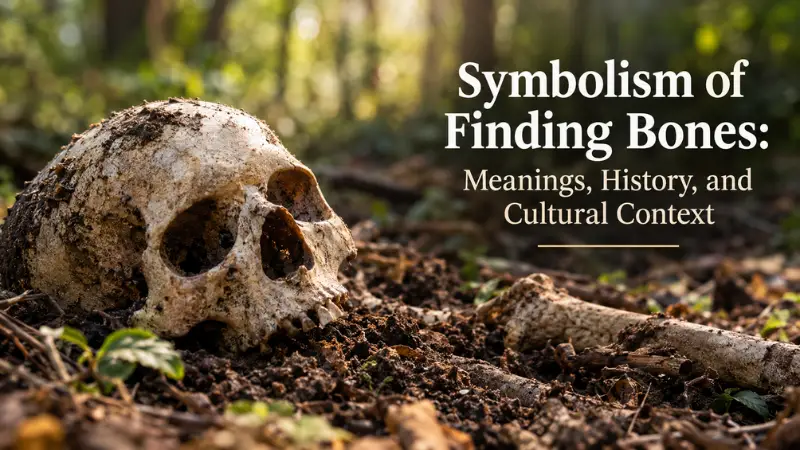
Finding bones can be unsettling. Maybe you spotted a small skull on a forest trail, turned up fragments while gardening, or stood in front of a skeleton in a museum. Bones outlast soft tissue by a very long time, so they tend to make us think about death, the passage of time, and the people and animals that came before us.
The symbolism of finding bones depends on what kind of bones they are, where you find them, and what the discovery means to you. In the United States, bones show up everywhere: archaeologists study them, hikers stumble across animal remains, artists use skulls to explore mortality, and they feature in Halloween decorations, religious imagery, tattoos, and memorials.
Some people read an unexpected discovery as a sign of change or an ending. Others look at it through science, faith, folklore, or personal memory. These views can coexist, but finding bones is not a reliable omen and doesn’t predict anything. Bones can also stand for survival, identity, evidence, ancestry, and hidden things coming to light.
Quick Answer: What Does Finding Bones Symbolize?
Finding bones most often symbolizes mortality, remembrance, and the past, a reminder that life is temporary. Depending on the religious or cultural setting, bones can also represent ancestors, resurrection, renewal, resilience, and the discovery of hidden truths.
Key takeaways
- Mortality: Bones remind us that life is finite.
- Remembrance: They connect us to ancestors, loved ones, and forgotten lives.
- Resilience: They are the structure that supports the living body.
- Discovery: Unearthed remains can reveal hidden histories.
- Renewal: Some traditions link bones with resurrection or restoration.
- Modern culture: Skulls and skeletons appear in art, tattoos, memorials, and Halloween imagery.
Found actual bones? If they might be human, don’t touch or move them. Leave the area undisturbed and contact local law enforcement. See what to do if you find bones below.
What Finding Bones Commonly Represents
Bones are the framework of the body. Once they’re separated from a living body, their meaning shifts toward what remains after life, change, or loss. That contrast is why bones can signal both an ending and proof that something once existed.
Common interpretations include:
- Mortality: Bones make death visible and remind us of life’s physical limits.
- Memory: They preserve a tangible link to people, animals, and earlier generations.
- Truth: They are physical evidence that can reveal facts hidden by time.
- Endurance: They survive long after other tissue has gone, suggesting lasting structure.
- Transformation: Finding something buried can mark a move from ignorance to understanding.
Circumstances matter. A deer skull on a hiking trail might spark curiosity about wildlife, while uncovering an ancestor’s remains could bring grief, recognition, or new questions about family history. The same discovery can mean very different things depending on a person’s background, beliefs, and experiences.
Ancient Roots of Bone Symbolism
Bones carried cultural weight long before modern archaeology. Early communities developed burial customs, funerary objects, and ceremonies that expressed ties between the living and the dead.
Archaeological evidence shows that some prehistoric burials included beads, tools, and pigments. This suggests the dead weren’t simply discarded; burial could keep a person’s place in a community’s memory and belief system.
In ancient Egypt, careful preparation of the body reflected religious ideas about death and the afterlife. Egyptian traditions focused on preserving the whole body rather than bones alone, but skeletal remains were part of a larger belief in bodily continuity.
Other societies treated ancestral remains as reminders of lineage, collective identity, or obligations to earlier generations. Meanings varied by time and place, so it would be inaccurate to say all ancient peoples believed bones held spiritual power. The common thread is simpler: physical remains connect the present to a past we can’t experience directly.
Bones as a Symbol of Mortality (Memento Mori)
The most familiar meaning of bones is mortality. They are recognizable parts of a body that once lived, which makes death hard to ignore. This idea runs through cemeteries, memorial art, skull illustrations, Halloween decor, and the Latin phrase memento mori, “remember that you must die.”
Mortality symbolism doesn’t have to mean fear or despair. It can prompt people to think about how they spend their time, which relationships matter, and what they want to leave behind. For someone going through a major life change, finding bones might become a personal cue to let go of an outdated identity or rethink old priorities. That reading comes from reflection, not from any supernatural rule.
Finding bones doesn’t predict death. At most, it can sharpen awareness of life’s limits and the value of the time we have.
Hidden Truths and the Past
Buried bones often symbolize something long out of sight that has finally become visible. That fits naturally with archaeology, forensic science, genealogy, and stories about forgotten communities.
A skeleton can reveal what written records never preserved. Scientists can examine bones and teeth to learn about age, diet, disease, and physical activity. In some cases, analysis can also help establish family relationships or clarify the circumstances of a death.
Symbolically, bones are evidence: what survives when explanations disappear or memories become unreliable. A few examples:
- On private land: Animal bones found while clearing an overgrown lot may show how the land was once used or what wildlife lived there.
- In archaeology: A burial site beneath a modern building may bring an overlooked community’s history into public view.
- In fiction: A skeleton in a remote landscape often exposes a long-hidden crime.
In each case, the bones don’t create the truth; they provide clues to investigate it. As a personal symbol, finding bones may reflect a wish to confront an unresolved question, revisit an old memory, or see a situation more honestly.
Ancestry, Family History, and Remembrance
Bones can symbolize ancestry because they are physical traces of people who lived before us. This is especially true for remains found at archaeological sites or in known family burial grounds.
For some, ancestry means genealogy, family stories, and inherited objects. For others, it involves religious traditions, cultural practices, or responsibilities toward the dead. Finding historical remains can make those connections feel immediate, turning an abstract past into evidence of real people who built homes, raised families, and formed communities.
Bones can also represent people left out of official histories. Their discovery can mean recognition: someone who left little written evidence still has a place in the record.
But human remains are not family memorabilia or historical curiosities. They may carry ongoing cultural, religious, and personal significance for descendants and communities. Remembrance means honoring the connection to the past and the dignity owed to the person whose remains survive.
Religious Interpretations: Resurrection, Renewal, and Restoration
Religious traditions give bones meanings that reach beyond physical death. These views vary widely, and none is the universal religious meaning of finding bones.
The Valley of Dry Bones (Ezekiel 37)
The best-known biblical reference is Ezekiel 37, where the prophet sees a valley of dry bones that come together and are restored to life. In context, the vision is mainly an image of the restoration of Israel, a people who feel defeated and hopeless. The dry bones represent a seemingly impossible situation, and their restoration expresses the possibility of collective renewal.
Many Christian readers also connect the passage to resurrection and to God bringing life out of apparent defeat. It is not a prediction about someone finding physical bones. In personal reflection, though, the image can prompt thoughts about recovering from hardship or rebuilding something that seemed beyond repair.
Other religious and spiritual perspectives
Some Christian traditions keep and venerate the relics of saints, linking physical remains with religious memory and devotion. Other spiritual frameworks view ancestral remains through ideas of lineage, continuity, or duty to the deceased, and practices differ even within a single religion.
Finding bones doesn’t show that a spiritual message has been sent. Religious meaning usually comes from the beliefs through which a person or community interprets the discovery.
What Finding Bones Means in American Culture
In the United States, bones appear in several overlapping contexts. They can be frightening, educational, decorative, sacred, or historically significant depending on where you encounter them.
| Context | Common interpretation | Important distinction |
|---|---|---|
| Halloween decorations | Death, fear, humor, the supernatural | Decorative skeletons don’t necessarily express religious beliefs. |
| Archaeological discoveries | History, evidence, human origins | Human remains require respectful, context-sensitive treatment. |
| Family cemeteries | Ancestry, mourning, remembrance | Personal and community traditions differ. |
| Tattoos and jewelry | Mortality, resilience, personal identity | Meaning depends on the wearer’s intention. |
| Wildlife discoveries | Nature, survival, ecological cycles | Animal bones often have ordinary natural explanations. |
A skull in a medical classroom encourages anatomical learning. The same image on a Halloween porch is meant to scare or amuse the neighbors. A historical burial site raises heavier questions about land ownership, cultural heritage, and how ancestral remains are treated, concerns that reach beyond the remains themselves to the communities connected to them.
Because American culture blends many religious, regional, and family traditions, bones have no single fixed meaning. Context matters more than assuming every discovery is a bad omen or a spiritual sign.
Día de los Muertos and other traditions
Skeletons and skulls play a visible role in Día de los Muertos (Day of the Dead), a Mexican tradition observed November 1 and 2, with regional variations. Families build ofrendas, altars with photographs, candles, flowers, food, and other objects tied to loved ones who have died. Sugar skulls and skeleton imagery stand for death alongside remembrance, celebration, and the lasting importance of family.
The imagery also has roots in Mexican printmaking. Artist José Guadalupe Posada helped popularize calavera imagery, including the figure later known as La Catrina, using skeletons for social commentary as well as humor.
These traditions show that skeletal imagery doesn’t always mean dread. It can acknowledge mortality while celebrating the lives and personalities of the dead. Día de los Muertos is not simply a Mexican version of Halloween, and its imagery shouldn’t be treated as interchangeable with generic horror decor. Other societies also have traditions involving bones, funerary objects, or the veneration of particular remains, each with its own historical and religious background. Respect for the tradition matters as much as understanding the symbol
Bones as Symbols of Strength and Resilience
Bones aren’t only about death. In life, they protect organs, anchor muscles, and make movement possible. That physical role is why bones are also read as symbols of strength, stability, and resilience: essential structures that often stay recognizable after the rest of the body has gone.
In stories and personal artwork, bones can represent what holds someone together through hard times. Everyday language reflects this too, in phrases like “backbone” and “bare bones,” which means the essential structure of something. Finding bones can become a metaphor for returning to fundamentals: core values, dependable relationships, and the qualities that remain after upheaval.
Resilience isn’t a supernatural property of bones, though. It’s a meaning people draw from the skeleton’s function and the situation in which the symbol appears.
The Emotional and Psychological Side of Finding Bones
An unexpected encounter with bones can bring up curiosity, discomfort, sadness, fascination, or quiet reflection. Part of the reaction comes from the contrast between something familiar (a body part) and something out of place, which can make death feel suddenly close. Where you find the bones also shapes how you feel:
- In a forest: Animal bones may evoke the natural cycle of life and death.
- On family property: The discovery may raise questions about earlier residents or the history of the land.
- Near a cemetery: Bones may bring thoughts of mourning and respect for the deceased.
- During a difficult period: The experience may become a personal reminder of change, endurance, or unresolved grief.
People naturally look for meaning in the unexpected, often linking it to a recent loss, an important decision, or a memory on their mind. That can be valuable without proving the discovery was arranged for a supernatural purpose; a meaningful interpretation isn’t the same as a verified message. If finding bones leaves you persistently distressed, talk it over with someone you trust rather than searching repeatedly for frightening interpretations.
Bone Imagery in Tattoos, Jewelry, and Art
Bone imagery has a firm place in body art, jewelry, fashion, and design, and its meaning shifts with style, placement, and the story behind it.
Tattoos. A bone or skeleton tattoo may express acceptance of mortality, an interest in anatomy, an appreciation for gothic art, or a reminder to live honestly. Some people simply find beauty in the body’s underlying structure.
Jewelry. Pendants and accessories can signal individuality, alternative style, or a connection to someone remembered. Pieces made from actual historical or human material raise ethical questions that decorative replicas do not.
Art and decor. Artists use bones to explore mortality, anatomy, fragility, nature, and time. At home, a skull sculpture might work as a gothic accent, a scientific reference, or a reminder of impermanence. In digital art, album covers, clothing, and social profiles, skeletal imagery can signal humor, rebellion, a love of horror, or an intentionally unconventional look.
A bone tattoo doesn’t automatically mean its wearer has experienced trauma or holds a particular belief. The most accurate interpretation starts with the person’s own explanation.
Is Finding Bones Good or Bad Luck?
Finding bones can feel ominous because they’re associated with death, burial, and the unknown. In folklore and storytelling, an unexpected discovery may signal danger, reveal a haunting, or warn that a forgotten event is about to return. Those are narrative and cultural associations, not evidence that bones cause bad luck.
The same discovery can have positive associations. It might reveal an important historical fact, spark an interest in the natural world, or prompt reflection on family and priorities.
It helps to separate emotional symbolism from prediction. Feeling uneasy when you find a skull is understandable. Concluding that it guarantees misfortune is a separate claim the experience itself doesn’t support. A small bird skeleton under a window may just reflect an ordinary encounter between wildlife and buildings, while a bone fragment found during excavation could be part of a historically important site. Instead of labeling a discovery good or bad, consider the setting, the available evidence, and your own reaction.
Common Misunderstandings About Bone Symbolism
- “Finding bones always predicts death.” Bones are associated with mortality, but an association isn’t a prediction. Most discoveries have ordinary natural, archaeological, or historical explanations.
- “Every bone is a spiritual sign.” Some people interpret unusual experiences spiritually; others use science or personal reflection. No single reading applies to everyone.
- “All cultures see bones as negative.” Many traditions link bones with ancestry, remembrance, devotion, or renewal.
- “Human bones are just historical objects.” Remains can be valuable scientific evidence, but they belonged to individuals and may matter deeply to descendants and communities.
- “Finding bones means the past should stay buried.” Buried remains can stand for painful memories, but uncovering the past is sometimes necessary for historical understanding, accountability, or reconciliation.
What to Do if You Actually Find Bones
If you find bones in real life, handle the practical side before the symbolic one. The first question is whether the remains are animal, human, archaeological, or uncertain.
- Possible human bones: Don’t pick them up, clean them, move them, or take them home. Leave the area undisturbed and contact local law enforcement or the appropriate local authority, especially if the remains look recent or the circumstances seem suspicious. Authorities can arrange for qualified professionals to assess the find.
- Possible archaeological or Indigenous burial sites: Avoid disturbing the surrounding ground and seek guidance from the relevant authorities. Federal and state requirements may apply, particularly on public or federally managed land. The National Park Service explains the federal framework on its NAGPRA page.
- Suspected animal bones: Avoid unnecessary handling, especially if their condition or origin is unclear. Land managers or wildlife professionals can help identify unusual finds.
Once the practical situation is handled, you can think about what the discovery means to you: what surprised you, what the location suggests about the past, or why the find stayed on your mind. Acting responsibly doesn’t reduce its symbolic significance; it simply recognizes that real remains deserve appropriate treatment.
FAQs
What does finding bones symbolize spiritually?
Depending on a person’s beliefs, finding bones may symbolize mortality, ancestral connection, renewal, or the restoration of something lost. These are possible interpretations, not proof of a supernatural message.
Is finding bones a good or bad sign?
Neither. There’s no reliable basis for treating the discovery as a prediction. Its significance depends on the circumstances, cultural context, and the meaning you attach to it.
What does finding animal bones symbolize?
Animal bones may represent nature’s life cycle, survival, adaptation, or the relationship between living things and their environments. They can also prompt curiosity about the species, its habitat, and how it died.
What does finding bones mean in the Bible?
In Ezekiel 37, the valley of dry bones represents the restoration of Israel from despair and apparent defeat. Many Christian readers also see renewal and resurrection in the passage, but it doesn’t establish that finding actual bones is a personal omen.
What does a bone tattoo symbolize?
A bone tattoo may represent mortality, strength, anatomical interest, gothic style, or acceptance of life’s temporary nature. The meaning varies by wearer, so the design alone can’t reveal someone’s beliefs or experiences.
Why are bones associated with ancestors and remembrance?
Bones are physical evidence of earlier generations, linking the present to people who lived before us. In some cultural and religious traditions, ancestral remains also carry ongoing spiritual or communal significance.
What should I do if I find what might be human bones?
Leave them where they are, avoid disturbing the surrounding area, and contact local law enforcement or the appropriate authorities. Don’t assume old-looking bones are archaeological or harmless without a professional assessment.
Conclusion
The symbolism of finding bones centers on mortality, remembrance, hidden history, resilience, and the link between present and past. In America, bones can appear as spooky Halloween decor, meaningful religious imagery, archaeological evidence, personal artwork, or reminders of loved ones who have died.
Their meaning changes with the setting and the person interpreting them. A discovery can prompt reflection on life’s brevity, uncover a forgotten chapter of history, or deepen appreciation for the lives that came before ours. RThe symbolism of finding bones centers on mortality, remembrance, hidden history, resilience, and the link between present and past. In America, bones can appear as spooky Halloween decor, meaningful religious imagery, archaeological evidence, personal artwork, or reminders of loved ones who have died.
Their meaning changes with the setting and the person interpreting them. A discovery can prompt reflection on life’s brevity, uncover a forgotten chapter of history, or deepen appreciation for the lives that came before ours. Religious and cultural traditions add further layers, but no universal rule makes every find an omen. Ultimately, finding bones is an encounter with what remains, and the most meaningful reading begins with understanding the context and treating the discovery with respect. religious and cultural traditions add further layers, but no universal rule makes every find an omen. Ultimately, finding bones is an encounter with what remains, and the most meaningful reading begins with understanding the context and treating the discovery with respect.