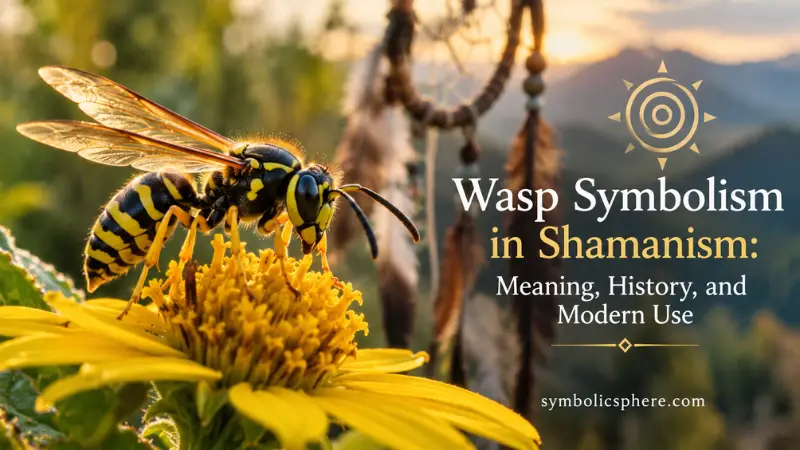
Wasp symbolism in shamanism is most often linked to protection, boundaries, focused action, and cooperation. A wasp’s narrow waist, sharp stinger, and purposeful movement make it an instantly recognizable symbol of caution and determination. But shamanic traditions are diverse, and no single meaning applies to all of them. This guide separates what the insect’s behavior can inspire from what any specific culture has actually documented.
Shamanism is a broad term for spiritual practices in which certain practitioners act as intermediaries between their communities and the spirit world.. In some Indigenous traditions, that role involves healing, ritual, ancestors, animals, and the natural environment. Contemporary spirituality uses the word more loosely, often to describe animal encounters read as personal messages.
Wasps suit animal symbolism because their behavior gives people so much to reflect on. They defend their nests, build intricate structures, and work persistently. Those traits can inspire symbolic readings, but they don’t show that any particular shamanic tradition treats the wasp as a spirit guide.
Quick Answer: What Does a Wasp Symbolize in Shamanism?
In modern American spiritual discussions, a wasp commonly symbolizes protection, assertiveness, healthy boundaries, and determined action. It can also prompt reflection on community, disciplined work, and survival. These are interpretations drawn from the insect’s behavior. They are not universal shamanic teachings, and meanings vary by cultural tradition.
TL;DR
- Protection: Defensive behavior can symbolize guarding personal or communal boundaries.
- Determination: Persistent activity suggests focused, purposeful effort.
- Community: Social wasps offer a way to think about cooperation and shared responsibility.
- Transformation: The wasp’s life cycle can inspire personal-growth interpretations.
- Cultural context: No universal wasp doctrine exists across shamanic traditions.
- Personal meaning: Modern encounters can be meaningful without being presented as ancient teaching.
What Does a Wasp Represent Symbolically?
A wasp’s symbolism starts with what it does. Unlike animals admired mainly for beauty or gentleness, the wasp commands attention through alertness, persistence, and its ability to defend itself.
Several readings appear often in contemporary animal symbolism:
- Protection: The stinger and defensive behavior suggest guarding yourself, your family, or your home.
- Boundaries: The insect can stand for resisting unwanted interference instead of accepting every demand.
- Determination: Repeated trips between food sources and the nest suggest concentrated effort.
- Cooperation: Social wasps coordinate activity within a colony.
- Adaptability: Their ability to use different environments and food sources invites reflection on changing circumstances.
The value of these readings lies in the questions they raise. Someone dealing with an intrusive relationship might take a wasp encounter as a reminder to set clearer limits. Someone working toward a hard goal might associate the insect with persistence. Neither reading requires believing the wasp delivered a supernatural message.
Is the Wasp a Spirit Animal in Shamanism?
There is no universal shamanic rule that names the wasp a spirit animal. In contemporary American spirituality, people sometimes call an animal that keeps catching their attention a spirit animal, power animal, or personal guide. A wasp may enter that framework because its behavior suggests alertness, determination, and self-defense.
Some people use the wasp as a reminder to speak more directly, protect their time, or finish a difficult task. Others find it prompts them to rethink how they handle conflict.
These labels need care, though. Some Indigenous peoples have specific teachings about relationships with animals, and those shouldn’t be assumed to match popular online descriptions of spirit animals. It’s also misleading to say everyone who sees a wasp repeatedly has been chosen by a guide. Repeated sightings can come from seasonal activity, a nearby nest, flowering plants, or food.
It helps to separate three possibilities:
- Cultural tradition: A particular community may have a specific, documented relationship with an animal.
- Personal symbolism: An individual may choose the wasp as an image for a quality they value.
- Practical observation: Repeated sightings may simply reflect the insect’s habitat and behavior.
These can coexist, but they shouldn’t be confused. Personal meaning doesn’t establish a historical tradition, and an ordinary explanation doesn’t prevent someone from finding meaning in an encounter.
What Shamanism Means Across Different Traditions
Shamanism is not one religion with one set of symbols. The term covers practices involving relationships with spirit beings, healing, ritual, divination, and other engagement with realities understood as more than ordinary physical experience.
The word entered wider scholarly use through encounters with Indigenous peoples of northern Asia, particularly Tungusic-speaking communities. Researchers later applied it to a much broader range of practices worldwide. That expansion created a problem: traditions grouped under one label can differ greatly in beliefs, ceremonies, spiritual authorities, and relationships with animals.
Some communities understand particular animals through inherited stories or ritual responsibilities specific to their people. Others emphasize plants, ancestors, landscape features, or other spiritual beings instead. An animal with an established role in one community can’t automatically be given the same role in another.
So claims about a specific traditional meaning of the wasp need evidence from the culture concerned. Without that, the wasp’s behavior is best treated as support for personal symbolic reflection.
Ancient Roots of Insect Symbolism
People have watched insects for thousands of years, and their behavior has fed folklore, art, religious imagery, and practical knowledge. Depending on species and circumstances, insects can seem threatening, beneficial, destructive, industrious, or remarkably organized.
Wasps stand out. Their nests contain carefully arranged cells, social colonies have organized roles, and their defensive behavior makes a small insect seem formidable. These features offer plausible foundations for associations with labor, order, defense, and collective survival.
But resemblance isn’t proof. To show how a community understood an insect, researchers need written accounts, oral histories recorded in context, archaeological objects, or descriptions of ritual practice. That matters especially for shamanic traditions, some of which were passed on mainly through oral teaching, and outsiders’ historical descriptions may be incomplete or shaped by their own assumptions.
Insects have long given humans material for symbolic thought, but no single ancient origin for wasp symbolism in shamanism can be established.
Wasp Symbolism of Protection and Personal Boundaries
Protection is the most intuitive modern reading of the wasp. A small creature that defends its nest decisively is an immediate image of responding to threat.
In personal symbolism, this can mark the difference between being aggressive and being appropriately protective. You don’t need to confront every disagreement, but you may need to act firmly when safety, dignity, or personal limits are at stake.
The wasp can prompt practical questions:
- Am I letting people cross boundaries I need to keep?
- Do I protect my time and attention as carefully as my responsibilities?
- Am I reacting to a real threat, or just feeling defensive?
- Can I be firm without causing unnecessary harm?
Protection has a communal side too. A social wasp’s nest is a shared structure, and defending it can stand for protecting a household, workplace, or group. The metaphor has limits, since human relationships call for judgment, empathy, and negotiation rather than instinct alone. A wasp can remind you to safeguard what matters while telling healthy boundaries apart from hostility.
Determination, Discipline, and Cooperation
Determination. Wasps spend their time searching for food, building nests, and doing what survival requires. Watching that persistence can inspire an association with disciplined work. In personal-growth terms, the wasp may represent doing a task consistently instead of waiting for motivation. For someone writing a book, finishing professional training, or rebuilding a financial routine, it can serve as a nudge to focus on the next necessary task rather than the whole challenge.
Persistence isn’t always good, though. Staying in a harmful relationship or chasing an unworkable plan just because you won’t quit isn’t discipline. The most constructive reading pairs purposeful action with sound judgment.
Cooperation. Many familiar wasps are social insects, with a colony that may include a queen and workers who build the nest, gather food, and defend it. Other wasps are solitary, so not every species illustrates collective behavior. Still, social wasps give a clear metaphor for how many small tasks maintain a larger structure.
Applied to human life, this can encourage reflection on shared responsibility in a family, neighborhood, volunteer group, or team. Not every contribution is visible, but less visible work can be essential. The image also raises a balancing question: cooperation shouldn’t mean sacrificing your well-being indefinitely.
As with the other meanings here, this is a modern analogy, not a documented belief shared across shamanic cultures. It also doesn’t mean wasps have human intentions or consciously teach lessons. The meaning comes from the observer comparing animal behavior with human experience.
Wasp Symbolism of Transformation and Change
Wasps that undergo complete metamorphosis develop through egg, larva, pupa, and adult stages. That natural progression is a starting point for reflecting on change, so in contemporary symbolism the wasp is sometimes tied to adaptation, maturation, and moving from one life stage to another.
The reading can resonate during a career change, a move, recovery from a major disappointment, or a step into greater responsibility. It reminds us that development happens in stages and that the finished result doesn’t show how it formed. The nest adds another layer: building a stable structure takes repeated effort, suitable conditions, and materials gathered over time, much like creating a new life after uncertainty.
Transformation is a reasonable contemporary interpretation based on the insect’s life cycle, not an established universal meaning of the wasp in shamanism. And not every hard transition is a spiritual calling. Personal growth usually involves ordinary decisions, support from other people, and practical work.
What Does Seeing a Wasp Mean? Modern American Perspectives
In the United States, wasps are familiar outdoor insects. People meet them around gardens, picnic tables, porches, parks, trash containers, and building eaves. A wasp at a summer barbecue may first suggest caution or annoyance, while someone interested in animal symbolism may see the same moment as a chance to reflect.
There’s no single American interpretation. Attitudes depend on personal experience, cultural background, spiritual beliefs, and whether the insect feels like a threat or just part of the local environment.
| Context | Possible meaning | Common associations | Important distinction |
|---|---|---|---|
| Personal spirituality | A prompt to examine boundaries | Protection, awareness | Personal interpretation, not universal doctrine |
| Work and ambition | A reminder to stay focused | Persistence, discipline | Effort should remain purposeful |
| Family and community | Reflection on shared duties | Cooperation, defense | Human relationships require flexibility |
| Life transitions | A metaphor for adapting | Growth, change | Not proof of a supernatural message |
| Fear or discomfort | Recognition of perceived danger | Caution, self-protection | A practical hazard can be real |
| Art and tattoos | A chosen personal emblem | Independence, resilience | Meaning depends on the wearer |
Spirit animal language in American culture usually describes personal connections with creatures. It isn’t interchangeable with the specific teachings of any Indigenous nation or traditional practitioner. A wasp encounter can be personally significant without representing an inherited cultural belief, and recognizing that leaves room for individual spirituality while respecting established traditions.
Is Seeing a Wasp a Good or Bad Omen?
A wasp sighting isn’t inherently a good or bad omen. Some people read an encounter as a reminder about boundaries or responsibilities, while ordinary factors such as nests, season, and food often explain why the insect showed up. If a sighting feels meaningful to you, treat it as an invitation to reflect, not a prediction.
Wasp Dream Meaning and Personal Reflection
Dreams about wasps can be unsettling, especially when the insect stings, follows, or surrounds the dreamer. Psychological approaches usually begin with the dreamer’s emotions and recent experiences instead of assuming the insect has one fixed meaning.
A wasp in a dream might bring to mind conflict, anxiety, defensiveness, persistent irritation, or a situation that feels hard to escape. After a painful argument, it might stand for lingering tension. For someone else, it may simply reflect a recent encounter outdoors.
The details can help clarify personal associations:
- A wasp approaching: You may be anticipating confrontation or feeling exposed to criticism.
- A wasp nest: It may raise questions about family tension, group dynamics, or a problem that seems to be growing.
- Escaping a wasp: This may reflect a wish to avoid a stressful situation.
- Watching a wasp without fear: It may suggest growing familiarity with something you once found threatening.
These are possibilities for reflection, not scientifically established interpretations or predictions. A shamanic approach to dreams draws on a community’s own understanding of dreams, spirits, and ritual, and it shouldn’t be flattened into a universal dictionary where every insect means the same thing.
If a wasp dream feels significant, write down what happened, what emotions came up, and whether anything in waking life resembles that feeling. Let the interpretation come from your circumstances, not fear of an assumed omen.
[INTERNAL LINK: dream symbolism or animal dream meanings article]
Emotional and Psychological Meanings of the Wasp
The wasp can provoke conflicting reactions. Some people admire its efficiency and independence, while others feel immediate anxiety because of the sting. Those reactions shape which qualities people attach to it.
- Fear and vigilance: A wasp can pose real risk, particularly for someone with a severe sting allergy. Symbolically, that perceived threat can stand for a conflict that needs attention.
- Confidence and assertiveness: The wasp is small but can defend itself against larger animals, which some read as refusing to be underestimated.
- Irritation and unresolved tension: A wasp that keeps returning to a picnic table can resemble a problem that interrupts daily life until it’s addressed.
- Respect for limits: Size doesn’t always determine vulnerability, and approaching an unfamiliar creature carelessly has consequences.
None of these is universal. A gardener may appreciate wasps for their ecological roles, including preying on other insects and, in some species, pollinating. Someone who has had a dangerous allergic reaction may reasonably associate them with serious risk. Reflection works best when it starts with your actual response, not an assumed message.
Wasp Symbolism in Tattoos, Jewelry, and Design
Wasps appear in contemporary tattoos, illustration, jewelry, clothing, and graphic design. Their angular bodies, contrasting colors, and recognizable stingers make them visually distinctive.
In personal artwork, a wasp may communicate independence, resilience, protectiveness, or an unwillingness to be pushed around. Someone might choose it after overcoming a difficult experience or learning to set stronger boundaries. A wasp tattoo can also simply express an interest in insects or natural history, and its meaning can’t be reliably read from the image alone. Designers often use the silhouette for tension, movement, or industriousness without invoking any religious tradition.
If you’re choosing a wasp design for spiritual reasons, ask what it represents to you personally. If you mean to reference a particular Indigenous or other traditional practice, research that context directly instead of relying on a generic animal-symbolism chart.
[INTERNAL LINK: animal tattoo symbolism article]
How to Approach Wasp Symbolism Responsibly
A few misunderstandings come up often in modern spirituality:
- Fixed meanings across cultures. The idea that every animal means the same thing everywhere is easy to summarize but hides the evidence needed to support a cultural claim.
- Undocumented “ancient” claims. Statements like “ancient shamans always regarded the wasp as a protector” or “every wasp sighting signals a spiritual awakening” shouldn’t be presented as fact without reliable support.
- Blurred terminology. “Shamanism” is often applied to unrelated traditions whose practitioners have their own names, practices, and beliefs.
- Commercialized spirituality. Indigenous concepts are sometimes sold as universal products, which can misrepresent living communities and turn specific practices into generic self-help.
A more respectful approach follows a few principles:
- Name the specific tradition when making a cultural claim.
- Distinguish documented teachings from modern personal interpretation.
- Don’t claim Indigenous authority or ancestry without a legitimate basis.
- Treat spiritual reflection as personal practice, not proof of supernatural events.
- Consider ordinary explanations for animal encounters first.
The same applies to cross-cultural claims. In North America, Indigenous nations are not a single cultural group, and their languages, histories, and relationships with animals are distinct. A claim about one nation’s understanding of wasps needs evidence from that nation or reliable documentation of its tradition. Siberian, Central Asian, and other traditions grouped under “shamanism” likewise don’t share one animal-symbol system. A wasp may hold a specific role in a documented local tradition, and responsible writing leaves room for that without inventing common meanings.
None of this requires giving up personal symbolism. It simply keeps individual meaning from being mistaken for historical fact.
How Wasp Symbolism Continues to Evolve
Wasp symbolism keeps shifting with how people meet the insect. In a garden, it may stand for ecological balance. In a journal, a need to be more assertive. In a tattoo, resilience. In a dream, anxiety or a recent experience.
Digital culture speeds this up. A short post can turn an insect into a sign of protection or transformation with no demonstrated link to any historical tradition. That’s not unusual, since symbols regularly pick up new meanings as they move between communities, art, and personal experience. The challenge is recognizing when an interpretation is newly created rather than inherited.
The wasp stays useful as a symbol because its meaning isn’t fixed. The insect offers observable qualities, and the observer’s circumstances decide which ones matter.
FAQs
What does a wasp symbolize spiritually?
In contemporary spiritual interpretation, a wasp may symbolize protection, determination, personal boundaries, and cooperation. These meanings come largely from the insect’s behavior and shouldn’t be mistaken for a universal teaching shared by all shamanic traditions.
Is the wasp a spirit animal in shamanism?
No universal shamanic rule identifies the wasp as a spirit animal. Some individuals choose it as a personal spiritual symbol, but claims about its role in a specific Indigenous tradition require evidence from that culture.
Is seeing a wasp a good or bad omen?
A wasp sighting isn’t inherently good or bad. Some people take it as a reminder to attend to boundaries or responsibilities, while ordinary environmental factors often explain why the insect appeared.
What does a wasp symbolize in a dream?
A wasp in a dream might represent anxiety, conflict, defensiveness, or a persistent problem, depending on the dreamer’s experiences. Dream imagery has no universally established meaning, so your own emotions and circumstances are more useful than rigid interpretations.
What does a wasp tattoo mean?
A wasp tattoo can express independence, resilience, self-protection, determination, or an interest in nature. Its meaning depends on the wearer, and the image alone doesn’t establish a connection to shamanic or Indigenous beliefs.
Does wasp symbolism differ across cultures?
Yes. Animal meanings vary with local histories, folklore, religious practices, and relationships with the natural environment. A meaning documented in one community shouldn’t be attributed to another.
What should I do if I keep seeing wasps?
First consider practical explanations such as nearby nests, seasonal activity, flowering plants, or food sources. If the encounters also feel personally meaningful, reflect on the qualities you associate with wasps without assuming repeated sightings prove a supernatural message.
Conclusion
Wasp symbolism offers a useful way to reflect on protection, assertiveness, persistence, cooperation, and adaptation. These associations come from recognizable features of the insect’s life, but their significance depends on the person, the situation, and the cultural framework.
Because shamanic traditions are diverse and can’t be reduced to a universal list of animal meanings, wasp symbolism in shamanism calls for particular care. The wasp may hold a specific role in a documented local tradition, serve as a personal spiritual image, or simply prompt reflection on everyday challenges. Those possibilities should stay distinct.
In the end, the wasp asks a practical question: how can you protect what matters, meet your responsibilities, and respond thoughtfully when your boundaries are tested? Its symbolism works best alongside careful observation, honest self-reflection, and respect for the traditions through which people understand the natural world.