Balloons are thin, lightweight, and filled with air or gas — yet few objects carry as much emotional weight at once. Balloon symbolism shows up at nearly every major moment in American life: birthdays, graduations, weddings, hospital visits, memorials, parades, and public celebrations.
Much of that meaning comes from how a balloon behaves. It expands, rises, drifts, and eventually deflates or bursts. Those physical qualities make balloons an easy stand-in for happiness, possibility, freedom, childhood, change, and the fleeting nature of special moments.
Their symbolism is largely modern rather than ancient, having developed alongside ballooning, rubber manufacturing, mass entertainment, party culture, advertising, and American holiday traditions.
Quick Answer
Balloon symbolism commonly represents celebration, happiness, freedom, hope, and life milestones in American culture. Because balloons rise and eventually disappear or deflate, they also carry a second layer of meaning: letting go, remembrance, fragile hope, temporary happiness, and the passage from one stage of life to another.
Key Takeaways
- Balloons most commonly represent celebration, happiness, freedom, and milestones.
- A rising balloon suggests hope, release, ambition, or moving forward.
- Party culture cemented the link between balloons and childhood, especially birthdays.
- At memorials, balloons can represent remembrance, grief, and saying goodbye.
- Color shifts the emotional message, though there’s no universal code.
- Outdoor balloon releases now raise real environmental and wildlife concerns.
What Balloons Commonly Symbolize
The strongest modern meaning of a balloon is celebration. Balloons signal that ordinary space is being transformed for an unusual occasion — a classroom, living room, restaurant, or backyard decorated with balloons immediately tells people that something worth marking is happening.
That occasion might be joyful — a birthday, engagement, graduation, retirement, baby shower, or championship — but the underlying idea stays the same: a normal day has become a milestone.
Balloons also commonly suggest:
- joy and playfulness
- freedom and lightness
- hope and optimism
- childhood and nostalgia
- achievement and transition
- letting go and remembrance
- temporary happiness
Not every balloon carries all of these meanings at once. Context — the setting, the occasion, the balloon’s condition — usually determines which interpretation fits.
Why Rising Balloons Suggest Freedom and Hope
Much of the symbolism comes from movement. A helium balloon naturally travels upward when released, visually leaving the weight and restrictions of the ground behind. That makes rising balloons an intuitive image for freedom, possibility, aspiration, and emotional release.
The idea works especially well in illustrations, film, advertising, and personal art. A person holding several floating balloons often reads as optimism or imagination; someone releasing a single balloon can suggest leaving something behind.
There’s tension built into the image, too. A balloon that escapes can’t be recovered. Freedom and loss end up existing together — letting go can mean liberation, but it can just as easily mean accepting that something is gone. That ambiguity is exactly why balloon imagery works for both celebrations and memorials.
From Early Flight to the Modern Party Balloon
The symbol’s history begins with flight, not birthday parties.
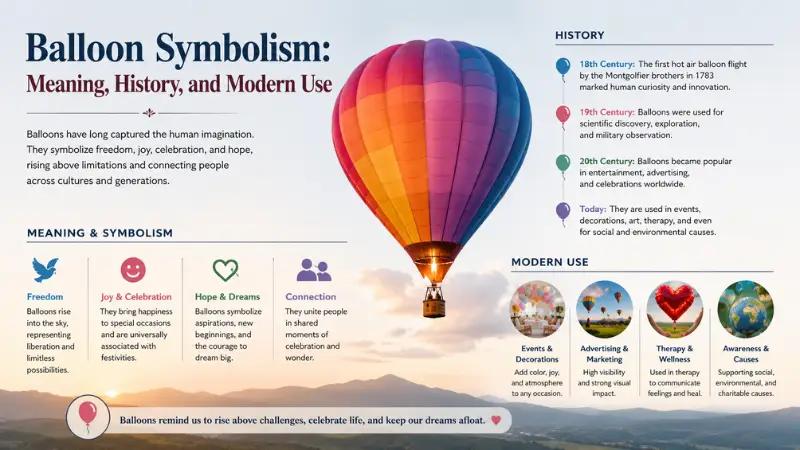
In 1783, brothers Joseph-Michel and Jacques-Étienne Montgolfier demonstrated the first successful hot-air balloon flight in France; later that year, humans made their first untethered flight in a Montgolfier balloon. The event captured enormous public attention and turned the balloon into a symbol of technological possibility, adventure, and a once-impossible dream: human flight. Eighteenth-century European art and prints celebrating the invention show how quickly ballooning entered the public imagination.
The familiar rubber balloon came later. Michael Faraday made rubber balloons in 1824 while experimenting with hydrogen — scientific equipment, not party decor, but the basic form that would eventually become a household object. Mass production and commercial entertainment later carried the balloon out of the laboratory and into everyday celebrations.
How Balloons Became Symbols of Celebration
The connection between balloons and celebration is largely practical. They’re colorful, lightweight, inexpensive, and able to transform a room’s appearance in minutes — no permanent decorating required.
They’re also tied to anticipation. Balloons are normally inflated before guests arrive or an event begins, so seeing them signals that something is about to happen. That gave balloons a social meaning beyond their physical appearance: they became a visible marker that someone cared enough about the occasion to decorate for it.
That’s why a balloon bouquet can communicate more than its price tag suggests. It can say congratulations, welcome home, happy birthday, get well soon, or simply, “this day matters.”
Balloon Symbolism in American Culture
In the United States, balloons are strongly linked to birthdays and children’s parties, but their role extends well beyond childhood. They commonly appear at:
- graduations
- weddings and engagements
- retirement parties
- school dances
- sporting celebrations
- baby showers
- grand openings
- election-night gatherings
- anniversary parties
- hospital celebrations
- welcome-home events
Public spectacle added another layer. Giant character balloons joined the Macy’s Thanksgiving Day Parade in 1927 and became one of its most recognizable traditions. In that setting, a balloon represents more than personal happiness — it becomes a symbol of communal entertainment, holiday anticipation, childhood imagination, and large-scale spectacle.
Birthday Balloons and the Meaning of Childhood
No setting is more closely tied to balloons than the birthday party. For children, balloons usually signal play before they carry any abstract meaning — they float, bounce, squeak, twist into animals, and sometimes burst unexpectedly, and those sensory moments become part of childhood memory.
Because most people encounter balloons repeatedly at birthdays while growing up, the object later becomes a nostalgia trigger. An adult seeing brightly colored balloons might remember school parties, family gatherings, or childhood excitement — giving balloons a double meaning: happiness in the present, plus a pull back toward an earlier stage of life. That connection is especially visible at milestone birthdays, where number-shaped balloons turn age itself into decoration.
Balloons as Symbols of Milestones and New Beginnings
Balloons frequently appear at transitional moments because they create a visual sense of upward movement. At graduations, they suggest achievement and possibility. At weddings, they add to an atmosphere of beginning. At retirement parties, they mark the end of one role and the start of another.
There’s no formal tradition requiring balloons at these events — the symbolism comes from the combination of celebration and transition. An inflated balloon looks full, elevated, and ready to move, which fits moments when someone is imagining the future. It’s part of why phrases like “dream big,” “rise,” “soar,” and “the sky’s the limit” pair naturally with balloon imagery: the balloon becomes a visual shortcut for moving past a previous boundary.
What Balloon Colors Communicate
A balloon’s color can shift its meaning, though there’s no universal code — event type, design, surrounding colors, and personal association all matter more than any fixed rule.
| Balloon Color | Common U.S. Association | Typical Context |
|---|---|---|
| Red or pink | Romance, affection, excitement | Valentine’s Day, anniversaries |
| Gold or silver | Achievement, glamour, milestones | Graduations, anniversaries, New Year’s |
| White | Simplicity, weddings, remembrance | Weddings, memorial decor |
| Black | Elegance, humor, mourning, maturity | Adult birthdays, themed events |
| Bright multicolor | Fun, childhood, inclusion | Birthdays, festivals, school events |
| Rainbow colors | Diversity, joy, LGBTQ+ Pride | Pride events, community celebrations |
These meanings flex with context. Black balloons at a 30th or 50th birthday tend to read as comic rather than mournful, and white balloons at a wedding communicate something very different from white balloons at a memorial. Color should always be read together with occasion and setting.
Emotional and Psychological Meaning
Balloons communicate emotional lightness unusually well. Their rounded shape, bright colors, and tendency to float contrast with objects that feel heavy, rigid, or grounded — a contrast that design and storytelling use to express optimism, imagination, innocence, or relief.
They’re also fragile. A small puncture can destroy an object that looked full and impressive seconds earlier, which makes the balloon an effective metaphor for hopes or expectations that look substantial but may prove vulnerable. English reflects this: plans can “inflate” like a balloon, and expectations or costs can “balloon” when they expand rapidly. A bursting balloon can represent sudden disappointment — the cheerful object becomes a reminder that excitement can collapse without warning.
Letting Go, Grief, and Memorial Meaning
Balloons sometimes appear in grief rituals, particularly when people want a visible action to represent farewell. Watching an object rise away can feel like a physical enactment of separation — the person stays on the ground while the balloon moves farther away until it disappears.
In that context, balloon imagery can communicate:
- Remembrance — the balloon is dedicated to someone absent
- Release — letting go becomes a visible, physical act
- Continuing love — messages or names attached to the balloon
- Acceptance — the balloon can’t be brought back once it’s gone
This meaning is emotional rather than tied to any single religious tradition; families and communities interpret the act differently depending on their own beliefs. Environmental concerns, covered below, have also changed how these ceremonies are carried out today.
The Meaning of a Deflated or Popped Balloon
An inflated and a deflated balloon can communicate almost opposite ideas. A full balloon suggests anticipation, activity, or possibility. A deflated one usually indicates the event has ended — balloons resting on the floor after a party can create a surprisingly reflective image: the guests are gone, and something anticipated for days is already over.
In photography and film, that contrast can represent disappointment, exhaustion after excitement, lost innocence, broken expectations, loneliness, or the end of a relationship or event. A popped balloon is more sudden — it can symbolize shock, interruption, or the destruction of an unrealistic hope. Balloon imagery isn’t automatically cheerful; its condition matters as much as its color.
Hot-Air Balloons Carry a Different Symbolic Tone
Party balloons and hot-air balloons share a name and basic shape, but their cultural meanings diverge. Hot-air balloons are more closely tied to travel, perspective, exploration, and adventure — they carry people rather than simply decorating a space.
Their slow movement suggests calmness, too. Unlike the speed of airplanes or cars, balloon flight depends heavily on wind and atmospheric conditions, which in visual storytelling makes the balloon feel less like a symbol of control and more like one of openness to experience. The first successful passenger flights in 1783 opened a new chapter in human flight, giving the hot-air balloon a lasting connection to invention and experimentation — a legacy that modern images still draw on when representing exploration or a fresh perspective on life.
Balloons in Tattoos and Personal Art
Balloon tattoos tend to lean on the object’s movement and fragility rather than its party-decoration role. A rising balloon can represent independence or freedom from a restrictive period; several balloons together may symbolize optimism, childhood memories, or important relationships. A balloon floating away carries a more complicated meaning — depending on the design, it could represent releasing grief, accepting change, remembering someone, or distancing from the past.
Details change the interpretation significantly: a child’s hand holding a string reads differently from a cut string, a heart-shaped balloon differs from a black one, and a balloon paired with a name or date often serves as a personal memorial. Because tattoos are highly individual, the wearer’s own explanation should always take priority over general symbolism.
Balloons in Art, Film, Advertising, and Digital Culture
Balloons work well in visual media because they’re instantly recognizable. Advertisers use them to build a festive mood around sales, openings, and product launches; social media creators use balloon walls, arches, and number balloons as photo backdrops for milestone announcements.
Film and fine art can use the same object very differently. A bright balloon in an otherwise bleak setting may represent remaining innocence. A balloon escaping someone’s hand can show loss without a line of dialogue. A room full of balloons might suggest abundance, fantasy, or overwhelming celebration. Because audiences expect balloons to be cheerful, creators can deliberately place them in sad, empty, or threatening scenes to create discomfort — that flexibility is what makes the balloon such a useful modern symbol.
Cross-Cultural and Religious Interpretations
Balloons don’t have a single ancient symbolic tradition comparable to the lotus, the cross, the serpent, or the olive branch. Because modern balloons emerged relatively recently, their meanings come from contemporary social practice rather than ancient mythology.
Across many cultures today, balloons signal celebration simply because birthdays, weddings, festivals, retail events, and children’s entertainment have adopted them internationally — though local colors and customs still shift the specific message. There’s also no standard biblical meaning assigned to balloons; they don’t appear in biblical texts because the technology arrived much later. Comparisons between a rising balloon and prayer, heaven, or spiritual release are modern personal analogies, not established religious symbolism — a distinction worth keeping in mind when a source claims otherwise.
The Problem With Releasing Balloons
For decades, people released balloons at weddings, memorials, graduations, and community ceremonies because the upward drift looked beautiful and read as freedom or farewell. The symbolism hasn’t changed — but awareness of what happens afterward has.
Released balloons eventually come back down, often in rivers, lakes, or the ocean. The NOAA Marine Debris Program documents how balloon debris ends up in waterways, where marine animals ingest it or become entangled in the attached ribbon. The National Park Service similarly flags released balloons as a wildlife hazard when they drift into protected parkland.
Some U.S. jurisdictions have restricted intentional releases as a result — Virginia, for example, has prohibited many outdoor balloon releases since 2021. The older idea of “sending something into the sky” is increasingly separated from the physical act of releasing balloons. Stationary memorial displays, bubbles, planted flowers, reusable decorations, and written messages now preserve the emotional gesture without sending litter into the environment.
How the Meaning Has Changed Over Time
The balloon’s symbolic history unfolds in overlapping stages. In the late eighteenth century, large balloons represented technological wonder and the astonishing possibility of human flight. Through the nineteenth and twentieth centuries, rubber balloons became linked with toys, entertainment, decoration, and childhood.
Mass public celebration added another layer — giant parade balloons turned the object into spectacle and American holiday imagery. Modern event culture expanded it further still: balloon arches, organic installations, metallic number balloons, and social-media backdrops moved balloons from children’s decorations into design elements for weddings, corporate events, and adult milestones. Alongside all of this, memorial traditions gave balloons a quieter association with grief and release.
Today the meaning ranges from simple fun to more complicated reflections on freedom, memory, fragility, and environmental responsibility.
FAQs
Are balloons a positive symbol?
Usually, yes — balloons most often communicate celebration, joy, optimism, or achievement in the United States. Their meaning turns sadder when they appear deflated, abandoned, released at a memorial, or used in artwork about loss.
What does a balloon floating away symbolize?
A floating-away balloon typically represents freedom, letting go, separation, or something that can’t be recovered. In a happy context it can suggest independence; in a sad context, loss or farewell.
What does a balloon tattoo mean?
A balloon tattoo often represents freedom, childhood memories, hope, personal growth, or releasing part of the past. Details like color, strings, names, and dates usually point to the more specific meaning.
What do balloons symbolize at a funeral or memorial?
At memorials, balloons can represent remembrance, emotional release, love for someone who has died, or the act of saying goodbye. Because outdoor releases can harm wildlife, many families now use stationary displays or non-release alternatives instead.
Do balloons have a biblical meaning?
No — there’s no established biblical symbolism for balloons, since modern balloons didn’t exist when biblical texts were written. Comparisons between rising balloons and heaven, prayer, or spiritual freedom are modern interpretations, not traditional religious symbols.
What does a popped balloon symbolize?
A popped balloon often represents an expectation suddenly destroyed — in stories or artwork, it can suggest disappointment, shock, broken optimism, or the abrupt end of something exciting.
Why are balloons associated with birthdays?
Balloons became practical party decorations because they’re colorful, playful, and easy to arrange into festive displays. Repeated use at children’s parties cemented the American association between balloons, childhood excitement, and growing older.
Conclusion
Balloons carry meaning because their physical behavior mirrors familiar human experience: they rise, drift, expand, burst, and slowly lose their shape. Those qualities make them natural symbols for joy, hope, freedom, ambition, vulnerability, transition, remembrance, and letting go. This association with freedom and imagination also has historical roots, as the Smithsonian Libraries’ history of ballooning shows how early flight captured ideas of freedom, exploration, and human possibility.
In American culture, balloon symbolism remains most strongly tied to celebration and major life moments — yet its meaning shifts with color, setting, and condition. A bouquet beside a birthday cake says something very different from a single balloon disappearing into the sky, or a deflated one left behind after the party ends. That flexibility is exactly what keeps the balloon meaningful: it can mark the excitement of a beginning while reminding us that special moments don’t stay suspended forever.