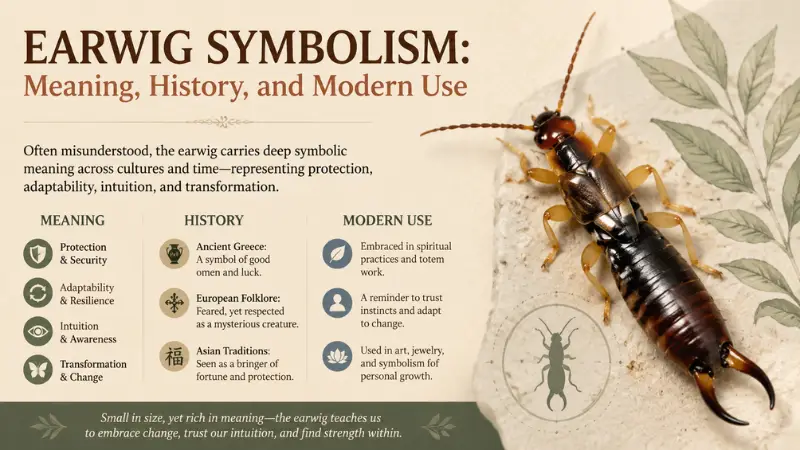
Few insects carry a reputation as unfair as the earwig’s. With its pincer-tipped abdomen and habit of hiding in cracks and damp corners, it looks like something built to alarm you — and for centuries, people believed it was. Earwig symbolism today draws on that old fear, but it has also picked up newer, more practical meanings tied to resilience, protection, and the discomfort of things unseen. Understanding why this small, mostly harmless insect became a symbol at all says as much about human psychology as it does about the bug itself.
Most people who search out the meaning of the earwig aren’t casual insect enthusiasts. They’ve usually just found one in a shoe, seen one in a dream, or come across the name in a book or tattoo design and wondered why it feels so loaded. The answer traces back to a single myth that outlived its own debunking, plus a set of biological traits — the pincers, the nocturnal habits, the surprising parental care — that give the insect real symbolic material once you look past the myth.
This article walks through where earwig symbolism came from, how it functions in American culture specifically, and where the line sits between genuine folklore and modern exaggeration.
Quick Answer
Earwig symbolism in modern American culture usually centers on hidden fear, vulnerability, and unwanted intrusion — a legacy of the old myth that the insect crawls into people’s ears while they sleep. Historically, in European folk tradition, the earwig represented a nighttime threat lurking in dark, unseen places rather than any single fixed virtue or vice. More recent interpretations, especially in nature-focused and psychological contexts, reframe the earwig as a symbol of resourcefulness and protective instinct, largely because of its surprisingly attentive maternal behavior.
TL;DR
- Name comes from an old myth about ear invasion, not actual behavior
- Symbolizes hidden fear and things lurking unseen, not evil or death
- U.S. culture treats it mainly as a pest-control nuisance symbol
- Female earwigs’ egg-guarding gives it a secondary meaning of protection
- Rarely used in mainstream religious or heraldic symbolism, unlike bees or moths
- Modern tattoo and design use leans into “creepy but harmless” irony
What Earwigs Actually Look Like
An earwig is a slender, reddish-brown to black insect, usually somewhere between a quarter-inch and an inch long, with a flattened body built for squeezing into tight spaces. Its most recognizable feature is the pair of forceps-like pincers, called cerci, at the tip of its abdomen — curved and thicker in males, straighter and thinner in females. Most people encounter earwigs under flowerpots, inside rolled-up garden hoses, beneath bark or mulch, or scurrying out from a damp doormat when it’s lifted. They’re nocturnal, which means most sightings happen by accident, often triggering a startled reaction that has more to do with the insect’s alien appearance than anything it’s actually doing.
Why the Name Alone Creates the Fear
The word “earwig” is the whole reason this insect carries symbolic weight at all. It descends from Old English terms roughly meaning “ear creature,” tied to a widespread European superstition that the insect would crawl into a sleeping person’s ear and, in the more dramatic versions of the story, tunnel into the brain or lay eggs there. Entomologists have never found evidence supporting this behavior. Some researchers instead trace the name to the shape of the earwig’s folded hindwing, which faintly resembles a human ear when spread open — meaning the insect may have been named for how it looks, not for anything it does. Either way, the name shaped the symbol long before science had a say in it, and that mismatch between reputation and reality is central to what the earwig represents.
Core Meaning Today
Strip away the myth and the earwig’s symbolism settles into a few consistent threads: something small and unnoticed that becomes threatening once it’s too close, a stand-in for irrational fear that outlasts the facts, and — less commonly — a quiet emblem of protective instinct, borrowed from the female earwig’s real habit of guarding her eggs and newly hatched nymphs. Unlike symbols such as the butterfly or the owl, the earwig doesn’t carry one dominant, agreed-upon meaning across cultures. Its symbolism is smaller in scale and more situational, usually invoked to represent unease rather than any grand concept like death, rebirth, or wisdom.
Historical Origins of the Symbol
The earwig’s symbolic life begins in oral tradition rather than formal mythology. Unlike scarabs in ancient Egypt or cicadas in East Asian philosophy, the earwig never received sustained religious or literary attention in the ancient world. Its reputation grew instead through folk warnings passed between households — the kind of practical, fear-based lore parents used to keep children cautious about where they put their heads while sleeping outdoors or in older housing with dirt floors and thatch. Because Europe’s early modern population lived in close contact with insects, and because ear pain was common and poorly understood before modern medicine, it’s easy to see how a coincidental case of an insect wandering into an ear became generalized into a rule about the entire species. Once the story had a name attached to it, it needed no further embellishment to spread.
Symbolism in the United States
In the U.S., earwig symbolism is shaped less by inherited folklore and more by pest control culture and suburban home ownership. The insect entered North America through European immigration and shipping routes in the early twentieth century, and it’s now common across much of the country, particularly in the Pacific Northwest and southern states. Because most Americans’ first encounter with an earwig happens in a garden, basement, or garage rather than through a scary bedtime story, the symbolism here leans practical: the earwig represents household vulnerability, the sense that pests can get in no matter how careful you are, and mild embarrassment at being startled by something so small. It rarely appears in American religious symbolism, state or national iconography, or literary tradition in a serious way. When it does show up in fiction, it’s almost always used for exactly the reason the old myth exists — to produce a flash of visceral discomfort in the reader.
Cross-Cultural Meaning
Outside the U.S., the earwig’s symbolism stays fairly consistent with its European roots, though the intensity varies. In British and Northern European folk tradition, it holds onto the ear-invasion association most strongly, likely because that’s where the etymology originated. In French, the insect is called perce-oreille — “ear piercer” — carrying the same idea in a more literal form. It doesn’t have a significant presence in most Asian, African, or Indigenous American symbolic systems, where insects like the cicada, scarab, or dragonfly tend to carry the larger cultural weight instead. This absence is itself informative: the earwig’s symbolism is largely a Western European export tied to a specific etymological accident, not a universal archetype shared across human cultures the way symbols like the snake or the spider tend to be.
Emotional and Psychological Meaning
Psychologically, the earwig taps into a very specific kind of fear: the fear of small, hidden invasion rather than open confrontation. It’s not associated with danger in the way a scorpion or wasp is, since it can’t sting and rarely bites hard enough to break skin. Instead, it triggers discomfort because of where it hides and the folklore about where it might go. For many people, encountering an earwig produces a flinch response rooted more in cultural conditioning than actual risk assessment — which is part of why the insect is sometimes used as a shorthand in writing and design for irrational anxiety, or for fears that persist even after someone knows, rationally, that they’re unfounded.
Modern Usage
Earwig imagery shows up in a narrower set of contexts than most symbolic insects, but it has a real presence.
Tattoos: Earwig tattoos are a niche but growing choice among people drawn to “unlovable creature” imagery — the same instinct that makes moths, cockroaches, and vultures popular in alternative tattoo culture. The appeal is usually reclaiming something widely feared or dismissed as ugly, turning it into a personal symbol of resilience or unconventional taste rather than horror.
Jewelry and decor: Less common than tattoos, but earwig motifs appear occasionally in gothic-leaning jewelry and insect-collection-inspired home decor, usually marketed toward buyers who already gravitate toward beetles, moths, and other “creepy-crawly” aesthetics.
Pop culture: The insect’s name has been borrowed for band names, album titles, and a stop-motion film about a girl raised by witches — cases where the word’s slightly unsettling sound does more work than the actual insect’s biology.
Social media: Nature and pest-control content creators frequently post earwig videos specifically because the reaction — a mix of disgust and fascination — performs well, reinforcing the same fear-based association that’s existed for centuries, just in a faster feedback loop.
Controversies and Misuse
The earwig’s biggest symbolic controversy isn’t cultural misuse in the way a sacred symbol might be misappropriated — it’s factual misrepresentation. Pest control marketing and viral content still sometimes lean on the ear-invasion myth for shock value, despite it being thoroughly debunked. This keeps the fear-based symbolism alive well past its factual expiration date. It’s worth separating two things clearly: the historical folklore, which is a legitimate part of European oral tradition and fair to discuss as such, and modern claims that repeat the myth as if it were current entomological fact, which misinform readers and unfairly damage the reputation of an insect that’s largely beneficial to gardens as a predator of aphids and other plant pests.
Evolution of Meaning
The earwig’s symbolism has moved in a fairly narrow but noticeable arc. In pre-modern Europe, it functioned as a literal cautionary tale — a specific, physical fear tied to sleep and vulnerability. As entomology matured and the myth was disproven, the symbolism didn’t disappear; it shifted into something more ironic and aesthetic. Today, the insect is less often invoked as a genuine warning and more often used deliberately for its “creepy but harmless” quality — in humor, in reclaiming-the-ugly-bug tattoo culture, and in nature content that plays on old fears knowingly rather than sincerely. A newer, quieter thread has also emerged among people interested in insect behavior: recognition of the female earwig’s unusually attentive care for her eggs and nymphs, which has started to nudge the symbolism toward maternal protectiveness in some nature-writing and psychological-symbolism circles, even though this reading hasn’t caught up to the older, fear-based one in general popularity.
Earwig Symbolism at a Glance
| Context | Meaning in the USA | Common Associations | Notes |
|---|---|---|---|
| Folklore origin | Hidden threat, unfounded fear | Ear invasion myth, nighttime vulnerability | Debunked but still repeated |
| Home and garden | Household pest, minor nuisance | Basements, gardens, damp hiding spots | Actually beneficial for eating aphids |
| Tattoo culture | Reclaimed “ugly bug” identity | Resilience, nonconformity | Niche but growing |
| Nature symbolism | Maternal protectiveness | Egg-guarding, nymph care | Emerging, less mainstream |
| Pop culture | Unsettling but harmless | Band names, horror-adjacent media | Leans on the name’s sound, not biology |
Why the Pincers Matter to the Symbolism
The forceps at the end of an earwig’s body do a lot of symbolic heavy lifting even though they’re mostly used for the mundane tasks of mating and minor self-defense. Visually, pincers read as weapons, which primes people to assume the insect is more dangerous than it is. This is a case where appearance outpaces function: earwig pincers can deliver a light pinch but aren’t capable of anything more serious, yet their shape alone is often enough to make the insect feel threatening on sight, reinforcing the same “looks worse than it is” quality that runs through the rest of its symbolism.
FAQs
Does an earwig symbolize anything positive?
Yes, though it’s a minority interpretation. Because female earwigs guard their eggs and young more attentively than most insects, some modern nature symbolism uses the earwig to represent protective, hands-on parenting rather than pure fear.
What does an earwig tattoo usually mean?
Earwig tattoos generally signal an appreciation for overlooked or “ugly” creatures, often paired with themes of resilience or defying conventional beauty standards, rather than referencing the old ear-invasion myth directly.
Is the earwig a symbol in any religion?
Earwigs don’t hold a significant place in major world religions. Unlike insects such as the scarab or the bee, they never accumulated sustained religious or mythological symbolism tied to specific deities or rituals.
Why are earwigs associated with fear if they’re mostly harmless?
The association comes almost entirely from the debunked myth that they crawl into ears and burrow toward the brain. The fear outlived the folklore that created it, partly because the name itself keeps the idea alive.
Do earwigs symbolize anything different in other countries?
The core association with ear invasion appears across several European languages and cultures, including in the French name perce-oreille, but the symbol doesn’t have significant meaning in most non-European traditions.
Is it true earwigs are good for gardens?
Yes. Earwigs prey on aphids, mites, and other small pests, which is part of why some modern interpretations push back against their purely negative reputation and reframe them as quietly beneficial rather than threatening.
Why don’t earwigs appear much in classic literature or art?
They lack the dramatic scale or visual grandeur of symbols like the moth or the serpent, and their folklore stayed largely oral rather than being written into religious texts, epic poetry, or formal mythology, which limited their reach into fine art and literature.
Conclusion
Earwig symbolism is a rare case of a myth outrunning the insect it was ever about. The idea that earwigs crawl into ears and burrow toward the brain has no basis in fact, yet it built the entire symbolic identity of the species — one centered on hidden fear, small-scale vulnerability, and discomfort with things unseen. In the United States, that meaning shows up mostly through pest-control anxiety and a newer, more self-aware use in tattoo and design culture that treats the insect’s bad reputation as something worth reclaiming rather than fearing.
What makes the earwig worth understanding as a symbol isn’t grandeur — it never had any — but the honest gap between its reputation and its biology. A creature known mainly for a myth that isn’t true, and for a maternal instinct most people never hear about, says something useful about how symbols get made in the first place: not always from truth, but from whatever story sticks.